I’m still recovering from what may or may not be COVID-19, so I don’t have a regular Sciency Words post for you today. But during the time I’ve been sick, I’ve been watching a lot of YouTube, and I discovered a YouTube channel that I wanted to share. It’s called Cinema Therapy.
It’s hosted by a professional filmmaker and a behavioral psychologist. The two of them watch movies together and talk about the psychological truths (and falsehoods) expressed by those movies. I’ve especially enjoyed their analyses of The Lord of the Rings films, and this episode on Frodo Baggins and radical acceptance was really helpful for me in my current situation.
And hey, psychology is a scientific field. Radical acceptance is a term used in that scientific field. So there’s your Sciency Word for the week!
Hello, friends! Welcome to this month’s meeting of the Insecure Writer’s Support Group! If you’re a writer, and if you feel in any way insecure about your writing life, click here to learn more about this amazingly supportive group!
They say write what you know. Sometimes writers follow that advice without intending to. There’s a recurring theme in my writing. I never noticed it was there until my editor pointed it out. That theme is illness.
In the epic, sprawling Sci-Fi universe I’m creating for Tomorrow News Network, a lot of people get sick. There are lots of space viruses and space parasites floating around out there, some of them natural, others manmade (or rather, alien-made). I also tend to use disease as a metaphor for other things. When my editor pointed this out to me, my reaction was basically: “Oh, that makes sense.”
It’s become something of a running joke among my circle of friends. If there’s a big, scary disease in the news, James will probably catch it. I’ve had tuberculosis. I’ve had West Nile virus. I’ve had swine flu. To be honest, I’m surprised that I managed to dodge COVID-19 for as long as I have.
But last week, I found out that I’d been exposed to somebody who later tested positive for COVID. Shortly thereafter, I started experiencing COVID-like symptoms. I’m currently quarantined at home, waiting patiently for the results of my COVID test.
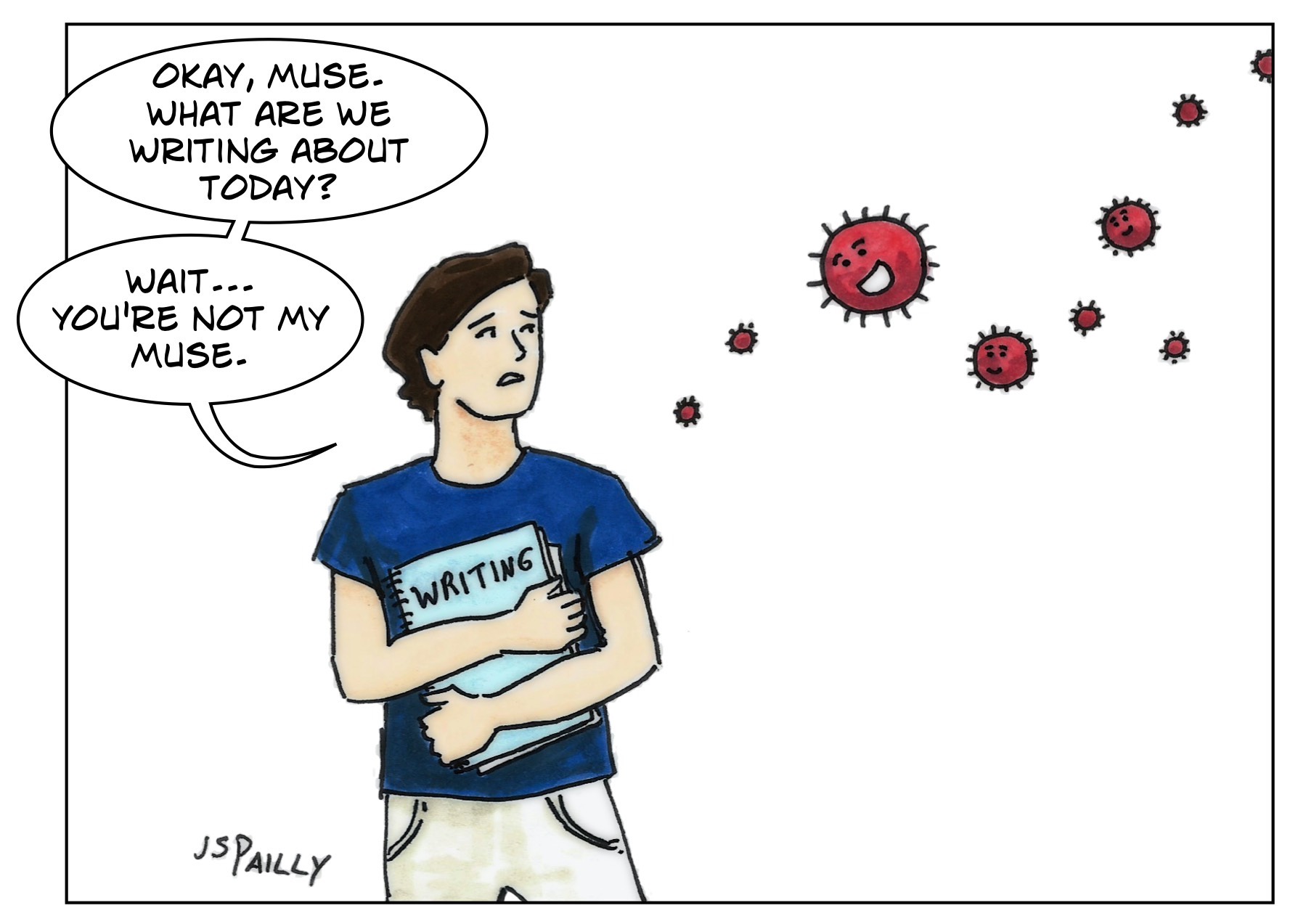
Needless to say: not a lot of writing is happening right now. Not a lot of anything is happening, except sleeping, chicken soup eating, and binge watching Carl Sagan videos on YouTube. But my muse assures me she will return as soon as I’m feeling better, and we’ll probably have another scary space plague to add to our epic Sci-Fi universe.
If you’ve ever looked at my artwork and thought it would look good on a T-shirt or a notebook cover or a tote bag, well… I have good news for you! The Planet Pailly store is now open on Redbubble.com!!!
You can get my artwork printed on shirts or coffee mugs or throw blankets… there’s a shockingly wide selection of stuff you can buy. You can also get stickers in various sizes, so feel free to slap my artwork on anything and everything you want!
Now I was initially concerned about quality. Redbubble is a print-on-demand service, and I’ve had some bad experiences with print-on-demand services in the past. But I can assure you that Redbubble stuff is top quality. I am really, really happy with the way this T-shirt turned out.
This spiral notebook is also really cool.
My only complaint is that Redbubble doesn’t offer free shipping. They do, however, offer bundle discounts if you order multiple items at once. So if you buy a T-shirt from me, and maybe a shower curtain from another artist, and a set of coasters from somebody else, your discounts should start stacking up nicely.
The Planet Pailly store currently has three “highly technical diagrams” that have previously appeared on this blog: the Sun, Jupiter, and Pluto. More astronomical objects will be added soon (if you have requests, let me know in the comments). Also coming soon: the cover art from Tomorrow News Network.
So if you’re looking for the perfect gift for your sciency friend, or the perfect gift for your sciency self, please check out my Redbubble store. And be sure to check out some of the other artist stores on Redbubble too! There’s cool stuff for everybody, and your money will help independent artists (like me) keep doing what we do.
Hello, friends! Welcome back to Sciency Words, a special series here on Planet Pailly where we take a closer look at interesting and new scientific terms in order to expand our scientific vocabularies together! Today’s Sciency Word is:
PRESERVATION BIAS
So is there life on Mars? Well, there could be. It’s not totally impossible. But as I’ve said before on this blog, I think the odds of us finding living things on Mars are pretty low. The odds of us finding dead things on Mars, however… I think those odds are much better!
Or at least I did think that until I read this paper, entitled “A Field Guide to Finding Fossils on Mars.” That paper introduced me to the concept of “preservation potential,” and subsequent research led me to learn about something paleontologists call “preservation bias.”
Basically, turning into a fossil isn’t easy. A lot of factors have to come together just right in order for a dead organism to become preserved in the fossil record. As that Martian fossil field guide explains:
On Earth, most organisms fail to fossilize because their remains are physically destroyed, chemically oxidized or dissolved, digested by their own enzymes, or consumed by other organisms. Fossilization only occurs when processes of preservation outpace degradation.
Preservation bias refers to the fact that certain organisms—or certain parts of certain organisms—stand a better chance of fossilizing than others. Preservation bias can also refer to the fact that some environments (rivers and lakes, for example) do a better job creating and preserving fossils than others (for example, deserts).
A lot of factors can get involved in this, but as a quick and easy example, think of the dinosaurs. Dinosaur bones fossilize easily enough. Other parts of the dinosaur… not so much. That, my friends, is preservation bias at work, favoring hard tissue, like bone, over soft tissue, like muscle or fat.
Now imagine what would have happened if dinosaurs somehow evolved without bones (that’s a weird concept, I know, but just bear with me a moment). How much would we know about those boneless dinosaurs today? Would we know about them at all? Those hypothetical boneless dinosaurs could have roamed the earth for billions of years and left hardly a trace of evidence for us modern humans to find!
Which brings us back to Mars. There was a time, very long ago, when Mars was a much warmer and wetter planet than he is today. It’s possible—no, I’d say it’s probable!—that life of some kind developed on ancient Mars, just as it did on ancient Earth. But would that ancient Martian life have left us any fossils to find? Maybe. Maybe not. It depends on the various factors involved in preservation bias.
A single atom of love may not seem like much. By definition, it is the smallest quantity of love that could possibly exist. And yet, just like a real atom, even a single atom of love contains within itself tremendous amounts of power.
P.S.: Quantum physics fans may enjoy knowing this: the background for today’s drawing was done using a color called “Copenhagen blue.”
Hello, friends! Welcome to Sciency Words, a special series here on Planet Pailly where we talk about those wild and crazy words scientists use. Today’s Sciency Word is:
SAFETY ELLIPSE
I don’t know about you, but when I’m trying to dock my shuttle pod with another spaceship, I like to take a few long, leisurely loops around that other spaceship first. You know, like this:
Spaceships are pretty! Who wouldn’t want to get a good look at them from every conceivable angle before completing docking maneuvers? But it turns out that circling round and round a spaceship like this is not just for admiring the view. It’s also for safety! As explained in this paper:
A “safety ellipse” is an out-of-plane elliptical periodic relative motion trajectory around the primary spacecraft such that the trajectory never crosses the velocity of the primary.
That clear things up? No? Okay, how about a quote from this paper instead:
This paper defines a safe trajectory as an approach path that guarantees collision avoidance in the presence of a class of anomalous system behaviors.
Still confused? Here’s a short video demonstrating what a safety ellipse (a.k.a. a safe trajectory) looks like:
Basically, if your shuttle pod experiences engine failure or any other major malfunction, flying in a safety ellipse ensures that you will not collide with the ship you were trying to dock with. At least not for a good, long while.
I first heard about this term the other day while watching the livestream of the SpaceX Dragon capsule approaching and docking with the International Space Station. Several times, the livestream commentators mentioned that Dragon was utilizing a “24 hour safety ellipse” or “24 hour safe trajectory,” meaning that if anything went wrong, mission control would have at least 24 hours to fix it before Dragon and the I.S.S. collided.
So remember, friends: the next time you’re going to dock with another spacecraft, do that out-of-plane elliptical periodic relative motion thing. In other words, circle around the other ship a few times before making your final approach to dock. It’s for safety reasons.
P.S.: It’s also for enjoying the view. Spaceships are pretty!
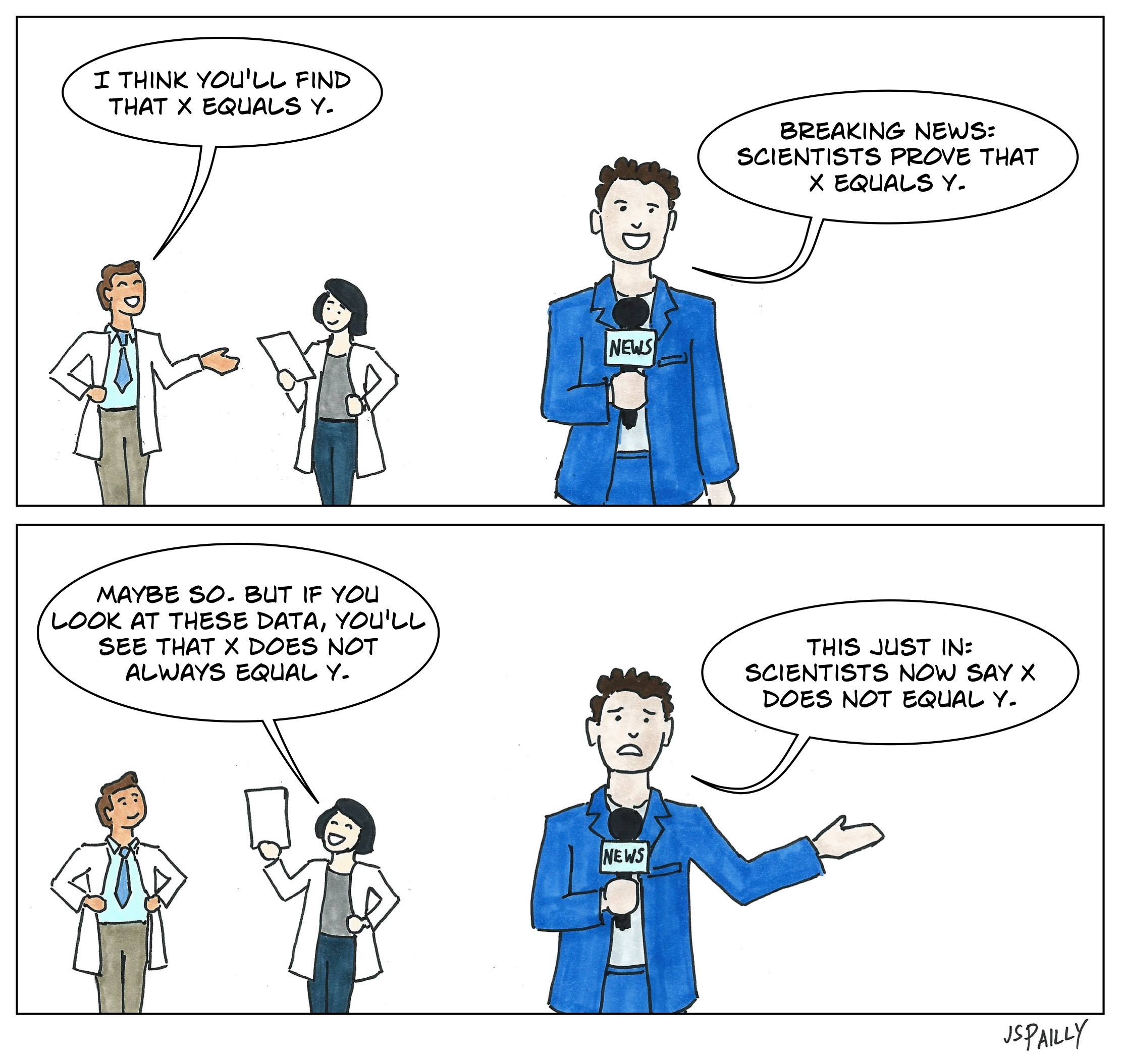
So there’s this notion in the popular press that when a new scientific paper comes out, that paper should be taken as the final definitive word on an issue. Science has spoken. This is a scientific fact now. But that is not how science works.
When new research is published, you should expect there will be followup research, and then that followup research will be followed up by even more research. A new scientific paper really shouldn’t be seen as a proclamation of fact but rather as the beginning of a dialogue among scientists, or perhaps as the continuation of a dialogue that’s already in progress.
The recent detection of phosphine in the atmosphere of Venus has turned out to be a fantastic example of this ongoing dialogue in action. The initial research was published in two separate papers (click here or here). Basically, astronomers found the spectral signature of phosphine (PH3) in the Venusian atmosphere, and they were at a loss to explain where all that phosphine could be coming from.
Based on everything we currently know about Venus, those two papers tried to rule out several possible explanations. Such a large quantity of phosphine could not be created by Venus’s atmospheric chemistry. It could not be spewing out of volcanoes on Venus’s surface. It could not be delivered to Venus by asteroids or comets. One very intriguing possibility that could not be ruled out: maybe there’s life on Venus. On Earth, phosphine is produced almost exclusively by living things.
But those two papers were not the definitive final word on the matter. A dialogue had begun. Soon, followup research came out suggesting that phosphine could be spewing out of volcanoes after all. It would still be pretty shocking to discover that Venus has enough active volcanoes to produce that much atmospheric phosphine—but it be nowhere near as shocking as discovering Venus has life.
And then even more followup research came out with this paper, which points out possible errors in the original research and suggests that we may be dealing with a false positive detection. Venus might not have phosphine after all, or maybe it doesn’t have as much as originally believed.
And the dialogue continues. More research will come. More responses will be published, and then there will be responses to those responses, and so forth until the scientific community reaches some sort of consensus about this Venusian phosphine business. And even then, that scientific consensus still might not be the 100% final word on the matter.
Based on the way the popular press reports science news, you could easily get the impression that scientific papers should be treated as gospel truth. You would be understandably confused, then, when one scientific paper comes out refuting the findings of another. Subsequently, you may come to the conclusion (as a great many people apparently have) that science must not know anything at all. Science just keeps contradicting itself, it seems.
But scientific papers are not meant to be taken as gospel truth. They’re part of an ongoing back-and-forth dialogue. So the next time you hear about some new scientific discovery on the news, remember that scientific papers are not intended to be bold proclamations of fact. And when you hear about some new paper refuting older research, you’ll understand what’s going on.
Hello, friends! Welcome to Sciency Words, a special series here on Planet Pailly where we talk about science and science-related terminology. Today on Sciency Words, we’re talking about:
DATA
Okay, are you supposed to say “this data” or “these data”? Are you supposed to say “the data is” or “the data are”? In other words, are you supposed to treat “data” like a singular or plural noun?
Well, before I answer those questions, let me tell you something about English grammar that you already know, even if you don’t know that you know it. English makes a grammatical distinction between count nouns (like shoe, child, or cactus) and mass nouns (like corn, furniture, or homework).
Count nouns have different singular and plural forms (shoe/shoes, child/children, cactus/cacti). Mass nouns do not. When was the last time you heard someone walk into a room and say, “Oh, look at all these furnitures”?
Traditionally, data has been treated as a count noun, with datum as the singular form and data as the plural. This is consistent with the word’s Latin origin. In Latin, datum meant something like “a thing that is given,” and so data would mean “things that are given.”
But of course, Latin is a dead language; English is still living, and in living languages words change. Right now, “data” is in the process of changing from a count noun to a mass noun. If I had to guess, I’d point the finger at personal computers for causing this change. I imagine datum and data were once rather esoteric, rather academic words. Then personal computers put the word “data” into the vocabulary of the masses—but not the word “datum.”
I mean, given how much (how many?) data computers process, how often would anyone need to talk about a single datum? In our daily experience, a single bit of data is akin to a single grain of sand. And so, much like the word “sand,” many of us have started treating “data” as a mass noun. Those who still use “data” as a count noun are in the minority.
A few years ago, the statistics blog Five Thirty Eight conducted a survey asking, among other things, if people preferred “the data is” or “the data are.” As Five Thirty Eight explains:
To those who prefer the plural, I’ll put this in your terms: The data are pretty conclusive that the vast majority of respondents think we should say “data is.” The singular crowd won by 58 percentage-points, with 79 percent of respondents liking “data is” to 21 percent preferring “data are.”
There are still some contexts where saying “this data” or “the data is” would be frowned upon. Basically, the more academic a setting you’re in, the more countable (and less mass-able) your data should be. Although I’ve noticed that even the most persnickety of academics are more likely to talk about a singular “data point” rather than use the word “datum.”
Of course, none of this matters if you’re talking about Commander Data, the character from Star Trek. In that context, Data is a proper noun, and therefore a countable noun, and therefore:
So as you know, Earth is “the Blue Planet” and Mars is “the Red Planet.” By my math, that leaves us with six other planets in our Solar System that don’t have color-related nicknames. Today, I’d like to try and fix that.
Jupiter was the toughest. He’s actually lots of different colors: red, grey, white, orange… and then the Juno mission recently showed us that Jupiter’s polar regions are blue! Of course Jupiter is most famous for being red in that one specific spot, but even the Great Red Spot changes colors from time to time, fading from red to pink to white before turning red again.
Anyway, those are my picks for the color-related nicknames for all the planets. Do you agree with my picks? Disagree? Let me know in the comments below!
Hello, friends! Just sharing some artwork today. I originally named this one “Climbing Word Count,” but then I realized “Word Up!” was a better name. I think anyone who’s a writer can understand what this one’s all about.







 Planet Pailly