Sci Friday: Antimatter

The next few years may brings us spectacular new discoveries about antimatter.  CERN has gone from creating a few dozen atoms of anti-hydrogen at a time to making hundreds, and the Space Shuttle Endeavor will soon deliver a new antimatter and dark matter detector to the International Space Station.

Here are some articles that try to predict what we might learn.

Why Do Kids Love Dinosaurs?

Normally on this blog, I try to share some interesting new thing I’ve learned about science.  Today, I have a question.  Why do kids love dinosaurs?  The answer might give us a clue about how to get kids interested in science.

My guess is that kids like words that end in -est.  Biggest, tallest, strongest…  Maybe it has something to do with being so little.  Maybe kids admire dinosaurs because they want to grow up to be the biggest, tallest, and strongest themselves.

Picture courtesy of wpclipart.com

When I was a kid, my favorite dinosaur was the Plesiosaurus.  It had flippers instead of feet, and in my mind that made it the weirdest.  I’m not sure what that says about me.

Anyway, what’s your theory?  Why do you think children love dinosaurs?

Sci Friday

I’m stealing an idea from fellow blogger Jon Gibbs.  Every Friday on his blog, An Englishman in New Jersey, he posts links to some interesting blog posts about writing.  So starting today, every Friday I’ll post some links to interesting articles (or other things) about science.

Please leave a comment if you enjoy any of today’s links.

Join the Dark Side

Any science enthusiast, and probably any science fiction fan, has heard of dark matter.  80% to 90% of the matter in our universe is invisible.

You may be wondering, as I did, how we know about it if it’s invisible.  The answer is that we’ve observed it by its effects.

As Earth orbits the sun, its motion is controlled by two forces: the sun’s gravity and the Earth’s momentum (velocity).  These forces are perfectly balanced, and if Earth’s momentum were a bit higher it would escape the sun’s gravity and fly off alone into space.

In the same way, stars orbit the center of the galaxy, their momentum balanced to the center’s gravity.  Except the balance is wrong, and the stars are moving too fast.  They should fly off, yet they don’t; thus, some invisible stuff must be increasing the gravitational force of our galaxy.

There could be a simpler explanation.  Perhaps our laws of gravity are incorrect.  We’ve only studied how gravity affects falling objects, planetary orbits, and the interactions of stars.  Maybe there’s more to gravity than we can see on such small scales, and we require a galactic perspective to see our error.

As far as I know, most scientists are not ready to rewrite gravity.  Not without more evidence.  Personally, I think the existence of dark matter is easier to believe, but science fiction writers should be aware of crazy new ideas in science.  They may become the basis for a great story.

Links:

  • Observations of the Bullet Cluster, a group of galaxies colliding with each other, may prove that dark matter exists.  Click here.
  • Other scientists say a Modified Gravity Theory can explain the Bullet Cluster.  Click here.
  • The theory of dark fluid combines dark matter with dark energy, another big, invisible part of our universe.  Click here.

Commas (Off Topic)

I’m seeing more and more commas out of place, and not just on the internet.  Published authors don’t know how to use them right either!  Every book I read I seem to find at least one comma someplace it doesn’t need to be.  Usually a lot more than one.

The thing is, English is a living, evolving language.  If enough people keep making the same mistakes over and over, the mistakes become part of English grammar.  Just like how the definition of irony has changed because everyone (especially Alanis Morissette) used it wrong (I remember when irony only had two definitions; now dictionary.com says it has eight).

Most people assume languages become simpler as they age.  But maybe that’s not always true.  If the rules of how to use a comma get more complicated, to accommodate all the people who use them wrong, then maybe future English will be even more complicated and confusing than the English of today.

Empty Space, Part 2

Good story telling involves overcoming obstacles.  In sci-fi, those obstacles often include aliens, robots, various anomalies in space or time…  We forget that every cubic light-year of space is full of danger even before we start making stuff up.
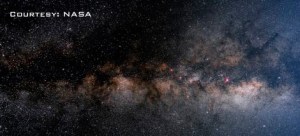
Pictured above: our galaxy, the Milky Way.  Part of the image is obscured.  You see those dark clouds?  That’s dust.  Cosmic dust.  Vast clouds of it—enough to block out the stars behind.  Our galaxy is a very dirty place.

If you want to travel anywhere near the speed of light, that dust becomes a huge obstacle.  A collision with a particle smaller than a grain of sand—at high enough velocity—would punch a hole through your ship.  Passing through a cloud of such particles would be like walking into a spray of bullets.

Find that hard to believe?  Think about hitting a deer.  At ten miles per hour, it’s not so bad.  At thirty-five, it’ll probably leave a dent.  At seventy, your car is lucky to be alive.  The greater the speed, the more damage the deer will do.  Now imagine hitting a deer—or anything—at the speed of light, 10 million times faster than any car can go.

With so much dust in our galaxy, the navigators of any interstellar spaceship will spend a lot of stressful hours dodging particles too small to even see.  That, combined with the cosmic radiation from yesterday’s post, makes “empty” space as dangerous as any alien, robot, or space-time anomaly.

Links:

Click here for the Iris Nebula, a place where clouds of cosmic dust are clumping together to form new stars.

Click here for some computer simulations of what cosmic dust particles look like at the molecular level.

Click here for a glossary of terms related to cosmic dust and other things found in “empty” space.

Empty Space, Part 1

Good story telling involves overcoming obstacles.  In sci-fi, those obstacles can include aliens, robots, various anomalies in space or time…  We forget that every cubic light-year of space is full of danger even before we start making stuff up.

In addition to normal background radiation, empty space is full of other dangerous particles like high-energy helium ions (alpha particles), high-energy electrons (beta particles), and high frequency photons (gamma rays).  These particles spew out of stars constantly and often get trapped in the magnetic fields of our planet and solar system.

Despite all our technology, astronauts are exposed to that radiation every time they go into orbit; so much so that NASA has safety guidelines to limit exposure during any individual’s lifetime.

Here on Earth, we are protected by the ozone layer and Earth’s magnetosphere (and yet too much sunlight… ultra violet radiation… can still give you cancer).  Without some similar protection, any brave explorer in deep space will die a slow and un-dramatic death.  Below are links to PDF files from NASA about radiation in space.

Minimizing Space Radiation Exposure During Extra-Vehicular Activity

Radiation Exposure and Mission Strategies for Interplanetary Manned Missions

Tomorrow, we’ll look at another obstacle out there in “empty” space.

What’s in Your Water?

Centuries ago, the Romans drank water from lead pipes. They thought this was a great idea. Lead must have seemed like such a good metal, easy to work with, relatively strong, cheap enough to use in as many aqueducts as were needed.

Today, we look back at the Romans and their lead pipes and laugh a little. “Those silly Romans,” we say. “No idea how toxic lead is.”

We don’t use lead pipes anymore. We have iron, copper, plastic… materials that won’t poison our water supply. After 2,000 years, we’ve learned so much from science, and our lives are so much healthier for it.

But I wonder. In the year 4011, what will people laugh at us for? What stupid thing are we doing today that future generations will mock us for? What ubiquitous thing in our era is our version of lead pipes?

Sciency Words #6

Aquaculture: Aquaculture is the practice of raising fish and other seafood in captivity, just as cows and chickens are raised in captivity on farms. Supposedly in the future we will depend on fish rather than land animals for our protein; it was even the subject of a book by Arthur C. Clark (better known for writing 2001: A Space Odyssey). But how healthy is farmed fish compared to other farmed animals, and how much do fish farms hurt the environment? It’s a relatively new industry, so regulations aren’t fully in place yet.

Links:

National Oceanic and Atmospheric Administration

9 Facts on Aquaculture from the Huffington Post

The Deep Range by Arthur C. Clark.

Getting You Off the Ground

Let’s assume you weight about 150 pounds.  It would cost somewhere between $750,000 to 1,500,000 to launch you into space.  As we all know, fuel prices are high right now, but that’s only part of the problem.

In order to get you off the ground, your rocket must carry X pounds of fuel.  In order to keep you at a high enough velocity long enough to escape Earth’s gravity, the rocket will also have to carry Y pounds more.  But now we’re talking about launching 150 + X + Y pounds, which means we’ll need even more fuel to get the rocket started, which in turn makes the rocket heavier, which then means you need more fuel.  And I haven’t even mentioned the weight of the rocket itself.

The good news is that as the rocket goes, it burns some of that fuel and gets lighter… but still, that’s a lot of fuel.

So if we’re going to build an intergalactic empire, we need to find a way to make space travel cheap.  Jules Verne suggested one possibility.  In his book, From the Earth to the Moon, mankind’s first spacecraft doesn’t carry fuel at all.  Instead, a large machine like a gun fires it into space.

This would still require a lot of fuel, but not all that extra fuel to carry the fuel.  There are still other problems.  The initial acceleration would be a lot greater—great enough to kill any human beings inside the ship.  But a good science fiction writer can invent ways around that problem.

* * *

Footnotes

  • Experts and other people on the internet disagree on the exact cost of launching one pound of matter into space, but everyone does agree that it’s ridiculously expensive.  I’m assuming it’s somewhere between $5,000 and $10,000 per pound.
  • The cost will also vary depending on what you use as fuel.  NASA’s space shuttle uses liquid hydrogen and liquid oxygen as well as solid fuels like ammonium perchlorate.
  • According to NASA’s website, each time they launch the space shuttle, they use more than 1,600,000 pounds of fuel, and each mission costs about $4,500,000.
  • How much acceleration can a human survive?  Click here to see my previous post on this subject.
  • Dr. Michio Kaku recently described one possible ground-fueled launch system on his blog (click here).