You Won’t Remember This Post

Apparently a third Men in Black movie comes out in May of 2012.

Do you remember the little flashy light thingie from Men in Black?  The thing that erased people’s memories so the secret of aliens living on Earth could remain secret?  Well, if you don’t remember it, I guess it worked.

Anyway, neuroscientists are developing new methods to make people forget things.  Not with flashy lights, but with drugs.  Experiments on rats show that, by injecting a chemical directly into the brain, scientists can make the rats forget to associate a specific sound with an electrical shock.  Click here for more on these experiments.

Other drugs and chemicals are already known to alter or erase short-term memory in humans.  With continued research, scientists hope to find new treatments for posttraumatic stress disorder and addictions to various legal and illegal substances.

But imagine what would happen if that flashy light thing from Men in Black got into the wrong hands.  If organized crime ever learned of its existence, I’m sure they’d pay a lot of money to get one.  Somehow I suspect they’d find getting memory-erasing drugs much easier than hunting down the Men in Black.  If it were available with a prescription, they’d only need a crooked doctor or a burglar willing to hit a pharmacy.

Supporters of memory-erasing or memory-dampening drugs say there are already laws to protect us from the misuse of these drugs.  However, if someone doesn’t remember being the victim of a crime how can the law be enforced?

Personally, I don’t know what to think about this.  A memory-erasing drug could help a lot of people dealing with posttraumatic stress disorder, but there is also a lot of potential for misuse.  What do you think?  Should research of this nature be allowed or banned?

For more information, click on the following links.

The Ethics of Forgetfulness Drugs from Neuroskeptic.

Why We Need Memory-Altering Drugs from Io9.

Living in the Future

It’s going to be the future soon, and you may be wondering what your everyday life will be like when it’s finally here.  These three videos take a look at how our vision of the future has changed over the years.

First is the House of the Future, part of the Tomorrowland theme park at Disneyland.  This video of from the late 1950’s.

Next, we have the House of Tomorrow, built by a group of architects called “Living Tomorrow.”  The video is from 1991.

Lastly, we have a video from Corning Glass Company showcasing futuristic products that can be made using glass.  It includes not only a house of the future but the workplace of the future, the bus stop of the future, and the shopping mall of the future.

Sadly, these visions of the future never seem to turn out as cool as they seem in the videos.  But still, that roll-up computer screen is pretty awesome, and it looks like it’s smartphone compatible!

Sci Friday

This has been an interesting week in the world of science.  SpaceX moved up plans to send a capsule to the International Space Station, Russia announced plans to build a hotel in space, and IBM says they’ve made a new computer chip that imitates the human brain.  At this rate, science fiction won’t be science fiction anymore; it’ll just be fiction.

The Cyborg with the Dragon Tattoo

When you hear the word cyborg, you probably picture a man with various electronic prosthetics.  If you’re a Trekkie, you might think of the Borg, people with machines all over and inside their bodies, walking around like zombies, forcing other people to become just like them.  Cybernetics is scary.  It’s dehumanizing, but maybe there’s another way.

We are the Teddy Borg. Resistance is futile. Your stuffed animals will be assimilated.

Researchers have developed a new cybernetic technology similar to something we’re more familiar with: tattoos.  They can apply thin layers of electronic circuits to the skin.  Even transistors and semiconductors are now flat enough to lay smoothly on human skin.  The trick is making the whole thing flexible enough to keep up with everyday human movement.

The cybernetic tattoo is not even a real tattoo but more like a temporary tattoo.  You can peel it off when you’re done with it.  This has many possible uses, from medical devices to cell phone technology to MP3 players.  A tattoo on your neck could serve as a microphone.  On your hand or arm, it could be a control switch.  In your ear, a speaker.

In science fiction, cyborgs often represent our deep-rooted fears of technology.  Star Trek’s Borg literally invade our bodies to transform us into machines.  But for many people, getting a tattoo is normal, and getting a cybernetic tattoo might seem cool.  If people get used to that, they may someday feel comfortable with other cybernetic technologies too.

Or maybe not.  It’s still a little scary, at least to me.

For more on “electronic skin,” click here.  For more on the Borg, click here.

Love Machine

Ever notice how some people get emotionally attached to their smart phones?  It’s not new.  People get emotionally attached to all kinds of inanimate objects, from cars to furniture to lucky Super Bowl shirts.  There’s a new exhibit at MoMA, the Museum of Modern Art, which explores this phenomenon, specifically how people fall in love with technology.

In a sense, designing a computer program or a gadget or some other device to be user friendly is an art.  When it’s done right, it almost feels like the machine knows us and knows exactly what we want it to do.  Whereas machines with bad user interfaces tend to do exactly what we don’t want them to.  Those are the ones we get mad at and shout at like a pet that keeps peeing on the carpet.

But when technology works right, when it’s easy to understand and easy to use, we openly talk about how much we love it.  I for one love my iPhone.  I know it’s an illusion; the phone doesn’t know me or what I’m thinking.  It doesn’t know what I want or need.  It’s the people who designed it who put a lot of thought into what their customers would want and need.   That makes them artists in a way, and that’s why technology deserves a place at MoMA.

(Now for the science fiction part.)  I love my iPhone.  Maybe you love your smart phone, or your computer, or some other gadget you own.  Maybe that’s not a bad thing.  If someday machines develop emotions of their own, they might discover that humans already love them.  Maybe, if humans and machines love each other, we’ll never have to live through the Terminator or Matrix movies in real life.

Click here to see a more detailed description of the “Talk to Me” exhibit at MoMA.

Sci Friday

Here are this week’s sciency links.

The Robots are Coming

Well, we all knew this day would come: robots are stealing our jobs.  The video above is an advertisement for FRIDA, a human sized robot capable of performing a multitude of tasks in a factory setting.  Although the video says the robot is meant to work along side humans, most likely the robot will replace us.

Again, we knew this was coming, and I’m sorry if you end up losing your job to FRIDA or WALL-E or Apple’s inevitable iEmployee.  I don’t mean to be insensitive, but we also have to think about kind of robots we allow to replace us.  It’s fortunate that science fiction has warned us over and over again about robot revolutions.  It seems Freda’s programming has safety in mind (see the part of the video about 40 seconds in).

The robot has a directive not to harm humans, and this directive is more important than its instructions to do whatever it’s doing with its hands.  Although relatively simplistic, it reminds me of the Laws of Robotics proposed in several Isaac Asimov novels.  The first law says, “A robot may not harm a human being, or, through inaction, allow a human being to come to harm.”

Robots cannot break this law, and it’s such a fundamental part of their programming that a human can’t remove it without making the robot entirely useless.  So even as robot society grows and expands, the robots always remain peaceful and altruistic.  It’s a completely different vision than that of, for example, the Terminator movies.

A company in Taiwan has already started buying FRIDA robots for its factories.  No doubt, people will lose their jobs.  As I’ve said, we knew this day would come.  But at least we can design robots to be safe and friendly, not heartless killers.

Sci Friday

It’s been a big week for science.  Once upon a time, Earth may have had two moons, and Mars might have liquid water right now (Doctor Who fans should be worried).  Here are this week’s sciency links.

Eat Your Chlorine!

Chlorine is bad for you.  Don’t eat it.  Don’t drink it (i.e., don’t drink bleach).  If you happen to see a cloud of yellow-green gas floating nearby, walk away and don’t breathe it.  But new research may show that some organisms can thrive in a chlorine-rich environment.  They might even come to depend on this deadly poison for survival.

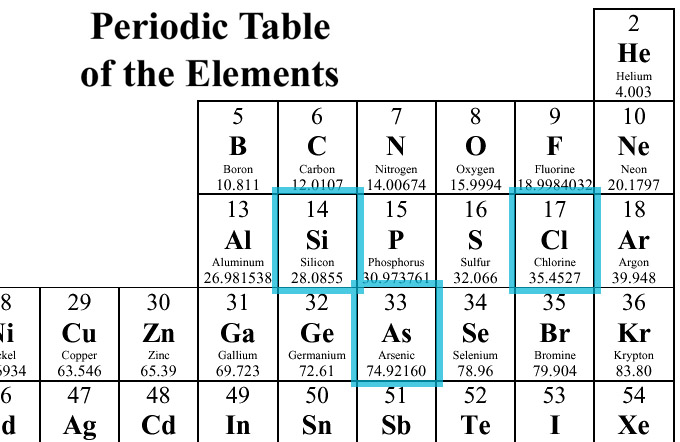
Alternative biochemistries may incorporate silicon, chlorine, or even arsenic.

Science fiction often speculates about alternative biochemistries, most notably silicon based life.  Up until recently, we’ve only been able to study carbon based life, where carbon is used as the primary building block for organic molecules.  Since silicon is similar to carbon, Sci-Fi says it might be possible for some alien creature to substitute silicon for carbon.

In December of last year, NASA scientists announced the discovery of bacteria which could replace their phosphorus with arsenic.  This research is still in dispute (sometimes the arguments get a little personal), but it seems researchers generally agree arsenic based life could exist somewhere, if not on Earth.  (See my previous posts on arsenic eating bacteria, “Eat Your Arsenic” and “Don’t Eat That Arsenic!”)

Now researchers in Germany claim they’ve engineered new E. coli bacteria which substitute a chlorine compound for part of the bacteria’s DNA.  As far as I can tell, this discovery is not in dispute… yet.  But again, it shows that real scientists believe an alternative biochemistry is possible.

Please note that while people use terms like arsenic based and chlorine based life, these examples are still carbon based.  Carbon can do things that no other element can, not even silicon.  It can form strong, lightweight chains of atoms, which are extremely useful for making things like DNA (see “Carbon vs. Silicon” for more).  Swapping silicon for carbon makes those chains fall apart.  If a silicon based life form exists, like the one pictured below, its biochemistry has to be completely different from ours and not just a one-for-one substitution.

As astronomers discover more and more planets outside our solar system, those alternative biochemistries become very important.  When they examine these planets, looking for telltale clues of oxygen-nitrogen atmospheres and other signs of life-as-we-know-it, they also have to remain open to the possibility of life-as-we-don’t-know-it.  Maybe even the highly unlikely silicon based life of science fiction.

Click here for more on chlorine based life.

P.S.: No word yet on any Sci-Fi thrillers where bleach-immune E. coli escape from the lab to wreak havoc of innocent humans’ digestive systems.

Sci Friday

Here are this week’s sciency links.  I strongly recommend reading the second one before checking out the new Planet of the Apes movie.