Baby, You Can Drive My Car

Perhaps the greatest disappointment of the 21st Century is that we still don’t have flying cars.  We were promised, damn it.  Old timey Sci-Fi lied to us.  This should have happened back in the year 2000!  However, the 21st Century is young, and maybe—just maybe—we’re starting to catch up.

Introducing the Transition by Terrafugia.  According to the manufacturer’s website, the Transition is a street-legal aircraft currently in development.  The anticipated price tag is a mere $279,000.  Check out the video:

Based on the video, the Transition doesn’t appear to be a “true” flying car but rather a hybridization of car and airplane.  This isn’t a vehicle that levitates.  It does not hover in the air like Luke Skywalker’s landspeeder.  I would assume that to purchase one, you will first have to earn your pilot’s license, and I can tell you that is a much more complicated process than a relatively quick and painless trip to the D.M.V.

However, this is the beginning.  The fact that a company now exists and is working toward the ultimate dream of the 21st Century hints at more to come.  According to Terrafugia’s website, other flying car designs are already in development.

P.S.: Don’t forget that levitating trains already exist!

Sciency Words: Rotating Disk

Today is a big day for both math and science nerds.  It’s Pi Day, the day we celebrate the magical number 3.141592…, but it also happens to be Albert Einstein’s Birthday.

Sciency Words Logo

So for today’s edition of Sciency Words, we have a term that involves both circles (and the number pi) as well as Einstein’s physics.  Today’s Sciency Word is:

Rotating Disk

The rotating disk thought experiment is one of the strangest ideas to come out of Einstein’s general theory of relativity.  Part of relativity is the concept of length contraction.  If I were to somehow accelerate a yardstick to a speed close to the speed of light, the yardstick’s length would contract or shorten noticeably.  The same thing would happen in an extremely powerful gravitational field, such as the gravitational field of a black hole.

But what happens if a rotating disk is accelerated close to the speed of light?  What happens to the circumference of the disk?  Well, according to Einstein’s thought experiment, the circumference would also contract, just like the straight yardstick.  However, the radius of the disk would not change, because the radius is always perpendicular to the disk’s rotation.

The math can get complicated, as it often does in general relativity, because we are no longer dealing with the Euclidean geometry we all suffered through in high school.  Instead, we are now entering the strange world of non-Euclidean geometry, a world in which parallel lines can intersect, the angles of triangles do not necessarily add up to 180 degrees, and the ratio of a circle’s radius and circumference does not always equal pi.

To put that in a simpler way, pi does not always equal pi.  This is not some weird fluke of mathematics but a real phenomenon, one which was predicted by Einstein and later demonstrated through scientific experiments.  Do we live in a strange universe or what?

Happy Pi Day, everyone, and happy birthday to Albert Einstein!

Seriously, the Solar System is Enormous!!!

Today, I want to share a few interesting links related to our topics of science and speculative fiction.

First off, we have a map of the Solar System.  This is no ordinary map of the Solar System, though.  This map is to scale, with the size of the Moon represented as a single pixel and the distances between planets accurately portrayed.  It took me about twenty minutes to explore the entire map, and I strongly recommend reading all the notes.  They get pretty philosophical once you pass Jupiter.  Click here for “If the Moon were One Pixel: A Tediously Accurate Map of the Solar System.”

Next, Michelle Joelle compares J.R.R. Tolkien’s essay “On Fairy-Stories” with William Desmond’s God and the Between.  The important lesson here is that fairy tales and other forms of speculative fiction should not be dismissed as escapism.  They may in fact be tools to help us understand that which transcends the crude, material world we see around us.  Click here for part one of Joelle’s series.  Click here for part two.  And click here for part three.

Lastly, if I gave you the numbers 2, 4, and 8, would you be able to predict what number I’d give you next?  You might assume I’m following a simple mathematical pattern, but that’s not the pattern I’m thinking of.  The video below takes a look not so much at math tricks but at how difficult it is for us to escape our assumptions once they’re made.

Sciency Words: Technocracy

Sciency Words Logo

Today’s post is part of a special series here on Planet Pailly called Sciency Words.  Every Friday, we take a look at a new and interesting scientific term to help us all expand our scientific vocabularies together.  Today’s word is:

TECHNOCRACY

Technocracy is a hypothetical form of government in which political power is given to technical experts, mainly scientists and engineers.  Government policy is set not by debates or elections but by experimentation through the scientific method.  The ultimate goal of a technocratic government would be to create a self-sustaining society, a society that lives in maximum comfort given the limits of its natural resources.

Although there have been plenty of examples of scientists contributing to public policy decisions, we have yet to see a true technocracy in action.  I think a technocratic political system might have some advantages.  In democracies, we elect our leaders, but that is no guarantee that the best or brightest people in society will lead.  Too often, it’s the better-funded candidate who wins the election, or if not that, it’s the candidate who does a better job rallying the crowd with an elegant speech.

In the Tomorrow News Network series, the government of the alien race known as the Hykonians is identified as the Hykonian Technocracy.  Also, in the T.N.N. story “Mother Mars,” the ancient Martians appear to have a technocratic form of government.  I find the idea of a technocracy fascinating, and I can see how some might think it’s an improvement over our current democratic institutions.  However, I have chosen to portray these fictional technocracies as deeply flawed and prone to corruption, because no political system is perfect.

In the Tomorrow News Network series, the Hykonian Technocracy has a long history of conflict with the people of Earth.  It all began with a certain incident in Roswell, N.M.

Despite the potential advantages of a government run by Einsteins, I fear the disadvantages are far greater.  There’s probably a good reason this form of government does not already exist somewhere.  But what do you think?  Would we be better off under a technocracy, or should we stick to the political system we already have?

IWSG: The Perils of Word Counts

InsecureWritersSupportGroupToday’s post is part of the Insecure Writer’s Support Group, a blog hop hosted by Alex J. Cavanaugh.  It’s a way for insecure writers like myself give each other advice and encouragement.  Click here to see a full list of participating blogs.

* * *

Here’s a piece of advice attributed to one of my role models: “Not everything that counts can be counted, and not everything that can be counted counts.”  These words are often attributed to Albert Einstein, although there is some scholarly debate as to whether or not Einstein actually said this.  But that’s not important right now.  The words themselves have weighed heavily on my mind of late, regardless of their historical origin.

I’m the kind of writer who keeps scrupulous records of everything: deadlines, word counts, the number of hours I spend writing…  I even make pie charts about this stuff.  In short, I do a lot of counting, and that usually serves me well.  Counting keeps me on schedule and forces me to work a little harder to get that extra thousand words done.  Also, because of my scrupulous record keeping, I can flip back through old calendars and see how my writing discipline has increased over the years.  Where once I struggled to complete 3,000 words in a week, I now routinely write that much in a day.

The down side is that on days when I don’t write, or for reasons beyond my control I can’t write, I see this unmarked day in my records, and that makes me feel like a failure.  It’s exponentially worse when I see a series of unmarked days in a row.

Due to a recent family emergency, I now have over a week of zero writing.  Despite the circumstances, I feel guilty.  Yes, a close relative was hospitalized, and yes, I had to travel a long distance to see her, and yes, my presence seemed to make a difference, BUT WHAT ABOUT MY WRITING QUOTA!!!

It’s only because of that quote from Einstein (or whoever) that I am able to keep things in perspective and remember that some things are more important than word counts.

Sciency Words: Particle Zoo

Sciency Words Logo

Today’s post is part of a special series here on Planet Pailly called Sciency Words.  Every Friday, we take a look at a new and interesting scientific word to help us all expand our scientific vocabularies together.  Today’s word is:

PARTICLE ZOO

At some point in the last century, scientists thought they had a pretty good grasp on all the subatomic particles.  They knew about protons, neutrons, and electrons, and they thought they understood more or less how these particles interacted.

Then they discovered the photon and the neutrino and the positron and six different kinds of quarks and a few vector bosons and the Higgs boson and the pion and kaon and gluon… this list can go on for awhile.  Particle physics went from being relatively simple to frustratingly complicated very quickly.

Many of these particles cannot be observed directly.  Some have never been observed at all but are predicted to exist by elaborate, mathematical models.  The existence of the Higgs boson, for example, was only recently confirmed by experiment.

There are literally hundreds of different subatomic particles, many of them composite structures made from other subatomic particles.  Some of these particles are truly bizarre, as different from one another as elephants and crocodiles, giraffes and hippopotami.

Some physicists find this embarrassing and derisively refer to the still-growing list of particles as the “particle zoo.”  I prefer to think of this so-called zoo as a beautiful reminder that the universe is far more complicated and interesting than we humans can possibly imagine.

Revisions

1.1 Medusa Effect

It’s been a while since I updated anything on the Tomorrow News Network website.  I’ve been neck-deep in revisions of the 2012 stories for the last few months.  When I started writing T.N.N. over two years ago, I was very much a novice.  I’m not going to claim that I have since mastered the art of writing, but I am far more competent at my craft than I used to be.

I have also started working with an editor who has taught me the difference between “borders” versus “boarders,” “prescribed” versus “proscribed,” and “farther” versus “further.”  My editor has also called my attention to a number of other embarrassing errors that I am now in the process of fixing.

Today, I am happy to announce that the revised versions of the first two Tomorrow News Network stories are available on the T.N.N. website.  Revisions of the third story are coming soon.  In fact, I had a meeting with my editor today concerning story #3, “The Orion War,” and she tells me that the updated version is much stronger than the original.

1.2 99 White Balloons

For those of you who’ve read these stories before, I hope you’ll take the time to read them again and see how they’ve improved.  And if you’re new to T.N.N., I beg your indulgence as this revision process goes forward.  Any typos or grammatical errors you find will be corrected in due time (probably).

Please click here to start reading the new version of “The Medusa Effect,” the “pilot episode” of the series.  Click here to read the new “99 White Balloons,” which focuses on the true story of Roswell.

Sciency Words: Underdetermination

Sciency Words Logo

Today’s post is part of a special series here on Planet Pailly called Sciency Words.  Every Friday, we take a look at a new and interesting scientific word to help us all expand our scientific vocabularies together.  Today’s word is:

UNDERDETERMINATION

This word comes to us not from science itself but from the philosophy of science.  According to the philosophy of science, when we have two competing theories to explain some natural phenomenon, we are supposed to choose which theory is correct based on the evidence available to us.  But what happens when we don’t have enough evidence?

For example, let’s say that I theorize that horses are slow moving animals that can only trot, and you theorize that they are capable of running really fast.  If the only experience either of us has ever had with horses is watching one stand still eating its hay, then our two theories are underdetermined by our lack of experience with horses.

In the recent evolution vs. creationism debate between Bill Nye the Science Guy and Ken Ham of Answers in Genesis, Ken Ham never used the word “underdetermined,” but that is exactly what he was trying to argue: that our choice between evolution and creationism is underdetermined by a lack of evidence.  Of course, that’s not the case at all.  There is an overwhelming amount of evidence in support of evolution and plenty of evidence to refute creationism as well.

One example of genuine underdetermination is in the search for life on Mars, where there are some signs of the possibility of life, some evidence that makes life less likely (but still not impossible), and as of yet no discovery of an actual Martian organism, living or dead.  Another example of underdetermination are the various competing versions of string theory, which as I understand it remain untested and untestable due to the limits of technology.

Underdetermination is always a temporary problem.  It would not take long to prove which of our theories concerning horses is correct.  We’d only have to go to a farm or perhaps a rodeo, or we could simply look up horse videos on YouTube.  As NASA rovers continue exploring Mars, the question of Martian life will be resolved.  As for string theory, I’m sure the necessary technology will be invented eventually.  Of course if some people refuse to accept any evidence that disproves their preferred theory, that is another problem entirely, and the sciency word for that is confirmation bias.

Snow: Good or Bad?

I’ve heard a lot of complaining these last few weeks about snow.  Here in the North Eastern U.S., we got a lot of it.  Far more than we’re used to, and perhaps a bit more than we know how to handle.

Now I certainly understand why some people hate snow.  It’s not only inconvenient; it can also be dangerous.  Snow contributes to people getting sick.  It makes driving more difficult.  It even makes walking difficult.

IMG_1118

At the same time, snow is beautiful.  Just because it’s dangerous doesn’t change its beauty.  The Sun is dangerous, bombarding our planet with high quantities of radiation, but we still think sunshine is beautiful.  The ocean is dangerous, with all those sharks and jellyfish and, of course, the possibility of drowning, yet I think most of us would agree that it is beautiful.  So why should snow be different?

For those of you who harbor a deep, seething hatred for snow, I’m only asking one thing: take a moment to stop, look out at the fluffy, white landscape, and try to enjoy the beauty.  Just for a moment.  You can go back to complaining later, but don’t let your grumbling suck all the joy out of life.

Sciency Words: Osculation

Welcome to this special Valentine’s Day edition of Sciency Words!  Sciency Words is a series here on Planet Pailly where we take a look at new and interesting scientific terms so we can all expand our scientific vocabularies together.  Today’s word is:

OSCULATION

Osculation: noun.  The scientific term for kissing.

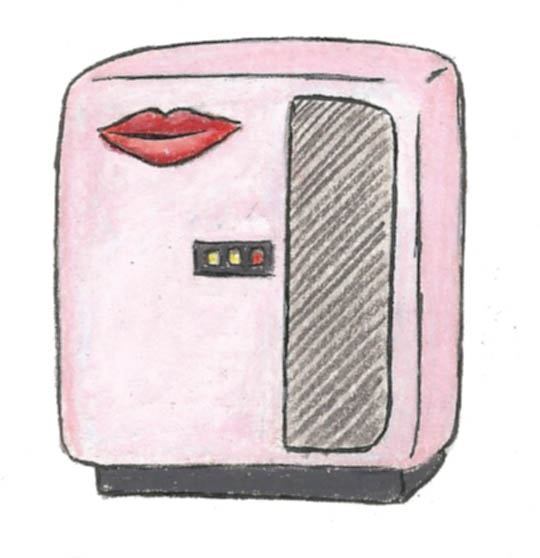
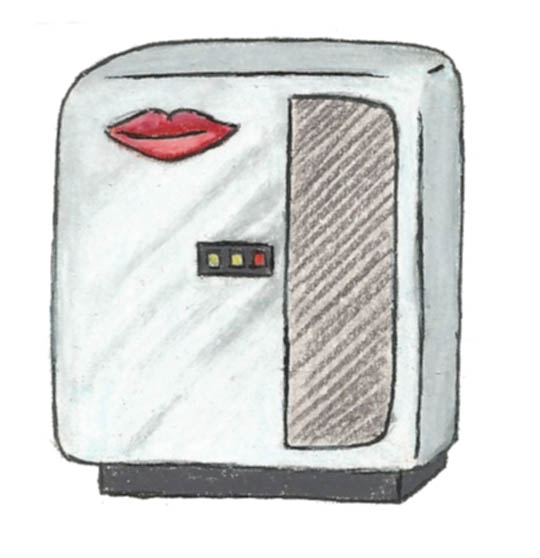
I have no idea why they needed a technical term for this, but I’m glad the word exists because now I know what to call my latest invention.  Ladies and gentlemen, meet the Osculator 5000.

Osculator 500 in Flirty Pink
For all you osculating needs.

Whether you’re spending Valentine’s Day alone or need a little extra practice before tonight’s hot date, this is the machine for you!  The Osculator 5000 comes fully programmed with three settings: peck on the cheek, kiss, and tongue.  To enhance your osculation experience, the Osculator 5000 includes a built in speaker and over a dozen prerecorded sound effects.  Order now, and give the Osculator 5000 a chance to turn you on.

Osculator 500 in Sexy Chrome
Now also available in chrome!