Sciency Words: Breakfast, Lunch, and Dinner

Today’s post is part of a special series here on Planet Pailly called Sciency Words.  Every Friday, we take a look at a new and interesting scientific term to help us all expand our scientific vocabularies together.  Today’s word is:

BREAKFAST, LUNCH, AND DINNER

I like to believe there is a God and that everything in the universe serves some purpose, but bedbugs make me wonder. They don’t pollinate flowers or help remove waste. They don’t form symbiotic relationships with other organisms. They’re not even a “benefit” to viruses and bacteria; I’m told they are very poor transmitters of diseases.

800px-CDC_11739_Cimex_lectularius_SEM
Image courtesy of the C.D.C.

Bedbugs don’t do anything except lounge around, suck on people’s blood, and have super disturbing, violent sex. As far as I can tell, they serve no purpose whatsoever. They’re not even cute.

One way to identify whether or not you have a bedbug infestation is the unusual pattern of bite marks they often leave on your skin. For some reason, bedbugs tend to bite their victims three times, leaving a triangle of red bite marks that experts euphemistically call “breakfast, lunch, and dinner.” Click here to see examples of bedbug bites.

So sleep well tonight, and let me know if you can think of any reason why a just and kind God would allow these disgusting creatures to exist.
Love Hurts: New Research on Spider Mating Behavior

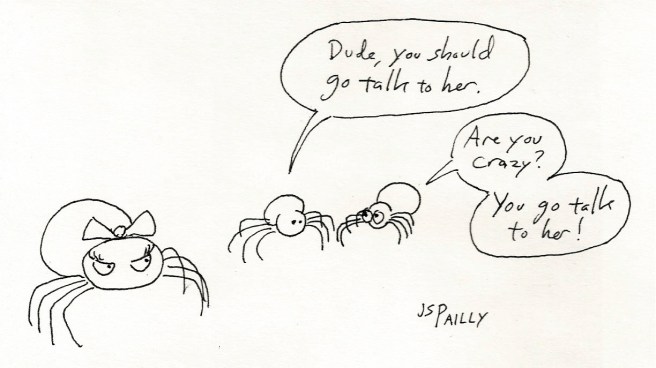
Today’s post is for the ladies.  Have you ever been sitting in a bar minding your own business when some sleazy guy saunters over to you looking for “a good time”?  Well, here’s one way to handle this situation: murder that scumbag and eat his corpse.  That’s what certain female spiders do.

Researchers in Spain report that when a male spider approaches a female, if the male is judged undesirable, the female will simply eat her suitor.  Delicious.  Undesirable male spider traits include diminutive size, unhealthy appearance, and presumably lame pick up lines (the one about “spreading all eight of your legs” is really getting old).

This new research also showed that some of the more aggressive females ate their suitors regardless of how desirable those unfortunate suitors may have been.  It’s worth noting that the research was conducted on the species Lycosa hispanica, a wolf spider native to Spain, so we don’t know if this behavior is universal to all spiders.  For the sake of all those lonely, lovesick male spiders out there, I hope it is not.

Spider Cold Feet

For more information on the sexual cannibalism of Spanish wolf spiders, click here.

Einstein’s Old Envelopes

The other day, I came across an amusing story about Albert Einstein. He and his wife were visiting the Mount Wilson Observatory in Southern California, and several of the astronomers there were bragging about how powerful their telescope was. They said it could reveal the secret workings of the universe. Elsa, Einstein’s wife, laughed and said, “My husband does that on the back of an old envelope.”

Today, we think of scientists working in big laboratories with lots of expensive equipment. To make any meaningful scientific discoveries, we assume you first need a large budget, subsidized either by the Federal Government or a major corporation like Lockheed Martin or Kaiser Permanente. And yet Einstein required none of that. All his greatest contributions to science were made using nothing more than his mind—and apparently some old envelopes.

Einstein Time

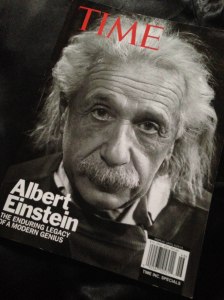
P.S.: I found this anecdote in a recent special edition of Time Magazine profiling Einstein. I highly recommend reading it. Einstein is a far more fascinating and complicated historical figure than popular culture has portrayed him to be.

Sciency Words: Heuristic

Sciency Words Logo

Today’s post is part of a special series here on Planet Pailly called Sciency Words. Every Friday, we take a look at a new and interesting scientific term to help us all expand our scientific vocabularies together. Today’s word is:

HEURISTIC

Heuristic: adjective. A fancy way of saying your scientific equation, theory, or idea is “close enough.” You’ve provided an easy way to think about a difficult problem, at least under certain specific circumstances. A heuristic theory can only give you a limited degree of precision, and if you stray too far beyond the specific circumstances that heuristic theory applies to, you might get answers that are way, way off the mark.

A good example is the equation E = mc2. We’ve all heard of this equation, but it is only a simplified version of Einstein’s actual mass/energy conversion equation. So long as your velocity equals zero or a value close to zero, E = mc2 is close enough. Otherwise, you’ll have to use the full equation: E2 = (mc2)2 + (pc)2.

We might also consider Newton’s laws to be heuristic. They approximate the behavior of objects in motion under circumstances we humans are likely to experience. But Newton’s laws are ever so slightly off, and on extremely large scales (think super high gravity or velocities approaching the speed of light), these minor discrepancies become significant.

To some extent, we might be able to label almost all scientific theories heuristic. Each new generation of scientists takes our body of scientific knowledge, corrects the errors of the past, and adds a bit more precision to our accepted theories. But I think the word heuristic should be reserved for those theories that only work under certain conditions and are blatantly incorrect under others.

P.S.: The word heuristic has other meanings in fields like psychology and computer science, but I believe the definition I’ve provided here is close enough under most circumstances.

The Periodic Table: A Source of Conflict

In Isaac Asimov’s The Gods Themselves, the plot revolves around the discovery of a new isotope of plutonium known as plutonium 186. As anyone familiar with chemistry already knows, such an isotope cannot possibly exist (at least not in our universe), but it turns out that by acquiring it from a parallel universe, we are able to create a cheap and highly efficient new source of power.

In last week’s edition of Sciency Words, we talked about “conflict minerals.” These valuable minerals are essential to our technologically advanced society, but they’ve also become a source of conflict in the world. The most noteworthy example is in the Democratic Republic of the Congo, where the mining of four specific metallic elements has funded a bloody and protracted civil war.

Right now, real people are suffering and dying because of gold’s exceptional ability to conduct electricity and tungsten’s extremely high melting point. To understand why this is happening requires a little study of the periodic table of elements, which reveals the special properties of these and other metals.

Whether we’re talking about the minerals mined in Congo or mythical isotopes like plutonium 186, the lesson is the same. We cannot deny the importance of science in our world when the information contained in the humble periodic table of elements can spark so much conflict, both in science fiction and real life.

Sciency Words: Conflict Minerals

Sciency Words Logo

Today’s post is part of a special series here on Planet Pailly called Sciency Words. Every Friday, we take a look at a new and interesting scientific term to help us all expand our scientific vocabularies together. Today’s word is:

CONFLICT MINERALS

Certain rare minerals are essential to our modern, technological world. Unfortunately, our sources for these minerals include countries known for their human rights violations, such as the Democratic Republic of the Congo, which is currently in the midst of a bloody, protracted civil war. When these rare minerals come from such war torn parts of the globe, we call them conflict minerals.

I imagine this term could apply to a wide range of chemical elements, but there are four particular metals of note:

  • Gold: in addition to being pretty, gold is an exceptionally good conductor of electricity, making it useful in a wide range of electronic devices.
  • Tin: alloyed with silver, tin is used for soldering electronic components.
  • Tantalum: used for making capacitors.
  • Tungsten: no known chemical element has a higher melting point than tungsten, making it ideal for use in light bulbs, vacuum tubes, and any other electronic device that tends to get really hot.

Reportedly, both sides of Congo’s civil war have profited from the mining of these four specific elements. All that money pouring into Congo has no doubt perpetuated the violence and prolonged the war.

According to an article in April’s issue of Scientific American, Intel has decided to stop buying conflict minerals. Obviously, they’ll still use gold, tin, tantalum, and tungsten in their products, just not if they came from places like Congo. The same article states that the U.S. Securities and Exchange Commission will soon require companies to disclose where the metals in their products come from.

P.S.: Many of the rare metals we depend on here on Earth are readily available in space. I’ve written before about how this might be just the incentive we need to make space exploration a priority once again. Maybe it would reduce our dependence on Congolese mining as well.

IWSG: Quantum Computers

InsecureWritersSupportGroupToday’s post is part of the Insecure Writer’s Support Group, a blog hop hosted by Alex J. Cavanaugh.  It’s a way for insecure writers like myself give each other advice and encouragement.  Click here to see a full list of participating blogs.
* * *

Bear with me on this.  Today’s post may seem really sciency at first, but I promise it is about writing.

Scientists are currently working on a new kind of computer called a quantum computer.  In fact, there’s a company based in British Columbia called D-Wave that claims they’ve already started selling these special, new computers (for several million dollars a pop), though there’s ongoing controversy about whether or not D-Waves product is truly “quantum.”

What makes these quantum computers so special is that they take advantage of the weird science of quantum mechanics.  Rather than recording data as a series of zeros and ones, a quantum computer uses a series of qubits (or Q-bits) to store data as zero, one, or zero and one at the same time.  The advantage of this is it allows quantum computers to skip steps in complex calculations, making those calculations much faster.

What does this have to do with writing?  I’ll tell you.  You and I, my fellow insecure writer, are not quantum computers.  We’re more like the regular kind.  Yes, there is something weird and almost quantumly magical about creativity and inspiration and the Muse, but writing itself is a long, often tedious process, and we don’t get to skip steps.


Sciency Words: Planet X

Sciency Words Logo

Today’s post is part of a special series here on Planet Pailly called Sciency Words.  Every Friday, we take a look at a new and interesting scientific term to help us all expand our scientific vocabularies together.  Today’s word is:

PLANET X

Planet X is the name given to any hypothetical planet yet to be discovered in our Solar System.  Percival Lowell originally coined the term back in the early 1900’s.  Lowell is the same astronomer who thought he saw canals on the surface of Mars, “proving” the existence of a Martian civilization.

At one time, Uranus and Neptune could have born the Planet X title.  Scientists long suspected the existence of a seventh planet due to anomalies in the orbit of Saturn.  After Uranus was discovered, anomalies in its orbit hinted at the existence of Neptune, and anomalies in Neptune’s orbit hinted that there might be even more planets beyond it.

Recent data from the Wide-Field Infrared Survey Explorer, a.k.a. WISE, found no evidence of a Planet X, which seemed to put the matter to rest once and for all.  There are lots of dwarf planets out there, like Pluto and Eris, but nothing large enough affect Neptune’s orbit in any meaningful way.

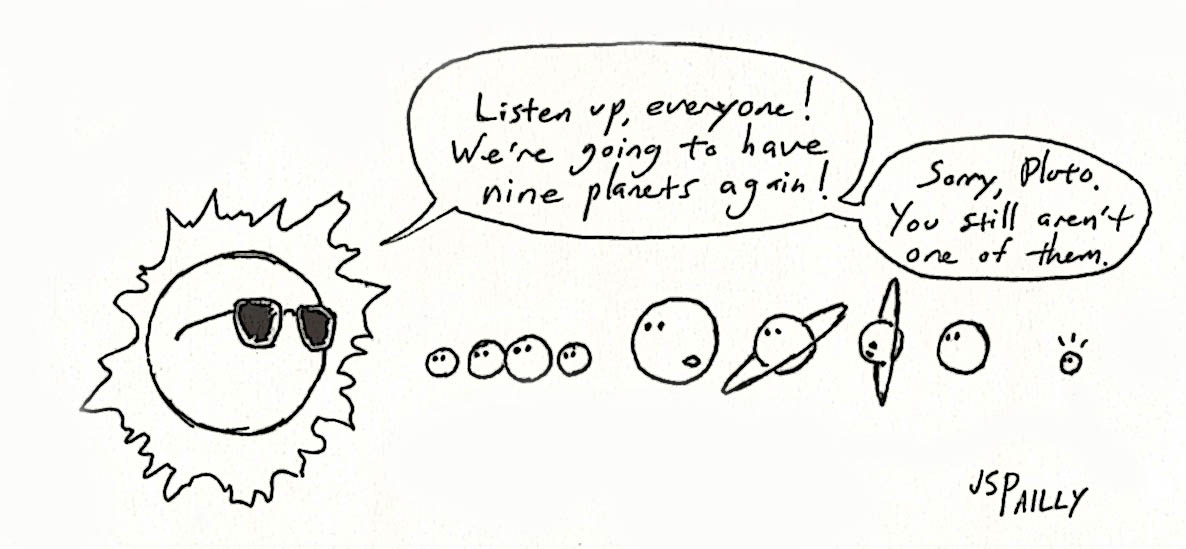
Now NASA scientists are proposing the existence of Planet X again to explain anomalous perturbations in the orbits of two of the most distant known dwarf planets.  To be fair, WISE failed to detect any Saturn or Jupiter-sized planets.  This new Planet X would be much smaller, closer to the size of Earth or Mars.

It seems our Solar System just keeps getting more and more crowded.

9 Planets

Sciency Words: Cyclic Universe Theory

Sciency Words Logo

Today’s post is part of a special series here on Planet Pailly called Sciency Words.  Every Friday, we take a look at a new and interesting scientific term to help us all expand our scientific vocabularies together.  Today’s word is:

Cyclic Universe Theory

How did the universe begin?  Scientists have several competing theories.  You’ve probably heard of the Big Bang theory, but there’s a less well-known alternative called the cyclic universe theory.  I admit I do not understand all the details of these two theories, but I’ll try to muddle through the key concepts as best I can.

According the Big Bang theory, all the matter and energy of our universe was once compact into a microscopic point.  Then, in a singular, cataclysmic event, that matter and energy exploded, triggering a rapid inflation of space-time.  The ensuing mayhem, according to the theory, should have produced massive gravity waves.

The cyclic universe theory tells a different story.  Before that point in time when our current universe began, there was another universe, and before that another and another going back ad infinitum.  Each of these universes reached a point of maximum expansion then began to contract inward, collapsing upon itself in a “Big Crunch,” which would be followed immediately by a “Big Bang.”  According to this theory, the process would not produce gravity waves.

Although the majority of physicists seem to favor the Big Bang theory, they haven’t found any clear evidence to support one theory over the other.  In other words, these two theories are underdetermined.  At least that was the case until now.  New data collected by the BICEP2 telescope in Antarctica indicates that massive gravity waves permeated the early universe, just as the Big Bang theory predicted.

However, the cyclic universe theory still has its adherents, and rightly so.  BICEP2’s data has yet to be confirmed by researchers using other telescopes, and even if those gravity waves did exist, I have no doubt the cyclic universe theory can be modified somehow to account for them.  The Big Bang theory has scored a major victory, but the debate isn’t over.

Personally, I’m hoping the detection of gravity waves will be confirmed, strengthening the Big Bang theory’s case.  I hope this not only because it would constitute a huge advance in our scientific knowledge, but also because The Cyclic Universe Theory would be a terrible name for a sitcom.

431311