Jupiter’s All Warm and Fuzzy Inside

Don’t let Jupiter’s stormy personality fool you. He’s all warm and fuzzy on the inside.

I have a couple more “Alien Eyes on Earth” posts on the way, but last week one of my favorite space missions was in the news: the Juno mission to Jupiter.

Now I have to confess I haven’t done a whole lot of research on what Juno’s found. I take it some of the highlights are:

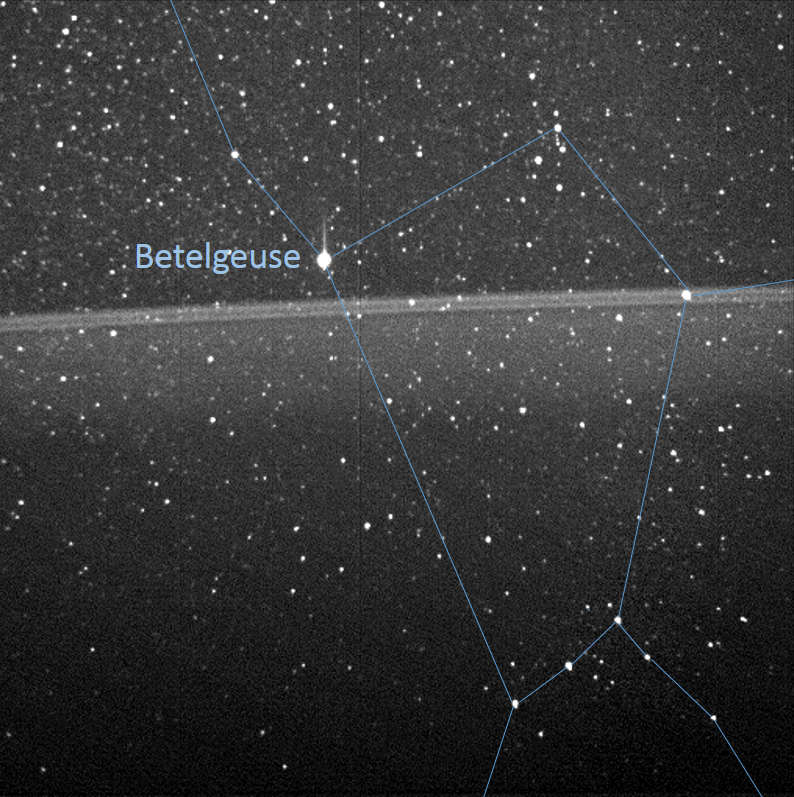
  • We got a cool picture of Jupiter’s rings with the constellation Orion in the background.
  • Those cyclones clustered around Jupiter’s poles—those are still weird.
  • It sounds like something freaky is happening with Jupiter’s auroras. I’m planning to do a separate post on that in the near future.

But the thing that really grabbed my attention was this: Jupiter’s core is being described as “fuzzy.” I’m not sure how to visualize that, but it’s also being described as “partially dissolved,” which makes a little more sense to me.

We know about this because Juno is gravity mapping the planet—using highly precise measurements of Jupiter’s gravitational field to determine how mass is distributed in the planet’s interior.

We also know about it thanks to Juno’s magnetometer. Planetary magnetic fields are generated by an internal dynamo effect, the result of all that pressurized liquid metal swirling and churning around a planet’s core. But according to Juno’s magnetometer, it seems Jupiter’s magnetic field is not what we expected, which suggests… what? Multiple dynamo effects? A big dynamo in the middle with smaller dynamos surrounding it?

Again, I haven’t done any proper research about this. Not yet. But I had a thought that I wanted to throw out there: we never figured out why Neptune’s magnetic field is so out of whack.

So now I’m wondering if there could be a connection there. Could weird, confusing, complicated magnetic fields just be a common feature of gas giants?

Also, the Sun has a wildly complex tangle of magnetic field lines around it. Might there be a relationship between the weird magnetic fields of gas giant and the weirder magnetic fields of stars?

I don’t have any answers. I’m just speculating after all the Juno news last week. It’ll be interesting to see what Juno tells us next.

On Thursday, we’ll get back to those aliens studying Earth from a distance.

Links

Jupiter Surprises in Its Closeup from Science Friday.

Jupiter Data from Juno Probe Surprises Scientists from Solar System Digest.

Jupiter Surprises in First Treasure Trove of Data from NASA’s Juno Mission from Spaceflight Now.

Uniform

I wrote a flash fiction story, and it went live yesterday over at Fiction Can Be Fun! I hope you’ll go check it out, along with two other cool stories posted with it. They’re all based on the writing prompt “uniform.”

@breakerofthings's avatarFiction Can Be Fun

Express Yourself

I’m here today for the second in my series of interviews with the journalist, biographer, pundit and bon vivant, Jocelyn Humpheries.  Today we’re focussing on her writing as a biographer and in particular some of the little snippets that didn’t make the final cut.  Jocelyn: which of your biographical subjects was your favourite?

Oh! That is rather invidious – I do so detest those sorts of questions.  I enjoyed writing all of them, even – perhaps especially! – the scathing ones.  I do have a soft spot for the first one I wrote where the subject was, at the time, still living.  He was such a dear!  I don’t know if people say that about me now, but he would have been about the same age as I am now when I interviewed him.

That would be Colonel Hart-More?

Indeed. Although he didn’t really like to use his…

View original post 1,121 more words

Sciency Words: Exoplanet

Today’s post is part of a special series here on Planet Pailly called Sciency Words. Each week, we take a closer look at an interesting science or science-related term to help us expand our scientific vocabularies together. Today’s term is:

EXOPLANET

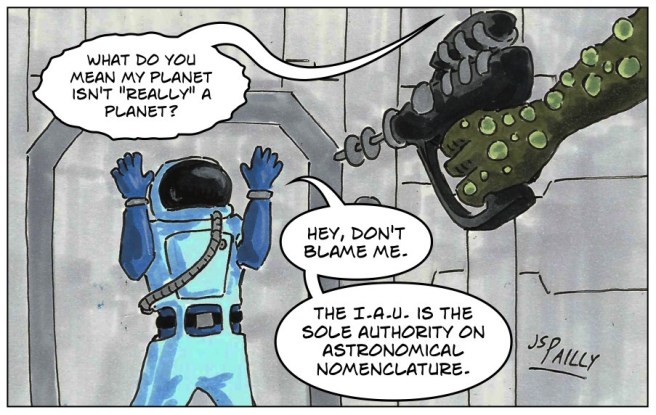
According to the International Astronomy Union (I.A.U.), an astronomical object qualifies as a planet if:

  • It orbits the Sun.
  • It’s round due to the pull of its own gravity.
  • It’s cleared its orbital path of asteroids or other debris (this is the part of the planet test Pluto failed.

The I.A.U.’s planet definition has caused a lot of grumbling and controversy, and not only because of Pluto. Let’s focus today on the first criterion for planethood: in order to be a planet, an object has to orbit the Sun. Not just any sun, but the Sun, as in our Sun. With a capital S.

Which means big, round objects orbiting other stars don’t qualify. The I.A.U. suggests calling them exoplanets or extrasolar planets, but they aren’t, strictly speaking, planets.

I have mixed feelings about this. On the one hand, it seems awfully geocentric of us to have one word for objects orbiting our Sun and a different word for the same type of objects orbiting other stars.

However, I have to admit having a special term for “planet orbiting another star” is kind of handy. It saves me time in conversations and cuts down on the word counts of blog posts. So I guess it’s worth knowing the official I.A.U. definition for this handy, time-saving term.

Except the I.A.U. doesn’t have an official definition for exoplanets. Why not? Let’s try adapting the current planet definition to exoplanets and see what happens.

  • An exoplanet has to orbit a star other than our Sun. (Seems okay so far).
  • An exoplanet has to be round due to the pull of its own gravity. (Our telescopes can’t visually confirm that exoplanets are round, but based on estimates of their mass we can safely assume they’re round. We’re probably still okay.)
  • An exoplanet has to have cleared its orbital path of debris. (This is a real problem because in most cases there’s no way to confirm, visually or otherwise, that an exoplanet has done this.)

There is a proposal to change the I.A.U. planet definition again, this time based on quantitative data rather than visual observations. This, by the way, is different than the geophysical everything’s-a-planet definition I wrote about previously. The geophysical definition would make Pluto a planet again; the quantitative definition would not.

Back in 2006, the I.A.U. changed the definition of planet, excluding Pluto from the planet club, because we’d learned new information about our Solar System. More new information about planets, exoplanets, and other planet-like objects has been piling up since then, which is why we keep hearing about these proposals to change the definition again.

Personally, I like the more inclusive geophysical definition, but that’s just my preference. Plenty of intelligent and well-meaning people disagree. But I think sooner or later, the I.A.U. will have to revisit this issue to ensure the definitions of planet and exoplanet match.

Mystery Blogger Award

Oh my gosh, I won an award! Yay me! A very special thanks to Outside Perception for nominating me for this award, and also thank you to Okoto Enigma for creating this award. According to Enigma’s website:

“Mystery Blogger Award” is an award for amazing bloggers with ingenious posts. Their blog not only captivates; it inspires and motivates. They are one of the best out there, and they deserve every recognition they get. This award is also for bloggers who find fun and inspiration in blogging; and they do it with so much love and passion.

Okay, I’m blushing. Look, I know these kinds of awards are a bit silly, but still it’s nice to be recognized.

So as part of accepting this award, I’m supposed to tell you three facts about myself and then answer five questions from Outside Perception. Here goes:

Three Facts About J.S. Pailly

  • For my day job, I work at a local T.V. news station. I can’t say I like my job, but I do pick up a lot of good story ideas for my true passion, which is…
  • Writing! Also illustration, and space stuff, but mostly my true passion is writing.
  • In 2012/2013, I wrote a series of short stories about a journalist who travels through time. I have a top-secret plan to rewrite and revise these stories and publish them as an ebook. Oh shoot! That was supposed to be a secret!

Five Questions from Outside Perception

1. Tell us about something you used to believe only to find out it was incorrect.

All my life, I’d heard the story about how Albert Einstein failed math. Turns out it’s not true. Apparently Einstein’s school switched grading scales during his final year, so his school records make it look like he failed when in fact he got perfect marks every single year.

2. If given the choice between cake or death, what would it be?

Well, the obvious answer would be cake, but I suspect this is a trick question. You see, I’ve played Portal. I know the cake is a lie. Death might be preferable.

3. What was your imaginary friend’s name and what special skills did they have?

Was? Did? My imaginary friend is still around! She’s asked me to never reveal her true name on the Internet; however, she makes semi-regular appearances on my blog. She’s my muse, and her special skill is inspiration, supposedly.

4. What is your all time most watched movie?

Star Wars. The three original Star Wars movies, to be precise. They’re the only movies I watched obsessively as a kid and still watch obsessively today.

5. When you have down time… (laugh… yah, I know). Okay, if you ever had down time, what would you do?

I’ve been slowly amassing a Lego collection. Most Lego enthusiasts end up building Lego cities. I’d like to do that someday, except rather than a traditional city, I want to build a huge Lego Mars colony.

As part of this award, I’m supposed to nominate a bunch of other people for the award and ask them five questions of my own choosing.

And the Nominees Are:

My Questions

  • What do you want to be when you grow up?
  • What book has had the most influence on you?
  • Has a movie ever brought you to tears? If so, what movie was it?
  • If you were a dinosaur, which dinosaur do you think you’d be and why?
  • What will be the title of your autobiography?

Now I don’t want to put any pressure on anybody, because I know not everyone likes these kinds of blogging award things. If I nominated you and you want to accept the award, the rules are listed below. If not, I still got to link to some pretty cool blogs, and that makes me happy.

Award Rules

  • Put the award logo on your blog.
  • List the rules.
  • Thank whoever nominated you and link to their blog.
  • Mention the creator of the award (Okoto Enigma) and provide a link as well.
  • Tell your readers 3 things about yourself.
  • Nominate roughly 10 – 20 people for this award.
  • Notify your nominees by commenting on their blogs.
  • Ask your nominees five questions.
  • Share a link to your best/favorite post that you’ve written.

Right, almost forgot about that last thing. I’m not sure if this is my best or my favorite post, but there is a post that’s been on my mind a lot lately for some reason. It’s an old IWSG post called “Research Rant.”

Why Sci-Fi?

Today, my first official post as a contributor for Universe of Possibilities is up. Universe of Possibilities is a new Sci-Fi hub started by Simon Farnell. My post is about how I got into science fiction in the first place.

This ended up being a more personal kind of post than I originally intended, but that’s okay. Science fiction lies at the heart of who I am as a person. A post like this was bound to touch on some personal stuff.

Sciency Words: Magnetar

Today’s post is part of a special series here on Planet Pailly called Sciency Words. Each week, we take a closer look at an interesting science or science-related term to help us expand our scientific vocabularies together. Today’s term is:

MAGNETAR

Space has a lot of cool ways to kill you. This one’s especially nifty! Magnetars are neutron stars with intensely powerful magnetic fields. Like, absurdly powerful magnetic fields.

Fly your spaceship near a magentar, and that overpowered magnetic field will start pulling the electrons off your atoms. This will kill you. It’ll destroy your spaceship too. Without those electrons, chemical bonds don’t work. Your molecules will unravel, and you and your ship will just disintegrate.

Even from a distance, magnetars are a menace. In 2004, a strong burst of gamma radiation washed over Earth, compressing our planet’s magnetic field and partially ionizing our atmosphere. That gamma radiation came from a magnetar on the other side of the galaxy.

If a magnetar could do that to us from so far away, just think what it must have done to any alien civilizations that happened to live closer. I can’t help but imagine there’s a vast dead zone on the other side of the galaxy, with magnetar SGR 1806-20 right in the middle.

The good news is that magnetars don’t last long. Their magnetic fields decay rapidly, so these raging monsters turn into regular neutron stars within a few thousand years. Also, while their outbursts of gamma rays and X-rays can affect our planet, there aren’t any magnetars close enough to Earth to really threaten us.

Oh wait. Yes there are. Sort of.

I’m Back!

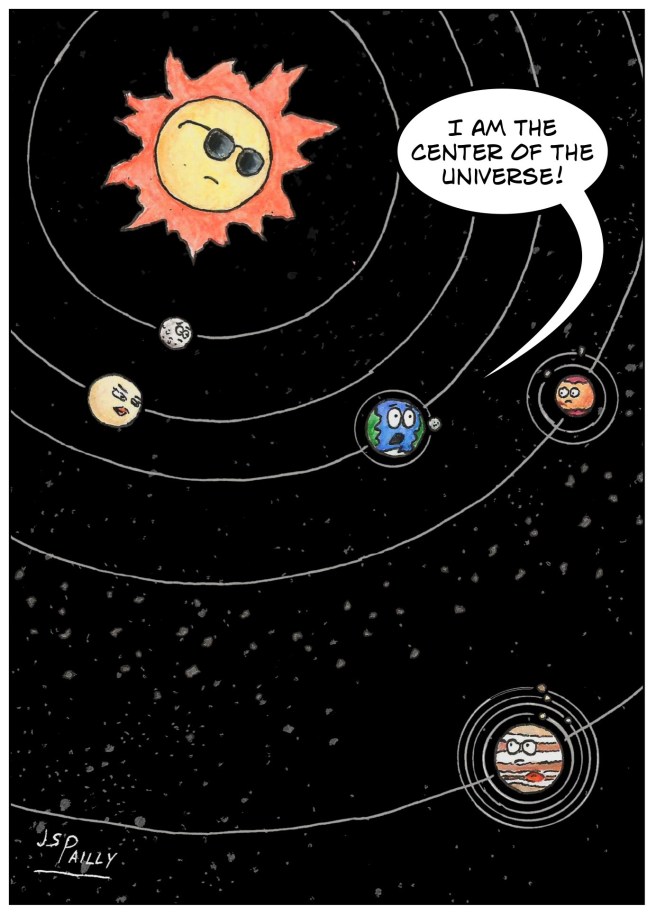
Today is Galileo Galilei’s 453rd birthday. With that in mind, here’s a throwback to the world of 453 years ago.

fb15-center-of-the-universe

Today is also my official return to regular blogging! You might notice that I’ve made a few small changes around here. First off, no more ads! Because nobody likes ads, and it actually didn’t cost me much to get rid of them.

Also, the web address has changed from planetpailly.wordpress.com to simply planetpailly.com. It’s a small thing, I know, but I’m pretty excited about it. Makes me feel more legit somehow.

I’ve made a few other small, cosmetic changes, and I might continue fiddling with a few details over the next few months.

As for the Tomorrow News Network website… umm… I’ll get back to you about that.

Meanwhile, I have some fun stuff lined up for this website, starting with a visit to KIC 8462852. What the heck is that? Tune in for Friday’s edition of Sciency Words to find out! Or you could just google it. The Internet’s been buzzing about KIC 8462852 for a while now.

[BLOG TITLE REDACTED]

Regular readers may have noticed I missed Friday’s Sciency Words post. You may have also noticed I skipped Molecular Monday on the first Monday of the month. And I can tell you right now that I’ll be skipping a lot more of my regularly scheduled blogging days in the near future.

I did post for the Insecure Writer’s Support Group last Wednesday, and in my IWSG post I mentioned that I have a top-secret master plan for 2017. And that secret plan requires me to [TEXT REDACTED] and also [TEXT REDACTED].

Okay, it’s a secret plan. I guess I can’t say much, but you can probably guess that I’m doing something with the Tomorrow News Network series. You may also see some changes coming to Planet Pailly, such as [TEXT REDACTED].

Dang it, text redactor! They’re going to see those changes soon anyway. Can’t I tell them anything? [TELL THEM YOU’LL BE BACK ON FEBRUARY 15TH.]

Regularly scheduled blogging will resume on February 15, 2017, for both Planet Pailly and Tomorrow News Network. Until then, I’ll do my best to keep you appraised of my progress, without violating the terms of my top-secret master plan.

P.S.: By some weird cosmic coincidence, February 15 happens to be Galileo Galilei’s birthday. Seems like an appropriate day for a new space adventure to begin.

What’s Up with Juno?

It’s been awhile since we checked in with Juno, the NASA space probe currently orbiting Jupiter. So Juno, how’s the mission going?

dc20-juno-update-1

Uh-oh. That doesn’t sound good. What happened?

dc20-juno-update-2

Okay, here’s a quick timeline of events:

  • On July 4, 2016, Juno entered orbit of Jupiter. The main engine worked flawlessly at the time.
  • On August 27, 2016, Juno performed its first science pass of Jupiter. All its instruments appeared to be in working order.
  • On October 19, 2016, Juno was supposed to shorten its orbital period from 53 days to 14 days, but there was a problem with the main engine. Plan B was to just do another science pass, but then there was a problem with the main computer.

According to this article from Spaceflight 101, we now know what happened with the computer, and it sounds like it’ll be a fairly easy fix. The malfunction was caused by an instrument called JIRAM. Continuing with our timeline:

  • On December 11, 2016, Juno performed another science pass, this time with JIRAM switched off. All the other science instruments seem to be in working order, and a software patch for JIRAM will be uploaded soon.
  • Coming February 2, 2017, Juno will approach Jupiter again. This will likely be another science pass, since NASA still doesn’t know what’s wrong with the main engine.

The main engine is turning out to be the real problem. According to a press release from October, some pressure valves that should have opened in a matter of seconds took several minutes to open. Until NASA figures out why that’s happening, they’re going to leave Juno’s orbit alone.

Juno can still perform its mission in its current 53-day orbit; it’ll just take longer. We’re looking at five years rather than the original year-and-a-half. That screws up the original science observation calendar, and the prolonged exposure to Jupiter’s intense magnetic field might lead to more computer glitches in the future.

dc20-juno-update-3

Fingers crossed.

Time: A Year in Space, A Book Review

I was thoroughly unimpressed by Time Magazine’s “Mission to Mars” special issue, which I previously reviewed here. But I wanted to give Time another chance, so I ordered their “A Year in Space” special edition from earlier in the year.

Mr11 Year in Space
I’m pretty sure this is how the Year in Space mission began.

Quick Review

Not perfect, but much better than the Mars thing.

Longer Review

The writers provide a fairly decent overview of Scott Kelly’s year in space mission. They go into some detail about a few key science objectives… but you can find that sort of information basically anywhere. In that respect, this magazine is no better or worse than reading Space.com.

What’s far more interesting are all the little anecdotes about daily life aboard the International Space Station. There were plenty of little details I’d never heard about before. In a few cases, I got answers to questions I’d never thought to ask.

My personal favorite was a photograph of the space station’s kitchen counter (page 34). It has magnets attached to it, because how else are you going to keep your silverware from floating away? And for everything that’s not metal, the kitchen counter also has Velcro. Again, this is a very small detail, but it’s something I never knew and never even thought about before.

We also get a little insight into the psychology of an astronaut, with little quotes and stories from Scott Kelly, his twin brother Mark Kelly, and a few others who’ve either been to the ISS or served in other space missions.

It’s not much. It’s nothing super deep or profound. But it does help humanize space exploration just a bit. You don’t get them from most books or articles about space, or at least I don’t. For that reason alone, I’d say this magazine is worth a read.