Sciency Words: Mars Direct

Today’s post is part of a special series here on Planet Pailly called Sciency Words. Each week, we take a closer look at an interesting science or science-related term to help us expand our scientific vocabularies together. Today’s term is:

MARS DIRECT

In November of 1989, NASA published the findings of a 90-day study on the future of the American space program. That report came to be known as the 90-Day Report and established a goal of putting humans on the surface of Mars within thirty years. The methods to achieve this goal were complicated. Very complicated. Stupidly complicated, or so thought aerospace engineer Robert Zubrin.

So in 1991, Zubrin and colleagues published a paper outlining an alternative plan which they called “Mars Direct.” Zubrin further elaborated on the Mars Direct plan in his book The Case for Mars.

Mars Direct means exactly what it says: astronauts would go directly to Mars. This is in contrast to the elaborate and expensive space infrastructure ideas proposed in the 90-Day Report, which involved enormous space stations and moon bases and orbital fuel depots and fleets of giant starships, all of which would have to be built before even one person could set foot on the Red Planet.
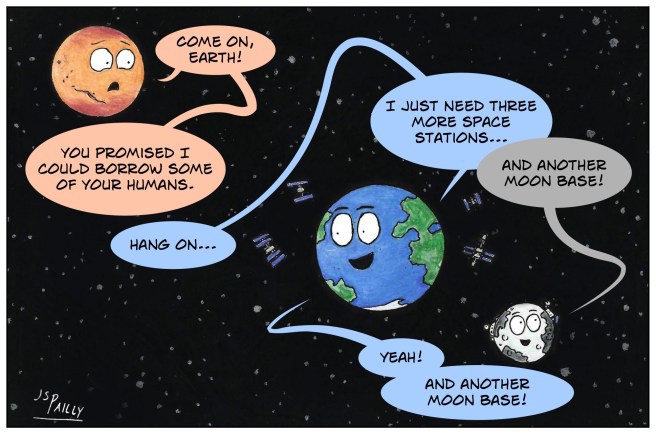
I won’t go through all the details of how Mars Direct is supposed to work (there’s a good reason Zubrin had to write a whole book about this); I’ll just cover the basics.

Launches would take place every twenty-six months, coinciding with the regular planetary alignments of Earth and Mars. Specifically, Zubrin advocates for launches during Earth/Mars conjunctions, when Earth and Mars are on opposite sides of the Sun. That may seem counterintuitive, but because of the math and the delta-v and the orbital mechanics and… you know what, let’s just say it’s because you end up using less fuel.

Once we get this plan started, the launch schedule would go as follows:

  • First Conjunction: A single, unmanned spacecraft heads to Mars. This will be used as the first Earth Return Vehicle (ERV-1) and it will spend the next twenty-six months making fuel for itself.
  • Second Conjunction: A pair of spacecraft head to Mars. One is another Earth Return Vehicle (ERV-2) and the other will carry a habitat module (HAB-1) and four astronauts (Expedition-1).
  • Third Conjunction: Expedition-1 returns to Earth aboard ERV-1, leaving HAB-1 and ERV-2 behind. Meanwhile HAB-2 and ERV-3 launch from Earth, along with the crew for Expedition-2.
  • Fourth Conjunction: Expedition-2 returns to Earth aboard ERV-2. HAB-1 and HAB-2, now connected together, are left behind. So is ERV-3. Meanwhile Expedition-3, HAB-3, and ERV-4 launch from Earth.

The cycle keeps going after that. With each expedition to Mars, the habitat complex grows a little bigger, laying the groundwork for full-scale colonization later on, and because of the way Earth Return Vehicles are staggered, each crew on Mars always has access to two ERVs, which seems like a wise precaution.

One of the key selling points for Mars Direct is that it’s cost-effective, at least in relative terms; it certainly costs a whole lot less than what was proposed in the 90-Day Report. Also, Mars Direct would only use currently available technology, so we could start doing this right now.

But for some reason, at least as far as I can tell, no government agency or private organization (aside from Zubrin’s own advocacy group, the Mars Society) has committed to Mars Direct. Oh yes, lots of people talk about it. Sometimes people borrow bits and pieces of the plan, but no one—not NASA, not Buzz Aldrin, not even Elon Musk—seems willing to adopt it in its entirety. And I’m not sure why.
Sciency Words: Moon

Today’s post is part of a special series here on Planet Pailly called Sciency Words. Each week, we take a closer look at an interesting science or science-related term to help us expand our scientific vocabularies together. Today’s term is:

MOON

There are three things I want to cover with today’s post. Firstly, for anyone who may not already know, Earth’s moon is officially called the Moon (with a capital M). Unless you don’t speak English, in which case it’s called whatever it’s called in your language, provided that you treat the word as a proper noun. This according to the International Astronomy Union (I.A.U.), the one and only organization with the authority to name and classify astronomical objects.

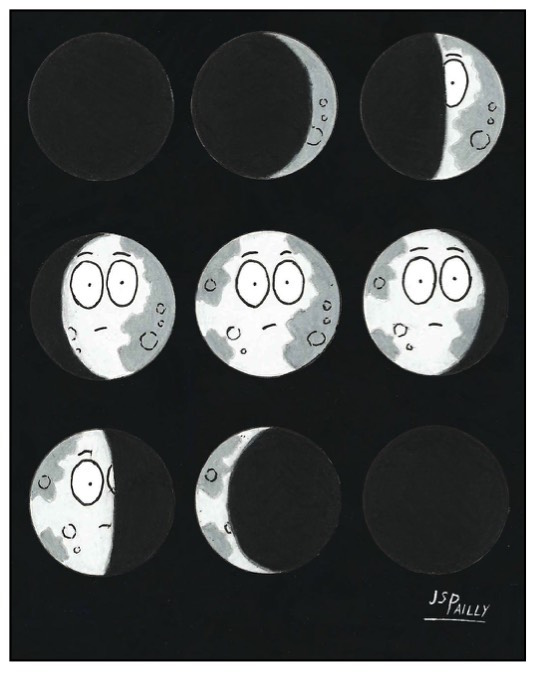
Phases of the Moon.

Of course the Moon is not the only moon out there, so I also want to talk a little about the official I.A.U. sanctioned definition of the word moon. Unfortunately there isn’t one, which seems odd given how the I.A.U. are such stickers about their official definition of the word planet.

A common unofficial definition is that a moon is any naturally occurring object orbiting a planet, dwarf planet, or other kind of minor planet (such as an asteroid or comet). Except this definition creates some problems:

Saturn has like a bazillion moons!

Since there’s no lower limit on size or mass, you could consider each and every fleck of ice in Saturn’s rings to be a moon.

The Moon isn’t a moon!

In a very technical sense, the Moon does not orbit the Earth. The Earth and Moon both orbit their combined center of mass, a point called a barycenter. In the case of the Earth-Moon system, the barycenter happens to lie deep inside the Earth, so this distinction may not seem important, but…

Pluto is Charon’s moon, and Charon is Pluto’s!

The barycenter of the Pluto-Charon system is a point in empty space between the two objects. Pluto is the larger of the pair, so we generally consider Charon to be Pluto’s moon; however, you could argue that Pluto and Charon are moons of each other. You could even write a love song about their relationship.

Of course I’m not seriously arguing that Saturn has billions upon billions of moons, nor am I arguing that our own Moon is not really a moon. There does seem to be some ambiguity about Charon’s status (is Charon a moon, or are Pluto and Charon binary dwarf planets?), but I’m not sure if this ambiguity has caused any real confusion in scientific discourse.

Still, as we learn more about moons in our own Solar System and also moons in other star systems, I think the I.A.U. will eventually have to come up with an official definition. And that brings me to the third and final thing I wanted to cover today: exomoons.

An exomoon would be defined as a moon (whatever that is) orbiting a planet or other planetary body outside our Solar System. Finding exoplanets is hard enough, so as you can imagine, searching for exomoons really stretches the limits of current telescope technology. But astronomers are trying, and next month (October, 2017) the Hubble Space Telescope will be making special observations of a planet named Kepler-1625b in an attempt to confirm a possible exomoon detection.

One Last Thing About the Eclipse

This hasn’t been much of a research week for me. I’m more focused on the fiction side of my writing at the moment, rather than the science stuff.

So today I’m just sharing some artwork, something I didn’t quite get done in time for the eclipse.

You know, we are kind of lucky that we have these total solar eclipses. By some amazing coincidence, our large Sun and small Moon appear to be the same size in Earth’s sky, allowing the Moon to perfectly cover up the Sun.

That doesn’t happen anywhere else in the Solar System. That perfect planet-moon-star alignment is likely rare, perhaps even unique in our galaxy. So whenever we make first contact with aliens, and they start bragging about their luminous forests or crystal waterfalls or whatever, we Earthlings will have a unique and beautiful thing to brag about to: we have total solar eclipses.

Eclipse Day 2017 and Hermione Granger

One of my favorite fictional characters—one of the characters I most strongly identify with—is Hermione Granger from the Harry Potter series. She’s depicted as extremely bookish, and at one point we’re told she’s nervous about flying because it’s “something you couldn’t learn by heart out of a book.”

Yup, that sounds like me. I’ve spent an enormous amount of time studying science, but almost everything I know comes out of books rather than from hands on experience.

And so as the Great American Eclipse of 2017 approached, I felt increasingly nervous, just like Hermione going out for her first flying lesson. I’d read a lot about the eclipse, done pretty thorough research about the kinds of glasses I’d need to buy, and yet… I still felt horribly unprepared.

To make matters worse, the eclipse glasses I’d ordered online seem to have gotten lost in the mail. On the day of the eclipse, they still hadn’t arrived. I had a backup plan, but I wasn’t sure if it was going to work. I’d read online that you can use a pair of binoculars to project an image of the Sun onto a piece of paper. Again, I’d read about this, but I’d never tried to do it, and I wasn’t 100% convinced this was going to work for me. Some of the instructions I’d read sounded kind of complicated.

And yet to me extraordinary delight, it worked! My hands were a bit shaky, but I was able to project the Sun onto a page of my sketchbook and watch as the Moon slowly moved across the image.

My hastily improvised eclipse observatory.

Watching the eclipse turned out to be a highly emotional experience for me. I’ve been going through some things in my personal life, and this was a powerful reminder that no matter what happens, the universe keeps turning. Also, I realized at one point that the binoculars I was using originally belonged to my Dad, so in a sense it was like I got to share the experience with him.

And lastly, for a Hermione Granger-type person like me, this was one of those rare moments when something I read about became real to me. Maybe it wasn’t as exhilarating as learning to fly on a broomstick, but still… Eclipse Day 2017 was a magical experience for me.

The Titan Mission That Could’ve Been

This is a follow-up to my recent post about NASA’s next flagship-class mission. There seemed to be a lot of interest in the comments about a possible mission to Titan and/or Enceladus, Saturn’s most famous moons.

The competition for flagship mission funding can get pretty intense. The Titan Saturn System Mission (or T.S.S.M.) was a strong contender last time around, as was a proposed mission to Europa, the most watery moon of Jupiter.

According to Titan Unveiled by Ralph Lorenz and Jacqueline Mitton, things got a little nasty when the Europa team started calling Titan “Callisto with weather,” the implication being that Titan was geologically boring.

Callisto, by the way, is a large by often overlooked moon of Jupiter.

Ultimately Team Europa won. NASA deemed their proposal to be closer to launch-readiness. Now after a few years delay due to a certain global financial meltdown, the Europa Clipper Mission appears to be on track for a 2022 launch date (fingers crossed).

As excited as I am for Europa Clipper, the mission to Titan would’ve been really cool too. It actually would have included three—possibly four—spacecraft.

  • A lake-lander to explore Titan’s liquid methane lakes.
  • A hot air balloon to explore the organic chemical fog surrounding Titan.
  • A Titan orbiter to observe Titan from space and also relay data from the lander and balloon back to Earth.
  • And a possible Enceladus orbiter, built by the European Space Agency, which would have tagged along for the ride to Saturn.

It’s a shame T.S.S.M. didn’t get the green light from NASA. Just think: we would’ve had so many cool things going on at once in the Saturn System, enough to almost rival the activity we’ve got going on on Mars!

But now once Europa Clipper is safely on its way (again, fingers crossed), Team Titan will have another shot at getting their mission off the ground.

Sciency Words: Tentacle

Today’s post is part of a special series here on Planet Pailly called Sciency Words. Each week, we take a closer look at an interesting science or science-related term to help us expand our scientific vocabularies together. Today’s term is:

TENTACLE

Believe it or not, octopuses do not have any tentacles. Zero. None. They have four pairs of arms, according to cephalopod experts.

When discussing cephalopod anatomy, arms are defined as shorter, more muscular appendages with suckers all the way along their length. Tentacles are longer and only have suckers at the “club-shaped” end. So octopuses have eight arms. Squid and cuttlefish have eight arms and two tentacles.

As a science fiction writer, I’ve created a few characters who have tentacles. Or at least, I think I have. But maybe my buddy Omglom here only has arms.

However, after doing further research I’ve found that this arms vs. tentacles thing is specific only to cephalopods. In a more generalized zoological sense, just about any boneless, flexible, elongated appendage can be referred to as a tentacle.

The word tentacle traces back to a Latin word meaning “to feel” or “to test” or “to probe.” This seems appropriate to me because in most cases tentacles aren’t really for grasping or manipulating objects. They’re sensory organs used for feeling, smelling, tasting, and even seeing (for example, the eyestalks of slugs and snails are considered to be tentacles).

There’s even a mammal with tentacles: the star-nosed mole, which has twenty-two tiny tentacles arranged in a star pattern around its snout. These tentacles are extremely sensitive feelers which help the star-nosed mole feel its way around as it burrows through the earth.

As for my friend Omglom… the gelatinoids of Rog aren’t cephalopods, so his tentacles can be called tentacles after all!

P.S.: It may sound strange, but the proper plural form of octopus is octopuses, not octopi. The cephalopod expert at the end of this video does an outstanding job explaining why.

NASA’s Next Flagship Mission

Let’s imagine you’re NASA. You have two big flagship-class missions coming up: one to search for life on Mars (launcing in 2020) and another to search for life on Europa (launching in 2022). These flagship missions are big, expensive projects, so Congress only lets you do one or two per decade.

After 2022, the next flagship mission probably won’t launch until the late 2020’s or early 2030’s, but still… now is the time for you to start thinking about it. So after Mars and Europa, where do you want to go next? Here are a few ideas currently floating around:

  • Orbiting Enceladus: If you want to keep looking for life in the Solar System, Enceladus (a moon of Saturn) is a good pick. It’s got an ocean of liquid water beneath it surface, and thanks to the geysers in the southern hemisphere, Enceladus is rather conveniently spraying samples into space for your orbiter to collect.
  • Splash Down on Titan: If there’s life on Titan (another moon of Saturn), it’ll be very different from life we’re familiar with here on Earth. But the organic chemicals are there in abundance, and it would be interesting to splash down in one of Titan’s lakes of liquid methane. If we built a submersible probe, we could even go see if anything’s swimming around in the methane-y depths.
  • Another Mars Rover: Yes, we have multiple orbiters and rovers exploring Mars already, but some of that equipment is getting pretty old and will need to be replaced soon. If we’re serious about sending humans to Mars, it’s important to keep the current Mars program going so we know what we’re getting ourselves into.
  • Landing on Venus: Given the high temperature and pressure on Venus, this is a mission that won’t last long—a few days tops—but Venus is surprisingly similar to Earth in many ways. Comparing and contrasting the two planets taught us how important Earth’s ozone layer is and just what can happen if a global greenhouse effect get’s out of control. Who knows what else Venus might teach us about our home?
  • Orbiting Uranus: This was high on NASA’s list of priorities at the beginning of the 2010’s, and it’s expected to rank highly again in the 2020’s. We know next to nothing about Uranus or Neptune, the ice giants of our Solar System. Given how many ice giants we’ve discovered orbiting other stars, it would be nice if we could learn more about the ones in our backyard.
  • Orbiting Neptune: Uranus is significantly closer to Earth than Neptune, but there’s an upcoming planetary alignment in the 2030’s that could make Neptune a less expensive, more fuel-efficient choice. As an added bonus, we’d also get to visit Triton, a Pluto-like object that Neptune sort of kidnapped and made into a moon.

If it were up to me, I know which one of these missions I’d pick. But today we’re imagining that you are NASA. Realistically Congress will only agree to pay for one or two of these planetary science missions in the coming decade. So what would be your first and second choices?

Going Up: Jupiter’s Auroras Get Weirder Than Ever

Last week, the Juno mission flew over Jupiter’s Great Red Spot and sent back some spectacular close-ups. But I’m not ready to talk about that. Not yet. I’m still catching up on the Juno news from two months ago.

Toward the end of May, NASA released a ton of fresh data from Juno, including new information about Jupiter’s auroras. Astro-scientists had previously known about two sources contributing to these auroras: the solar wind and the Io plasma torus. Now Juno may have discovered a third.

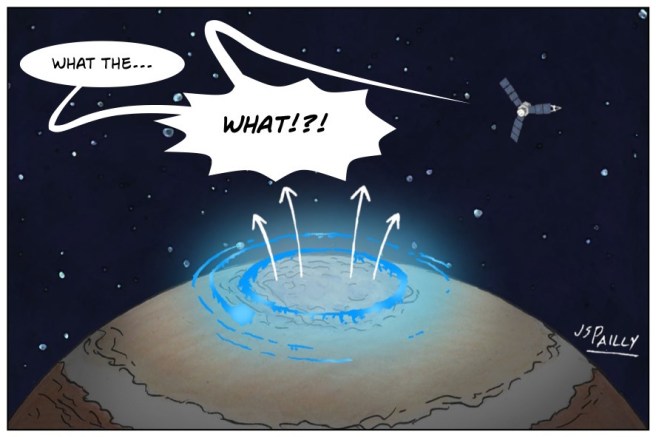
As Juno flew over Jupiter’s poles, it detected electrically charged particles flying up.

I can’t emphasize enough how weird this is. I wanted to write about it right away, but I held off doing this post because I was sure I must have misunderstood what I was reading.

Auroras are caused by electrically charged particles accelerated down toward a planet’s magnetic poles. These particles ram into the atmosphere at high speed, causing atmospheric gases to luminesce. At least that’s how it’s supposed to work. I guess nobody told Jupiter that.

In addition to the “normal” downward flow of particles from the Sun and Io, Jupiter’s magnetic field apparently dredges charged particles up from the planet’s interior and hurls them out into space. So Jupiter’s auroras are triggered by a mix of incoming and outgoing particles.

This definitely falls under the category of “further research is required.” Even now, I still feel like I must have misunderstood something. This is just too weird and too awesome to be true.

P.S.: As for the Great Red Spot, I’m waiting to hear something about the microwave data. We’re going to find out—finally!—just how far down that storm goes.

Io: Jupiter’s Ugliest Moon

For today’s post, I hopped in my imaginary spaceship and flew all the way out to Io, one of Jupiter’s moons. Without a doubt, Io is the ugliest object in the Solar System.

I know, that’s mean. I shouldn’t say things like that. But come on, just look at it. Seriously, look at it. It’s like some moldy horror you might find in the back of the fridge.

So yeah, Io’s hideous. Let’s go look at something else instead. Something pretty, like Jupiter’s auroras.

We have auroras back on Earth, of course, but Jupiter’s are a whole lot bigger, a whole lot more powerful, and when viewed in ultraviolet, a whole lot brighter. Also, unlike Earth’s auroral lights which come and go, Jupiter’s are always there. They may vary in intensity, but they never stop, never go away.

Auroras are caused by charged particles getting caught in a planet’s magnetic field, directed toward the magnetic poles, and colliding at high speed with molecules in the planet’s atmosphere.

On Earth, those charged particles come mostly from the Sun in the form of solar wind. No doubt the solar wind contributes to Jupiter’s auroras as well, but the greater contributing factor is actually—believe it or not—Io. That’s right: ugly, little Io causes Jupiter’s auroras. I guess spreading ionized sulfur all over the place is good for something after all!

In fact if you ever get to see a Jovian aurora, you’ll notice little knots in the dancing ribbons of light. These knots correspond to the positions of several of Jupiter’s moons. And the largest, brightest, most impressive of these knots… that one belongs to Io.

Jupiter.Aurora.HST.mod.svg
Image courtesy of Wikipedia.

So I guess today’s lesson is that even the ugliest object in the Solar System can still help make the universe a more beautiful place.

Meet the Oddball Planets

The planet Uranus is often called the oddball of the Solar System because it’s tipped over sideways.

Uranus’s axis of rotation is tilted approximately 98° relative to its orbital path around the Sun, but Uranus isn’t the only planetary body with an “odd” axial tilt.

Just recently, we learned that Enceladus, one of Saturn’s icy moons, may have been knocked on its side by an asteroid impact at some point in its history. If that’s true, Enceladus has since reoriented itself. Being sideways was only a temporary thing in that case.

But then there’s Pluto. Pluto is also tipped on its side, as is Charon, Pluto’s largest moon.

In fact with an axial tilt of 122° relative to their orbital path around the Sun, you could argue that the Pluto/Charon pair is almost upside down.

Which brings us to Venus. Venus’s axial tilt can be defined in two different ways. You could say Venus is rotating backwards, clockwise where the other planets rotate counterclockwise, with a modest axial tilt of about 3°. But it’s equally valid to say Venus’s rotation is normal (i.e.: counterclockwise) but that the planet is flipped upside down, with its axis of rotation tilted 177°.

Of course there’s really no such thing as up, down, or sideways in space. Directions are relative to your point of view. The planets simply are the way they are, a result of each planet having its own unique history, without regard for what we humans might consider “normal.”

Maybe we should keep that in mind before we start labeling planets oddballs.