Improbable Planets

A lot of people want to tell us what is or is not possible.  Okay, I admit traveling faster than the speed of light is impossible.  Knowing a subatomic particle’s exact position and momentum at any given time—that’s impossible.  But most other things in science fiction are merely improbable.

The Kepler Space Telescope recently sighted six new planets orbiting a yellow dwarf star.  The Kepler Mission, discussed in a previous post (click here), is looking for planets in a region near the constellation Cygnus.  The discovery of six planets is good progress.  The discovery of six planets in one star system is exciting.  The discovery of planets orbiting so close together is impossible improbable.
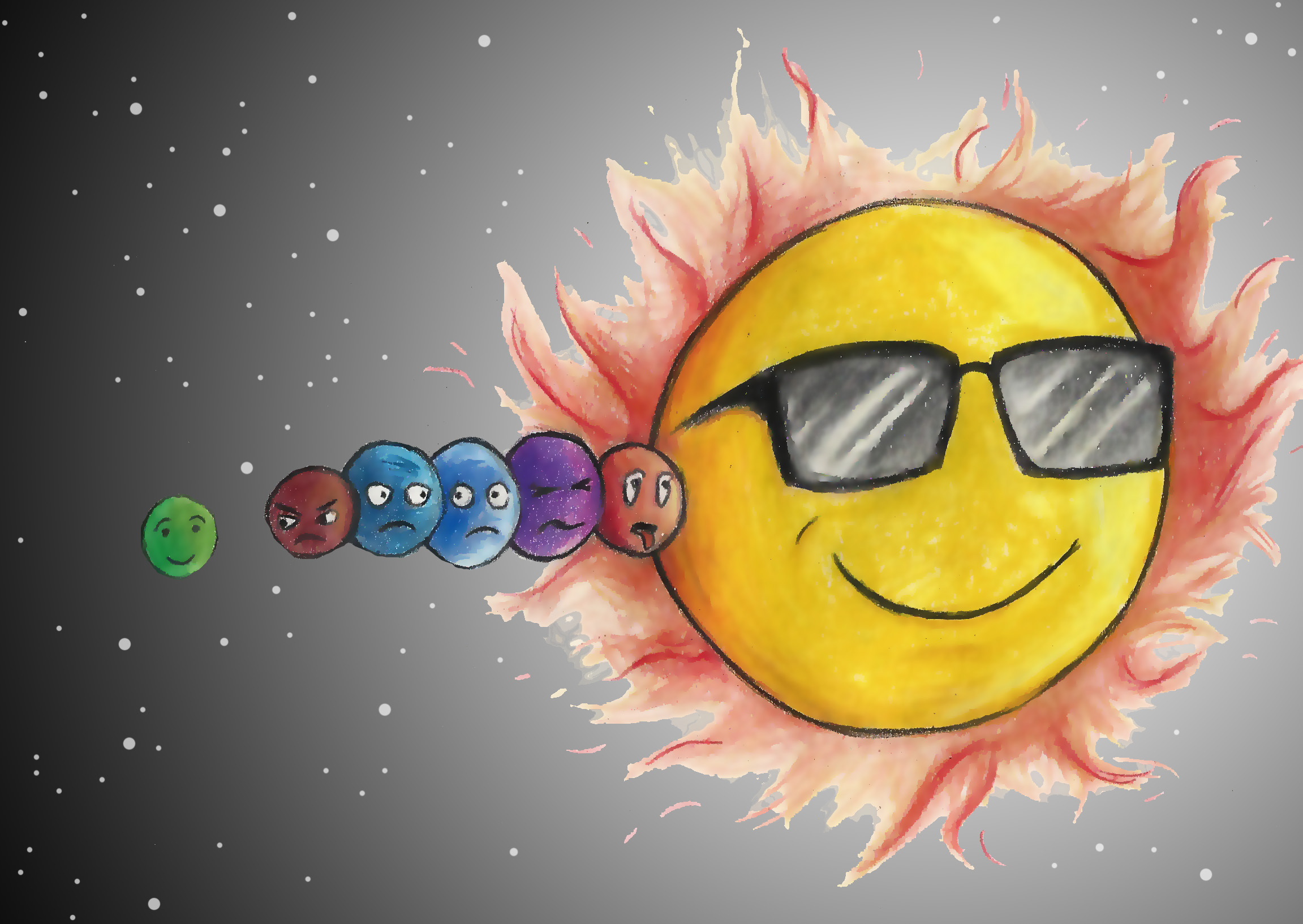
Kepler 11 and its planets (sizes and distances not to scale).

As illustrated in the cartoon above, five of these newly found planets are uncomfortably close together.  And they’re orbiting way too close to their parent star—closer than Mercury is to our Sun.  Only the sixth planet is traveling in what we’d call a normal orbit.  So much for the Titius-Bode Law.

Of course in science, everything must be checked and double checked, and then as we develop better technology and learn more about the universe, we’ll have to check our data yet again.  These six planets may not be as close together as we currently believe… or they may be closer.

The point is in science there are too many things we don’t know.  Even things we think we know might be wrong.  Science fiction writers have a duty to remind us that in this complex, beautiful universe anything is possible.  Except traveling faster than light.

For more information on Kepler 11 and its planets (and a more “accurate” illustration of the Kepler 11 star system), click here.

P.S.: What do you think is impossible improbable?

A Star Named Molly

Generally, research makes a story better.  Sometimes, however, it destroys a story completely.  For a long time, I’ve wanted to write an epic space opera that takes place in a star system named Molly.  Somewhere between gratuitous space battles, someone asks why it’s called that, and the answer turns out to be that hundreds of years earlier someone paid to name a star after his girlfriend.

We’ve all heard of those star naming services, but according to my research they’re all frauds.  Only the International Astronomical Union (IAU) has the authority to name a star, and they usually assign names based on a star’s position and apparent brightness.  Some stars have names, like Sirius or Betelgeuse, but that’s because they were well known long before the IAU came along.

I don’t believe in facts getting in the way of a good story­—otherwise I would have given up on science fiction a long time ago—but this one bothers me so much I don’t want to use it.  I still think the idea of an epic space opera in the Molly System is funny, but I don’t want to legitimize the star naming scam.

If you want to read more about the IAU and their stance on buying star names, click here.

P.S.: I apologize to Molly.  I’m sure your boyfriend had the best of intentions.

Theory of Everything

Last week, I wrote about how scientists eventually solved the mystery of the Moon’s origins.  They took several theories, each with evidence for and against it, and combined them into the Giant Impact Theory.  Click here for last week’s post.

Today, scientists are struggling with an even bigger puzzle.  How do we reconcile general relativity with quantum mechanics?  Evidence supports them both.  Relativity works great with really big objects, like planets and stars; quantum mechanics works well for small things like electrons and quarks.

Although there isn’t much experimental data to support it, String Theory is the best guess we have.  It tells us the universe has more than three spatial dimensions, but all those extra dimensions are too small to easily observe.  Subatomic particles are one-dimensional strings, which means…

Okay, to be honest I don’t understand String Theory.  I’m not a real scientist, just a science enthusiast, and reading about one-dimensional strings in a ten-dimensional universe hurts my brain.  The problem is there are so many versions of String Theory, each of which only solve a part of this complex puzzle.

The universe is such a strange place.  Sometimes I wonder if there are things human beings can never understand.  The so-called Theory of Everything, I believe, is not one of them.  Much like the origin of the Moon, this is a puzzle we can solve.  We’ve already put some of the pieces together­—the various versions of String Theory—we just need a clever scientist to figure out how those pieces connect.

P.S.: I forgot to add a sci-fi tie-in.  In Xenocide by Orson Scott Card, some clever scientists use something like String Theory to prove human beings have souls.  This is why I prefer science fiction, because real science will never do that.

Theory of the Moon

The Moon.  It’s right there.  You don’t even need binoculars to see it, yet we know very little about it.  We’re not even sure where it came from.  Until the 1980’s, there were three popular hypotheses about the Moon’s origins:

  • The Sister Hypothesis: Earth and the Moon formed at the same time from the same material, making them siblings.
  • The Daughter Hypothesis: The Moon broke off of the Earth at some point.  One 19th Century scientist said the Pacific Ocean formed where the Moon used to be.
  • The Wife Hypothesis: The Moon formed elsewhere, perhaps as another planet.  It got caught in the Earth’s gravity, and the two have been together ever since.

All these hypotheses sound plausible, but none of them are correct.  Following the Apollo Missions, we learned that the Earth and the Moon have eerily similar compositions, supporting the Sister or Daughter Hypotheses, but the Moon has significantly less iron, supporting the Wife Hypothesis.

Today, Selenologists (Moon scientists) have combined the three old theories.  They believe that a large object from somewhere else did approach the young Earth (Wife), but instead of entering orbit the two collided.  The impact spewed matter into space (Daughter), and the Moon formed alongside a new, smaller Earth (Sister).

If the object that hit Earth had a lot of iron, that would explain the discrepancy between Earth and the Moon’s iron content.  Also, the Moon is slowly moving away from us, which makes sense if it’s made of material that once spewed into space.

The Giant Impact Hypothesis is not perfect, but it is the best explanation we have for the existence of our unusual moon.  I should mention that no other planet in the Solar System has such a large moon in relation to its own size, a fact that helped historians in Isaac Asimov’s Foundation novels identify the long lost home world of humanity.

Next week, I’ll explain why I think the Giant Impact Hypothesis is similar to String Theory.

Utopia in Washington D.C.

Earlier this week, I posted a joke about congressmen on Twitter.  At the time, I didn’t know about the shooting in Arizona, and I have since removed the joke.  It was in poor taste given the circumstances.

While flipping through various cable news stations, I heard a lot of commentators asking if we should do something to change the adversarial tone in politics.  I guess the shooter had some problem with Democrats, since the congresswoman who was shot is a Democrat.

Many of the talking heads on TV said politicians should stop calling each other evil, communists, Nazis, racists, etc.  The same talking heads would then blame the Democrats/Republicans for starting it, and I would facepalm.

As a science fiction writer, it’s my job to imagine what the world would be like if X happened.  I wish our politicians would spend less time criticizing each other and more time fixing actual problems.  But what if it really happened?  A world without political criticism?  Would that be a utopia or a dystopia?

P.S.: Here is the Twitter comment I mentioned in the beginning.  Of course, I don’t think it’s funny anymore.  “I just had a terrible idea for a super hero: The Adventures of Congress Man.”

Where’s My Flying Car?

We’re now a decade into the 21st Century, and I still don’t have a flying car.  Also, we haven’t found the alien monolith on the Moon—which was supposed to happen back in 2001.  Electronic reading devices are starting to catch on, and most people own their own computers, but we still have a lot of catching up to do.

Blade Runner is set in 2019, and some of the events of Back to the Future, Part II take place in 2015 (I’m telling you, we’ve got to het working on those flying cars or Doc Brown is going to be very upset).  Also, Skynet and the Terminators will turn on us by the end of the decade, leading to a long, bloody conflict with the machines.

The good news is that once the Terminator Wars are over, Zefram Cochrane will invent warp drive and make first contact with the Vulcans.  Furthermore, the Jetsons is set somewhere near the end of the 21st Century—so we’re sure to have flying cars by then.

Someone told me our medical technology is going to become so advanced that I should live to be 150 to 200 years old (I’m almost 30 right now).  So I have the 22nd Century to look forward to as well!

We still have about 90% of the 21st Century ahead of us.  What are you looking forward to?

The Biggest Science News of 2010: #1

Long ago, if you didn’t have the blessing of the Church to do something, it probably wouldn’t get done.  Later, you had to go to the king.  Today, if you have a difficult project, you need the help of a corporation.  Like it or not, we live in the era of capitalism.

Earlier this year, President Obama decided NASA should rely more on the private sector.  As you may have heard, there’s a recession going on, and the government is in debt, so a lot of government agencies are being asked (politely, I’m sure) to cut spending.

At first, I didn’t like this idea.  I pictured astronauts wearing spacesuits that looked like NASCAR jackets raising the flag of Coca Cola on Mars.  But maybe private companies are better qualified to lead us into space; they do almost everything else for us.

On December 8th, Space X (Space Exploration Technologies Corp.) launched one of its Dragon capsules into orbit and successfully returned it to Earth, splashing down in the Pacific Ocean.  This was a test flight with no crew in the capsule, but soon Space X hopes to ferry astronauts to and from the International Space Station.  They already have a contract to deliver cargo.

For good or evil, Corporate America will take the next great step for Man into outer space.  That’s why I’m choosing the changes at NASA as the #1 science story of the year.  Whatever happens next will be great material for science fiction.

Click here for #2.

Click here for #3.

The Biggest Science News of 2010: #2

The human race depends on one thing for its energy.  Our technology has been pushed to the limit in order to get it.  And then there was an accident.  The consequences were devastating.  The BP oil spill could have been a sci-fi disaster story.

I’m choosing it as the second biggest science story of the year not only because of the impact on the environment and culture of the gulf coast, but also because we learned a lot about how the government handles (or fails to handle) a science related crisis.

There are a lot of books out now on how the oil spill happened and how BP and the US government responded.  This is a research opportunity for science fiction writers, because if something goes wrong at the antimatter factory, or if an alien virus escapes the lab, or if any other huge science experiment gets out of control, I bet whoever is in charge will make some of the same mistakes.

The Biggest Science News of 2010: #3

We’re counting down the three biggest science stories of the year, based not only on how they impact science but how they can be used in science fiction.  These choices are, of course, only my opinion and I welcome comments from anyone who disagrees.

In the beginning of December, NASA teased us with promises of a press conference on astrobiology.  It turned out they’d discovered some new bacteria in California that use arsenic (instead of phosphorus) as a nutrient.

Following the announcement, questions quickly arose about these bacteria.  Did they actually incorporate arsenic into their biochemistry, or did they simply survive on what little phosphorus they could get?  Further research is required.

Despite concerns about the validity of this discovery, the “arsenic eaters” show that alternative biologies are possible.  No one seems to disagree that some organism somewhere could replace phosphorus with arsenic; they only doubt whether or not this particular species has done so.  That’s good to know if you’re a science fiction writer.  Maybe there are arsenic-based aliens.  And if that’s possible, than silicon-based life could exist as well.