Do You Believe in Spider-Man?

For years, science know-it-alls laughed at Spider-Man because, of course, real spiders produce silk in their abdomens, not their hands.  Most insects and arachnids use tiny hooks or sticky pads on their feet to climb walls; they don’t cling to things using silk.  At least, that’s what we used to think.

Now studies are showing that tarantulas, being too big to hold themselves to walls with tiny claws alone, actually do produce silk in the tips of their feet.  A small amount of silk keeps them secure, even if the surface they’re climbing begins to shake, and traces of that silk remain after they’ve moved on.

I’m surprised we went so long without discovering this.  It’s not like tarantulas are some exotic, new creature just discovered in the depths of the rainforest; people have kept them as pets for decades!  Apparently those traces of silk were found earlier, but scientists at the time assumed the tarantula produced them in its abdomen and attached the material to its feet as it climbed.  Another example of the danger in making assumptions.

Of course science fiction often predicts major discoveries well before actual science has a clue.  Spider-Man is now entirely plausible.  Well, the radioactive spider bite is still kinda silly, but at least science backs up some of his powers.

For more information on tarantula’s and their amazing feet, click here.  There is also conflicting evidence, which may prove tarantulas don’t produce silk from their feet after all.  For that, click here.
Why Should You Read Science Fiction?

Someone once told me that people who read romance novels are better lovers.  Supposedly there’s a study to prove this.  Also, people who read mysteries have a stronger sense of right and wrong.  I suppose that makes sense.  We learn a lot from what we read.  So what does science fiction teach us?

Most people have a stereotype in their heads about Sci-Fi fans.  We’re supposed to be a bunch of overweight, pimply nerds living in our parents’ basements.  We have poor social skills, we can’t get girlfriends, and naturally, we all wear thick glasses.  Why would anyone read science fiction when it turns you into that?

Well, I say it’s a risk worth taking.

For one thing, science fiction gives us a sense of wonder.  The universe is huge and complicated, and really anything is possible.  Even right here on Earth there are so many things we don’t understand.  And with that wonder comes a sense of respect for nature, from the tiniest atom to the largest galactic cluster, and every organism in between.

Science fiction also teaches us to be optimistic.  Almost every story insists that, no matter how bad things are today (and sometimes things today do seem pretty bad), the human race does have a future.  Somehow or other, we’re going to make it, and we might get flying cars!

So go read a science fiction book.  Yeah, you might have to move into your parents’ basement, but at least you’ll know the universe is really interesting.

P.S. I said we can’t get girlfriends because, obviously, girls don’t like science fiction.  Click here if you believe that.

Sci Friday

Here are this week’s sciency links.
STS-135: Final Launch of the Space Shuttle Program from NASA on YouTube. This is the video of the final launch of Space Shuttle Atlantis.
Pitching Plastic for Good from CNN. New technology could allow us to recycle 100% of our plastic.
An Alien Encounter 20 Years Away? From Big Think.
Space X’s Next Launch Will Carry NASA Solar Sail Experiment from Wired Science.
Dawn of a New Age: The First Person to Reach 150 is Already Alive… And Soon We’ll Live to be a THOUSAND, Claims Scientist from The Daily Mail.
The Four Ways We Kill Ourselves from Living to 150.

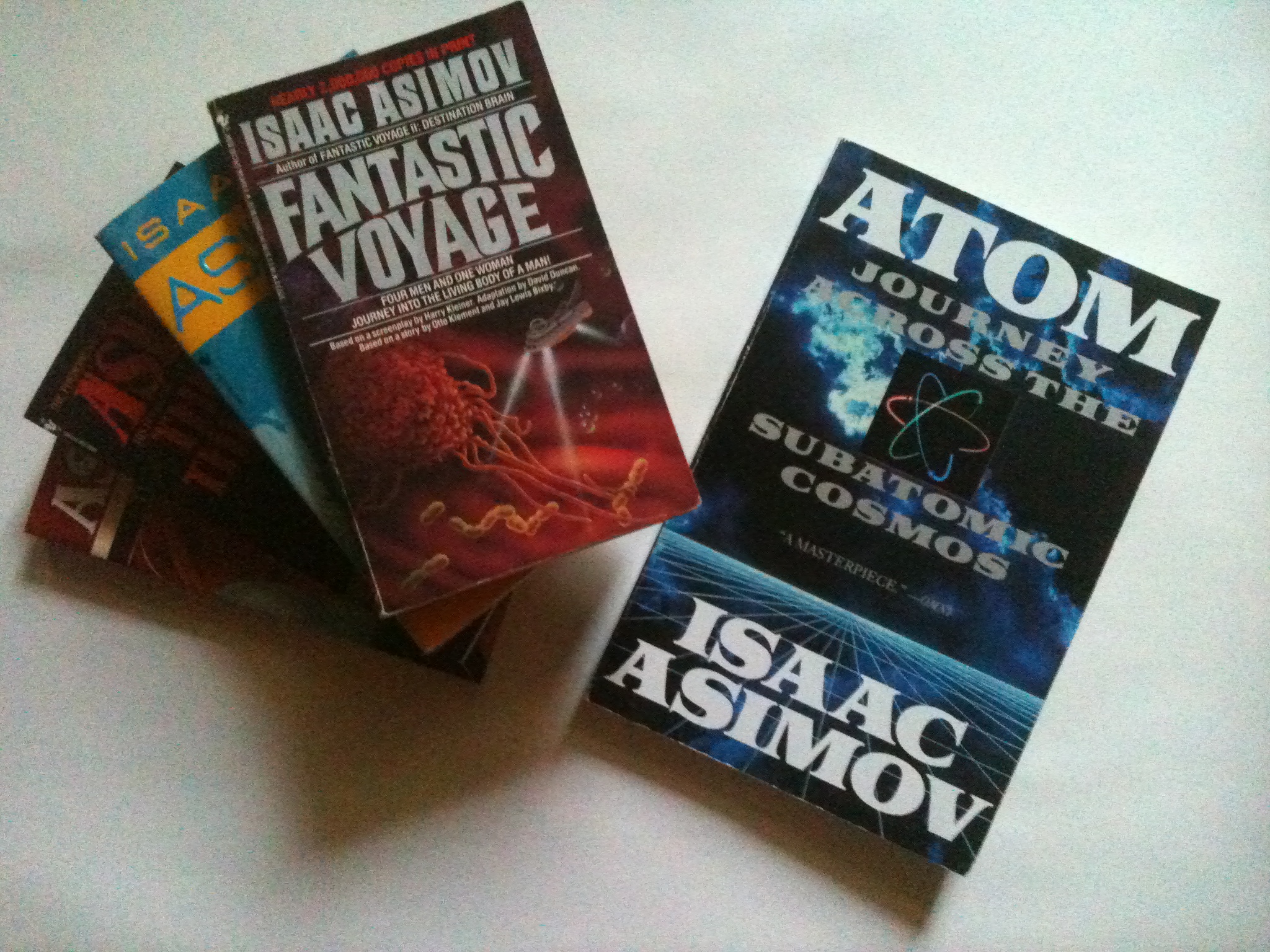
Book Review: Atom: Journey Across the Subatomic Cosmos

If you’re like me, you took some science courses in high school or college because you had to but didn’t learn much.  But you like science fiction, or maybe you just like those sciency documentaries on the Discovery Channel, and you feel a little overwhelmed by how complicated science really is.  If so, Isaac Asimov’s Atom: Journey Across the Subatomic Cosmos is the book for you.

Isaac Asimov is better known amongst us Sci Fi folk for writing I, Robot, Fantastic Voyage, and the Foundation novels.  But he also wrote many books on science (without fiction).  Originally published in 1992, Atom lays out the history of atomic theory starting with the ancient Greeks and quickly moving on to the late 19th and early 20th Centuries, when most of the critical theories about atoms were made.

I always like science presented as history because it shows how one discovery leads to another, giving the reader a much clearer understanding of why science is the way it is today.  There were two basic discoveries: first, the discovery that matter is made of small, indivisible particles called atoms, and second that those indivisible particles are actually divisible.  They’re made of protons and neutrons with a cloud of electrons around them, all held together by tremendous amounts of energy.  And those protons and neutrons—they can be broken into smaller particles too, which is where things get weird.

Some of this stuff will seem familiar, coming from half-remembered science classes.  Some will be entirely new to you, but Asimov has a way of making complicated concepts easy to understand (even the weirdness).  It’s a gift he probably learned writing so many great science fiction stories and novels.

This book gave me a better understanding what atoms are and how they work.  Because of Asimov’s clear writing style, it helped me understand the difference between nuclear fission and fusion, why antimatter exists, and what the Pauli exclusion principal is and why it’s important.  Understanding atoms makes a lot of things easier to understand; after all, everything is made of them.

One warning: Asimov makes some interesting predictions about future discoveries.  For example, he says elements 110 and 114, which had not yet been discovered in 1992, might be stable.  They are not.  Most of his predictions turned out to be incorrect, so don’t rely on them.  Otherwise this is a great way to start the science education you didn’t get in school, and after reading it you’ll find you understand a lot more of what they’re talking about on those sciency Discovery Channel shows.

Click here to see this book on Amazon!

Sci Friday

Here’s this week’s sciency links!

So You Think the Weather’s Bad?

We all complain about the weather sometimes.  It’s too hot, too cold, too rainy, not rainy enough.  Then you read Dune.  In Dune, the weather is always hot, it never rains, and they get these ridiculous sand storms with winds over 800 kilometers per hour (500 miles per hour).  At that speed, the sand will tear apart metal and strip the skin off your bones.

On Earth, we have many different types of climate, from arid deserts to tropical rainforests.  Arrakis, the fictional planet where most of Dune takes place, has only one climate (two if you count the polar ice caps).  It is pure, uninterrupted desert.  This creates a whole lot of dangers, including those ridiculous sand storms I mentioned.

But Dune’s a science fiction novel, and the whole thing is made up.  That’s reassuring, but there’s a real planet not too far from here that at times has Arrakis-like weather.  Below are two pictures of Mars.  One is on a clear, sunny day; the other is a day back in 2001 when a sandstorm blanketed the entire planet.

A Global Dust Storm on Mars
Source: Hubblesite.org
Mars, like Arrakis, has only one climate (again, not counting the ice caps).  Therefore, there’s nothing to stop a sandstorm from spreading.  It can grow and grow as much as it wants, sweeping over everything, leaving no place to hide.

As much as I want to live on Mars, there are some things about it that are really scary.  This is one of them.  Let’s all be thankful Earth has the proper balance to make life not only possible but relatively comfortable.

Click here for more info on 2001’s global sand storm on Mars.

Sci Friday

This week’s sciency links.

Can You See My Doppler?

If you’re like me, you want to visit another planet someday.  Hopefully, someday you will.  In the meantime, there’s a video game called Mass Effect, which is probably the most scientifically accurate video game ever made.  Playing it, you almost feel like your living in an intergalactic society, landing on strange, alien planets, meeting strange, alien people.

It’s the sciency details that make this game seem so real.  You need elements like iridium and palladium to upgrade your weapons; I don’t remember anyone referencing iridium or palladium in a video game before.  And of course there’s the popular quote in reference to the laws of motion: “Sir Isaac Newton is the deadliest son-of-a-bitch in space!”

One of my favorite details is the presentation of the Doppler effect in faster than light travel.  Light waves coming from a ship will be stretched or compressed depending on whether it’s moving away from you or coming towards you, just as the sound of a train or ambulance is distorted when its moving away or towards you.  As light waves stretch, the color we see shifts towards red; compressed light shifts towards blue.

So a spaceship traveling faster than light will look blue to people ahead of it and red to people behind.  Actually, these color shifts would be much more than just red and blue; they’d go beyond infrared and ultraviolet, so a spaceship traveling faster than light is effectively invisible (a fact the game does mention at some point).

Scientists already use the red or blue shifts of other galaxies to determine their movement.  The degree of shifting even tells us how quickly those galaxies are moving relative to our own.  I don’t remember any other work of science fiction addressing the red/blue shifts of spacecraft, which is why—from a purely sciency point of view—Mass Effect is a really cool game.

* * *

P.S.: If my little discussion on the scientific accuracy of Mass Effect doesn’t persuade you to buy it, than maybe this trailer will.  Mass Effect 3 comes out in March, 2012.

Mysteries of Mercury

The MESSENGER Probe has been in orbit of Mercury for about three months now, and its already unraveling some of the tiny planet’s biggest mysteries.  Just getting a probe to Mercury was a challenge, due to the proximity of the Sun, so until now we’ve had surprisingly little information about that particular planet.

Some of the things MESSENGER is investigating include Murcury’s volcanic activity, its magnetic field, and the possibility that, deep within some of its craters, there might be water ice.  In the spirit of science fiction, here are some other things it might find.

  • In addition to water at the bottom of those craters, perhaps there are tunnel entrances leading to a labyrinth of underground caves where alien life could exist.
  • Evidence that Mercury is not a planet but an abandoned, Death-Star-like spaceship.
  • Analysis of the surface reveals that it is Mercury, not the Moon, that is made of cheese.  Unfortunately, because of the heat generated by the Sun, the cheese is overcooked and completely inedible.

What are your theories?  What do you think we might find on Mercury?