Don’t Try This at Home

So here’s a fun fact.  If you close your eyes and hold a radioactive substance up to your eyelid, you’ll see tiny flashes of light.  Pretty cool, huh?  According to Uncertainty, a book about the history of quantum mechanics, Pierre and Marie Curie were the first to observe this phenomenon, using a previously undiscovered element that they named radium.

These flashes of light, along with other experiments and observations, helped the Curies figure out what exactly radiation is and why it happens.  By studying and handling radioactive substances, the Curies also helped us determine the true structure of the atom, with its tightly packed nucleus and cloud of surrounding electrons.

They eventually won the Nobel Prize for their work, but their achievement came with a price.  Marie died from radiation exposure, and Pierre probably would have too if he hadn’t died in a street accident first.  It’s thanks in part to the Curies that we now know how dangerous radiation can be.  So don’t try this at home!

Do Phasers Recoil?

You’re probably familiar with Newton’s third law of motion: every action has an equal and opposite reaction.  This is evident in firearms.  Whenever a bullet is propelled forward, the weapon recoils backward.  But what about those futuristic energy weapons you see in science fiction?  The blasters in Star Wars appear to recoil; the phasers on Star Trek do not.  Which is more realistic?

While the kind of energy weapon we see in science fiction is far beyond our current technology, several other Sci-Fi-like weapons do already exist or are in development.  Take for example the railgun.  Rather than use a chemical explosion like gunpowder or a mechanical force like a spring or hammer to fire a projectile, railguns use high powered magnetic fields to accelerate a metal slug to an enormous speed.  By the time that slug exits the barrel of the gun, it’s traveling so fast it can shoot straight through solid concrete walls.

But even though railguns don’t experience the same mechanical recoil as traditional firearms, they do experience recoil of a different kind.  Think about what happens when you try to press two refrigerator magnets together.  They push against each other.  The magnets inside a railgun are exponentially more powerful than the ones on your refrigerator, so the forces at work are much stronger.  Also, depending on how the magnets are arranged inside the gun, the magnetic recoil tends to push outward rather than to cause the gun to kickback.

It’s amazing this magnetic recoil doesn’t cause railguns to explode, flinging shrapnel in all directions with that same devastating force that punches holes in concrete walls.  According to Tom Boucher, the Navy’s test director for their experimental railguns, despite the extremely sturdy design on the Navy’s railgun prototype “… if we don’t carefully manage [the current in the railgun], it will still come apart.  We have huge amounts of forces we’re dealing with here.”

So should phasers and other futuristic energy weapons have recoil?  I’d say yes, but not necessarily in the same way as a Colt .45 or an AK-47.  Perhaps they have magnetic recoil, like a railgun.  Or perhaps, if the weapon uses an energy source beyond our modern science, the recoil manifests itself in some other way that science has yet to understand.  But however phasers and blasters and other Sci-Fi weapons are supposed to work, they must still obey Newton’s third law.

Links:

Click here for more from Tom Boucher and a demonstration of the U.S. Navy’s railgun prototype on YouTube.

Click here for “Recoil in Electromagnetic Railguns,” a scientific article from the Third Symposium on Electromagnetic Launch Technology.

The Office of Planetary Protection

I have said before that one day science fiction won’t be science fiction anymore; it will just be fiction.  To some degree, we already live in a sci-fi world.  Look at all the diseases we can now cure, or look at the International Space Station, or just look at everything our cell phones can do.  Today, we’re going to take a look at something else that may sound like science fiction but is in fact 100% real: the Office of Planetary Protection.

The Office of Planetary Protection is sort of like the Environmental Protection Agency for the Solar System.  Its job is to ensure that NASA doesn’t violate the Outer Space Treaty of 1967, which stipulates among other things that any probe sent to another planet must not contaminate that planet with Earth-born bacteria.  The point of this is not only to protect alien ecosystems (if they exist) but also to ensure that if we do discover life on another planet, we can be certain it’s genuine alien life and not something that stowed away on one of our own space vehicles.

Take Mars as an example.  While it’s clear there isn’t anything like deer or grizzly bears on Mars, or even anything as small as a mouse or insect, there could be native Martian bacteria.  These microscopic organisms might live in areas like Newton Crater, where scientists have observed what appears to be liquid water seeping through the soil.  This water might be enough to support an entire ecosystem of microorganisms.

The Planetary Protection Office has another job as well: protecting us from any life forms that might threaten our own ecosystem.  Many nations, including the United States, are planning “sample return missions,” meaning they want to send a spacecraft to another world, have it collect samples, and send those samples back to Earth for further analysis in a laboratory.  Obviously we want to avoid an outbreak of alien bacteria similar to what happened in Michael Crichton’s The Andromeda Strain.  The Planetary Protection Office will make sure that doesn’t happen.

But just as the EPA is the source of a lot of controversy, so too is the Office of Planetary Protection.  Some scientists complain that planetary protection rules are making space exploration prohibitively expensive.  Sending a probe to Mars is costly enough without having to pay so much extra to sterilize every single delicate, mechanical component.  Given the current state of the economy and the current state of NASA’s budget, some say we shouldn’t waste money protecting alien ecosystems that might not even exist.  There are also questions about how effective the Planetary Protection Office really is given the fact that some of the Curiosity rover’s tools may have been contaminated before its launch in 2011.

Dr. Catharine Conley, the person currently in charge of NASA’s Planetary Protection Office, at least has a sense of humor about her work.  She owns a pair of Ray-Ban sunglasses, just like Will Smith from Men in Black.  She got them as a gift her first day on the job.  Despite the controversies, I feel safer knowing she’s there, keeping planet Earth safe from alien bacteria and keeping the alien bacteria safe from us.

Voyager 1 Leaves the Solar System… For Realz

You may have heard at some point in the past year that the spacecraft Voyager 1 has left the Solar System.  You may have been confused when you heard it left the Solar System again a week later, and again a month after that, and then again and again and again.  They’ve made the announcement many times, and retracted it many times as well, but this time NASA scientists are absolutely at least 98.9% positively certain Voyager really has left the Solar System.

Voyager 1

It’s kind of hard to tell when you’ve left the Solar System because no one’s ever done it before, so no one knows where the signpost is.  Finding that signpost is made more difficult by the fact that some of Voyager 1’s instruments don’t work anymore (Voyager 1 was launched in 1977).

The border between the Solar System and interstellar space is called the heliopause, and it’s the point where the Sun’s radiation gives way to the radiation of the rest of the galaxy.  Determining the exact location of the heliopause may be extra important for science fiction writers.  Just as rivers and mountain ranges once determined the political boundaries of nations on Earth, the heliopause may determine the political boundaries of human territory in a Sci-Fi future.

For more information on Voyager 1’s continuing mission in interstellar space, click here.

P.S.: Voyager 2 is getting close to the heliopause as well.  Maybe in a few years, it will follow in its sister’s footsteps.

Indie Life: Advice from Grandma Pailly

IndieLife7Today’s post is part of Indie Life, a blog hop for independent authors hosted by the Indelibles.  Click here to see a list of participating blogs.

* * *

Being an indie writer is tough, and it’s often made tougher by the insensitive comments of others.  Comments like, “Oh, so you aren’t really published.”  We’d all like to believe that what other people think doesn’t matter, but deep down we know it does.

So I’d like to share a piece of advice that my grandmother once gave me.  It’s something to remember on those days when some unthinking $&#@! gets under your skin.  Grandma Pailly told me that it does matter what other people think, but only certain people—not everyone—and you get to decide which people they are.

So choose carefully whose opinion matters to you.  It’s probably not that random guy from the Internet who bashed your writing or that snooty editor from BIG NAME publishing house.  For me, it’s a small circle of friends and family… especially, of course, my grandmother.

So who is it for you?


Three Reasons NOT to be an Astronaut

Regular readers of my blog know how desperately I want to live on the Moon or Mars or at least get to go to space once in my lifetime.  It might even be fun to have a career in space exploration, but there are some things about being an astronaut that sound… less than dignified.  Here are a few reason not to be an astronaut.

  • No shower.  For decades, NASA and other space agencies have struggled to figure out how to build a shower that works in space.  In zero gravity, water likes to form big, liquid globs that drift aimlessly around the room.  Skylab had a shower of sorts, as did Russia’s Mir space station, but the current International Space Station has no shower, mainly because every drop of water on the ISS has to be strictly rationed.  The best astronauts can hope for is a kind of sponge bath using a washcloth and a tiny bag of soapy water.
  • No laundry.  This is similar to the no shower problem.  Water just doesn’t cooperate, and there isn’t enough of it anyway.  Most astronauts have to wear the same clothes and the same underwear for days on end.  All their dirty laundry is then dumped into space with the rest of the garbage (and incinerates when it hits the planet’s atmosphere), and fresh clothing is sent up from Earth.
  • The toilet.  I was once told astronauts have to wear diapers because there’s no toilet in space.  Fortunately, this isn’t true, but the toilet on the International Space Station is not what I’d call ideal, and apparently “mistakes” have been made.  Just watch the video.

All that being said, every great explorer has had to make some sacrifices and endure certain hardships.  I’m sure many suffered far worse things than dirty laundry and no working shower.  If I’m ever given the opportunity, I’d still go to space.  I think I’d rather be a space tourist than an actual astronaut, though.  To those astronauts who are not only boldly going where no one’s gone before but are bravely sacrificing many of the creature comforts we Earthlings take for granted… I salute you.

The Economics of Space

As you may have heard, the economy is in bad shape.  Some people say it’s getting better, others say it’s getting worse, but it seems everyone agrees it’s not as good as it needs to be.  As much as people like to blame President Bush and/or President Obama, this isn’t only an issue for the United States but for the whole world.  The solution to this global economic problem may lie in space.

A team of researchers in Glasgow, Scotland have been studying the list of Near Earth Objects (a.k.a. NEOs), the asteroids that tend to come dangerously close to Earth.  Scientists watch these NEOs so that we’ll have some early warning if any of them threaten to collide with our planet.  It’s an effort to save lives, but now it may also help save the economy.

The Glasgow researchers have identified twelve NEOs that they believe we could capture using existing technology.  These asteroids contain many valuable resources.  Some, like iron, nickel, and cobalt, we’ve all heard of, but asteroids may also provide traces of rare elements like neodymium and erbium which are essential for all our fancy electronics.  Those twelve asteroids could be worth a small (or perhaps not-so-small) fortune.

In our current economy, we can only tap the resources here on Earth, and those resources are limited.  Capturing NEOs allows us to expand our pool of resources, but that’s only the first step toward taking advantage of everything space has to offer.  The Moon has a plentiful supply of helium-3, which one day we might be able to use as a carbon-free, radiation-free fuel.  Colonizing Mars would open up a whole new real estate market and help alleviate Earth’s overcrowding problem.  And if just twelve asteroids are worth so much money, imagine what we could do with the hundreds of thousands of them out in the asteroid belt.

51BnElEXzqL._SS500_

In his Asteroid Wars novels, Ben Bova wrote about a future where major corporations squabble over the wealth of the Solar System.  Freelance prospectors fly out to the asteroid belt hoping to claim a big lump of metal and minerals for themselves.  Some of these prospectors get rich, others get killed, and big business, now armed with lasers, gets more and more violent.  In space, individual and corporate greed go unchecked by any form of law enforcement.  It’s as dangerous as the Wild West.  Perhaps more so.

I had once hoped that our scientists would lead the human race into space, driven by the desire for exploration and discovery.  Now it seems increasingly likely that businessmen will take the next giant leap for mankind.  We can only hope that things don’t turn out like in Ben Bova’s novels.

The Void People

I’d like to announce that a short article I wrote for Sci Fi Ideas has been posted as part of their Alien August competition.  The article profiles the Void People, an alien race who live inside an artificial black hole.  I feel truly honored to have something I wrote on such a great website.  Please click here to see my article.

If you write Science Fiction, Sci Fi Ideas is the perfect place to find a little inspiration.  They don’t usually publish completed stories but rather brief articles suggesting plot ideas or describing potential settings, characters, or alien races.  Anyone can then come and develop those ideas under a creative commons license.

I don’t go there so much to get ideas for my stories but to help keep my mind open to the many possibilities Science Fiction can offer.  Science Fiction relies on strange, unconventional ideas.  Often, the stranger and more unconventional the idea, the better the story will be.  We need websites like Sci Fi Ideas to keep us from rehashing plots from Star Trek over and over again and to keep us thinking about all the weird, crazy things that can happen in this universe.

So I hope you’ll go check out my article on the Void People, and be sure to bookmark or subscribe to Sci Fi Ideas.  They’ve got a lot of cool stuff, so it’s worth wasting a few hours browsing through their posts.  Maybe you’ll find an idea or two for your next science fiction adventure.

P.S.: I’d like to call special attention to “The Planet Brokers” by Dan Palacios.  It’s one of the rare completed stories published on Sci Fi Ideas.  I read it only a few days ago, and it’s the best Science Fiction story I’ve encountered in a long, long time.  It’s about the day we sold the planet Venus to alien prospectors.  Click here to start reading “The Planet Brokers.”

The Girliest Planet

Venus may be the only planet named after a woman, but it is no longer the girliest planet in the known universe.  Scientists recently announced the discovery of the planet GJ 504b.  This is one of the few planets outside our Solar System that astronomers have been able to photograph, and they report that the planet is pink.  Really pink.  Like Barbie Dreamhouse pink.

Scientists have gathered a lot interesting data about the pink planet aside from it’s color, such as it’s distance from its parent star and its temperature.  What hasn’t been widely reported is that the planet Venus hasn’t taken the news well and is super jealous.

Venus and the Pink Planet
The surface temperature of Venus is between 800 and 900 degrees Fahrenheit, whereas GJ 504b’s is estimated to be roughly 460.

For more information on the pink planet, click here.

Indie Life: Experiments in Time Management

IndieLife7Today’s post is part of Indie Life, a blog hop for independent authors hosted by the Indelibles.  Click here to see a list of participating blogs.

* * *

I recently took a great leap of faith, dropping to part-time employment so I could pursue my writing dreams.  I quickly learned, however, that I was not as well prepared as I’d thought.  As I wrote in last month’s Indie Life, I suck at time management.  Fortunately, I think I’ve finally found a system that works for me.

At first, I thought I could just “wing it.”  I love writing so much I assumed I wouldn’t need to coerce myself into doing it.  When that failed, I tried planning everything ahead with a weekly writing schedule.  That also failed, mainly due to the unpredictability of certain health problems.  Just as I began to worry that I couldn’t handle life as an indie writer, my next experiment in time management turned into a huge success.

Being an indie writer is like having a job, so I’m requiring myself to “clock in” for at least 25 hours a week (combined with my part time job, that means I have 50-hour work weeks).  If I’m too sick to write or if my muse is being shy, that’s okay.  I’ll clock in later, just so long as I get my 25 hours done eventually.  And because I write down when I clock in and what I’m working on during that time, I now have surprisingly detailed records of my progress.

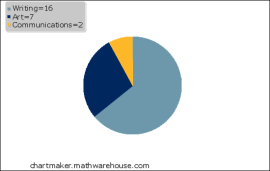
These pie charts show how much time I spend writing, working on art (I’m also pursuing a career as a freelance illustrator), and dealing with what I call “communications.”

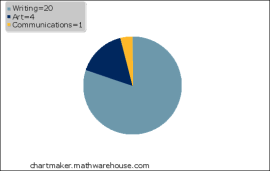
Clock Act Week 1 Clock Act Week 2 Clock Act Week 3

Communications represents the whole business side of my indie writer/illustrator career.  It includes things like networking and social media.  Based on my records, I can clearly see that I’m not spending enough time on communications.  So not only has my new clock rule solved my time management problem, but it’s helped me identify areas where I need improvement.

I’m not trying to convince you to have your own clock rule.  What works for one person might not work for another.  My point is that if you stumble, if your preconceived notions about being a writer prove false, don’t despair.  Try something new.  Keep trying new ideas until you find a system that work for you.

So what are you struggling with as an indie writer and what solutions have you tried?  How well have they worked for you?

P.S.: Pie charts created using the website chartmaker.mathwarehouse.com.