It’s the day before Christmas, and there’s that one person on your list who you can barely tolerate, a person you loathe and yet you can’t just skip over them. A mother-in-law, perhaps. Or that guy at work (you know… that guy). Or that so-called friend who keeps stabbing you in the back. What makes the perfect gift for the people in your life you absolutely hate?
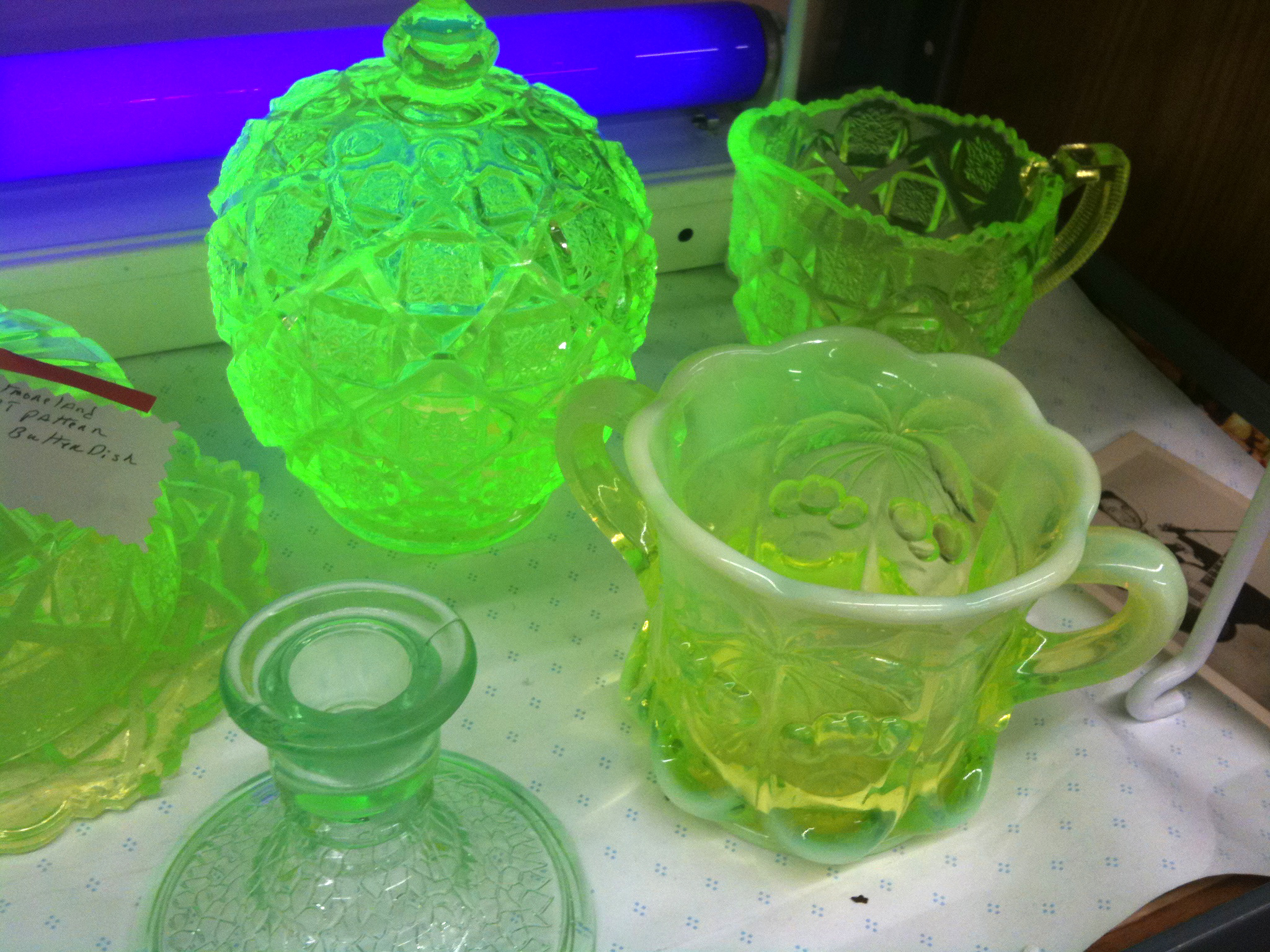
How about uranium glass? It’s glass with just a tiny bit of uranium mixed in. Decades ago, before the dangers of uranium were well understood, people made glassware out of this stuff, and you can still find it in antique stores or on eBay. It’s quite beautiful, with a distinctive yellowish green color, and under certain lighting conditions it will even glow.
But of course it’s radioactive. The radioactivity is fairly low and generally considered safe, but it’s still radioactive, making it the perfect gift for the special someone who you wish would just die.
Today’s post is part of Indie Life, a blog hop for independent authors hosted by the Indelibles. Click here to see a list of participating blogs.
* * *
A few months ago, I took a leap of faith, quitting my full time job in favor of a part time position. My goal was to spend more time writing and start to become a true career author. I still have a long way to go on this journey, but here are some of the things I’ve learned so far:
This is my destiny. I had my doubts at first. Some well-meaning people tried to convince me not to do this, and I shared their concerns. But I am now convinced that this is what I am meant to be doing, and though I still have some big obstacles ahead of me, I have faith that somehow things are going to work.
The double rule: a fellow writer, someone much farther along this journey than I, once told me that whatever amount of time you think it will take you to write something, it will actually take twice as long. He was right, and I now call this the double rule.
The excuses rule: you can always find an excuse not to write. Something’s happening with the family. Something’s wrong with the dog, cat, or goldfish. All the food in the refrigerator needs to be arranged in alphabetical order. The excuses rule is that, no matter what emergency (or so-called emergency) is going on, I have to keep writing. In other words, there are no excuses.
You can’t do this without some financial preparedness. I did not abruptly storm into my boss’s office one day and quit. I created a savings account, built it up over the course of several years until I had enough money to live on for roughly 18 months. Then I quit my job. Having that money set aside gives me the confidence to keep writing and keep dreaming, knowing that I will not end up homeless and destitute, begging for scraps of food outside the local McDonald’s.
Anyone can find a way to follow their dreams. Regardless of your situation, you can find a way to make this work. It just takes time, discipline, and perhaps a little creative thinking.
Hire a professional editor. This part frightened me, putting my beautiful manuscript into the hands of an editor and getting it back covered in red ink, but I didn’t need to be afraid. An editor’s job isn’t merely to point out your mistakes but to help you tell the best story you can. When I finally started working with an editor, it was the first time that I didn’t feel like I was all alone on this journey.
The education rule: I once believed that I shouldn’t take this step until I’m “ready,” until I “know everything I need to know.” That’s ridiculous. The life of the writer, indie or otherwise, is all about asking questions and learning more. The most important thing I’ve learned is that I still have a lot to learn, and I always will.
So, my fellow Indie Lifers, what have you learned since going Indie?
It often seems like money has been around forever, but it hasn’t. Some ancient human had to invent the concept of money, and the idea has continued evolving ever since. Originally, currency was made from precious metals, and its value was that of the metal itself. Later, someone thought of the idea of paper money, which originally represented a sample of precious metal stored in the national treasury someplace, like a little note saying, “I own a pound of gold.” Now money is its own thing, no longer tied directly to the value of gold or silver, and thanks to credit cards and online banking, even paper money is starting to feel a bit antiquated.
Today, I want to take a look at what money might be like in the future. Here are two videos (essentially advertisements) showing how technology is reinventing the concept of money all over again.
P.S.: One day, perhaps there might be no need for money at all. This is the future envisioned by Star Trek, and it’s a possibility that has fascinated and confused many devoted Trekkies over the years, including myself. Click here to find out more about the Star Trek economy.
Back in July, NASA’s Cassini spacecraft happened to be in perfect alignment with Saturn and the Sun (the technical term for that is syzygy, by the way!). This allowed Cassini to take an amazing snapshot of a Saturnian eclipse. If you haven’t seen this picture yet, you really need to check it out (click on the image below to see a larger, more detailed version).
Click image to see full scale version, courtesy of Astronomy Picture of the Day.
Cassini has taken other pictures of Saturn eclipsing the Sun, but this one is particularly special. Far off in the background, you can see a tiny, blue speck; namely, Earth. If you look closely, you might be able to see the even tinier speck beside it: our beloved Moon. Venus and Mars are also in the photo, meaning that in this one picture you can see half the planets in the Solar System all at once (or almost half, depending on your opinion about Pluto).
But wait, there’s more! If you click on the image and view the full-scale version, you should be able to find at least three of Saturn’s moons. Just below Saturn and slightly to the left, you should see a small, tan-colored moon which I’m guessing is Titan, and there’s another moon nearby that’s almost certainly Enceladus (the geysers give it away). A third moon is located in the upper right, but most of it is in shadow so I can’t guess what its name might be.
We know for a fact that there is life—lots and lots of life—crammed onto that one tiny, blue speck, but we Earthlings might not be alone. According to recent theories, there are four other places in the Solar System that might be able to support life: Mars, Europa (a moon of Jupiter), Titan, and Enceladus. So it’s possible that this picture doesn’t just show a bunch of cool planets and moons. It may also be our first group photo with the Martians, Titanians, and Enceladians. This picture might be the first to show all the life bearing worlds of the Solar System together (or almost all of them—sorry, Europa—we’ll try to squeeze you in next time).
As you can tell, I’ve spent an embarrassingly large amount of time studying this image and thinking about what it means. It’s stuff like this that keeps me from getting too bogged down with earthly concerns. Pictures like this remind me that I’m a citizen of a much bigger, much wider universe. So I want to send a big thank you to the Cassini spacecraft for sending back such an awesome photo!
P.S.: Click here for another cool picture of Earth and the Moon. This one’s close enough that we’re not reduced to a tiny, nearly invisible speck, but still far enough away to show how truly small our planet is. The picture was taken by the MESSINGER spacecraft while on route to Mercury.
Neil Gaiman, author of Coraline, American Gods, and a couple really outstanding episodes of Doctor Who, has some interesting thoughts on Internet piracy. He, along with growing numbers of well-known and well-respected writers, doesn’t think it’s so bad. In fact, Gaiman says piracy might be a good thing.
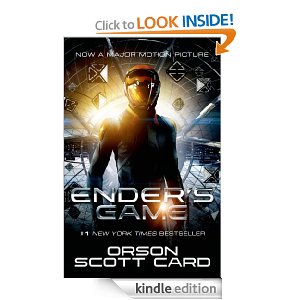
Orson Scott Card is one of my roll models as an author, but not necessarily as anything beyond that. Specifically, I do not agree with his position against gay marriage, nor do I condone his vehement and sometimes hateful attempts to stop it. Now there’s a movie coming out based on his greatest book, Ender’s Game (I wrote a post on that yesterday), and there’s an effort to boycott the movie because of Card’s controversial political views.
Card’s views can be extreme, even to those who favor traditional marriage. According to the website skipendersgame.com, Card once said that people in the LGBT community “[…] cannot be permitted to remain as acceptable, equal citizens within [a] society.” As a bookworm, especially a bookworm of Science Fiction books, this puts me in a difficult position. I love Ender’s Game, but I have far too many gay friends for me to be neutral, and even if that weren’t the case… really, you don’t think they should be citizens?
But Ender’s Game isn’t about this at all. It has nothing to do with marriage equality. In fact, it’s a book about learning to understand another person’s point of view, no matter how “alien” that person may seem to you. It’s about looking at someone you think of as an enemy and finding only a reflection of yourself. In other words, it’s about tolerance.
It’s strange to get this message of tolerance from a man who, by all appearances, is not very tolerant himself. So where should we draw the line between an author and the stories he writes? How much do the political views of writers, actors, artists, or musicians affect the way we perceive and enjoy their work?
You’ll usually find Ender’s Game and Dune taking top spots on lists of the greatest Science Fiction or Sci-Fi/Fantasy novels of all time. On my own top ten list, they’re constantly battling over the #2 slot (for me, The Lord of the Rings is unquestionably #1). Now the movie version of one of those books (Ender’s Game) comes out in theatres this Friday.
But we all know what Hollywood sometimes does to popular books. Just look at what happened to Dune. The feature file version is… well… some people liked it, I guess. So as we approach the release date for Ender’s Game, I’ve been both excited and apprehensive. Will they ruin Orson Scott Card’s best and most provocative book?
So it was with a great sense of relief and reassurance that I read this interview with Gavin Hood, the director of Ender’s Game. This is a man who seems to understand what this story is about beyond the epic space battles and explosions and such. In the interview, he said, “There’s always a theme I’m drawn to, that we humans are not good or bad. We’re all a mixture of both. We can have great compassion or commit great violence.”
Ender’s Game is about a lot of things: war, space, childhood, video games… but in that statement, Gavin Hood has captured the soul of Orson Scott Card’s work. If he can do that in three sentences, I’m sure he can do it in a two-hour movie.
So this Friday, when I walk into the local movie theatre and give them $9.00 of my hard earned cash, I will feel confident that I’ll get to see the real Ender’s Game on the big screen, and not some Hollywood bastardization of the book I love.
Science fiction uses scientific language as a form of artistic expression. With that in mind, today’s post is part of a series here on Planet Pailly called Sciency Words. Every Friday, I’ll bring you a new and interesting scientific word to help us all expand our scientific vocabulary. Today’s word is:
GEORGIUM SIDIS
In the late 18th Century, Sir William Herschel discovered a new planet. Up until that point, everyone assumed there were only six planets in the Solar System. When asked what to name this planet, Herschel called it the Georgium Sidis, meaning “George’s Star,” in honor of his patron, King George III of England.
Fortunately (or perhaps unfortunately), this name didn’t stick. Non-English scientists were offended and didn’t want our seventh planet named after an English king, so they re-named it Uranus after the ancient Greek god of the sky. This choice has worked out great for most of the world, but not for those of us who speak English. For us, the planet Uranus has become the victim of far too many astronomy jokes.
Incidentally, I named a character in one of my Tomorrow News Network stories George Sidis in honor of Uranus’s original name. Sidis is a secondary antagonist in “Children of the Swarm,” and yes, I’d describe him as kind of an ass.
* * *
Did you already know this word? If so, please share another sciency word in the comments below. That way, we can all keep expanding our sciency vocabularies together!
P.S.: There’s a brand new short story on the Tomorrow News Network website. 3,000 years into the future, the Earth Empire has a new secret weapon: the brain of Albert Einstein. Click here to start reading “Einstein’s Clone.”
A few weeks ago, Sci Show did this segment on 3D printers, and it started me thinking.
It won’t be long before 3D printers become a truly ubiquitous part of our lives, just like televisions, cars, and smart phones. But the name “3D printer” just doesn’t sound right to me. It reminds me of “horseless carriage.” It’s a name that describes a thing by comparing it to another thing that is kind of similar but actually very different.
But just as the term “horseless carriage” was eventually replaced by “car,” I suspect “3D printer” will sooner or later be replaced with some new, more appropriate term. In Star Trek, they have a machine called a “replicator.” In the Mass Effect series, they sometimes refer to something called “micro-facturing.” Those seem like good possibilities.
So what do you think the 3D printer will be called once we get used to having them around?
P.S.: If you’re looking for good science news, there’s no better place than Sci Show. I often say that I don’t believe anything until I hear Hank Green say it.
Bad news, everyone. Our worst nightmare is about to come true. No, I don’t mean the one where you show up to work/school with no clothes on. I mean that other one. The one full of robotic super snakes. Soon, those robo-snakes will be real.
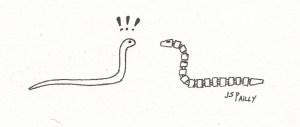
Snake meets robo-snake.
They’re designing these things for the purpose of exploration. The European Space Agency wants future Mars rovers to bring little, robotic snake companions. These robo-snakes could slither around on the Martian surface, crawling into those tight spaces rovers just can’t go.
But I think we all know what’s going to happen. One day, when the robots rise up against us to overthrow humanity, we’ll see swarms of robo-snakes coming at us. Thanks, European Space Agency.
P.S.: As if robotic snakes weren’t bad enough, scientists are also working on a robotic octopus. Click here to read about that.



 Planet Pailly
