Science in the Chronoverse

Here on Planet Pailly, I write about real science, or at least I try to. That’s not so much the case on my other blog.

Today on the Tomorrow News Network website, I’m starting a series of posts about the “science of the chronoverse.” It’s basically the made-up science I use to justify time machines and faster-than-light travel in my stories.

illith-class-starship

The first post is on primitive science. Although actually, “primitive science” is just classical physics, so I guess I’m not making stuff up yet. But I will be soon!

Sciency Words: Technocracy

Sciency Words Logo

Today’s post is part of a special series here on Planet Pailly called Sciency Words.  Every Friday, we take a look at a new and interesting scientific term to help us all expand our scientific vocabularies together.  Today’s word is:

TECHNOCRACY

Technocracy is a hypothetical form of government in which political power is given to technical experts, mainly scientists and engineers.  Government policy is set not by debates or elections but by experimentation through the scientific method.  The ultimate goal of a technocratic government would be to create a self-sustaining society, a society that lives in maximum comfort given the limits of its natural resources.

Although there have been plenty of examples of scientists contributing to public policy decisions, we have yet to see a true technocracy in action.  I think a technocratic political system might have some advantages.  In democracies, we elect our leaders, but that is no guarantee that the best or brightest people in society will lead.  Too often, it’s the better-funded candidate who wins the election, or if not that, it’s the candidate who does a better job rallying the crowd with an elegant speech.

In the Tomorrow News Network series, the government of the alien race known as the Hykonians is identified as the Hykonian Technocracy.  Also, in the T.N.N. story “Mother Mars,” the ancient Martians appear to have a technocratic form of government.  I find the idea of a technocracy fascinating, and I can see how some might think it’s an improvement over our current democratic institutions.  However, I have chosen to portray these fictional technocracies as deeply flawed and prone to corruption, because no political system is perfect.

In the Tomorrow News Network series, the Hykonian Technocracy has a long history of conflict with the people of Earth.  It all began with a certain incident in Roswell, N.M.

Despite the potential advantages of a government run by Einsteins, I fear the disadvantages are far greater.  There’s probably a good reason this form of government does not already exist somewhere.  But what do you think?  Would we be better off under a technocracy, or should we stick to the political system we already have?

Revisions

1.1 Medusa Effect

It’s been a while since I updated anything on the Tomorrow News Network website.  I’ve been neck-deep in revisions of the 2012 stories for the last few months.  When I started writing T.N.N. over two years ago, I was very much a novice.  I’m not going to claim that I have since mastered the art of writing, but I am far more competent at my craft than I used to be.

I have also started working with an editor who has taught me the difference between “borders” versus “boarders,” “prescribed” versus “proscribed,” and “farther” versus “further.”  My editor has also called my attention to a number of other embarrassing errors that I am now in the process of fixing.

Today, I am happy to announce that the revised versions of the first two Tomorrow News Network stories are available on the T.N.N. website.  Revisions of the third story are coming soon.  In fact, I had a meeting with my editor today concerning story #3, “The Orion War,” and she tells me that the updated version is much stronger than the original.

1.2 99 White Balloons

For those of you who’ve read these stories before, I hope you’ll take the time to read them again and see how they’ve improved.  And if you’re new to T.N.N., I beg your indulgence as this revision process goes forward.  Any typos or grammatical errors you find will be corrected in due time (probably).

Please click here to start reading the new version of “The Medusa Effect,” the “pilot episode” of the series.  Click here to read the new “99 White Balloons,” which focuses on the true story of Roswell.

Indie Life: Good Cover Art Is Worth 100,000 Words

IndieLife7Today’s post is part of Indie Life, a blog hop for independent authors hosted by the Indelibles.  Click here to see a list of participating blogs.

* * *

They say a picture is worth a thousand words, but your cover art is worth much more than that.  Potential readers might not even bother to look at your book (much less buy it) if the cover doesn’t somehow catch their attention.  When I first started my indie life journey about two years ago, someone told me that I must hire a professional editor and I must hire a professional illustrator.  I chuckled at the time because I am a professional illustrator, or at least a semi-professional illustrator.  How hard could it be to do my own cover?

It wasn’t until I sat down with a blank sheet of paper and started thinking about how this one illustration—this one illustration!—could make or break the success of my first book and perhaps my whole career as a writer that I began to freak out.  I started sketching, then I stopped and started over, then I stopped and started over again.  Normally a project like this would take me a week, two weeks maximum, but this illustration took almost a full year.

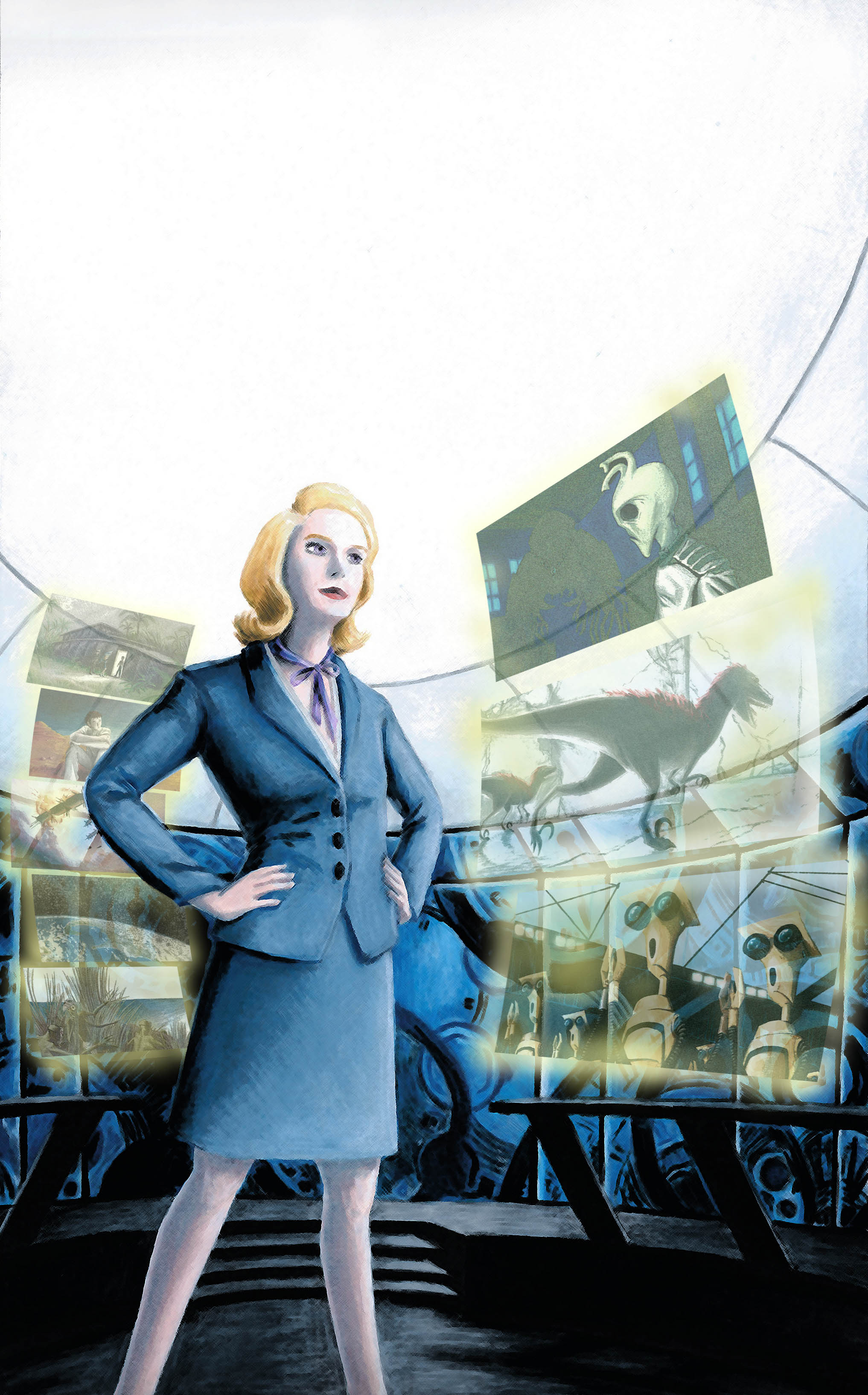
Drawing and painting have always been easier for me than writing, but this was worse than any writer’s block I’ve ever experienced.  Many times, I wondered if I should give up and hire someone less personally involved in my book to do the cover for me.  I knew perfectly well that was the only reason I was struggling.  But I kept working on it, and as of this past Sunday I finally finished.  Here is the long awaited cover art for Tomorrow News Network: Volume One.  Please let me know what you think!

Live from the Newsroom

As for the editing, I did hire a professional to help me with that.  Even if I were a professional editor, I wouldn’t trust myself to catch all the mistakes in my own manuscript.  For that, you need a genuine outsider’s perspective.  So far, the editing process has been far less stressful than doing my own cover art.  I’m happy to announce that, while I still don’t know the exact date yet, the day my book comes out is tantalizingly close!

P.S.: If you’re in need of an illustrator, my services are now available.  Please email me at james.pailly@gmail.com if you’re interested.  I promise it won’t take me a full year to do your cover art; I’d only inflict that kind of delay on myself.

Sciency Words: Georgium Sidis

Science fiction uses scientific language as a form of artistic expression.  With that in mind, today’s post is part of a series here on Planet Pailly called Sciency Words.  Every Friday, I’ll bring you a new and interesting scientific word to help us all expand our scientific vocabulary. Today’s word is:

GEORGIUM SIDIS

In the late 18th Century, Sir William Herschel discovered a new planet.  Up until that point, everyone assumed there were only six planets in the Solar System.  When asked what to name this planet, Herschel called it the Georgium Sidis, meaning “George’s Star,” in honor of his patron, King George III of England.
Uranus 2003
Fortunately (or perhaps unfortunately), this name didn’t stick.  Non-English scientists were offended and didn’t want our seventh planet named after an English king, so they re-named it Uranus after the ancient Greek god of the sky.  This choice has worked out great for most of the world, but not for those of us who speak English.  For us, the planet Uranus has become the victim of far too many astronomy jokes.

Incidentally, I named a character in one of my Tomorrow News Network stories George Sidis in honor of Uranus’s original name.  Sidis is a secondary antagonist in “Children of the Swarm,” and yes, I’d describe him as kind of an ass.

* * *

Did you already know this word?  If so, please share another sciency word in the comments below.  That way, we can all keep expanding our sciency vocabularies together!

P.S.: There’s a brand new short story on the Tomorrow News Network website.  3,000 years into the future, the Earth Empire has a new secret weapon: the brain of Albert Einstein.  Click here to start reading “Einstein’s Clone.”

Einstein’s Brain

When Albert Einstein died, his doctors removed his brain so it could be studied.  They carefully dissected it, taking lots of photos, and preserved the pieces of jars.  As disgusting as this may seem to us now, apparently it was common practice at the time whenever an especially intelligent person died.  It also means we now have some idea as to why Einstein was such a genius.

Einstein_portrait

There’s a bundle of nerves called the corpus callosum which connects the right and left hemispheres of the human brain, but according to researchers Einstein had a larger and thicker corpus callosum than most of us.  It’s like the two sides of his brain were connected by rope where the rest of us have only a few tangled strings.

You’ve probably heard about the difference between the left and right brains before.  The left side is supposedly more creative while the right is more analytical.  Left-brained people tend to be artists while right brainers make better scientists and engineers and accountants.  You might assume a theoretical physicist like Einstein would be a right brain type of guy, but it seems he was one of those lucky few who could use both sides equally well.

Of course we already knew this about Einstein, not from the dissection of his brain but from the things he said and did when he was alive.  He was a brilliant physicist, but he also played the violin.  Whenever he was stuck on some vexing mathematical problem, he often wandered over to his piano, played for a few minutes, then went back to his physics with some new insight.  And of course Einstein was most famous for his thought experiments, experiments he conducted not in a laboratory but in his own imagination.

My question I have is this: was Einstein born with his abnormally well wired brain, or is the brain more like a muscle, its parts growing and atrophying depending on how you use them?  Whatever the answer, it seems clear that the key to true intelligence is to try as best as we can to use our whole brains, not just one side or the other.

P.S.: I’m nearing completion of a new Tomorrow News Network story, and this one happens to be about Albert Einstein, specifically his brain and what scientists might do with it in the distant future.  Click here to read a preview scene from the upcoming short story “Einstein’s Clone.”

New Story: The Flood of Atlantis

Wherever Talie Tappler goes, death and destruction are sure to follow, so when she turns up on Earth circa 4000 BC, the people of Atlantis know there’s going to be trouble.  Now two Atlantians, a temple priest and a high class prostitute, have only a short time to save their civilization from certain doom.  Click here to start reading “The Flood of Atlantis.”

The Future of Journalism: J-Drones

The news business is getting ready to take the next bold step into the future.  No, we’re not quite ready for cybernetic cameramen, but apparently we are close to having robotic drones.  Students at the University of Missouri’s journalism school are learning how to fly drones for newsgathering purposes.

The US military has made extensive use of drones like the Predator drone in the War on Terror.  Smaller quad-copter drones seem to be turning into a popular hobby for some people.  A few years ago, there was even an effort to use drones as a taco delivery service.

Journalistic drones (or J-drones, as some people are calling them) give journalists a lot of new advantages.  They can get a bird’s eye view of a scene without the high cost of sending a news-chopper.  They can be sent to dangerous places without putting anyone’s lives at risk.  They provide an entirely new way to gather information, freeing journalists from the typical sound bites and allowing them to independently verify facts.

Let’s say for example that some big corporation has closed off a large plot of land to the media, perhaps threatening reporters with arrest if they dare to even approach the area (a situation like this recently happened in Arkansas).  Company officials say, “There’s nothing to worry about.  You can trust us, right?”  A news organization can then send up a drone to find out what’s really going on.

However, the use of J-drones is a legitimate cause for concern.  I’ve worked in the news business for a number of years, so I’m the last person to decry the evil, monolithic media.  The media serves a valuable function in society.  It keeps the public informed about what’s going on in our communities.  But I’ve been around long enough to know that some reporters are less ethical than others, and J-drones create a new opportunity to invade the privacy of anyone who might be considered newsworthy.

It’s important to note that the law doesn’t have much to say about these issues.  Most areas of the US don’t have laws about drones at all, and the FAA hasn’t yet decided how it wants to regulate commercial drones in US airspace.  So what do you think?  Will J-drones be a benefit to society, or will they cause more harm than good?

P.S.: I’m really kicking myself that I never thought to include flying robot cameramen in any of the Tomorrow News Network stories thus far.  Don’t be surprised if they turn up in some future TNN adventure.