Exofleet (Tomorrow News Network: A to Z)

Hello, friends, and welcome to the second week of the A to Z Challenge!  This year, my theme is the universe of Tomorrow News Network, my upcoming Sci-Fi adventure series.  In today’s post, E is for:

EXOFLEET

I started developing the Tomorrow News Network universe way back in 2011.  And it was way back in 2011 that I thought up an absolutely perfect name for an outer space military organization: the Space Force.

Apparently somebody else thought that name sounded cool too.  Now the term “Space Force” comes with a certain amount of political baggage, and… well, I don’t really want to deal with any of that in my own creative work.

While trying to think up a new name for Earth’s military forces, I took some inspiration from my ongoing obsession with scientific terminology.  Astronomers tend to make this weird distinction between objects found in our Solar System and objects found orbiting other stars.  Hence, the distinction between planets and exoplanets, moons and exomoons, asteroids and exoasteroids, etc.

And so in the distant future of Tomorrow News Network, the Earth Republic (and later the Earth Empire) is defended by not one but two space militaries.  The Solar Fleet patrols and protects the Solar System itself, while the Extrasolar Fleet (a.k.a. the Exofleet) ventures out into the galaxy, expanding Earth’s territories and defending humanity’s borders against alien aggressors.
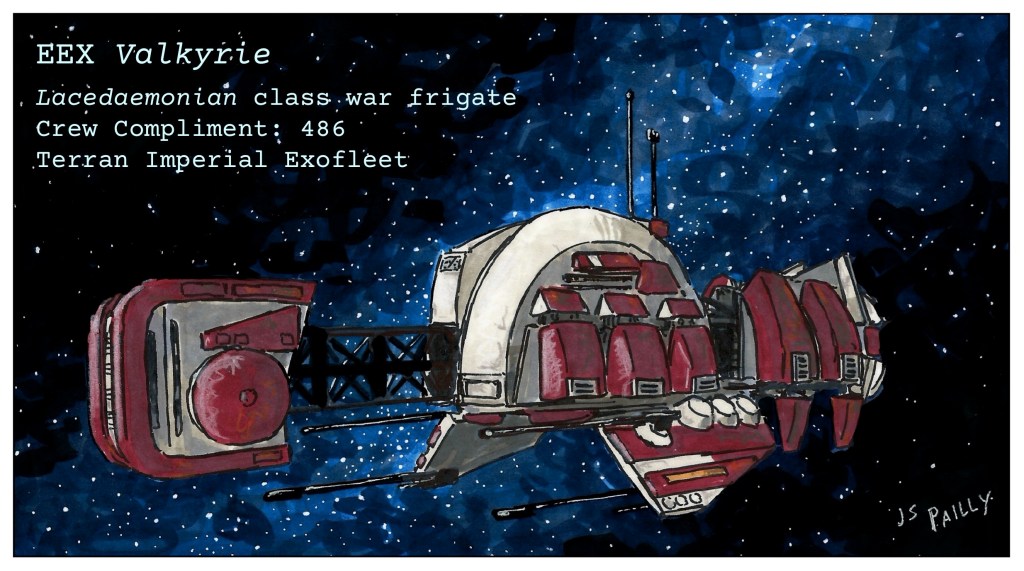
Would outer space military forces really be divided up in this way?  Does the distinction between the Solar Fleet and the Exofleet make sense?  Maybe, maybe not.  Personally, I don’t think the distinction between planets and exoplanets makes much sense either.  We humans love drawing divisions and making distinctions between things, regardless of whether or not those distinctions and divisions are necessary.  With that in mind, I think the Solar Fleet vs. Exofleet thing is true to life, even if it’s not the most pragmatic way to organize an outer space military.

In the Tomorrow News Network series, we’ll be seeing a lot more of the Exofleet than the Solar Fleet.  I mean, if the Solar Fleet ever has to go into battle, that must mean things are really bad, right?  It would take an extremely rare and extremely powerful invasion force to break through the Exofleet’s lines and threaten the Solar System itself.  Let’s hope that never happens!

Next time on Tomorrow News Network: A to Z, there are tons of aliens in the Tomorrow News Network universe, and yet as of the year 2020, we Earthlings haven’t made contact with any of them.  Why is that?

Digi-Stream (Tomorrow News Network: A to Z)

Hello, friends, and welcome back to Tomorrow News Network: A to Z.  For this year’s A to Z Challenge, I’m telling you all about the story universe I created for my upcoming Sci-Fi adventure series, Tomorrow News Network.  In today’s post, D is for:

DIGI-STREAM

There’s a longstanding trope in science fiction.  In the future, something very similar to the Internet will still exist, but it will be rebranded with an even more futuristic sounding name.  The Datanet.  The Cybersphere.  The Omni-Web.  Something like that.

I’ve heard a lot of people complain about this trope.  Why wouldn’t people in the future just call the Internet the Internet?  I was tempted to do just that in Tomorrow News Network, but then I realized that scaling up the Internet from a world wide web to a galaxy wide web might not work so well.

Why not?  Because of speed-of-light delays.  Connecting to a server on the galactic web could take hundreds or perhaps thousands of years (if not millions or billions of years), depending on which planet that server is located on.  Talk about slow Internet speeds!

Faster than light travel and faster than light communications are possible in the Tomorrow News Network universe, but not without consequences.  In the logic of Tomorrow News Network physics, anything traveling faster than light must also be traveling backwards through time.  We’ll talk about this more when we get to the letter I, but for now I’ll just say this: in most cases, F.T.L. technology creates more time travel-related headaches than its worth.

So instead of having continuous access to a galactic Internet, humans living in far-flung corners of the galaxy rely on a subscription service called digi-stream.  For young Milo Marrero and his girlfriend, Lianna (sorry, I mean Milo’s friend who happens to be a girl), the weekly digi-stream downlink is an opportunity to read all the insane rumors and crazy conspiracy theories that are circulating about the Tomorrow News Network and their star reporter, Talie Tappler.

But just as with the Internet of today, you shouldn’t believe everything you read in the weekly digi-stream downlink.

Next time on Tomorrow News Network: A to Z, we’ll meet the brave men and women who defend Earth from its enemies.

Cognis (Tomorrow News Network: A to Z)

Hello, friends, and welcome to day three of the A to Z Challenge.  For this year’s challenge, I’m telling you a little more about the universe of Tomorrow News Network, my upcoming Sci-Fi adventure series.  In today’s post, C is for:

COGNIS

Dear readers, I know some of you are fellow writers, so today I’m going to offer you some writing advice.  You know those abandoned manuscripts and story ideas you have collecting dust?  You know all those writing projects that just didn’t work out the way you wanted?  They don’t have to go to waste.  Think of them, instead, as a resource to be used for future writing projects.

Way back when I was an angsty teenager, I wrote a short story about a cyborg named E.K. Cognis.  Being a cyborg, Mr. Cognis had no emotions, but he was curious about what emotions might be like.  So Cognis and a fellow cyborg named K.T. Macnera downloaded a bunch of emotions into their brains. It was a profoundly mind-altering, mind-expanding experience.

As I said, I was an angsty teenager.  Downloadable emotions were supposed to be a metaphor for drug use.  Initially, Mr. Cognis and Ms. Macnera only wanted to “experiment” with emotions, but it’s not long before they become addicted.  After that, their status as upstanding members of cyborg society deteriorates rapidly.

This may be the single worst story I’ve ever written, a case of a young writer trying way too hard to be edgy.  The original story may or may not be saved on a floppy disk somewhere.  I will likely never find it, and I’m okay with that.

But when I started work on my Tomorrow News Network series, I soon realized that my main character—time traveling journalist Talie Tappler—would need a cameraman.  And when I thought of Mr. Cognis, I realized I had a character already made and ready to slip right into that role.

Cognis’s ongoing addiction to emotions creates plenty of opportunities for both humor and conflict in the Tomorrow News Network stories.  So does his complicated relationship with Ms. Macnera, who now works for T.N.N. as an assignment editor.

Tomorrow News Network has salvaged a great many concepts and characters from my old, abandoned stories.  Mr. Cognis was only the first. Story scavenging (as I like to call it) has made the process of creating a whole new Sci-Fi universe so much easier.  So don’t feel bad if you have some old, abandoned story ideas that never worked out.  Treat them as resources that can be used for building your next story world.

Next time on Tomorrow News Network: A to Z, turning the World Wide Web into the Galaxy Wide Web is far easier said than done.

Berzelius (Tomorrow News Network: A to Z)

Hello, friends!  For this year’s A to Z Challenge, I’ll be telling you more about my upcoming Sci-Fi adventure series, Tomorrow News Network.  In today’s post, B is for:

BERZELIUS

When you’re creating your own science fiction universe, you don’t have to know everything about everything, but it can be helpful to know a little bit more than what you end up telling your readers.  Today, I’m going to share a few details about the planet Berzelius.  Some of this will be in my book; most of it will not.

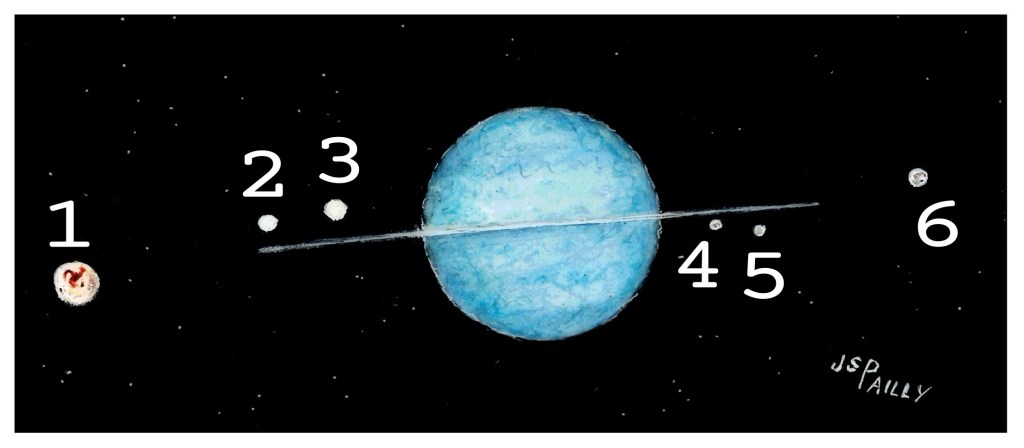
The planet Berzelius is an ice giant located in the Vesper Beta-Beta Star Sector.  It orbits a K-type (orange dwarf) star, and it has an impressive ring system and a family of five moons.

In terms of internal composition and structure, Berzelius has much in common with the planets Uranus and Neptune in our own Solar System; however, unlike Uranus or Neptune, Berzelius is located within the habitable zone of its sun.  Thus, the five moons of Berzelius are capable of supporting life—and at least one of those moons does support life in the form of scrubby, slimy “cyanomolds.”

The planet Berzelius is named in honor of Swedish chemist Jöns Jacob Berzelius, who is widely regarded as one of the founders of modern chemistry.  Berzelius is also closely associated with the discovery of lithium, the third element on the periodic table of elements.  Since lithium mining is such an important part of A.E.I.’s business, the name seemed appropriate.

Now all you lithium fanatics may be wondering why the planet isn’t named in honor of Johan August Arfwedson, the man who actually discovered lithium while working in Berzelius’s laboratory.  Well, don’t worry.  Something’s named after Arfwedson too, but we’ll talk about that when we get to the letter R.

Lastly, before I end this post, I just want to emphasize to you again that the planet Berzelius has five moons.  Count them:

See?  Five moons.

Next time on Tomorrow News Network: A to Z, dealing with emotions can be tough.  It’s even tougher when you’re a cyborg.

Alkali Extraction Incorporated (Tomorrow News Network: A to Z)

Hello, friends!  For this year’s A to Z Challenge, I’ll be telling you a little about my upcoming Sci-Fi adventure series, Tomorrow News Network.  In today’s post, A is for:

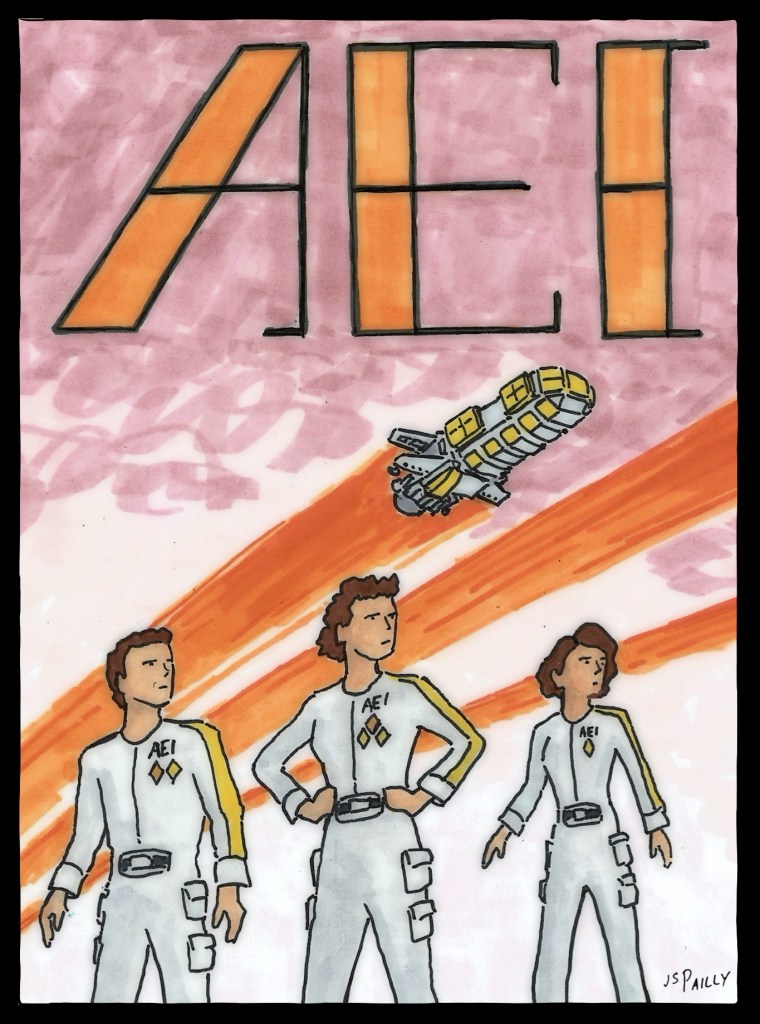
ALKALI EXTRACTION INCORPORATED (A.E.I.)

Faceless mega-corporations are everywhere in science fiction.  We see them in the Alien movies.  We see them in RoboCop, we see them in Blade Runner.  So when I started writing the first story in my Tomorrow News Network series, including a faceless mega-corporation just felt right.

In early drafts, I wanted to say as little about this faceless mega-corporation as possible.  I didn’t even give it a name.  The good people of Litho Colony all work for “the Company,” and whenever somebody mentioned “the Company,” everyone else would know which company they were talking about.  There was no need to be more specific.

My thought was that the Company was so big and so faceless that it didn’t need a name.  My critique group disagreed.  I got a lot of feedback from people asking who this giant corporate entity was.  What did they do?  What products or services did they sell?  And thus Alkali Extraction Incorporated (better known as A.E.I.) was born.

A.E.I. is a mining company specializing in the mining of rare chemical resources from planets along the galactic frontier.  They’re one of the leading suppliers of lithium for the Earth Empire, and they’ve recently expanded into the market for mesotronic elements—chemical elements that are stuck in a quantum state between matter and antimatter.

Litho Colony is the property of A.E.I.  The colonists do sometimes refer to A.E.I. as “the Company,” but they also sometimes refer to the Company by its actual name.  How could they not?  The letters “A.E.I.” are stamped everywhere, a constant reminder to the colonists of who their employers are.

Looking back on those early drafts of Tomorrow News Newtwork, book one, I get what I was trying to do with my faceless and also nameless mega-corporation.  But my critique group was right, and I’m glad I listened to them.

Next time on Tomorrow News Network: A to Z, the planet Berzelius has five moons.  Wait, let me count again.  Sorry, the planet Berzelius has six moons.

#IWSG: Ulterior Motives

Hello, friends, and welcome to this month’s meeting of the Insecure Writer’s Support Group.  If you’re a writer, and if you feel in any way insecure about your writing life, click here to learn more about this amazingly supportive group!

I don’t know about you, but my writing productivity crashed and burned toward the end of March.  Right now, I’m feeling insecure because I’ve done virtually nothing to prepare for this year’s A to Z Challenge.  I’m also feeling insecure because the timeline for publishing Tomorrow News Network, book one, has totally fallen apart.

I have no one to blame but myself.  Wait, no, that’s not true.  The coronavirus deserves a lot of the blame too.  Not all of the blame, but a lot of it.

So here’s my plan.  Even though I’m as ill-prepared for the A to Z Challenge as I could possibly be, I’m doing the challenge anyway.  My theme is the story universe I created for Tomorrow News Network.  Obviously, I have an ulterior motive for doing this.  It’s my way of saying: “Buy my book!”

Except the first book of the Tomorrow News Network series isn’t out yet. It won’t be released until (checks timetable, mutters curse at the coronavirus)—okay, I still have to figure out what my new release date will be.  But it’s coming soon!

I have a second ulterior motive as well.  You see, book one is more or less finished, but I still have to write books two, three, four, five (etc, etc, etc).  So as I tell you all about this fictional universe I’ve created, your feedback, dear reader, will be invaluable as I plan out the rest of the Tomorrow News Network series.

And lastly, my third ulterior motive may be the most important of all, given my current mental state during the coronavirus crisis.  As I said at the beginning of this post, my writing productivity crashed and burned near the end of March, and I’m having a tough time getting back into my creative groove.  I’m hoping that by participating in the A to Z Challenge—and by writing, specifically, about my own story universe—I’ll jumpstart my writing brain.  I guess we’ll have to wait until the end of April to know if that works.

In the meantime, please click here to check out the first Tomorrow News Network: A to Z post.  Today, A is for Alkali Extraction Incorporated, a faceless mega-corporation that’s mining alien planets for their resources.

Tomorrow News Network: A to Z

Hello, friends!  At long last, I’m ready to announce my theme for this year’s A to Z Challenge.  And that theme is:

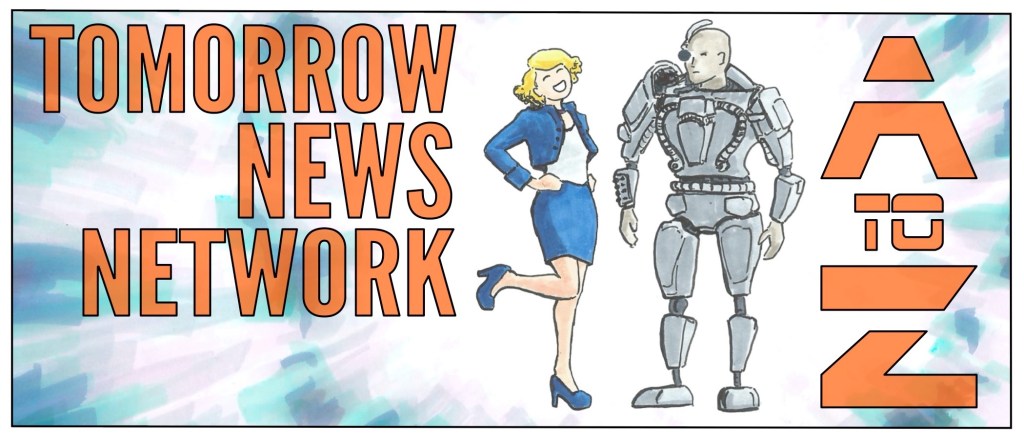
Tomorrow News Network is my own Sci-Fi adventure series, featuring time traveling journalist Talie Tappler, her cyborg cameraman Mr. Cognis, and the many high-profile news stories they cover across the space-time continuum.

Robot uprisings?  Alien invasions?  Mass extinction events?  Talie and Cognis will be there.  In fact, being time travelers, Talie and Cognis tend to show up before such cataclysmic events occur.

For the A to Z Challenge, I’ll introduce you to some of the characters (M is for Milo Marrero) and settings (L is for Litho Colony) that will appear in Tomorrow News Network, book one.  We’ll also explore some of the big concepts (J is for journalistic integrity) and small details (D is for digi-stream downloads) that will feature prominently in the Tomorrow News Network series going forward.

So on Wednesday, April 1st, we’ll kick things off by meeting a faceless mega-corporation that’s mining alien planets for their resources.  Also on Wednesday, it’ll be Insecure Writer’s Support Group day, and I’ll reveal my secret ulterior motives for picking my own story universe for this year’s A to Z Challenge.

Origin Stories: Who Invented Time Travel?

Welcome to Origin Stories, a monthly series here on Planet Pailly where we take a look at the origins of popular Sci-Fi concepts.  Today on Origin Stories, we’re looking at the origins of:

TIME TRAVEL

If I ever have a time machine—a real, working time machine—the first thing I’d do is go back in time and meet the person who invented time travel.  We do know who that person was.  His name was H.G. Wells, and he was the author of the classic science fiction novella The Time Machine.

Wells got the inspiration for The Time Machine from an unlikely source.  As science historian James Gleick explains in his book Time Travel: A History:

At some point [Wells] sees a printed advertisement for a contraption called Hacker’s Home Bicycle: a stationary stand with rubber wheels to let a person pedal for exercise without going anywhere.  Anywhere through space, that is.  The wheels go round and time goes by.

Of course there had been time travel-like stories before.  Remember the ghosts of Christmas Past, Present, and Future.  Remember the story of Rip Van Winkle, who found himself suddenly in the future after a really long nap.  Or remember Mark Twain’s A Connecticut Yankee in King Authur’s Court, in which a man from Connecticut gets bonked on the head and wakes up to find himself in the distant past.

But H.G. Wells was the first to take the idea of time travel semi-seriously.  He was the first to try to dress up the idea with scientific and technological jargon.  And in my opinion, no other author has handled time travel so clearly and concisely as Wells did.

The protagonist of The Time Machine, a man of science referred to only as “the Time Traveler,” first explains to a group of friends that we exist in a world of not three dimensions but four.  Everything that exists in this universe has the qualities of “Length, Breadth, Thickness, and—Duration.”  The Time Traveler’s friends then raise all the objections Wells’ readers might have had, and the Time Traveler explains all those objections away in exchanges like this:

“But,” said the Medical Man, staring hard at a coal in the fire, “if Time is really only a fourth dimension of Space, why is it, and why has it always been, regarded as something different?  And why cannot we move in Time as we move about in the other dimensions of Space?”

The Time Traveler smiled.  “Are you sure we can move freely in Space?  Right and left we can go, backward and forward freely enough, and men always have done so.  I admit we move freely in two dimensions.  But how about up and down?  Gravitation limits us there.”

“Not exactly,” said the Medical Man.  “There are balloons.”

“But before the balloons, save for spasmodic jumping and the inequalities of the surface, man had no freedom of vertical movement.”

In other words, we can only move freely in the third dimension thanks to technology—hot air balloons, airplanes, rockets….  Therefore technology may also give us the power to move freely through the fourth dimension of time.

Of course H.G. Wells didn’t actually believe in time travel.  As James Gleick goes on to say, all Wells was trying to do was “gin up a plausible-sounding plot device for a piece of fantastic storytelling.”  But as it would turn out a decade or so later, Wells was not too far off from the truth.  Physicists like Albert Einstein and Hermann Minkowski were soon treating time as variable, rather than a constant.  No, Einstein and Minkowski didn’t build any bicycle-like contraptions in their basements, but the notion of time as the fourth dimension—that soon became serious science.

Time travel has always been my favorite subgenre of science fiction.  It has been ever since my Dad first introduced me to Doctor Who.  I realize time travel isn’t everyone’s cup of tea, but personally I enjoy the kinds of brain-twisting puzzles that a good time travel adventure presents.  It’s the reason I still love Doctor Who, and it’s the reason time travel features so prominently in my own writing.

So if I ever have my own time machine, the first thing I’d do is go back in time to meet H.G. Wells.  I think I owe Mr. Wells a thank you.  

Your Life: Now with More Sci-Fi

The nice people over at Fiction Can Be Fun invited me to write a special blog post for them.
Has life got you down? Try turning your problems into science fiction! It won’t make your problems go away. Trust me, it won’t. But you might get a really cool Sci-Fi story out of it!

@breakerofthings's avatarFiction Can Be Fun

As it says on the front page, whilst Debs and I write the majority of the content on this blog ourselves, we’re also delighted to post contributions from others.  The periodic fifth Sunday in the month frequently causes consternation as we try and figure out what we’re going to be putting in that slot.  This time around, that fifth Sunday has coincided with our third birthday (time flies…), and we wanted something extra special.  This month we kicked off with a prompt we came up with in honour of James Pailly.  James runs the Planet Pailly blog, which is completely awesome, and well worth your time (once you’ve finished up here of course).  James has been a great friend to this blog, and he has very kindly written this article for us. I feel very privileged that we get to post it here.

–    David

They say we’re all…

View original post 896 more words

Molecular Monday: Worldbuilding with Lithium

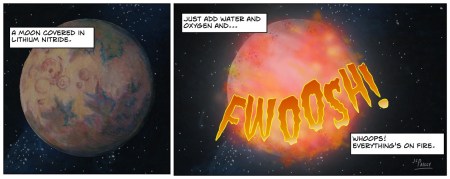
Once upon a time, long before I knew much about chemistry, I wrote a Sci-Fi story set on a moon orbiting some far-flung gas giant. For story reasons, I needed this moon to have some sort of valuable resource, and I picked lithium to be that resource. Again, I didn’t know much about chemistry at the time, but for some reason I guessed this lithium-rich moon would probably have a rust-red color to it, like Mars.

Fast forward to today. I’m currently in the process of revising this and other stories in the Tomorrow News Network series. One of the things I’m trying to do is apply a little more science to my storytelling. And regarding this rust-red moon, it turns out I sort of got this one right!

There is a compound of lithium and nitrogen called lithium nitride (chemical formula Li3N) which has the kind of dark red color that I wanted for my moon. Lithium nitride forms spontaneously wherever pure lithium comes into contact with atmospheric nitrogen, so it’s fairly easy to make. It doesn’t seem like much of a stretch to me that a lithium-rich moon would be covered in this stuff.

Of course the characters in my story need an otherwise Earth-like environment. That means Earth-like gravity, free oxygen, an active water cycle…

Okay, I’m not clear on just how rapidly everything would catch on fire in this situation, but based on a YouTube demonstration and some lab safety info I found online, it seems you should be careful about exposing lithium nitride to oxygen, and for God’s sake keep it away from water!

So yeah… it seems I have some to rethinking to do. Fortunately, there are other, less explosive lithium compounds I could work with.

Programming note: I’ve been doing Molecular Mondays as a once-per-month thing for a while now, but I feel like I’m starting to slip with my chemistry research. So Molecular Mondays will now return to its original biweekly schedule. So tune in two weeks from today when we’ll be talking about… I don’t know, probably lithium again.