A Breath of Fresh Hydrogen

Hello, friends!

So let’s imagine that extraterrestrials don’t breathe oxygen.  Oxygen is a pretty dangerous chemical, after all, so there’s good reason why alien organisms might want to avoid it.  But what would these aliens breathe instead?
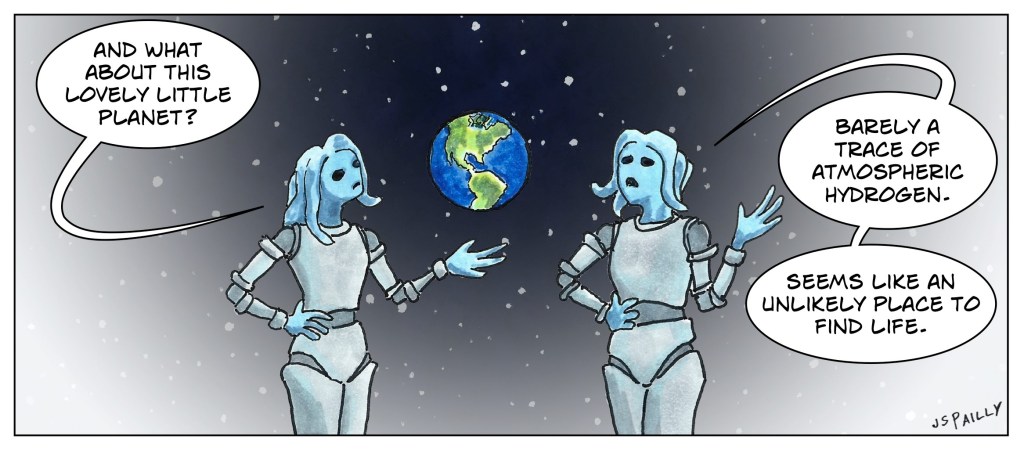
A few years back, I came across an interesting “fact” on a conspiracy theory website.  The government doesn’t want you to know this, but apparently a lot of alien species breathe hydrogen.  That conspiracy theory website said a lot of weird and wacky things, but this hydrogen-breathing alien idea… based on what I know about chemistry, that idea kind of made sense to me.

You see we Earthlings use oxygen to oxidize our food.  This oxidation reaction generates the energy we need to stay alive.  But oxidation reactions are sort of equal-and-opposite to reduction reactions.  Oxygen is a powerful oxidizing agent, obviously, but hydrogen?  Hydrogen is a pretty effective reducing agent.

A paper published earlier this year examined the possibility of Earth-like planets with hydrogen-rich atmospheres.  Such planets could, in theory, exist, but they’d have to meet one or more of the following criteria:

  • The planet would have to be much colder than Earth (think Titan or Pluto-like temperatures).
  • The planet would have to have much higher surface gravity than Earth.
  • The planet would have to continuously outgas hydrogen from some underground source (subsurface reservoirs of water ice mixed with methane ice might do the trick).

If one or more of these conditions are not met, then a hydrogen-rich atmosphere would quickly fizzle out into space through a process called Jeans escape.

Now, could life exist in that sort of hydrogen-rich environment?  The answer is yes.  Absolutely yes.  Even here on Earth, there are organisms that “breathe” hydrogen and use it to generate energy through reduction reactions.  These organisms can be found deep underground, or clustered around deep-sea hydrothermal vents, or in other exotic niche environments where hydrogen is plentiful and oxygen is rare.

The real question is: could hydrogen-breathers evolve into complex, multicellular life forms?  Earth’s hydrogen-breathers are mere microorganisms.  Their version of respiration is nowhere near as efficient as the oxygen-based system we humans and our animal friends use.  The inefficiency of hydrogen-based respiration has stunted the evolutionary development of Earthly hydrogen-breathers.

But maybe on another planet—a planet with a hydrogen-rich atmosphere unlike anything Earth has ever seen—maybe complex multicellular life could evolve on a planet like that.  Maybe.

It’s plausible enough for science fiction, at least.

Sciency Words: Outgassing

Hello, friends!  Welcome to Sciency Words, a special series here on Planet Pailly where we talk about science or science-related terminology.  Today on Sciency Words, we’re talking about:

OUTGASSING

Okay, I’m tempted to start this blog post with a fart joke.  But I won’t.  I’m too classy for that.  Outgassing is a normal and natural process that occurs on all the rocky and/or icy planets and moons of our Solar System.

According to the Oxford English Dictionary, the earliest known usage of “outgas” or “outgassing” is this 1919 paper titled “The Relative Adsorption of Mixtures of Oxygen and Nitrogen in Cocoanut Shell Charcoal.”  It’s a thrilling read.

Basically, solid substances (cocoanut shell charcoal, planetary regolith, etc) can get gas particles stuck to their surfaces or trapped inside them.  Gradually, these gas particles will escape.  The process of gas particles gradually escaping from a solid material is called outgassing.

On a planetary scale, outgassing is a major contributing factor in the formation of a planet’s atmosphere.  Or at least that’s true for small, terrestrial planets like Mercury, Venus, Earth, and Mars.  Gas giants tend to form their atmospheres through a different process (so before anyone makes a comment about this, there is no outgassing happening on Uranus).

So the main takeaway of today’s post is this: solid materials often have gas particles trapped inside them.  On a planetary scale, the gradual release of these gas particles helps to form planetary atmospheres.  This is known as outgassing.

Or you could just say terrestrial planets fart, almost constantly, and that’s where their atmospheres come from.

Science is Wrong About Everything

Hello, friends!  So one day when I was a little kid, I got into a huge argument with another kid in school.  I’d said something about how Earth is a sphere, like all the other planets.  The other kid told me (firstly) that Star Trek isn’t real and (secondly) that the earth is flat.

As evidence, the other kid told me to just look around.  It’s obvious that the world is flat.  If I needed more proof, I could look at a map.  More kids soon jumped into this argument.  They all agreed: the earth is flat, and also I’m a huge nerd for watching so much Star Trek.  I was outnumbered, and being outnumbered was further proof that I must be wrong.

I went home so mad that day.  How could those other kids be so stupid?  I was right.  Everybody else was wrong.  I’m tempted to turn this into a metaphor for Internet culture, but that’s not the point I want to make today.

Yes, when those other kids said the Earth is flat, they were wrong.  But when I said the Earth is a sphere, I was wrong too.  Less wrong, obviously.  But still, I was wrong.

Isaac Asimov’s essay “The Relativity of Wrong” is a brilliant summation of how science works.  It should be required reading for every human being (click here to read it).  As Asimov explains:

[…] when people thought the earth was flat, they were wrong.  When people thought the earth was spherical, they were wrong.  But if you think that thinking the earth is spherical is just as wrong as thinking the earth is flat, then your view is wronger than both of them put together.

As Asimov goes on to explain, there was a time, long ago, when educated people really did believe the world was flat, and they had good reasons for thinking it to be so.  But then discoveries were made.  New knowledge was learned, and people came to think of the world was a sphere.  Then more discoveries were made, and people started to think of the world as an oblate spheroid (round, but slightly bulgy at the equator).  And then still more discoveries were made, and even the oblate spheroid model turned out to be slightly inaccurate.

People (including people on the Internet) will gleefully point out that science has been wrong about stuff in the past; therefore, science could be wrong about stuff today—stuff like evolution, climate change, general relativity—also stuff like vaccinations and COVID-19.  When science is wrong so much, why pay attention to science at all?

Well, it’s true.  In absolutist (this-or-that-ist) terms, science is wrong.  Science is always wrong, about everything, all the time.  Science is full of educated guesses and close approximations of observed reality.  It’s not perfect.  It will never be perfect.  But with each new discovery, science is a little less wrong today than it was yesterday.  And you can trust science to keep being less and less wrong, even if it will never be 100% right.

And that process of constant refinement and improvement, that process of getting closer and closer to the truth—that’s something worth paying attention to, something worth taking seriously, don’t you think?

P.S.: I’ll concede that those kids in school were right about one thing.  I was, and still am, a huge Star Trek nerd.

Sciency Words: The Milky Way

Hello, friends!  Welcome back to Sciency Words, a special series here on Planet Pailly where we talk about the definitions and etymologies of science or science-related terms.  Today on Sciency Words, we’re talking about:

THE MILKY WAY

A while back, there was a very famous marketing campaign, coupled with a very famous slogan.  Some of you may remember it.  The purpose of this marketing campaign was, obviously, to encourage tourists to visit our galaxy.

According to ancient Greek mythology, the Milky Way was created as a result of a breastfeeding accident.  You see, the demigod Heracles was absurdly strong, even as a baby.  One day, the goddess Hera was breastfeeding baby Heracles.  Because Heracles was so strong, he started suckling too hard, and Hera had to pull him off her breast.  As a result, Heracles spat up all the milk he’d been drinking.  And, once again because Heracles was so absurdly strong, he ended up spewing milk all the way up into the sky.

Thus, the Greeks called all that “milk” in the sky Galaxias Kyklos, or “the Milky Circle.”  The “Way” part came later, thanks to the Romans, who looked at that same wide band of light cutting across the nighttime sky and thought it looked kind of like a road.  Thus, the Romans named it Via Lactea, which can be translated as “Road of Milk” or “Way of Milk.”  Or “Milky Way.”

So that’s how our galaxy came to be known officially as the Milky Way.  Except… is that really the official name?  I tried really hard, but I couldn’t find any statement or document from the International Astronomy Union (I.A.U.) concerning the official name of our galaxy.  The official names of other galaxies?  Sure, there are rules for that.  But our own galaxy?  Nothing.

I suspect the I.A.U.’s stance on this is similar to their stance on the official names for the Earth and the Moon, or the Sun and the Solar System: just keep using whatever names you already use in your native language.

According to Wikipedia, our galaxy is known as the Silver River (China), the Heavenly River (Japan), and the Ganges of the Sky (India).  In large portions of Africa and Central Asia, our galaxy is called the Straw Way or the Straw Thief’s Way.  Several cultures in and around the Arctic Circle call it the Bird’s Path, because it is said that birds follow that pathway of stars during migratory seasons.

Personally, I don’t think the Milky Way looks much like milk.  It’s too shiny.  Too sparkly.  Thanks to light pollution, I’ve only seen the Milky Way a few times in my life.  The first time was while camping in the backwoods of Indiana.  I thought then, and I still think now, that the Milky Way looks like someone spilled diamonds across the sky.

So if I ever got the chance to rename our galaxy (and as a science fiction writer, perhaps I will have that chance at some point), I’d want to name it something diamond-y.  The Diamond Way, or the Diamond River, or something like that.

So what do you think?  Do you like the name Milky Way, or do you prefer a different name like Silver River or Bird’s Path?  Or would you rather make up your own name, if you had the chance?

P.S.: According to the Mars Wrigley’s website, the Milky Way candy bar was NOT named after the galaxy.  As a space nerd, I was deeply disappointed to learn this.  In the future, I will be spending my candy allowance elsewhere.

Sciency Words: Necroplanetology

Hello, friends!  Welcome back to Sciency Words, a special series here on Planet Pailly where we talk about those weird words scientists use.  Today on Sciency Words, we’re talking about:

NECROPLANETOLOGY

I’d like to introduce you to a very special exoplanet, one of the very first exoplanets to be photographed by a telescope (by the Hubble Space Telescope, in fact!).  Its name is Fomalhaut b.  Its also known as Dagon, and here’s what it looks like…

Oh no!  What happened!?!

The prefix “necro-” comes from a Greek word meaning dead.  So necroplanetology refers to the study of planets and planetary bodies that are… dearly departed.  The term was first introduced in this 2020 paper, published in The Astrophysical Journal.

That 2020 paper describes a white dwarf star designated WD 1145+017.  A white dwarf is, as you may already know, the stellar remnant left behind after the death of a sun.  WD 1145+017 appears to have some debris orbiting it: the wreckage of a destroyed planet (or planets).

Finding planetary debris like that is an incredible opportunity for astronomers.  Like forensic scientists studying blood splatters at a crime scene, astronomers can observe this sort of planetary debris to determine how planets die, and they can also learn more about what the interiors of planets must have been like before their deaths.  That’s what the study of necroplanetology is all about!

Potential subjects of necroplanetological research include WD 1145+017, KIC 8462852 (a.k.a. Tabby’s Star), Oumuamua, Alderaan, and Fomalhaut b.  In the case of Fomalhaut b, the planet sure did look like a planet when its discovery was announced in 2008 (though Fomalhaut b appeared to be unusually bright at that time, given its estimated mass and other characteristics).  But since then, Fomalhaut b seemed to fade and disperse, suggesting that rather than observing a planet, we’ve been observing the debris field left behind after a recent planetary collision.

And another possible subject of necroplanetological research may be Proxima Centauri c.  As I told you in Wednesday’s post, Proxima c appears to be a lot brighter than we’d expect, given its estimated mass and other characteristics.  As this paper suggests, that excess brightness could be caused by a “conspicuous ring system” reflecting lots and lots of sunlight.  But that same paper also draws the unavoidable analogy with Fomalhaut b.  We may not be looking at a planet after all.  We may be looking at an expanding debris field left behind by a recent planetary collision.

We’ll have wait and see if Proxima c starts to fade and disperse, like Fomalhaut b did.  Personally, I hope that doesn’t happen.  But if it does, the destruction of a planet in the star system right next door to our own will be an incredible opportunity for necroplanetologists.

The Highly Conspicuous Rings of Proxima c

Hello, friends!  As you know, Saturn is a really pretty planet.  That’s not an opinion.  It’s a scientific fact.  But in the solar system right next door to our own, there is a planet even prettier than Saturn.  As you can see in the highly technical diagram below, the planet Proxima Centauri c may be the brightest, shiniest, prettiest planet known to human science!

The last time I wrote about Proxima Centauri c, the planet was only suspected to exist, based on circumstantial evidence.  But according to this press release, Proxima c’s existence is now confirmed.  Additional data about the planet was found in archived Hubble Space Telescope images dating back to the 1990’s.

However, certain details about Proxima c remain difficult to explain.  Most notably, the planet (as observed in infrared light) appears to be way, waaaay brighter than we would expect, based upon its estimated mass (approximately seven times the mass of Earth).  In my highly technical diagram, I tried to make Proxima c look as bright and shiny as possible, but I’m starting to think I didn’t make the planet bright and shiny enough!

According to this paper on Proxima c’s infrared signature, one possible explanation is a “conspicuous ring system” that’s reflecting a whole lot of extra sunlight.  If that’s the case, Proxima c really would be a stunningly beautiful sight, with wide, glorious rings that would put the rings of Saturn to shame.  However, that same paper offers other possible explanations that sound far more grim.  Something horrible may have happened to Proxima c and/or its moons.  But I’ll save that for Friday’s episode of Sciency Words.

P.S.: If you own a backyard telescope or a pair of binoculars and want to see Proxima c for yourself, well… you can’t.  But if you have access to a high powered astronomical observatory, there’s a really interesting technique that can help you find Proxima c and planets like it.  Science communicator Elizabeth Tasker has written an excellent article about that.  Click here!

Galactic Census Report: How Many Civilizations Are in Our Galaxy?

Hello, friends!  Have you heard the news?  Scientists have determined that there should be at least thirty-six alien civilizations in our galaxy right now.

Here’s the actual research paper from The Astrophysical Journal (warning: paywall).  As you might imagine, this research is based on some key assumptions.  And the authors do make it clear that they are making assumptions.  Reasonable assumptions, they argue, but still… ASSUMPTIONS!!!

The first major assumption is this: any Earth-like planet with an Earth-like chemical composition that happens to have an Earth-like orbit (i.e.: habitable zone) and has been around for an Earth-like period of time (approximately 4.5 billion years) has a reasonably good chance of developing Earth-like intelligent life.

The second major assumption is this: once a civilization advances to the point that it can start broadcasting its presence to the rest of the universe, that civilization will also have advanced to the point of being able to destroy itself.  Earth-like intelligent life has a tendency, the authors argue, for self-destruction.  Maybe it’ll be nuclear weapons, or maybe a climate catastrophe of some kind.  Or, I don’t know, maybe an increasingly globalized society will make itself more vulnerable to some sort of global pandemic.

Obviously the authors make other assumptions as well, but those two are the big ones.  When plugging numbers into a modified version of the Drake Equation, the most pessimistic assumptions yield an estimate of 36 civilizations in our galaxy (with a margin of error that could push that number all the way down to 4).  The most optimistic assumptions yield an estimate of 928 civilizations (with a margin of error that could push the number all the way up to 2908).

As I’ve said before, scientific papers should never be taken as proclamations of absolute fact.  That’s especially true for papers like this one.  Scientific papers are part of an ongoing back-and-forth conversation in the scientific community.  What do we currently know?  How much do we still have to learn, and what should our expectations realistically be?  That’s what this paper from The Astrophysical Journal is really about: setting expectations for SETI research.

So what should our expectations be, based on those two key assumptions the authors made?  Well, even under the most optimistic scenarios, our nearest neighbors are predicted to be hundreds (if not thousands) of lightyears away—far enough away that they’d be very, very, very difficult to find using our current technology, and establishing two way communications would be virtually impossible.

So maybe we’re not alone in the universe, but we may as well be.

Sciency Words: CETI vs. SETI

Hello, friends!  Welcome back to Sciency Words, a special series here on Planet Pailly where we take a closer look at the definitions and etymologies of scientific terms.  Today on Sciency Words, we’re talking about:

CETI

On October 10, 1966, scientists from the International Academy of Astronautics met in Madrid, Spain, to discuss CETI: Communications with ExtraTerrestrial Intelligence.  This was surely not the first time the term CETI was ever used, but based on my research, that 1966 meeting seems to be the earliest official usage of the term by the scientific community.

CETI refers to the act of sending signals or messages out into space for the express purpose of making contact with intelligent alien life.  It’s the human race shouting into the void, asking if anybody’s out there.  The most famous example of this is the Arecibo message, which was broadcast from the Arecibo radio telescope in Puerto Rico in 1974.

The idea of deliberately trying to attract the attention of extraterrestrials has always been controversial.  What if an alien intelligence does hear us?  What if that alien intelligence is not friendly?  But for the purposes of a Sciency Words post, I’m going to skip over that controversy and focus on the controversy about the word CETI itself.

CETI is far too easily confused with SETI (the Search for ExtraTerrestrial Intelligence).  CETI and SETI are closely related fields, but there’s one very important distinction between them.  It’s the difference between talking and listening.  CETI is about trying to talk to the rest of the civilized universe (assuming other civilizations exist, of course).  SETI is about listening patiently to see if anyone out there is trying to talk to us.

According to Google ngrams, the term CETI peaked in the late 1970’s/early 1980’s.  Since then, the term METI (Messaging ExtraTerrestrial Intelligence) has far surpassed CETI.  And in 2018, a special committee on SETI nomenclature recommended that CETI be dropped from scientific discourse in favor of METI.

And yet CETI still appears, from time to time, in scientific research.  For example, this paper from June of 2020 uses the term CETI extensively.  But we’ll talk about that paper more on Monday.  It makes some rather bold predictions about how many CETI-capable civilizations should exist in our galaxy at this very moment.

P.S.: The authors of that 2020 paper offer another solution to the CETI vs. SETI problem.  They suggest CETI should be pronounced as “chetee.”  I’m not sure how I feel about that.

P.P.S.: Actually, I am sure how I feel about that.  I’d rather use the term METI instead.

Need a New Role Model? Meet Mercury! — My Hubble Abode

Hello, friends!

Venus is my favorite planet, and it probably always will be. In my mind at least, Venus is the planet with the most personality. But Fran from My Hubble Abode makes a pretty compelling case for Mercury, and I can at least agree that Mercury deserves a lot more love than it currently gets. So to anyone who hasn’t picked a favorite planet yet, please take the following into consideration:

What’s your favourite planet? Saturn? Jupiter? Earth? It’s probably not Mercury, so here are 3 reasons that it should be your favourite planet! Mercury flaunts his natural face A poreless face has been all the rage, but there’s nothing about Mercury’s surface that says smooth. Mercury has the most cratered surface out of all the […]

Need a New Role Model? Meet Mercury! — My Hubble Abode

A Rainy Day on the Sun

Hello, friends!

I was recently introduced to a new song by Jean Grae entitled “Stop Drawing Sunglasses on the Sun” (click here).  The song raises some valid points.  As an artist who frequently draws sunglasses on the Sun, I guess I have some soul-searching to do.

In the meantime, I recently saw a report on spaceweather.com that said it was raining on the Sun.  So naturally, I drew this:

Pretty much everything associated with the Sun it extremely big, extremely hot, and relates somehow to the Sun’s extremely powerful magnetic field.  The Sun’s coronal rain (no relation to the coronavirus) is no exception.

First, let’s talk about the role of the magnetic field.  Ionized gas (a.k.a. plasma) rides up the Sun’s magnetic field lines to form solar prominences: those arch-like or loop-like structures that are often seen suspended above the Sun’s surface.

These prominences are extremely hot, at least by Earth standards, but they’re not quite as hot as the Sun’s surface.  According to this paper from Astrophysical Journal Letters, there are at least two possible explanations for how solar prominences loose their heat.  Whatever the cause of the heat loss, the result is that the cooling plasma begins to condense, much as cooling water vapor condenses in Earth’s atmosphere.  And then rain drops start to form.

But of course, these rain drops are extremely big, more like “rain blobs.”  Due to the technical limitations of Earth-based and space-based solar observatories, we can’t say for sure how big these rain blobs get, but some appear to be “on the order of 5000 km in radius,” according to that same paper from Astrophysical Journal Letters.

So in summation, it rains on the Sun.  Seriously, it rains a lot!  And like pretty much everything else relating to the Sun, this coronal rain is extremely big, extremely hot (by Earth standards), and is associated with the Sun’s extremely powerful magnetic field.  So maybe the Sun doesn’t need sunglasses, but an umbrella seems appropriate.

Next time on Planet Pailly, what is so super about a supermoon?