Is Mercury Shrinking? (Sciency Words: Lobate Scarps)

Today’s post is part of a special series here on Planet Pailly called Sciency Words. Every Friday, we take a look at a new and interesting scientific term to help us all expand our scientific vocabularies together. Today’s word is:

LOBATE SCARPS

Since the Solar System formed 4.5 billion years ago, Mercury has decreased in size by about 11 kilometers in radius. How do we know this? By studying wrinkly features on the planet’s surface called lobate scarps.

Fe09 Shrinking Mercury

Mercury’s interior is cooling off, and as it cools, the planet shrinks. Unlike Earth, Mercury doesn’t have active plate tectonics, so the planet’s surface is forced to contract like a deflating balloon. Lobate scarps are long, winding ridges standing over the still deflating landscape.

Recent data from the MESSENGER space probe has allowed scientists to measure the height of these scarps. From those measurements, they’ve extrapolated the size Mercury used to be compared to the size it is now.

And it just so happens that these measurements match the theoretical predictions for how much contraction a planet like Mercury should experience due to heat loss. It’s nice when theory and observation agree. It means we’re doing something right.

Links

Mercury Shrinking More Than Thought from Nature.com.

Is Mercury Still Shrinking? Astronomers Confirm The Littlest Planet is Getting Littler from International Science Times.
 

Why Doesn’t Mercury Have a Moon? (Sciency Words: Hill Sphere)

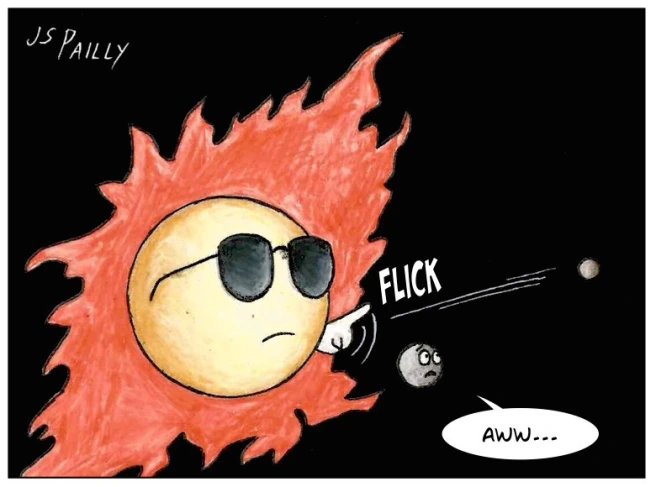
In 2012, NASA announced the discovery of a moon orbiting the planet Mercury. Sadly, this turned out to be an April Fool’s Day prank. In reality, Mercury does not and probably cannot have a moon. Why? Because the Sun is a bully.

Fe06 Flick

For a more complete answer, let’s get to this week’s edition of Sciency Words. Every Friday, we take a look at some new and interesting scientific term so we can all expand our scientific vocabularies together. Today’s word is:

HILL SPHERE

Named after American astronomer George William Hill, a planet’s Hill sphere is the region of space where that planet’s gravity has more influence over orbiting bodies than the gravity of the Sun.

In general, if a moon’s orbit lies within a planet’s Hill sphere, the moon will remain in orbit of the planet. Otherwise, the moon will probably escape the planet’s gravity and begin to orbit the Sun.

To determine the size of a planet’s Hill sphere, we must consider two factors against each other: the planet’s gravity vs. the proximity of the Sun. Even a large, Jupiter-sized planet will have a small Hill sphere if it’s too close to the Sun. Conversely, tiny planets can have surprisingly large Hill spheres if they’re far enough away.

Maybe at some point in the distant past, Mercury did have a moon. But Mercury is too small and way too close to the Sun to have a substantial Hill sphere. Sooner or later, this hypothetical moon would have been yanked away from Mercury and launched into a highly unstable orbit around the Sun.

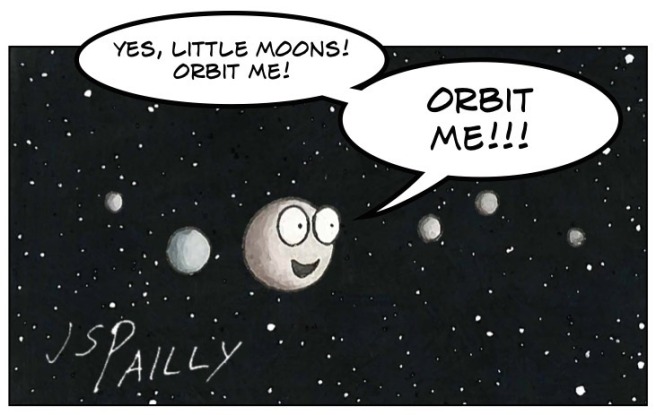
P.S.: Pluto may not be considered a planet anymore, but it still has a Hill sphere, and because Pluto is so far away from the Sun, its Hill sphere is much larger than the Hill spheres of Mercury, Venus, Earth, or Mars. Large enough to hold onto at least five moons.

Fe06 Pluto's Moons

Links

The Moon That Went Up a Hill but Came Down a Planet from Bad Astronomy

File: Hill Sphere of the Planets from Wikipedia

Sciency Words: Volatile

Sciency Words PHYS copy

Today’s post is part of a special series here on Planet Pailly called Sciency Words. Every Friday, we take a look at a new and interesting scientific term to help us all expand our scientific vocabularies together. Today’s word is:

VOLATILE

In colloquial English, the word volatile is an adjective used to describe things like the stock market or the Middle East. But as a technical, scientific term, volatile is a noun.

Volatiles are chemicals that tend to turn into gas at relatively low temperatures or when exposed to a vacuum (like the vacuum of space). Examples include:

  • Hydrogen
  • Oxygen
  • Ammonia
  • Methane
  • Water

Many volatiles are so eager to become gases that they’ll sublimate, meaning they’ll transform from solid to gas without bothering to be liquids first.

As we continue our exploration of the Solar System, we’ll be talking about this class of chemicals a lot. They’re especially important if you want to understand why Mercury is the way that it is. More about that on Monday.

Links

Volatiles from Wikipedia

Outgassing from Wikipedia

A Sciency Collaboration

I’m happy to announce that Sci-Fi Ideas has picked up my Sciency Words series as a new, regular feature on their website. I’ve been reading Sci-Fi Ideas for a few years now, and their articles are great for getting the creative juices going. I can’t tell you how excited I am to be joining their team.

Sciency Words MATH

The emphasis of science fiction is and always must be good storytelling. But as mentioned in a recent Sci-Fi Ideas podcast, science fiction writers do have some obligation to try to get the science part right.

As I do my research, trying my best to become a better Sci-Fi writer, I’m often struck by the diverse and colorful lexicon of scientific terminology I encounter. And that’s why I started writing Sciency Words: to celebrate all the strange, new words science has given us.

For now, Sci-Fi Ideas is reposting older editions of Sciency Words, and they picked some of my favorites. Today, it’s a piece I wrote on orbital vocabulary for last year’s science in video games series.

Sciency Words: SOHO

Sciency Words BIO copy

Today’s post is part of a special series here on Planet Pailly called Sciency Words. Every Friday, we take a look at a new and interesting scientific term to help us all expand our scientific vocabularies together. Today’s word is:

SOHO

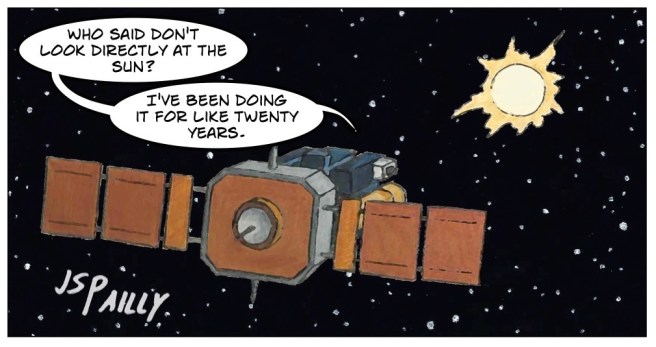
If you want to do any serious research about the Sun, you will soon come across this name: SOHO, short for the Solar and Heliospheric Observatory. It is a project of international cooperation between NASA and ESA (the European Space Agency). The Europeans built it, NASA launched it into space and is now responsible for operating and maintaining it.

SOHO is positioned between the Sun and Earth, and its mission is to monitor and study solar activity. Launched in December of 1995, SOHO was only supposed to be in operation for about two years, yet despite several malfunctions, the thing is still running nearly two decades later.

Much of what we currently know about the Sun is thanks to SOHO (which is why the name came up so often in my research).

  • SOHO observes activity on the Sun’s surface (like Moreton waves), and it has provided us with the first ever images of what’s going on beneath the surface.
  • SOHO is part of our early warning system, helping protect our technologically advanced civilization in case something like the Carrington Event ever happens again.
  • SOHO samples solar ejecta, allowing us to find out what exactly the Sun is spewing into space.
  • Remember that weird thing about the Sun’s temperature? SOHO is helping investigate that too.

Ja12 SOHOSo as we end our month-long adventures with the Sun, let’s give a big round of applause to the SOHO spacecraft, one of the hardest working spacecraft in the Solar System, and let’s hope that it will miraculously keep working for many years to come.
Starting Monday and continuing throughout the month of February, we will turn our attention to the Planet Mercury.

Sun Surfing (Sciency Words: Moreton Waves)

Ja09 Sun Surfing

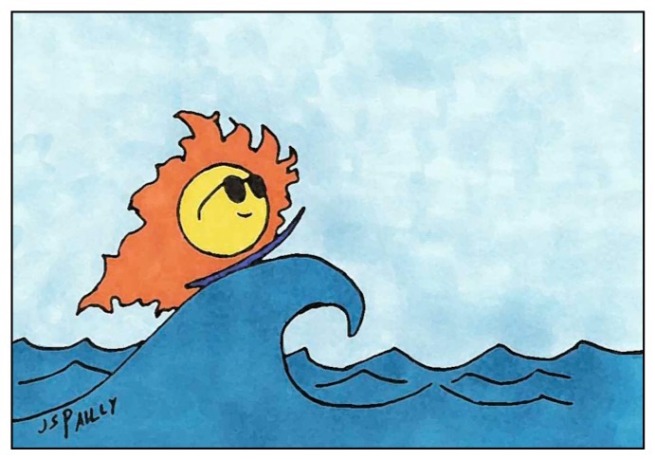
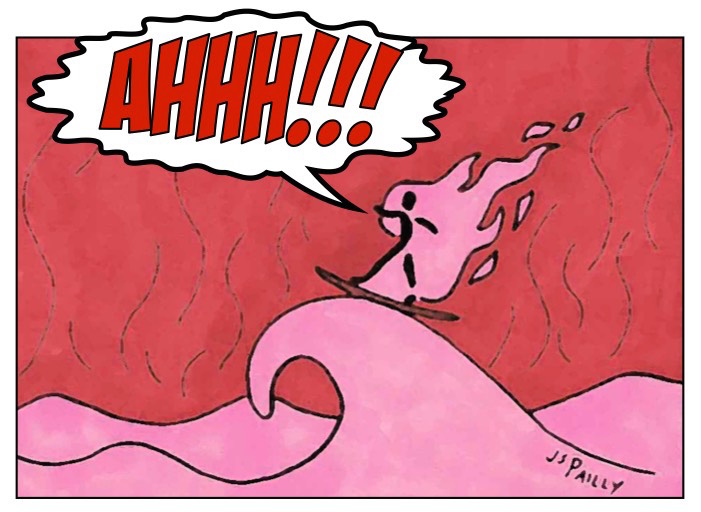
Okay, so the Sun can’t really go surfing, but maybe you could go surfing on the Sun.

Ja09 Surfing on the Sun

Okay, so you can’t really go surfing on the Sun, but if you could, the Sun’s got some pretty sick waves. It’s time for this week’s edition of Sciency Words, where we take a look at a new and interesting scientific term to help us all expand our scientific vocabularies together. Today’s term is:

MORETON WAVES

Sometimes, a solar flare will be so powerful, so intense, that it will cause the surface of the Sun to ripple. Sometimes it will throw up enormous tidal waves of scalding hot plasma. These waves are called Moreton waves, named after Gail Moreton, the astronomer who first discovered them.

In 2009, NASA astronomers observed a Moreton wave (or “solar tsunami,” as they called it) that was 60,000 miles high (100,000 km) traveling at a speed of 150 miles per second (250 km/s). That observation ended any doubts scientists had about the existence of these waves.

So in conclusion, do not go surfing on the Sun.

Sciency Words: The Carrington Event

Sciency Words PHYS copy

Today’s post is part of a special series here on Planet Pailly called Sciency Words. Every Friday, we take a look at a new and interesting scientific term to help us all expand our scientific vocabularies together. Today’s word is:

THE CARRINGTON EVENT

In 1859, British astronomer Richard Carrington was studying the Sun when he observed two bright flashes of light. This turned out to be a major solar storm. As luck would have it, the brunt of the storm was aimed directly at Earth.

Here’s the good news: the world didn’t end.

The bad news is that when the massive cloud of solar ejecta hit Earth, it triggered what’s called a geomagnetic storm, the worst geomagnetic storm on record.

Solar storms like the Carrington Event, pictured above, don’t hit Earth directly.  Instead, they mess with Earth’s magnetic field, which in turn messes with our technology.
Solar storms like the Carrington Event, pictured above, don’t hit Earth directly. Instead, they mess with Earth’s magnetic field, which in turn messes with our technology.

Telegraph wires picked up and transmitted energy from the geomagnetic storm, causing mayhem for telegraph operators around the globe. Operators received nasty electric shocks. Their equipment melted and/or emitted sparks. In some cases, those sparks ignited fires.

The global economy (such as it was in 1859) was disrupted, as were news services and personal correspondences, but things soon returned to normal. As I said, the Carrington Event was not the end of the world.

But imagine if such a thing happened today, with all our phone lines, Internet connections, power grids, airplanes, and satellites? What would happen to our computers, televisions, and microwave ovens? Fortunately for us, the National Oceanic and Atmospheric Administration is on top of this issue, and their Space Weather Prediction Center will be the subject of Monday’s post.

P.S.: If you love learning new words as much as I do, please check out Michelle Joelle’s blog Stories and Soliloquies.  Today (assuming I got the date right), she’s launching a new series called the Philosopher’s Lexicon, so now we can all expand our philosophical vocabularies together!

Sources

The 1859 Carrington Event from Tempo.

Monster Radiation Burst from the Sun from BBC News.

The Solar Storm of 1859 from Wikipedia.


Sciency Words: Ejecta

Sciency Words MATH

Today’s post is part of a special series here on Planet Pailly called Sciency Words. Every Friday, we take a look at a new and interesting scientific term to help us all expand our scientific vocabularies together. Today’s word is:

EJECTA

This is the fancy, technical term for stuff that gets thrown around whenever violent things happen. For example:

  • All the stuff that spews out of volcanoes… that’s ejecta.
  • When a meteor hits, the debris that gets thrown into the air is ejecta.
  • Whenever I get writer’s block, all the crumpled papers strewn around my office are ejecta.

Ja03 Ejecta

Since we’ll be spending most of January talking about the Sun, I figured this is a term we should all know. The Sun gets pretty violent and produces lots of solar ejecta, which is bad news for anyone who lives in space (it’s not exactly good news if you live on Earth either).

Sciency Words: The Other Kind of Tensor

Sciency Words PHYS copy

Sciency Words is a special series here on Planet Pailly where we take a look at new and interesting scientific terms to help us all expand our scientific vocabularies together. Today’s word is:

TENSOR (anatomy)

In last week’s edition of Sciency Words, we looked at what a tensor is in physics. Or at least we tried to since I don’t fully understand the concept yet. Today, we’re looking at tensors in terms of anatomy.

A tensor is a muscle that tenses a body part.

That’s it! We’re done here! Why does the physics version have to be so frickin’ complicated?

Sciency Words: What the Heck is a Tensor?

Sciency Words PHYS copy

Sciency Words is a special series here on Planet Pailly where we take a look at new and interesting scientific terms to help us all expand our scientific vocabularies together. Today’s word is:

TENSOR

I have barely scratched the surface of what this word means. In my efforts to become a better science fiction writer, I spend a lot of time reading (or attempting to read) scientific papers, and I’ve encountered this word many, many times. I have come to the conclusion that tensors—whatever they are—are one of the most important concepts in all of physics.

Here’s what I’ve learned so far:

  • Tensors involve a lot of math.
  • They can be easily translated from one frame of reference to another, assuming you understand all that math.
  • They mathematically show how large sets of coordinates and/or forces are related to each other.
  • Tensors are categorized into different ranks or orders, depending on how much math they involve.
  • Scalars and vectors are examples of simple tensors (order zero and order one, respectively).
  • Seriously, there’s a whole lot of math.

I think I’m off to a good start, but clearly I have a lot to learn. Tensors are used in a wide range of fields (I think I’m making a pun here, though I’m not sure if I get it). They’re used in both relativity and quantum mechanics, they’re used in engineering, and apparently they’re used in computer graphics (meaning they have an artistic application).

If anyone can help me get a better understanding of this concept or if you know a good place where I can try to learn more, please let me know in the comments below. Hopefully one day, I’ll be able to write a more intelligent post on tensors. Until then, keep it sciency, my friends.