Sciency Words: Delta-v

Today’s post is part of a special series here on Planet Pailly called Sciency Words. Each week, we take a closer look at an interesting science or science-related term to help us expand our scientific vocabularies together. Today’s term is:

DELTA-V

Okay, it might be a bit foolhardy of me to try to tackle this term. This is actual rocket science, and I’m nowhere close to being an actual rocket scientist. But this is still far too important of a concept for me to ignore, so I’ll do my best.

The simplest definition of delta-v (often represented mathematically as ∆v) is that it equals your total change in velocity. So if you’re driving along at 25 miles per hour and then accelerate to 65 mph, your delta-v equals 40 mph. And if you decelerate from 65 to 25 mph, your delta-v once again equals 40 mph.

Things start getting interesting when you consider delta-v to be cumulative. So if you start off at 25 mph, accelerate to 65 and then drop back down to 25, your total delta-v equals 80 mph (40 mph + 40 mph).

In rocket ship design, the term delta-v is used as a sort of proxy for how much thrust your engines are capable of and how much fuel you’re carrying. You might also consider the kinds of gravity assists or aerobraking maneuvers you can use to augment your delta-v without expending additional fuel.

This is where the math starts to get complicated, but if you can calculate how much delta-v your spacecraft is capable of, then you’ll know where you can go in space. And if you know where you want to go in space, you can figure out how much delta-v it’ll take to get there and build your spaceship accordingly.

I first learned about delta-v from a video game called Kerbal Space Program. It’s a fun and sometimes frustrating spaceflight simulator that does a reasonably good job approximating how real life space exploration works. Unfortunately I was never very good at it. The scenario in the comic strip above… I made that mistake a lot.

But hopefully I’ve learned my lesson well. I’d hate to run short of fuel during my upcoming totally-for-real, I’m-not-making-this-up trip to Mars (stay tuned!).

Links

The Tyranny of the Rocket Equation from NASA.

Can Kerbal Space Program Really Teach Rocket Science? from Scott Manley (well known for his YouTube tutorials on K.S.P.)

How to Use Kerbal Space Program to Teach Rocket Science from Digital Media Academy.

Six Words You Never Say at NASA from xkcd.

Sciency Words: Aldrin Cycler

Today’s post is part of a special series here on Planet Pailly called Sciency Words. Each week, we take a closer look at an interesting science or science-related term to help us expand our scientific vocabularies together. Today’s term is:

ALDRIN CYCLER

The term cycler can refer to two different but related things in orbital mechanics: an orbital trajectory that continuously and perpetually cycles between two planets, or a spaceship that’s been set on such a continuously, perpetually cycling trajectory.

The mastermind behind this idea is none other than the famous Buzz Aldrin, astronaut extraordinaire. Turns out Dr. Aldrin is more than just a pretty face. In 1985, Aldrin proposed using cyclers to transport equipment and personnel to and from the planet Mars. After crunching the numbers, physicists at NASA’s Jet Propulsion Laboratory confirmed that Aldrin’s idea would work.

The cycler trajectory Aldrin proposed is now known at the Aldrin Cycler. Aldrin’s plan would actually use two spaceships, one for outbound journeys to Mars and another for inbound trips returning to Earth.

According to Aldrin’s book, Mission to Mars: My Vision for Space Exploration, the outbound cycler ship would take roughly six months to reach Mars from Earth; the inbound ship would take about the same amount of time to reach Earth from Mars. Both ships would then spend the next twenty months looping around the Sun to catch up with their home planets and start the cycle again.

Presumably the ships would only carry human passengers during the shorter six-month legs of their respective journeys. The rest of the time, they could just fly on autopilot or remote control.

If the Aldrin Cycler proposal or something similar were implemented, traveling to and from Mars would be sort of like catching a train, with boarding taking place regularly every twenty-six months. I’ve even found a video showing what these cyclers might look like.

Okay, that’s actually an anime that I liked when I was a kid. We don’t have to make cycler ships look like trains (though we totally should).

The major drawback with the cyclers is that the upfront cost of building them will be enormous; however, if we’re serious about establishing and maintaining a permanent human presence on Mars, these cyclers would easily pay for themselves in the long run. The laws of orbital mechanics keep them going, so they’d require little to no fuel.

And since a cycler could keep cycling for decades or centuries or even millennia (in theory, they could go on forever, or at least until the day the Sun explodes), we Earthlings would always have guaranteed access to Mars, and our Mars colonists would always have a guaranteed means of getting home if they needed it.

Sciency Words: Island of Stability

Today’s post is part of a special series here on Planet Pailly called Sciency Words. Each week, we take a closer look at an interesting science or science-related term to help us expand our scientific vocabularies together. Today’s term is:

ISLAND OF STABILITY

According to Star Trek: Voyager, in the 24th Century there will be 246 elements on the periodic table. In one episode, the Voyager crew discovers element 247, and to their astonishment that element is stable.

Here in the 21st Century, on modern day Earth, there are only 91 naturally occurring elements. Element 43, technetium, and everything above element 92, uranium, have to be produced artificially. And these artificial elements are all unstable. Some of them, especially the really, really high numbered ones, are so unstable that they’re effectively useless.

When an atomic nucleus gets too big, the so-called strong nuclear force is no longer strong enough to hold the whole thing together. You can also run into problems if you don’t have a comfortable balance of protons and neutrons. At that point, when atoms are too big or improperly balanced, they start shedding nuclear particles until they can stabilize themselves. This process is called radioactive decay.

If you want, you can draw a chart with the number of protons in an atom along one axis and the number of neutrons along the other. But charts are boring, so let’s draw a map instead.

Physicist Glenn Seaborg (for whom element 106, seaborgium, is named) was apparently a big fan of maps. I imagine he and J.R.R. Tolkein would have gotten along well. In the 1960’s, Seaborg started referring to groups of atomic isotopes by “geographical” names, and these names have stuck.

On the map above, the landmass stretching up from the bottom left corner represents all the stable and semi-stable isotopes. This “Peninsula of Stability” is surrounded by a “Sea of Instability.” But somewhere out in that sea, according to Seaborg and others, certain very large atoms might theoretically become stable. These atoms would have just the right balance of protons and neutrons to hold themselves together despite their extreme size. These “magically” stable isotopes are represented by the Island of Stability.

Physicists have been trying to find the Island of Stability for decades now, but it seems to be perpetually just over the horizon. It was once predicted that elements 110 and 114 might be stable. They’re not. I remember reading that element 118 might turn out to be stable. It didn’t. Now there’s a prediction about element 120. We’ll have to wait and see about that one.

Also there’s a possibility that we’ve been skirting along the island’s coast, so to speak. Maybe if we just add a few more neutrons to some of the unstable elements we’ve already found, they’ll stabilize. Maybe. More on that in next week’s Molecular Monday post.

Personally, I think Star Trek: Voyager was on to something. My prediction is that the Island of Stability will be found all the way out at element 247, and I recommend the IUPAC name it Janewayium.

Sciency Words: Brainjacking

Today’s post is part of a special series here on Planet Pailly called Sciency Words. Each week, we take a closer look at an interesting science or science-related term to help us expand our scientific vocabularies together. Today’s term is:

BRAINJACKING

This is the kind of word you’d expect to find in one of those young adult Sci-Fi dystopia novels. Instead, I first encountered the term in a recent issue of Scientific American.

The word brainjacking is formed by analogy with hijacking. One possible definition involves a parasitic organism taking control of a host’s brain, perhaps altering the host’s brain chemistry in some way. A well known example is the zombie ant phenomenon, which is caused by a parasitic fungus.

But Scientific American was actually talking about humans, not ants—humans with medical implants in their brains, implants which may be vulnerable to hacking. Deep brain stimulation (D.B.S.) systems are sort of like pacemakers for the brain, and they’ve proven to be effective at controlling the symptoms of neurological disorders like Parkinson’s.

According to the abstract for this paper from World Neurosurgery, electronic brainjacking could come in two forms:

  • Blind attacks, which require no patient specific knowledge. Hackers could incapacitate or kill patients, or they could steal data from D.B.S. devices.
  • Targeted attacks, which do require some knowledge about the patient and how, specifically, the D.B.S. system is being used. Hackers could attempt to induce pain, control motor functions, enhance or repress emotions, or manipulate the brain’s rewards system.

Apparently these D.B.S. devices do not have a lot of security features built in, and what’s more they’re deliberately designed to be accessed and programmed wirelessly. That might at first seem like a serious design flaw, but it’s actually a necessary feature. In case of an emergency, E.M.S. personnel may need quick and easy access to your device.

Based on what I’ve read about brainjacking, there are zero documented cases of hackers actually attempting to do this… yet. But it’s clearly something both neuroscientists and cyber-security experts are worrying about.

And if there ever is a future where brain implants become ubiquitous, for both medical and non-medical purposes, then brainjacking may be a word everyone needs to know.

Sciency Words: Chthonian Planet

Today’s post is part of a special series here on Planet Pailly called Sciency Words. Each week, we take a closer look at an interesting science or science-related term to help us expand our scientific vocabularies together. Today’s term is:

CHTHONIAN PLANET

In ancient Greece, there were two ways to pray: with your arms raised up to the gods of Olympus or with your arms lowered in deference to the gods of the underworld, also known as the chthonic or chthonian deities.

Regarding spelling and pronunciation, the “chth” thing makes more sense if you’re familiar with how the Greek alphabet works. Much like the “p” in psychology or the “h” in rhinoceros, the “ch” in chthonian becomes silent in English.

English often retains these silent letters as a way to remind us of a word’s origin and history. Also, we have to do something to keep our spelling bees interesting.

Chthonian became an astronomy term in 2003 thanks to this paper: “Evaporation rate of hot Jupiters and formation of Chthonian planets.” The paper describes a scenario in which a hot Jupiter—a gas giant orbiting waaaaay to close to its parent star—has its entire atmosphere stripped away by solar radiation. Only the planet’s rocky and/or metallic core remains. It would probably look something like this:

This is actually a pretty clever play on the original meaning of chthonian, which could refer to the underworld and all things death-related OR could just mean the earth and everything beneath its surface.

In one sense, chthonian planets are dead. Very, very dead. Also, because a chthonian planet is still located dangerously near to its parent star, conditions there would be truly hellish. But in another sense, these chthonian planets would look like any other Earth-like exoplanets, meaning they are rocky, terrestrial worlds, as opposed to Jupiter or Saturn-like gas giants.

For the time being, the idea of chthonian planets is still more or less theoretical. We have not yet proven definitively that such worlds exist. However, several candidate chthonian planets have been identified. I’ll introduce you to two of them next week.

Sciency Words: Retropy

Today’s post is part of a special series here on Planet Pailly called Sciency Words. Each week, we take a closer look at an interesting science or science-related term to help us expand our scientific vocabularies together. Today’s term is:

RETROPY

In any serious conversation about time travel—and I mean any serious, scientific discussion of time travel, as in the kind of discussion actual real-life physicists might have—there’s a term that is virtually guaranteed to come up: entropy.

I’ve tried to define entropy before for Sciency Words, but I’ve never felt like I’ve done the term justice. It’s a big concept, and kind of a weird concept, and sometimes a depressing concept. It’s also a concept that most of us sort of grasp intuitively, even if we can’t quite put it into words.

The simplest definition is that entropy is the amount of disorder in a system, or perhaps the degree to which a system has decayed. Another good definition is that entropy is the measure of the amount of energy in a system that cannot or can no longer be used for work.

According to the second law of thermodynamics, the total entropy of any closed system will tend to increase over time. You can depend upon that! This makes entropy relevant to time travelers, because it’s one of the very few physical properties that is dependent on which direction time is flowing.

As we move forward in time, entropy will increase. And if entropy is increasing, you (as a time traveler) can be sure that you are traveling forward in time. And if you observe that the entropy of a closed system is decreasing, you can be sure you’re traveling into the past.

In the vocabulary of professional time travelers, there should probably be a special term for when entropy goes into reverse. I don’t know what that word is, but fellow blogger and poet James Ph. Kotsybar (also known as the Bard of Mars) recently proposed a pretty good option: retropy, short for retro-entropy.

He even wrote a haiku about it. It’s worth checking out, along with many of the Martian Bard’s other science-themed poems.

Sciency Words: Angstrom

Today’s post is part of a special series here on Planet Pailly called Sciency Words. Each week, we take a closer look at an interesting science or science-related term to help us expand our scientific vocabularies together. Today’s term is:

ANGSTROM

Last week on Sciency Words, we talked about spectroscopy, a word that’s so important to the kind of space science I write about here on Planet Pailly that I’m surprised I never covered it before.

But in the interest of brevity, I had to skip a lot of the important parts of the history of spectroscopy. I mentioned Isaac Newton and Niels Bohr, but I completely skipped one of the most important “fathers of modern spectroscopy,” Swedish physicist Anders Jonas Angstrom.

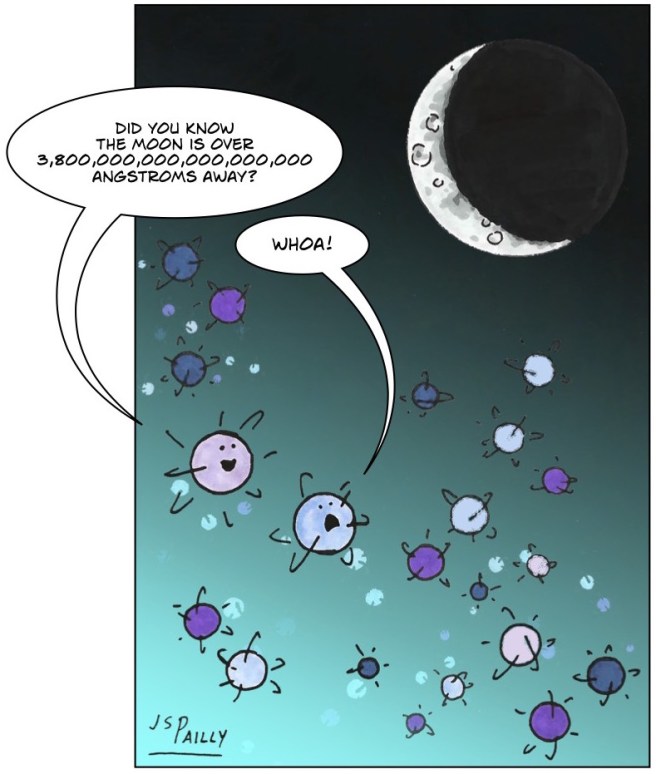
Angstrom is one of those scientists who’s so important he has a unit of measure named after him: the angstrom, which equals 10-10 meters, or 0.1 nanometers, and is represented by the symbol Å (the circle over the A is a Swedish thing—Angstrom’s name is more properly spelled Ångström).

The angstrom is not officially part of the International System of Units (S.I.), but scientists use it anyway. It’s a convenient unit for measuring wavelengths of light, certain tiny crystalline structures, and other distances at the molecular and/or atomic scale.

One of the reasons Anders Angstrom features so prominently in the history of spectroscopy is that he was among the first to combine spectroscopy and photography, allowing him to not only observe a spectrum for himself but to record it for others to see.

In 1868, Angstrom published a book with the first complete map of the Sun’s spectrum in visible light, showing over 1,000 absorption lines indicating the presence of hydrogen, helium, and other elements in the Sun’s atmosphere.

This book, titled Recherches sur le Spectre Solaire (Research on the Solar Spectrum), has long since passed into the public domain, so I was able to find a copy of it available for free online. Now if only I could read French….

As one last note, in his solar spectrum book Angstrom found it convenient to quantify wavelengths of light in units equaling one ten-millionth of a meter, also known as 10-10 meters, or 0.1 nanometers. Or in other words, Anders Angstrom was the first person to measure something in angstroms.

P.S.: I really hope I got my math right for today’s cartoon.

Sciency Words: Spectroscopy

Welcome to a special Saturday edition of Sciency Words, because sometimes life gets in the way of regular blogging schedules. Each week (normally on Fridays) we take a closer look at some science or science-related term so we can all expand our scientific vocabularies together! Today’s term is:

SPECTROSCOPY

What color is it? It sounds almost like a childish question, but as we look out into space, trying to study the Sun and other stars and distant planets, we can learn a great deal just by figuring out what color things are.

The science of spectroscopy has a long history, beginning with Isaac Newton. In the late 1600’s, Newton demonstrated that pure white light can be split apart into a rainbow of color using a prism. Newton called this a spectrum, from the Latin verb specto, meaning “I observe” or “I see.” (According to my trusty Latin-English dictionary, the noun spectrum also meant “apparition” or “ghost.”)

Over the decades and centuries to come (click here for a detailed timeline), scientists used increasingly sophisticated combinations of lenses, mirrors, and prisms to study Newton’s spectrum in greater detail. They also experimented on a wide variety of light sources: sunlight, starlight, firelight, and even electrical sparks.

An especially noteworthy experiment in 1752 showed that burning a mixture of alcohol and sea salt produced an unusually bright yellow band in the middle of the spectrum (we now know this to be a emission line for sodium). And in 1802, another experiment on sunlight revealed multiple dark bands in the Sun’s spectrum (which we now know are absorption lines for hydrogen, helium, and other elements in the Sun’s photosphere and corona).

All the colors of the rainbow, except a few are missing. This is an absorption spectrum.

It wouldn’t be until the early 20th Century, with the development of quantum theory and, specifically, Niels Bohr’s model of the atom, that anyone could explain what caused all these spectral lines.

No rainbow, just a few specific colors. This is an emission spectrum.

In Bohr’s atom, the electrons orbiting an atomic nucleus can only occupy very specific energy levels. When electrons jump from one energy level to another (the true meaning of a quantum leap), they either emit or absorb very specific frequencies of light. The light frequencies are so specific that they act as a sort of atomic fingerprint.

And so today, as we look out into the universe, seeing the glow of stars and the absorption patterns of planetary atmospheres, it’s possible for us to identify the specific chemical elements we’re seeing, even across the vast distances of space, simply by asking what color is it?

Sciency Words: Blackbody Radiation

Today’s post is part of a special series here on Planet Pailly called Sciency Words. Each week, we take a closer look at an interesting science or science-related term to help us expand our scientific vocabularies together. Today’s term is:

BLACKBODY RADIATION

This is a thing you already know, even if you don’t know that you know it. In fact this may be one of the very first scientific discoveries you made as a child: when things get really hot, they glow. As they get hotter, they glow brighter and change colors from red to orange to yellow to white.

This concept is modeled scientifically using something called a blackbody. Imagine an object that is perfectly black, by which I mean that it reflects absolutely nothing and absorbs 100% of the light that falls upon it. No such object exists in real life (although vantablack paint comes close), but a good scientist knows how to imagine impossible things for the sake of a thought experiment.

Now if you were to observe this hypothetical perfectly black object in all wavelengths of light, you might find that it glows slightly in infrared. This is due to the blackbody’s internal heat. As the temperature goes up, the “shade” of infrared you see will start creeping towards the visible part of the spectrum.

Soon, the blackbody will glow dull red, then orange, then bright yellow. As the temperature continues to climb, green and blue will get into the mix, but when so many colors of light are mixed together you tend to see pure white. If you keep going, you’ll get into ultraviolet light and beyond.

I have to admit that I’m glossing over a lot of details here (click here or here for a little more technical info). The important thing to know is that under ideal conditions, when you’re dealing with a glowing hot substance or a glowing hot object (like a stovetop or the Sun or flowing lava), color serves as a useful gauge for temperature.

In the late 19th and early 20th Centuries, the study of blackbody radiation became a matter of paramount importance to science, in large part due to the demands of the Industrial Revolution. Industrialists really needed a way to measure the temperatures of things like molten iron or steel. Dipping a thermometer into molten metal wasn’t a practical option.

Scientists came up with ways to approximate blackbodies in real life (it’s really clever how they did this). Thing is in these laboratory experiments the light emitted by blackbodies did not behave the way it was supposed to, according to classical physics.

In 1900, physicist Max Planck came up with what must have felt like an inelegant way to model light’s weird behavior. For Planck’s model to work, he had to pretend light is sometimes a particle and sometimes a wave. That didn’t make any sense, but it worked. Then in 1905, Albert Einstein proved that no pretending was required: light really is both a particle and a wave.

And thus began the madness of quantum physics!

Sciency Words: Brown Dwarf

Today’s post is part of a special series here on Planet Pailly called Sciency Words. Each week, we take a closer look at an interesting science or science-related term to help us expand our scientific vocabularies together. Today’s term is:

BROWN DWARF

In 1962, Indian astronomer Shiv S. Kumar theorized that there could be objects out there in space too big to be considered planets but too small to become stars. Since main sequence stars are referred to as dwarfs of various colors (our own Sun is a yellow dwarf), Kumar called his theoretical objects “black dwarfs.”

It turned out that the term “black dwarf” was already taken, so in 1975 American astronomer Jill Tarter (best known for her work with the SETI Institute) suggested the name “brown dwarf” instead. In an article from Universe Today, Tarter is quoted as saying: “it was obvious that we needed a color to describe these dwarfs that was between red and black.”

The term stuck, despite the fact that “brown” is a very misleading description. It’s not clear to us what color these objects are or would appear to be to the human eye. They do radiate light, but it’s mostly infrared light. In the visible spectrum, they might appear to be purple or magenta, or perhaps a rather dull red or orange. In fact they may come in all sorts of colors, depending on their metallicity. But astronomers do seem to agree about one thing: brown dwarfs are definitely not brown.

Today, brown dwarfs are typically described as failed stars.

Stars are defined scientifically as objects massive enough to cause nuclear fusion in their cores—specifically, to be classified as a star an object must be able to fuse hydrogen into helium. Brown dwarfs can’t do that.

But while this distinction between stars and brown dwarfs is fairly straightforward, the distinction between brown dwarfs and planets can get pretty murky. We actually don’t know enough yet about either brown dwarfs or exoplanets to be sure where to draw the line separating one from the other.

One of the leading proposals would define brown dwarfs based on their formation. If an object coalesces from a molecular cloud, as a star would, but fails to initiate hydrogen fusion, that object would be a brown dwarf. If an object forms in the accretion disk surrounding a star, the way planets form, then that object would not be a brown dwarf.

Another leading proposal would define brown dwarfs based on their internal physics. If an object can’t fuse hydrogen but can fuse other elements like lithium or oxygen, then that object would be a brown dwarf. (For more about these two competing proposals, click here.)

Eventually the International Astronomy Union will have to step in and set an official definition. But they’re not ready to do that. Not yet. Not until we’ve learned a lot more. In the meantime, ongoing observational research of objects like Gliese 504b (which I’ve nicknamed “Pinkie Pie”) may help the I.A.U. figure out which definition makes the most sense.