Sciency Words: Chemofossils

Today’s post is part of a special series here on Planet Pailly called Sciency Words. Each week, we take a closer look at an interesting science or science-related term to help us expand our scientific vocabularies together. Today’s term is:

CHEMOFOSSIL

On Wednesday, I made up a bunch of numbers for the odds that we will find life on (or bring life to) Mars. The odds, in my inexpert judgment, are pretty low for finding anything presently alive on Mars, but I’d say there’s a 50/50 chance we’ll find the fossilized remains of life that existed there in the past. Now if only our rovers were equipped with digging gear!

But after writing Wednesday’s post, I learned that there are, in fact, many different kinds of fossils, including body fossils, trace fossils, ichnofossils, and chemofossils. And according to this article by Claire Cousins, a planetary scientist working on the European Space Agency’s upcoming ExoMars rover, it’s these chemofossils that will probably be our first real evidence of ancient Mars life.

The word chemofossil is, as you may have guessed, a combination of the words chemical and fossil. I was unable to find out who coined the term, but it seems to have happened fairly recently. According to Google Ngrams, it starts appearing in literature in the 1970’s.

Chemofossils are the telltale chemicals left behind by dead and decaying biomaterial. Even if an organism becomes totally decomposed, there may still be a sort of residue that suggests some sort of past biological activity. A good example, which Cousins cites in her article, are amino acids that share the same chirality.

Finding amino acids on Mars would be mildly interesting, but amino acids can come from just about anywhere. However, if those amino acids all have “left-handed” chirality (or “right-handed” chirality), well… the only natural phenomenon we know of that picks and chooses the chirality of amino acids is life.

Now since I’m still in the mood for making up numbers, I’m going to say there’s a 99% chance someone will announce they’ve detected chemofossils on Mars, BUT we will spend the following decade or two arguing about whether or not they really did. As Claire Cousins writes, discovering life on Mars “[…] will be a gradual process, with evidence building up layer by layer until no other explanation exits.”

In other words, I doubt that discovering chemofossils will definitively prove that life once existed on Mars. But I do think chemofossils will be the first “layer of evidence” we find.

Sciency Words: Airy-0

Today’s post is part of a special series here on Planet Pailly called Sciency Words. Each week, we take a closer look at an interesting science or science-related term to help us expand our scientific vocabularies together. Today’s term is:

AIRY-0

Airy-0 is a small crater on Mars. There’s nothing particularly strange or noteworthy about it. Mars has lots of craters. Or at least, Airy-0 wouldn’t be noteworthy if not for some arbitrary decisions made on Earth over the course of the last few centuries.

In the 1830’s, Earth-based astronomers wanted to know the length of a Martian day, so they picked a dark, easily-identifiable surface feature and used that as a reference point to determine the planet’s rate of rotation. 19th Century astronomers also decided to use that dark surface feature to calculate latitude lines on the Red Planet. In other words, that dark feature (now known as Sinus Meridiani) became the reference point for the Martian prime meridian.

Then in the 1970’s, when NASA’s Mariner 9 space probe began sending back the first detailed maps of Mars, a specific crater within the Sinus Meridiani region was chosen to serve as a better, more precise reference point for the prime meridian. That crater was named Airy-0 in honor of George Biddell Airy, the astronomer who built the Airy Transit Circle telescope at the Greenwich Observatory in England.

I find this extremely fitting. The location of Airy’s telescope is used to define Earth’s prime meridian, so it makes sense that Airy’s crater on Mars would be used to define the prime meridian of Mars. But unfortunately, there seems to still be some uncertainty about Airy-0’s exact location.

Apparently the crater is small enough that space craft can have trouble locking onto it from orbit, and according to this paper from 2014, it turns out Airy-0 is approximately 47 meters east of where it was previously estimated to be. That’s a discrepancy of 0.001º latitude, which may not seem like much, but it’s enough to be problematic for science.

Three pictures of Airy-0 in increasingly high resolution over the past few decades. Airy-0 is the large crater in the top of each picture. Image courtesy of Wikipedia.

So Airy-0 will continue to be subject to intense scrutiny by us Earthlings, not so much because of anything intrinsically special about it but because, for the purposes of Martian cartography and Martian timekeeping, we really, really need to know exactly where Mars’s prime meridian is.

Sciency Words: The Darian Calendar

Today’s post is part of a special series here on Planet Pailly called Sciency Words. Each week, we take a closer look at an interesting science or science-related term to help us expand our scientific vocabularies together. Today’s term is:

THE DARIAN CALENDAR

In 1986, aerospace engineer and polymath Thomas Gangale published a paper titled “Martian Standard Time” in which he outlined a calendar which could be used by Martian colonists in the future. Gangale named this calendar the Darian calendar after his son, Darius, and he describes the idea in greater detail on his website (click here).

According to the Darian calendar, the Martian year begins on or around the vernal equinox, when the sun is directly above the planet’s equator and spring is just beginning in the northern hemisphere. Because the Martian year is nearly twice as long as Earth’s, we get twenty-four months rather than twelve.

The names of the months alternate between the Latin and Sanskrit names for the Zodiak constellations. Thus the month of Sagittarius (the first month of the year) is followed by Dhanus, then Capricornus, then Makara, then Aquarius, and so on until you get to Scorpius and then Vrishika (the last month of the year). Each month has 28 days… sorry, 28 sols… except Kumbha, Rishabha, Simba, and Vrishika (the 6th, 12th, 18th, and 24th months, respectively) unless it’s a leap year, in which case Vrishika is 28 sols long.

And regarding leap years, there are a lot of them: six every decade, so leap years are actually more common than regular years. But then every hundred years we have to take a leap sol away, and then every five hundred years we have to put it back—I know, this is starting to sound complicated, but it’s not that much worse than what we have to do to keep the Gregorian calendar balanced on Earth.

If you’re wondering about the days of the week (I mean, sols of the week), Gangale thought of that too. Each Mars week is made up of seven sols with names that hark back to the ancient Latin names for the days of the week:

Sol Solis (Sunday)
Sol Lunae (Monday)
Sol Martius (Tuesday)
Sol Mercurii (Wednesday)
Sol Jovis (Thursday)
Sol Veneris (Friday)
Sol Saturni (Saturday)

Also, Gangale designed his calendar so that each date always falls on the same sol of the week. The 1st of Sagittarius is always a Sol Solis, for example. That’s pretty convenient, I think, although it also works out that every month the 13th is always on a Sol Veneris (a Friday), which seems rather unlucky.

The question, of course, is will Martian colonists actually adopt this as their calendar? I don’t know, but it seems certain aspects of the Darian system—such as the way it handles leap years—have already been borrowed for other Mars-related research purposes.

Sciency Words: Sol

Today’s post is part of a special series here on Planet Pailly called Sciency Words. Each week, we take a closer look at an interesting science or science-related term to help us expand our scientific vocabularies together. Today’s term is:

SOL

If you’ve read or seen The Martian or pay any close attention to NASA’s ongoing Mars missions, you probably already know what this word means. A sol is a Martian day. The word itself is a shortening of the term solar day, the period of time it takes for a planetary body to rotate once in relation to the Sun.

Technically we could apply this term to any planetary body that experiences regular day/night cycles. A solar day on Earth is 24 hours, as you probably already knew. A solar day on Jupiter is about 10 hours long, and a solar day on Venus is roughly 2,802 hours (or 116.75 Earth days).

But for whatever reason, the shortened form “sol” seems to be used only in reference to Mars, where it equals 24 hours, 39 minutes, and 35 seconds. It’s weird how close a Martian sol is to an Earth day, isn’t it?

Starting with the Spirit and Opportunity missions, NASA has actually made some of its scientists and engineers work on Mars time rather than Earth time. That extra 39 minutes and 35 seconds obviously messes with people’s sleep cycles, eating habits, and social calendars. But it’s important for the crew in mission control to be in sync with the robotics activities taking place on Mars.

Since humans have a natural tendency to be playful with language, a few clever new words have emerged as a result:

  • Yestersol: the sol prior to the current sol, formed by analogy with yesterday.
  • Tosol: the current sol, formed by analogy with today.
  • Solmorrow: the sol after the current sol, formed by analogy with tomorrow.
  • Nextersol: an alternative to solmorrow, presumably formed by analogy with yestersol. Personally I like the sound of solmorrow better.

What really pleases me about these terms is that we haven’t even landed the first humans on Mars yet, and we’re already coming up with vernacular lingo for the Red Planet. Could this be a preview of how Mars colonists might actually speak one day… I mean, one sol? And how else might we adapt human culture to the new environment? I for one am looking forward to Mars’s version of Shakespeare.

Next time on Sciency Words: it’s one thing to know that a Martian day is called a sol, but how the heck are you supposed to find tosol’s date on a calendar?

Sciency Words: Entomophagy (Dining on Mars, Part 3)

Today’s post is a special combination post, continuing my Dining on Mars series and also my regularly scheduled Sciency Words series. Today’s new and interesting science or science-related term is:

ENTOMOPHAGY

When humanity finally makes it to Mars, we might not be going alone. We may end up bringing some insects with us.

To be clear, this wouldn’t be an accidental thing. No, we’d be bringing our insect friends on purpose. Why?

The word entomophagy comes from two Greek words meaning “insect” and “to eat,” and it refers to the practice of eating insects.

Personally, I’m not too keen on becoming an entomophage, but that has more to do with my cultural background than anything else. In many parts of the world that are not the United States or Western Europe, entomophagy is quite normal, and in the near future it may become an important means of feeding a growing global population.

But insects-as-food may be even more important for feeding the early colonial population of Mars. That’s because efficiency is the key to surviving on Mars, and insects make for an extremely efficient food souce. They don’t require a lot of room or resources compared to other sources of animal protein, and when you eat them very little goes to waste. I’m told with some species you’re supposed to remove the wings before cooking, but otherwise the entire insect body is edible.

Apparently insect flavors can vary a lot from species to species, and sometimes depend on what the insects ate themselves. I’ve heard certain species described as “nutty” or “lemony” or even “minty.” Others have more meat-like flavors. According to this article from bugible.com, giant water bugs taste like salted banana, and sago grubs taste a little like bacon. And pan-fried crickets with soy sauce taste amazing, or so I’m told.

Actually, after writing this post I’m feeling a bit hungry. Maybe I could get used to entomophagy after all. Anyone care to join me for lunch?

Sciency Words: Graben

Today’s post is part of a special series here on Planet Pailly called Sciency Words. Each week, we take a closer look at an interesting science or science-related term to help us expand our scientific vocabularies together. Today’s term is:

GRABEN

According to the appendix of Frank Herbert’s Dune, a graben is defined as “a long geological ditch formed when the ground sinks because of movements in the underlying crustal layers.”

According to real life, a graben is… well, it’s exactly what Frank Herbert said it is. The term comes from a German word meaning trench, which is a nice, direct way to describe what grabens look like: trenches.

Grabens tend to form between two “normal faults” if the faults run more-or-less parallel to each other. In other words, they form when two masses of the planet’s crust start moving away from each other, allowing a thin sliver of material to sink down into the gap between them.

Fault-Horst-Graben.svg
Image courtesy: Wikipedia.

I used to think grabens could only form due to the movements of tectonic plates, which would mean we should only expect to find them on Earth—the only planet known to have active plate tectonics. But really grabens can occur on any world where the planetary crust is moving around, being pushed or pulled in different directions, causing the surface to stretch and crack.

That could explain why grabens, or at least surface features that look an awful lot like grabens, have been observed on the Moon, Mars, and other places in the Solar System. And perhaps that’s also why they were found (will be found?) on the planet Arrakis, all the way out in the Canopus Star System, according to Frank Herbert.

Sciency Words: Astro-Paleontology

Today’s post is part of a special series here on Planet Pailly called Sciency Words. Each week, we take a closer look at an interesting science or science-related term to help us expand our scientific vocabularies together. Today’s term is:

ASTRO-PALEONTOLOGY

This may be a first for Sciency Words. Usually I discover new words to share with you during the normal course of my research, but this time I thought to myself, “astro-paleontology has got to be a thing by now,” and then went and found that it is.

Or at least it almost was. Back in the 1970’s, astronomer John Armitage wrote a paper titled “The Prospect of Astro-Palaeontology,” officially coining the term. And then it seems nobody followed up on the idea.

The word paleontology comes from several Greek roots and means the study (-logy) of that which existed (-onto-) in the past (paleo-). It think we’re all familiar with what this really means: digging up the fossilized remains of dinosaurs and other organisms that died long ago. By adding the Greek word for star into the mix (astro-), Armitage created a term for the search for and study of the fossilized remains of life on other worlds.

The blog Astro-Archeology did several posts about Armitage’s work. I recommend checking out all three of these posts:

To be honest, I don’t have a whole lot to add to what Astro-Archeology already wrote on this subject, except that the search for alien fossils on Mars is about to heat up.

None of our current Mars missions are equipped to search for life on the Red Planet, either living or dead. But NASA’s next rover, the Mars 2020 Rover, will be. Specifically, Mars 2020 will be designed to hunt for fossilized microorganisms.

So maybe the term astro-paleontology is due for a come-back.

P.S.: You may have noticed that John Armitage and Astro-Archeology spelled this term as astro-palaeontology and I’m spelling it as astro-paleontology, without the extra a. This is a British spelling vs. American spelling thing.

Sciency Words: Regolith

Today’s post is part of a special series here on Planet Pailly called Sciency Words. Each week, we take a closer look at an interesting science or science-related term to help us expand our scientific vocabularies together. Today’s term is:

REGOLITH

For a long time, I assumed this was another example of having one word for something here on Earth (soil) and a completely different term for the same thing on another planet (regolith). But no, we have regolith here on Earth too; however, other planets and moons do not appear to have soil, strictly speaking.

American geologist George Perkins Merrill is credited with coining the word regolith back in 1897. The term is based on two Greek words meaning “rock blanket.” I don’t know about you, but that conjures up a strange mental image for me. I mean, who’d want to snuggle up under a blanket of rocks?

But after doing further research, I think Merrill was being pretty clever with this one. Regolith is defined as a layer of loose gravel, sand, or dust covering a layer of bedrock.

As for the distinction between regolith and soil, I think it’s best to define soil as a special kind of regolith: regolith that contains enough organic ingredients to support plant life.

By that definition, Earth has both regolith and soil while places like the Moon and Mars only have regolith. That being said, a lot of people (including professional astro-scientists) go ahead and talk about Martian soil when they really mean Martian regolith.

Unless, of course, Martian regolith turns out to have more organic matter in it than we thought!

Sciency Words: Telerobotics

Today’s post is part of a special series here on Planet Pailly called Sciency Words. Each week, we take a closer look at an interesting science or science-related term to help us expand our scientific vocabularies together. Today’s term is:

TELEROBOTICS

This is a pretty easy one, I think. Telerobotics refers to controlling robots from a distance, usually a great distance. This is in contrast to robots that function autonomously or machines that require direct human control.

The word comes from the familiar Greek root tele-, meaning “far away,” and of course the word robot, which originally comes from Czech and means something like “forced labor.”

A wide variety of fields use telerobotics, but for the purposes of this blog we’re most interested in its use in space exploration. At this point most if not all spacecraft are telerobotic in nature. They receive instructions from mission control on Earth, carry out their instructions, and then transmit their status back to Earth so that mission control can decide what to make the spacecraft or space vehicle do next.

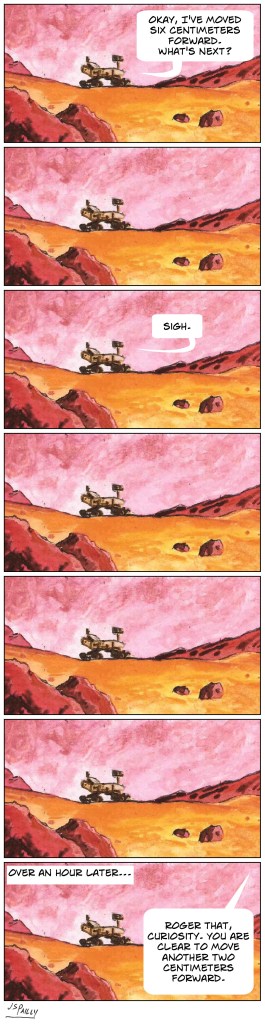
The problem, of course, is that this back and forth communication is restricted by the speed of light. In the case of the Mars rovers, this means that even performing the simplest tasks can take hours and hours. It’s very frustrating, especially for the rovers.

This is one of the biggest reasons Buzz Aldrin and others say we should send astronauts to Phobos (one of Mars’s moons) before sending anyone to Mars itself. From a small Phobos base, astronauts could telerobotically control the rovers in real time. The speed-of-light delay would be negligible.

The rovers could cover a lot more ground that way, dramatically speeding up our exploration of Mars. Also, when the time comes, the rovers could be used to quickly prepare a landing site and assemble habitat structures in advance of the first human colonists arriving on Mars.

Sciency Words: Geologic Periods of Mars

One of the reasons I write this Sciency Words series is to introduce you to terms that I know (or at least suspect) we’ll be talking about in upcoming blog posts. Right now, I’m just getting started with my special mission to Mars series, so I think this is a good time to introduce you to not one but four interesting scientific terms.

Today, we’re looking at the four major periods of Mars’s geological history (based primarily on this article from ESA and this article from the Planetary Society).

PRE-NOACHIAN MARS (4.5 to 4.1 billion years ago)

This would have been the period when Mars, along with the rest of the Solar System, was still forming.

NOACHIAN MARS (4.1 to 3.7 billion years ago)

This period was characterized by heavy asteroid/comet bombardment, as well as plenty of volcanic activity. Most of the major surface features we see today formed during this time: the Tharsis Bulge, Valles Marineris, several of the prominent impact basins in the southern hemisphere, and also the vast northern lowlands—or would it have been the northern oceans? Also valley networks that formed during this time look suspiciously like river channels.

HESPERIAN MARS (3.7 to 3.0ish billion years ago)

Around 3.7 billion years ago, it seems asteroid and comet impacts on Mars died down, and volcanic activity kicked it up a notch. We also see a lot of surface features called “outflow channels” corresponding to this time, rather than the river-like valleys that appeared during the Noachian. These outflow channels may have been created by sudden and violent floods, which may have been caused by melting ice dams releasing lake water.

AMAZONIAN MARS (3.0ish billion years ago to today)

The Amazonian Period began when the northern lowlands, specifically a region called Amazonis Planitia, was “resurfaced,” covering up any impact craters or other surface features that may have been there before. Mars experts disagree about when this happened, but most estimates seem to be in the neighborhood of three billion years ago. Any obvious volcanic or geologic activity ceased during the Amazonian, and for the most part all of Mars’s water has either frozen solid or evaporated into space.

On Earth, if you want to talk about the age of the dinosaurs, what you’re really talking about is the Mesozoic Era, which is subdivided into the familiar Triassic, Jurassic, and Cretaceous Periods. And so if you’re looking for dinosaur fossils, you need look for Mesozoic Era rocks.

At this point we only have a rough sketch of the geologic history of Mars. We don’t know enough to make the kinds of divisions and subdivisions that we’ve made for Earth. But if you want to go looking for Martian dinosaurs (by which I mean fossilized Martian life of any kind, even if its only microbial) then I can tell this much: look for Noachian and Hesperian aged rock formations. Those are the rocks that would have formed back when Mars still had oceans and lakes and rivers (or at least random, violent floods).

At least, landing near some Noachian and/or Hesperian rocks seems to be a high priority for NASA’s Mars 2020 rover.