Sciency Words: Cloaking Devices

Sciency Words: (proper noun) a special series here on Planet Pailly focusing on the definitions and etymologies of science or science-related terms.  Today’s Sciency Word is:

CLOAKING DEVICES

There are certain topics that I think I know a lot about. Star Trek is one of those topics.  But this post is the story of me being wrong about Star Trek things.

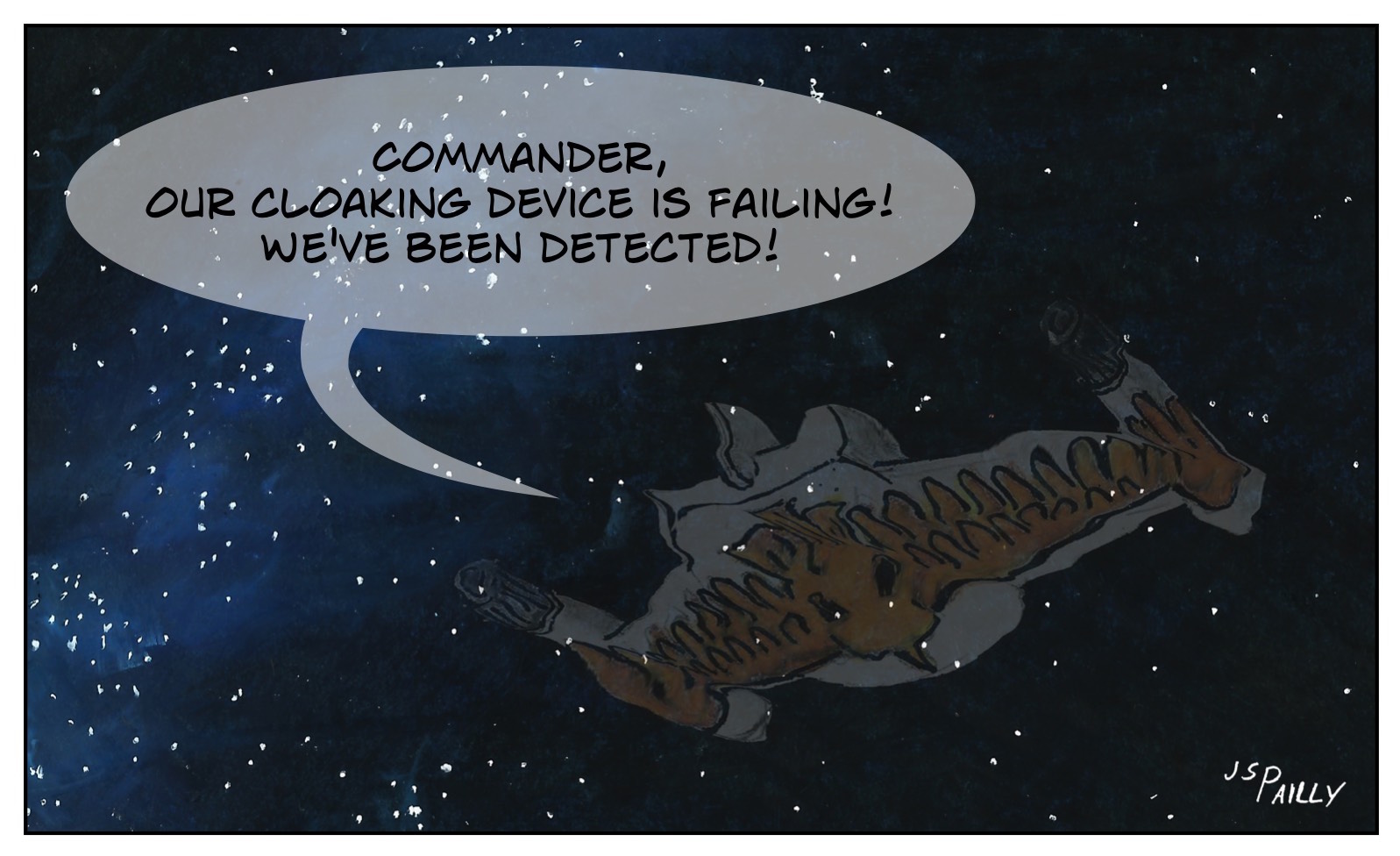
Cloaking devices are a common trope in science fiction.  They’re most closely associated with the Romulans, an alien race that sneaks around the Star Trek universe in their invisible spaceships, like the invisible spaceship pictured below.
Star Trek often gets credit for popularizing cool ideas, but not for inventing them.  I always assumed Star Trek popularized the cloaking device trope, but I figured the writers must have gotten the idea from somebody else—probably one of the early Sci-Fi writers of the pulp era.

But I was wrong.  According to Brave New Words: The Oxford English Dictionary of Science Fiction, the writers of Star Trek really did come up with the whole cloaking device thing.  The term “cloaking device” first appeared in an episode called “The Enterprise Incident” in 1968.

Except being the knowledgable Star Trek fan that I am, I still thought Brave New Words had made a mistake.  If nothing else, they’d overlooked the 1966 episode “Balance of Terror,” when the Romulans and their cloaking technology made their first appearance (or rather, their first disappearance).

But again, I was wrong, technically speaking.  In “Balance of Terror,” Mr. Spock explains that the Romulans are using a “practical invisibility screen.”  The Romulan commander refers to this as a “cloak” or “cloaking system.”  But strictly speaking, no one ever uses the term “cloaking device.”

Even after reading other sources (like this one) that said Star Trek really did invent the term cloaking device, and furthermore that the term really was first used in “The Enterprise Incident” and not “Balance of Terror,” I still didn’t believe it. When you think you know so much about a topic, it’s hard to admit when you’re wrong.  I had to rewatch both episodes to see for myself.

The point of all this is not just to tell you a cool thing about the history of Star Trek or how Star Trek has contributed to the Sci-Fi lexicon.  The real lesson is this: no matter how knowledgeable you think you are about a given topic, there is always still something more you can learn!

Harry Potter and the Curse of Radiolysis

Sciency Words: (proper noun) a special series here on Planet Pailly focusing on the definitions and etymologies of science or science-related terms.  Today’s Sciency Word is:

RADIOLYSIS

A while back, I told you about a few scientific terms that sounded to me an awful lot like magic spells.  I couldn’t shake the mental image of Harry Potter style wizards and witches screaming these words at each other at the top of their lungs.

All of these terms have to do with the breaking of chemical bonds, caused by light (photolysis), electricity (electrolysis), or heat (pyrolysis).  In that original Harry Potter themed post, I promised that if I found another scientific term that fit this same pattern, I’d draw someone in Slytherin colors casting the spell.  All the Hogwarts houses should be represented, right?

Well friends, that the day has finally come! I was recently skimming through this online glossary of astrobiology terms when I stumbled upon the word:

Radiolysis is the breaking of chemical bonds due to ionizing radiation.  To be clear, because there are lots of different forms of radiation out there, radiolysis refers to ionizing radiation only.

That’s the kind of radiation that most people find really scary, and rightfully so.  Ionizing radiation is most commonly associated with atomic bombs and nuclear reactors and stuff like that.  It’s also alarmingly common in outer space.  The Sun, along with all the other stars in the cosmos, are giant thermonuclear reactors, after all!  And despite their best efforts, all the best witches and wizards at NASA have still not found a shield charm that adequately protects our astronauts from the radiolysis curse.

I guess what I’m saying is radiolysis is some pretty dark and dangerous magic, so it’s appropriate that we get to see a Slytherin student playing around with this spell!

P.S.: And in case you were wondering why I was skimming through a glossary of astrobiology terms… I was doing preliminary research for a certain alphabet themed challenge that’s coming up soon.  Stay tuned!

Sciency Words: Submoon

Sciency Words: (proper noun) a special series here on Planet Pailly focusing on the definitions and etymologies of science or science-related terms.  Today’s Sciency Word is:

SUBMOON

After my recent post about exomoons and trickster moons, a reader commented asking about moons with moons.  Honestly, I couldn’t think of any reason why that wouldn’t be possible, but I felt like it must be an extremely rare thing. Otherwise we probably would’ve found something like that in our own Solar System by now.

And according to this paper entitled “Can Moons Have Moons?” the answer is yes.  Theoretically, under certain circumstances, a moon could have a very, very tiny moon of its own.

It’s important to note, however, that for an object to truly be considered a moon, its orbit must be stable.  For example, there are multiple objects that are in temporary orbit around Jupiter, but since those objects are not expected to stick around for more than a few years, or maybe a few decades at the most, they are not included in the official count of Jupiter’s moons.

In most cases, a small object caught in orbit around a moon will have a very difficult time maintaining that orbit.  The gravitational attraction of the nearby planet will just keep tugging and tugging, stretching the orbital path into a wider and wider ellipse.  It won’t take long before the moon’s gravity can no longer hold the small object it captured.

But according to that “Can Moons Have Moons?” paper, if a moon is relatively large (like our own Moon) and orbits relatively far away from its host planet (also like our own Moon), and if there aren’t a whole lot of other moons around to make gravitational interactions complicated, then yes: that moon could have a moon in a stable orbit.  A very, very tiny moon.  Something asteroid sized.

The research paper I’m citing proposes calling the moon of a moon a submoon, but that’s not an official scientific term.  Not yet.  It probably won’t be until an actual submoon is discovered somewhere out there.  Until then, other terms have been proposed, like meta-moon, nested moon, grandmoon, and moonmoon.  Moonmoon seems to be the most popular choice on the Internet, probably because of the Internet meme.  Which means when the time comes the I.A.U. will almost certainly not pick that one.  More likely, the I.A.U. will go with “dwarf moon” and insist that no further discussion of the matter shall be permitted.

For right now, I think submoon is the term with the most scientific legitimacy.  For the purposes of Sciency Words and other sciency writings, I think that’s the term to go with.  But what do you think?  What would you call the moon of a moon?

Sciency Words: Zettatechnology

Sciency Words: (proper noun) a special series here on Planet Pailly focusing on the definitions and etymologies of science or science-related terms.  Today’s Sciency Word is:

ZETTATECHNOLOGY

There’s a process in linguistics called semantic generalization, whereby a word that means something specific evolves into a broader, more general meaning.  This seems to be what happened to the word nanotechnology.

American engineer Eric Drexler is often credited for coining the word nanotechnology.  For Drexler, the word referred to nano-scale robots that could grab atoms and assemble them into molecules for us: whatever molecules we wanted, whatever molecules we could imagine!

But this idea soon came under assault from two sides.  On the one side: the public and elected officials who became increasingly nervous about the grey goo scenario, another term Drexler gets credit for.

And on the other side: specialists in Drexler’s own field who liked the idea of nano-scale technologies but didn’t think nano-scale robots could ever really work.

So Drexler’s colleagues took the word he created and started using it to mean other things: things that seemed more feasible to them and that the public would find less scary.  In other words, they semantically generalized nanotechnology.  In this article from Wired.com, Drexler has this to say about what happened:

I never expected that a bunch of researchers would pick up the label nanotechnology, apply it to themselves, and then try to redefine it.  That’s a shock, and it has led to a tremendous mess for everybody.

So Drexler lost his word, and as a result federal funding for nanotechnology research (as Drexler defined the term) went to other things that now also fell under the (now larger) nanotech umbrella.

Having coined not one but two new science-related terms, Drexler now came up with a third.  What he originally called nanotechnology he now started calling zettatechnology.  As explained in this news stub from AZoNano:

Since a micro-sized product of future molecular manufacturing techniques is likely to have around a sextillion (1021) distinct atomic parts [Drexler] has based the name on the prefix of that number—“zetta”.

I like this word.  Who doesn’t like words that begin with the letter Z? Unfortunately, this one doesn’t seem to have caught on.  This isn’t the first time I’ve profiled a word that didn’t quite make it. After all, the process of linguistic evolution is as much about the words that fail as the words that succeed.

Next time on Sciency Words, what do you call it when a moon has a moon?

Sciency Words: Grey Goo

Sciency Words: (proper noun) a special series here on Planet Pailly focusing on the definitions and etymologies of science or science-related terms.  Today’s Sciency Word is:

GREY GOO

American engineer Eric Drexler is often credited with coining the word nanotechnology, a term which essentially made his career and his reputation.  Ironically, Drexler also created the term that, according to this article from Wired.com, seems to have destroyed his career.

Nanotechnology, as Drexler envisioned it, involves nano-scale robots swimming around in a sea of atoms, assembling whatever molecules we have programmed them to build for us.  But what if we program our nano-assemblers to build more of themselves?  What if we can’t get them to stop building more of themselves?

Drexler warned of this possibility in 1986, in his book Engines of Creation. He described the growing mass of nano-assemblers as a grey goo, a blobby thing that just keeps growing and growing and growing until it consumes the whole planet.

That article from Wired is kind of dated (it’s from 2004), but the story it tells is fascinating, especially for our purposes here on Sciency Words.  It portrays Drexler as a shy, nerdy kid who grew up to be a shy, nerdy adult.  He had a revolutionary idea (nanotechnology) which propelled him to success and prestige.

But he also planted the seeds of his own downfall.  The grey goo scenario got picked up by science fiction writers and the media.  Fear and anxiety grew among the general public, and ultimately Congress cut off funding for nanotechnology, or at least they cut off funding for the kind of research Drexler wanted to do.  Drexler’s career was ruined as a result.

This sounds so much like a Greek tragedy, or perhaps the origin story of a super villain, that I can’t help but think Wired was embellishing some of the details.  Even so, words have enormous power to shape public discourse about any issue. Drexler seems to have learned that lesson.

Next time on Sciency Words, we’ll look at one more word Eric Drexler invented in an effort to salvage his vision of tiny, molecule-assembling robots.


Sciency Words: Nanotechnology

Sciency Words: (proper noun) a special series here on Planet Pailly focusing on the definitions and etymologies of science or science-related terms.  Today’s Sciency Word is:

NANOTECHNOLOGY

In 1959, Richard Feynman gave a lecture at Caltech entitled “There’s Plenty of Room at the Bottom” (here’s a transcript).  In that lecture, Feynman said:

The principles of physics, as far as I can see, do not speak against the possibility of maneuvering things atom by atom.  It is not an attempt to violate any laws; it is something, in principle, that can be done; but in practice, it has not been done because we are too big.

This is often cited as the point at which the science of nanotechnology was born, but it would be a few decades yet before the word nanotechnology came into use.

American engineer Eric Drexler is often credited with coining the term in reference to machines that would operate on a nanometer scale—on the scale of atoms, in other words.  Drexler envisioned what he called nano-assemblers which could maneuver about among atoms, picking individual atoms up and sticking them together like Lego blocks.

There was, and still is, a lot of debate among scientists about whether of not this could really work.  Atoms, in a sense, have minds of their own.  They’re not going to sit passively and let us do whatever we like with them.  You can’t circumvent the usual chemical processes that allow molecules to form.  Rather than sticking Lego bricks together, it might be better to compare a nano-assembler’s job to herding cats.

But for the purposes of this post, I’m going not going to say anything more about the actual science of nanotechnology, because there’s an interesting story to tell about the word itself.  While the word may have been coined by a scientist, it was laypeople (especially the media) that embraced it and turned it into a popular scientific term.  As explained in this paper from Interdisciplinary Science Reviews:

Interestingly, there was no process of consensus in the scientific community that nanotechnology was to be the term to describe the science, but then no one had come up with a competing word and it rather succinctly described what the activity was all about.  Like clothing fashion, however, the term rapidly became the norm without anyone actually stopping to ponder where it came from and why.

The word nanotechnology nicely demonstrates the role that the media can have in spreading a new scientific term and thus, in turn, influencing the parlance of the scientific community who came up with the science in the first place.

So if not for the media and public interest, maybe nanotechnology would not have become as well established a term as it is.  This is important because universities have established departments of nanotechnology, and grant money is allocated specifically for nanotechnology research.  That might not have happened if the word weren’t so well known.

However, the case could also be made that media attention has held nanotechnology research back.  But we’ll talk about that in next week’s episode of Sciency Words.

Sciency Words: Nominal Solar Radius

Sciency Words: (proper noun) a special series here on Planet Pailly focusing on the definitions and etymologies of science or science-related terms.  Today’s Sciency Word is:

THE NOMINAL SOLAR RADIUS

Last week, I told you about the classification system in use for main sequence stars. Today we’re going to talk specifically about G-type stars.  Or rather, we’re going to talk about one G-type star in particular: the Sun.

I was recently clued in on a controversy about the Sun.  After reading up on the issue, though, I don’t think this is a real controversy.  It’s more like an Internet controversy.

If you’ve ever wondered how big the Sun is, a quick Google search will get you an answer.  But it won’t get you the correct answer.  That’s because we apparently do not know precisely how big the Sun is.  As this paper from 2018 states: “[…] measuring with high accuracy the diameter of the Sun is a challenge at the cutting edge of modern techniques.”

Part of the problem is that we’ve tried using multiple methods for either measuring the Sun’s radius by direct observation or by calculating the radius based on other kinds of measurements.  And we keep getting different answers.  I take it we’re not getting wildly different answers, but there’s enough variation there to create a problem for scientists who study the Sun.

So here’s where the alleged controversy comes in.  Our friends at the I.A.U.—the International Astronomy Union, the same organization that decided Pluto is not a planet—decided a few years ago what the Sun’s radius should be.  They said it equals 695,700 km.  No more, no less.  I mean, who are these people to decide what is or is not a planet?  Who are these people to decide now how big the Sun is?

Except that’s not actually what the I.A.U. did. Regardless of how I may feel about the whole Pluto thing, I do agree with the I.A.U. about their definition of the solar radius.  Or to speak more precisely, I agree with their definition of the nominal solar radius.  As explained in the I.A.U. resolution on this matter:

These nominal values should be understood as conversion factors only—chosen to be close to the current commonly accepted estimate […] not as the true solar properties.  Their consistent use in all relevant formulas and/or model calculations will guarantee a uniform conversion to SI units.

So I don’t think the controversy, such as it is, really exists.  If we’re going to use the nominal solar radius as a unit of measure, we all have to agree about what that unit of measure is equal to—especially because we still don’t know what the actual solar radius is.

Feel free to bash the I.A.U. about Pluto, if you want, but when it comes to their nominal solar radius definition, I think the way they handled it makes a lot of sense.

Sciency Words: Oh Be A Fine Girl/Guy, Kiss Me!

Sciency Words: (proper noun) a special series here on Planet Pailly focusing on the definitions and etymologies of science or science-related terms.  Today’s Sciency Word is:

OH BE A FINE GIRL/GUY, KISS ME!

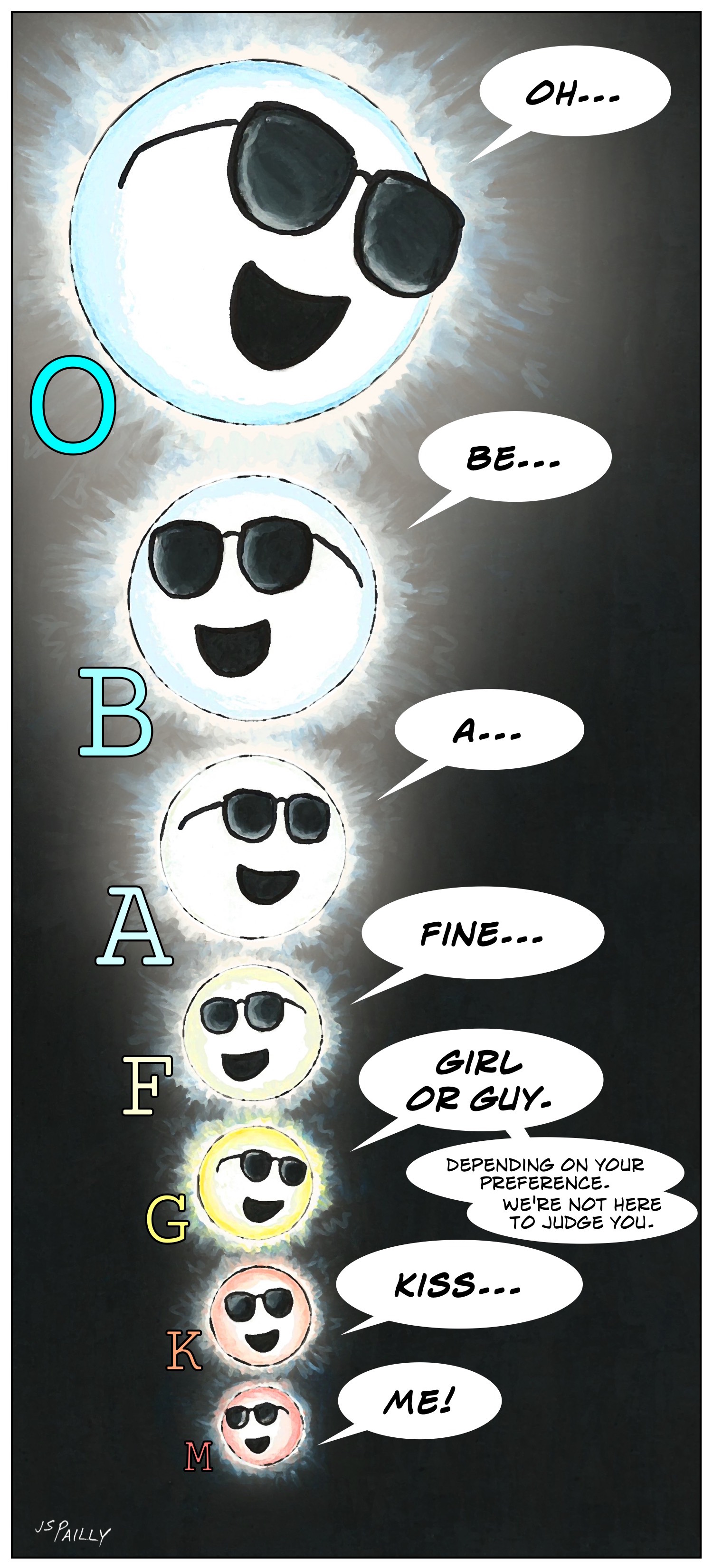
Our Sun is a main sequence star, meaning it fuses hydrogen into helium within its core.  The vast majority of stars in the universe are main sequence stars. They’re very important. Unfortunately, the classification system we use for these main sequence stars is a bit odd and not very easy to remember.

The biggest, hottest main sequence stars are called O-type stars.  The smallest and coldest are called M-type stars.  You’d be forgiven for thinking the stars in between are called N-type stars, but no.  Between the letters O and M, we get B, A, F, G, and K-type stars.

Apparently, at least according to Wikipedia, it didn’t start out this way.  Initially, all stars were classified under a different alphabetical system which, I presume, made more alphabetical sense.  But this seems to be yet another case of scientists naming things before those things are properly understood.

In the early 1910’s, Danish astronomer Ejnar Hertzsprung and American astronomer Henry Norris Russell put together what is now known as a Hertzsprung-Russell diagram.  This diagram revealed a close relationship between the color and brightness of most stars.  The color and brightness of these main sequence stars is also closely related to temperature and mass, respectively.

The old system no longer made much sense, but the alphabetical labels had been so widely used in scientific literature that it would have been difficult to get rid of them.  American astronomer Annie Jump Cannon is credited with fixing the problem: she rearranged the old lettering scheme to reflect our new knowledge about stars.  Henry Norris Russell then came up with a handy mnemonic device to help us remember the new system:

I have to admit I’ve always felt like this phrase is a bit pervy.  At least it’s a little more gender inclusive than it used to be (Russell’s original version was “Oh be a fine girl, kiss me,” because obviously astronomers are always male, and obviously males only want females to kiss them—but we’ve moved on from both of those assumptions since Russell’s time).

Still, as a mnemonic device, it works well enough. As I was reading this paper about the search for Earth-like planets, and how various types of main sequence stars might affect those planets, I found myself repeating the “Oh be a fine girl/guy, kiss me!” line quite a lot.  Not out loud, of course.  That would have gotten me slapped by somebody, I’m sure.

Sciency Words: Karman Line

Sciency Words: (proper noun) a special series here on Planet Pailly focusing on the definitions and etymologies of science or science-related terms.  Today’s Sciency Word is:

THE KARMAN LINE

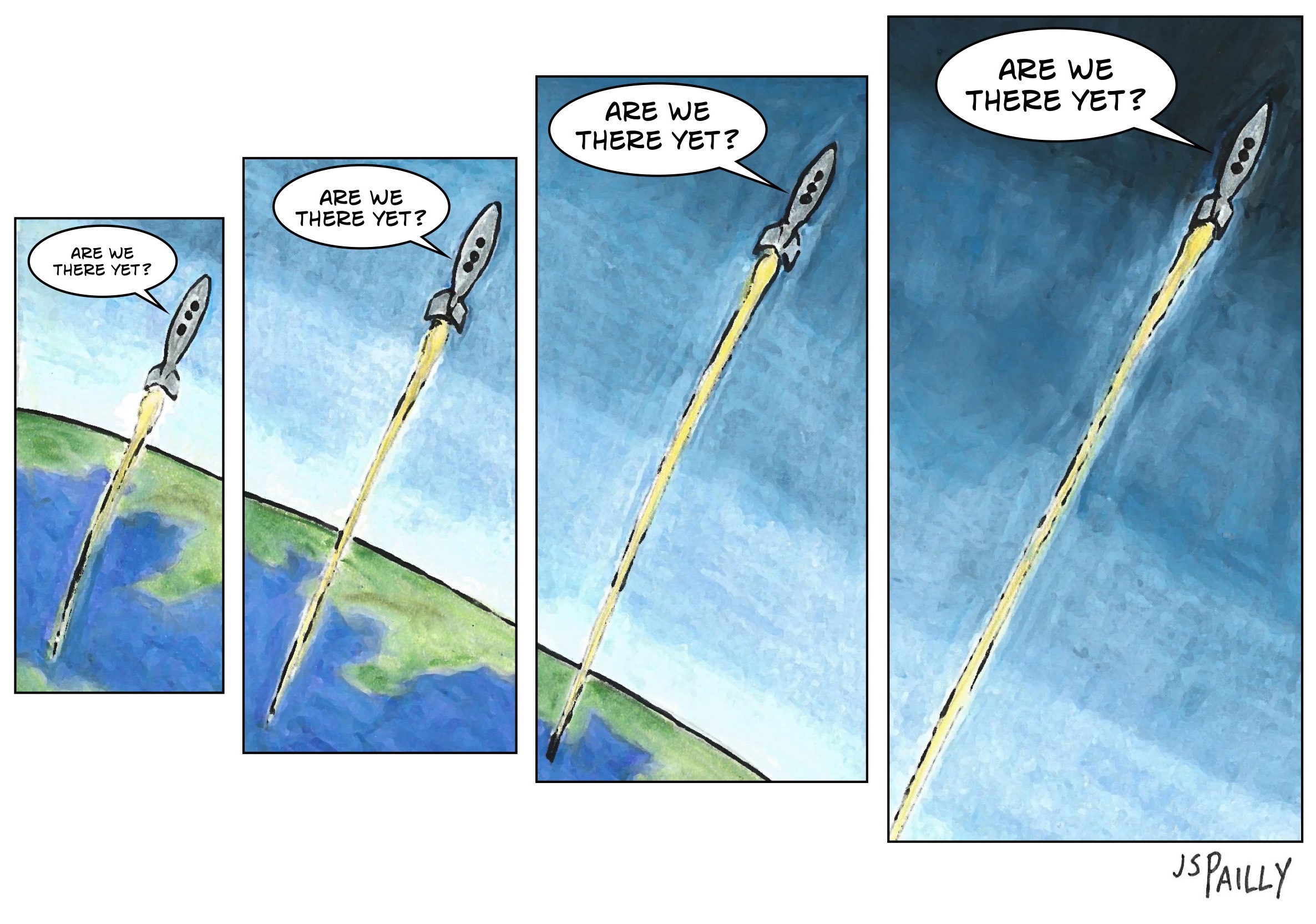
If I may begin on a personal note, I spent most of 2018 essentially grounded by real life problems.  So for 2019, I’m dusting off the old imaginary spaceship, and I’m ready to launch myself back into outer space.  It seems I have a whole lot of space research I need to catch up on!  But first, where exactly is space?  How far away is it?

In the early 1960’s, Hungarian-American physicist Theodore von Kármán proposed an idea that has come to be known as the Karman line. Basically, the Karman line can be defined as the altitude where you need to stop thinking in terms of aerodynamics and start thinking in terms of orbital mechanics.

A traditional aircraft flying above the Karman line will no longer get enough lift to stay aloft, and a satellite or other space vehicle that dips below the Karman line will experience too much atmospheric drag to maintain its orbit.  Technically speaking, there are still more layers of Earth’s atmosphere above that line, but still this seems like a sensible enough place to define the beginning of outer space.

So how high up is the Karman line?  According to the Fédération Aéronautique Internationale (F.A.I.), which is sort of like the Guinness Book of World Records specifically for air and space flight, the Karman line is 100 km above sea level.  This is the value that seems to be most commonly accepted around the world, but it is not the value accepted by one noteworthy space agency: NASA.

According to NASA, space begins 50 miles above sea level. This 50 miles number is not merely a result of America’s famous disdain for the metric system.  As explained in this paper from Acta Astronautica, calculating the exact altitude where aircraft can no longer fly and satellites can no longer maintain their orbits has been a challenge for many decades; however, an estimate of 80 km (approximately 50 miles) may be closer to the real Karman line than the 100 km estimate set by the F.A.I.

A lot may depend on your spacecraft’s design, the parameters of your orbit, and solar activity, which causes Earth’s atmosphere to puff up slightly at times.  But to quote from that Acta Astronautica paper:

[…] elliptical orbits with perigees at 100 km can survive for long periods. In contrast, Earth satellites with perigees below 80 km are highly unlikely to complete their next orbit.

In other words, a satellite can safely dip below an altitude of 100 km, but if it gets as low as 80 km, that satellite is toast.

So when I climb back into my imaginary spaceship, how far up do I need to go to reach space?  50 miles?  100 km?  Or is there some other number I should be aiming for?

I’m still not sure.  But given the places I’m planning to go with my research in the coming year, maybe it doesn’t really matter.  Me and my imaginary spaceship will be flying well beyond the Karman line, wherever precisely that line is.

Sciency Words: Cyborg

Welcome to another episode of Sciency Words, a special series here on Planet Pailly where we take a closer look at the definitions and etymologies of science or science-related terms so we can expand our scientific vocabularies together.  Today’s term is:

CYBORG

In 1960, two American researchers named Manfred Clynes and Nathan Kline were worried.  How could human beings ever hope to survive in the extreme conditions of outer space?  As they saw it, there were two solutions: we could either create artificial environments for ourselves, or we could alter our bodies to better suit the harsh realities of space.

That first option—creating artificial environments for ourselves in space—seemed utterly impractical to these two men. They equated it to fish inventing mobile fishbowls so they could leave the sea and go explore the land.

No, it would be far safer, easier, and cheaper (they reasoned) to reengineer the human body and mind through the use of technology, pharmaceuticals, and hypnosis.  So, first at a symposium on human space flight and then in this article for the journal Astronautics, Clynes and Kline described a “self-regulating machine-man system,” and they decided to call this hypothetical invention a cyborg.

The word is a portmanteau, combining the first three letters of the word “cybernetic” with the first three letters of the word “organism.” It’s actually Manfred Clynes who’s generally credited with coining the word.  Kline apparently liked the word well enough, but according to this article from The Atlantic, he expressed some concern that it sounded too much like the name of a town in Denmark.

Clynes and Kline seem to have had some rosily optimisitic notions about what our cyborgized future might have been like. Becoming cyborgs would not, in any way, diminish our humanity.  Rather, we would be elevated, both physically and spiritually, by all the new opportunities that would suddenly be available to us to go out and explore the universe.

With the benefit of historical hindsight, I think it’s easy to see at least one flaw in this idea.  The original question was how would human beings be able to survive in space?  Our options were the mobile fishbowl method or the total cybernetic reengineering of our bodies.

Well, since 1960, human beings have been to space quite a few times.  Our mobile fishbowls have their flaws, but they work well enough most of the time.  Replacing the human respiratory and digestive systems with technological alternatives (as Clynes and Kline suggested we’d need to do, among other things) does not sound like a safer, easier, or cheaper solution.  I mean, as difficult and expensive as it was to build the International Space Staion, that’s still probably easier and cheaper than doing the kind of surgery Clynes and Kline were talking about.

Maybe someday, that kind of cybernetic augmentation will become a reality.  But we’ll have to learn a whole lot more about how our bodies work first.  At least that’s how I see it.

P.S.: Clynes and Kline would have argued that cyborgs are still human, but better.  A superior form of human being, perhaps.  That is a position that the titular cyborg in my “Dialogue with a Cyborg” story would not agree with.