Kotta kottomira (Tomorrow News Network: A to Z)

Hello, friends, and welcome to week three of the A to Z Challenge!  For this year’s challenge, I’m telling you all about the universe of Tomorrow News Network, my upcoming Sci-Fi adventure series.  In today’s post, K is for:

KOTTA KOTTOMIRA

My muse is right.  If I told you what the words Kotta kottomira mean in universe, that would be a huge spoiler for The Medusa Effect, book one of the Tomorrow News Network series.  Unfortunately, I don’t have any other K-words to write about.

Hmmm….

Well, I can tell you this.  As part of my writing process, I host what I call “editing parties.”  I invite a few friends over for dinner.  Then after we eat, I read aloud a selection of whatever my current work in progress is.  It’s a great way to get instant feedback.  It’s far more effective than traditional beta reading, in my opinion.

Now in earlier drafts of The Medusa Effect, Kotta kottomira (whatever that is!) was originally Komse komsavia.  As far as gibberish space alien words go, I thought Komse komsavia looked good on the page.  It sounded right in my head, and beta readers never commented on it.  But when I read those words aloud to my friends, my friends started laughing.

Turns out that Komsa komsavia sounds too much like the French phrase comme ci, comme ça, meaning “neither good nor bad” or “eh, it’s so-so.”  At that point in the story, I had not yet revealed what my alien gibberish was supposed to mean, but it definitely was not supposed to mean that!

So I changed it.  Very special thanks to David and Andrea for helping me catch that little mistake.  Hopefully Kotta kottomira makes better alien gibberish than what I had before, and hopefully the ending of The Medusa Effect has not been spoiled for you by this blog post!

Next time on Tomorrow News Network: A to Z, Litho is a peaceful, isolated colony world.  Nothing bad could ever happen there.
Journalistic Integrity (Tomorrow News Network: A to Z)

Hello, friends!  Welcome to another episode of the A to Z Challenge.  For this year’s challenge, I’m telling you more about the universe of Tomorrow News Network, my upcoming Sci-Fi adventure series.  In today’s post, J is for:

JOURNALISTIC INTEGRITY

Tomorrow News Network has lots of weird aliens, cool planets, and gigantic spaceships.  Also, time travel.  Plenty of time travel.  But in a sense, T.N.N. isn’t really about any of that stuff.  Really, this is a series about journalism.

They say write what you know.  Just about every aspiring author has heard that advise at some point.  Well, I’ve spent over a decade working in the news business.  It’s an exciting and important job.  It can also be a frustrating and depressing line of work, depending on what happens to be in the news today.  The news business is what I know, so that’s what I write about.

Which brings us to the issue of journalistic integrity.  To quote my main character, the time traveling news reporter Talie Tappler:

You have to understand: we at the Tomorrow News Network have a policy.  We report the news.  We do not make the news, or remake the news, or interfere with the news in any way.  […]  It’s a matter of journalistic integrity.

Talie’s sense of journalistic integrity will be a source of conflict in most (if not all) of the Tomorrow News Network adventures.  She is a time traveler.  She knows the future.  When she shows up to cover a newsworthy event, she knows already what’s going to happen.  She knows who will suffer, who will die, and who will stand triumphant in the end.

And Talie will not interfere.  She will not meddle with history.  She will not alter time.  All Talie will do is smile coyly and tell you, “It’s a matter of journalistic integrity.”

Next time on Tomorrow News Network: A to Z, I will very awkwardly try to tell you about Kotta kottomira without revealing what those words mean (because that would be a major, major spoiler).

P.S.: A while back, I wrote a guest post for Fiction Can Be Fun about the real life origins of Tomorrow News Network.  So if you want to know more about how I’ve incorporated my work experience into my Sci-Fi writing, please click here.

Inverted Space (Tomorrow News Network: A to Z)

Hello, friends, and welcome back to the A to Z Challenge.  For this year’s challenge, I’ve been telling you more about the universe of Tomorrow News Network, my upcoming Sci-Fi Adventure series.  In today’s post, I is for:

INVERTED SPACE

On ancient Earth, there were three great revolutions in physics.  First came Isaac Newton and his laws of classical mechanics.  Then came Albert Einstein with his theories of special and general relativity.  And lastly, near the end of the 21st Century, Dr. Harold Strickland published his theory of inverted space.

In the simplest possible terms, inverted space is a place where the laws of physics are reversed.  It’s a universe of anti-physics, if you will.  Dr. Strickland believed that in order for our universe to exist as it does with the laws of physics that it has, then an equal and opposite universe must also exist to create balance.

One might expect such a radical and bold theory to spark debate and controversy among the scientific community.  It did not.  Few took any notice of Strickland’s work at the time.  It wasn’t until many years after Strickland’s death that he received the recognition and credit he deserved.  What changed?  The discovery of faster-than-light technology.

You see in our universe, nothing can travel faster than the speed of light; in inverted space, nothing can travel slower than light.  Of course, jumping into inverted space is dangerous.  The laws of physics are reversed, after all.  The attractive forces that hold atoms and molecules together become repulsive forces.  Molecular and atomic decoherence can occur within seconds!

But a quick jump in and out of inverted space is relatively safe, and a sequence of quick, carefully calculated “inversions” can allow a spacecraft to cross the vast distances of the galaxy.

It’s also worth noting that in inverted space, time runs backwards instead of forwards.  This troubled Dr. Strickland, yet it was an unavoidable consequence of his math.  If you were to jump through inverted space and then jump back to your starting location, would you not arrive before you departed?  Would this not violate causality and create a time travel paradox?

As it turned out, nature has its own ways of preventing paradoxes, even if Dr. Strickland couldn’t find them in his math.  When you push two magnets together, either positive to positive or negative to negative, the magnets resist.  They repel each other, and the harder you try to push them together, the harder they push back.

Something similar occurs in inverted space.  If you jump through inverted space and then attempt to jump back to your original location, your spacecraft will be deflected off course.  Your past and present selves seem to repel each other, like magnets, and so this is known as the chronomagnetic effect.

Nothing in the theory of inverted space predicted this chronomagnetic effect would exist, and nothing about the theory of inverted space can help explain why it occurs.  So while inversion theory is more advanced than relativity theory or classical mechanics, it still does not provide a complete picture of how the universe works.

For a complete picture of how the universe works, you’d have to learn about chronotheory, the science of time travel.  And next time on Tomorrow News Network: A to Z, we’ll talk about the people who use chronotheory to bring you tomorrow’s news today.

Hykonians (Tomorrow News Network: A to Z)

Hello, friends!  For this year’s A to Z Challenge, I’m telling you a little more about the universe of my upcoming Sci-Fi adventure series, Tomorrow News Network.  In today’s post, H is for:

HYKONIANS

Much like Mr. Cognis, the cyborg who’s addicted to emotions, the Hykonians are an idea that I salvaged from one of my old, abandoned manuscripts.  Actually, they appear in more than one of my old manuscripts.  You see, the Hykonians and I… we have a long history.

As a small child, I was already a space adventurer.  Sometimes I’d recruit other kids on the playground to be my crew.  The jungle gym was our spaceship, and we had to defend Earth from evil space aliens.  And what were those evil space aliens called?  They were called Hykonians, of course!  I have no idea how I came up with that name.  It just sounded right.

As I transitioned from playing on jungle gyms to writing my own stories and drawing my own comic books, the Hykonians continued to serve as my go-to bad guys.  They abducted humans for their evil experiments.  They hurled planet crusher missiles at Earth.  And when I started writing about time travel, the Hykonians were first in line to steal my hero and heroine’s time machine.

In science fiction, alien species often fit into easy categories.  You’ll find a warrior race or a logical race or a spiritually transcendent race or a race that’s obsessed with social media or a race that cannot understand the concept of love.  But because the Hykonians have been so many things in so many stories, I have a hard time pinning them down in that way.

In one story, I made them highly religious to the point of superstitious.  In another, they were led by a technocratic form of government that rejected anything but pure scientific fact.  They were an egalitarian culture, sometimes; but in one story I started exploring racial divisions in their society, with certain Hykonians jokingly calling themselves “High-konians” while others were referred to as “Low-konians.”  Also, at one point I wanted the Hykonians to be totally asexual.  Now they have four genders, and translating Hykonian pronouns into English is a huge problem.

So when I write about the Hykonians in Tomorrow News Network, I intend to honor everything that they’ve been in all those old stories.  Does that make Hykonian culture messy and confusing?  Yes.  Yes it does.  It’s just like human culture in that way.

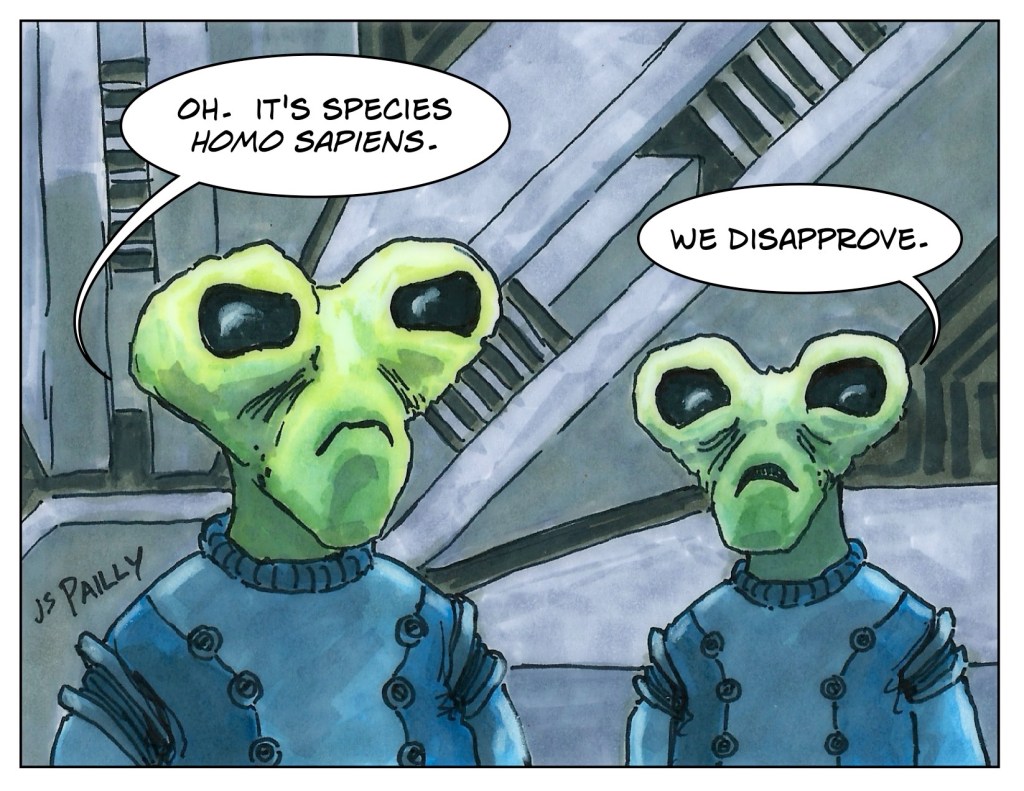
In Tomorrow News Network, the border of the Hykonian Hegemonic Empire is only a few lightyears away from Earth.  The Hykonians are effectively our next door neighbors.  And they’d be friendly neighbors, except that things sort of got off on the wrong foot between our two species.  Thus, the Hykonians do not approve of us Earthlings.

And unfortunately, we Earthlings have good reason to keep our guard up against them.

Next time on Tomorrow News Network: A to Z, anything that travels faster than light must also travel backwards through time.

The Galactic Inquisitor (Tomorrow News Network: A to Z)

Hello, friends!  Welcome back to the A to Z Challenge.  For this year’s challenge, I’m telling you a little more about the universe of Tomorrow News Network, my upcoming Sci-Fi adventure series.  In today’s post, G is for:

THE GALACTIC INQUISITOR

I’ve put a lot of thought into the world-building for Tomorrow News Network, and in these A to Z posts I’ve done my best to provide lots of detail (without straying into spoiler territory, of course).  But for today’s post, I’m afraid I don’t have many details to offer.

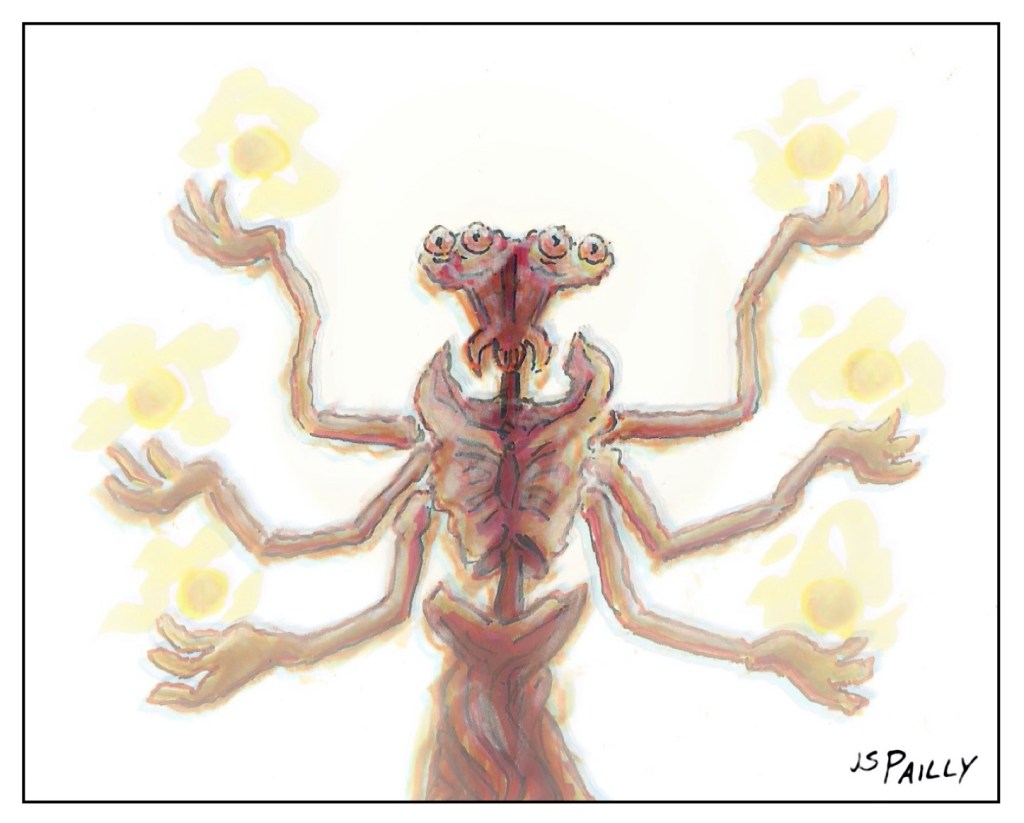
No one knows who the Galactic Inquisitor is.  No one knows where he/she/it came from, or how long he/she/it has been around, or what the source of his/her/its power might be.  On digi-stream, rumor has it that the Galactic Inquisitor is a giant insectoid, perhaps the last living remnant of the ancient insectoid races who once ruled the universe.

But of course, you shouldn’t believe everything you read on digi-stream.

While the identity and origins of the Galactic Inquisitor remain a mystery, his/her/its philosophy of justice has been made abundantly clear to anyone who’s had to stand trial in the Galactic Inquisitor’s court.  In the Galactic Inquisitor’s own words:

Real power must understand its own strength.  Real power must learn to be gentle.  Otherwise, real power will make itself the enemy of true justice.

However, despite these words, the Galactic Inquisitor is rarely gentle when exercising his/her/its power.  In the name of true justice, whole star systems have been obliterated.  Entire species have been wiped out, and vast dead zones of sterilized worlds have been left scattered throughout the galaxy.

And so in matters of interplanetary law, it is often wiser to settle disputes as swiftly and as independently as possible, before the Galactic Inquisitor feels the need to intervene.

Next time on Tomorrow News Network: A to Z, the human race has neighbors!

The Fermi Paradox (Tomorrow News Network: A to Z)

Hello, friends!  For this year’s A to Z Challenge, I’m telling you more about the universe I’ve created for my upcoming Sci-Fi adventure series, Tomorrow News Network.  In today’s post, F is for:

THE FERMI PARADOX

Okay, bear with me.  This post is going to get weird.  Some of what I’m going to tell you is true.  The rest is totally made up Sci-Fi nonsense.

THIS PART IS FACT

Historians disagree about the exact date, but sometime around 1950, nuclear physicist Enrico Fermi was having lunch with a few physicist colleagues.  The topic of conversation: extraterrestrial life.  It was during this conversation that Fermi famously quipped: “But where is everybody?”

Dr. Fermi then proceeded to lay out all the reasons why advanced alien civilizations should exist out there among the stars, and also all the reasons why we should have detected their presence by now.  And yet, despite our best efforts, we’ve found nothing.  So where is everybody?

This question is now known as the Fermi Paradox.  If you’re a scientist involved in SETI research, you will have to grapple with this issue at some point.  And if you’re a science fiction writer creating a sprawling Sci-Fi universe full of advanced alien civilizations, well… you should probably imagine up some sort of solution to the Fermi Paradox.

Mind you, it doesn’t have to be the most scientifically plausible solution.  But some of your readers will surely be wondering about this, so….

THIS PART IS FICTION

In time index 117-299, a Hykonian observation vessel crashed on Earth near a small Earthling village named Roswell.  The cause of the crash remains unknown.  The fate of the Hykonian crew remains unknown.  And what happened to the wreckage of the spacecraft itself?  Again, unknown.

Due to the suspicious circumstances surrounding the Roswell incident, the Galactic Inquisitor was forced to intervene.  The Hykonian Hegemony has demanded retribution; meanwhile, the local authorities on Earth continue to claim ignorance (something, something, weather balloons).  Until this matter is resolved, the Galactic Inquisitor has imposed an isolation ordinance over Earth.

All forms of interstellar communications are being jammed, and no spacecraft shall be permitted to enter of leave the Solar System.  Recent violations of this ordinance by NASA’s Voyager 1 and Voyager 2 space probes are currently under investigation.

Most Earthlings are left wondering, understandably, why they seem to be alone in the universe.  And so things shall remain until the Galactic Inquisitor’s ordinance is lifted.

Speaking of the Galactic Inquisitor, next time on Tomorrow News Network: A to Z, we’ll meet the timeless, near godlike being who maintains law and order in the galaxy.

Exofleet (Tomorrow News Network: A to Z)

Hello, friends, and welcome to the second week of the A to Z Challenge!  This year, my theme is the universe of Tomorrow News Network, my upcoming Sci-Fi adventure series.  In today’s post, E is for:

EXOFLEET

I started developing the Tomorrow News Network universe way back in 2011.  And it was way back in 2011 that I thought up an absolutely perfect name for an outer space military organization: the Space Force.

Apparently somebody else thought that name sounded cool too.  Now the term “Space Force” comes with a certain amount of political baggage, and… well, I don’t really want to deal with any of that in my own creative work.

While trying to think up a new name for Earth’s military forces, I took some inspiration from my ongoing obsession with scientific terminology.  Astronomers tend to make this weird distinction between objects found in our Solar System and objects found orbiting other stars.  Hence, the distinction between planets and exoplanets, moons and exomoons, asteroids and exoasteroids, etc.

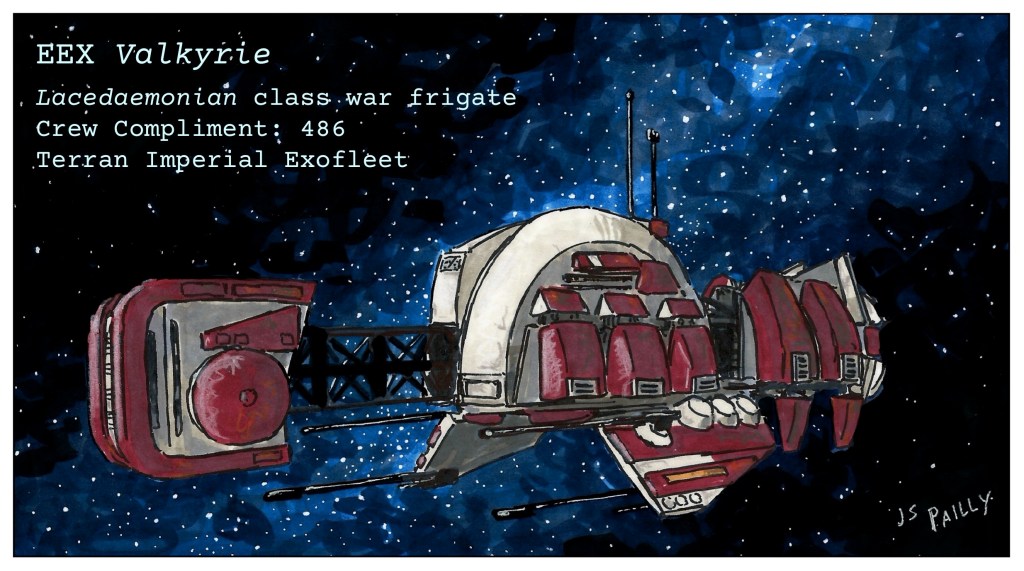
And so in the distant future of Tomorrow News Network, the Earth Republic (and later the Earth Empire) is defended by not one but two space militaries.  The Solar Fleet patrols and protects the Solar System itself, while the Extrasolar Fleet (a.k.a. the Exofleet) ventures out into the galaxy, expanding Earth’s territories and defending humanity’s borders against alien aggressors.

Would outer space military forces really be divided up in this way?  Does the distinction between the Solar Fleet and the Exofleet make sense?  Maybe, maybe not.  Personally, I don’t think the distinction between planets and exoplanets makes much sense either.  We humans love drawing divisions and making distinctions between things, regardless of whether or not those distinctions and divisions are necessary.  With that in mind, I think the Solar Fleet vs. Exofleet thing is true to life, even if it’s not the most pragmatic way to organize an outer space military.

In the Tomorrow News Network series, we’ll be seeing a lot more of the Exofleet than the Solar Fleet.  I mean, if the Solar Fleet ever has to go into battle, that must mean things are really bad, right?  It would take an extremely rare and extremely powerful invasion force to break through the Exofleet’s lines and threaten the Solar System itself.  Let’s hope that never happens!

Next time on Tomorrow News Network: A to Z, there are tons of aliens in the Tomorrow News Network universe, and yet as of the year 2020, we Earthlings haven’t made contact with any of them.  Why is that?

Digi-Stream (Tomorrow News Network: A to Z)

Hello, friends, and welcome back to Tomorrow News Network: A to Z.  For this year’s A to Z Challenge, I’m telling you all about the story universe I created for my upcoming Sci-Fi adventure series, Tomorrow News Network.  In today’s post, D is for:

DIGI-STREAM

There’s a longstanding trope in science fiction.  In the future, something very similar to the Internet will still exist, but it will be rebranded with an even more futuristic sounding name.  The Datanet.  The Cybersphere.  The Omni-Web.  Something like that.

I’ve heard a lot of people complain about this trope.  Why wouldn’t people in the future just call the Internet the Internet?  I was tempted to do just that in Tomorrow News Network, but then I realized that scaling up the Internet from a world wide web to a galaxy wide web might not work so well.

Why not?  Because of speed-of-light delays.  Connecting to a server on the galactic web could take hundreds or perhaps thousands of years (if not millions or billions of years), depending on which planet that server is located on.  Talk about slow Internet speeds!

Faster than light travel and faster than light communications are possible in the Tomorrow News Network universe, but not without consequences.  In the logic of Tomorrow News Network physics, anything traveling faster than light must also be traveling backwards through time.  We’ll talk about this more when we get to the letter I, but for now I’ll just say this: in most cases, F.T.L. technology creates more time travel-related headaches than its worth.

So instead of having continuous access to a galactic Internet, humans living in far-flung corners of the galaxy rely on a subscription service called digi-stream.  For young Milo Marrero and his girlfriend, Lianna (sorry, I mean Milo’s friend who happens to be a girl), the weekly digi-stream downlink is an opportunity to read all the insane rumors and crazy conspiracy theories that are circulating about the Tomorrow News Network and their star reporter, Talie Tappler.

But just as with the Internet of today, you shouldn’t believe everything you read in the weekly digi-stream downlink.

Next time on Tomorrow News Network: A to Z, we’ll meet the brave men and women who defend Earth from its enemies.

Cognis (Tomorrow News Network: A to Z)

Hello, friends, and welcome to day three of the A to Z Challenge.  For this year’s challenge, I’m telling you a little more about the universe of Tomorrow News Network, my upcoming Sci-Fi adventure series.  In today’s post, C is for:

COGNIS

Dear readers, I know some of you are fellow writers, so today I’m going to offer you some writing advice.  You know those abandoned manuscripts and story ideas you have collecting dust?  You know all those writing projects that just didn’t work out the way you wanted?  They don’t have to go to waste.  Think of them, instead, as a resource to be used for future writing projects.

Way back when I was an angsty teenager, I wrote a short story about a cyborg named E.K. Cognis.  Being a cyborg, Mr. Cognis had no emotions, but he was curious about what emotions might be like.  So Cognis and a fellow cyborg named K.T. Macnera downloaded a bunch of emotions into their brains. It was a profoundly mind-altering, mind-expanding experience.

As I said, I was an angsty teenager.  Downloadable emotions were supposed to be a metaphor for drug use.  Initially, Mr. Cognis and Ms. Macnera only wanted to “experiment” with emotions, but it’s not long before they become addicted.  After that, their status as upstanding members of cyborg society deteriorates rapidly.

This may be the single worst story I’ve ever written, a case of a young writer trying way too hard to be edgy.  The original story may or may not be saved on a floppy disk somewhere.  I will likely never find it, and I’m okay with that.

But when I started work on my Tomorrow News Network series, I soon realized that my main character—time traveling journalist Talie Tappler—would need a cameraman.  And when I thought of Mr. Cognis, I realized I had a character already made and ready to slip right into that role.

Cognis’s ongoing addiction to emotions creates plenty of opportunities for both humor and conflict in the Tomorrow News Network stories.  So does his complicated relationship with Ms. Macnera, who now works for T.N.N. as an assignment editor.

Tomorrow News Network has salvaged a great many concepts and characters from my old, abandoned stories.  Mr. Cognis was only the first. Story scavenging (as I like to call it) has made the process of creating a whole new Sci-Fi universe so much easier.  So don’t feel bad if you have some old, abandoned story ideas that never worked out.  Treat them as resources that can be used for building your next story world.

Next time on Tomorrow News Network: A to Z, turning the World Wide Web into the Galaxy Wide Web is far easier said than done.

Berzelius (Tomorrow News Network: A to Z)

Hello, friends!  For this year’s A to Z Challenge, I’ll be telling you more about my upcoming Sci-Fi adventure series, Tomorrow News Network.  In today’s post, B is for:

BERZELIUS

When you’re creating your own science fiction universe, you don’t have to know everything about everything, but it can be helpful to know a little bit more than what you end up telling your readers.  Today, I’m going to share a few details about the planet Berzelius.  Some of this will be in my book; most of it will not.

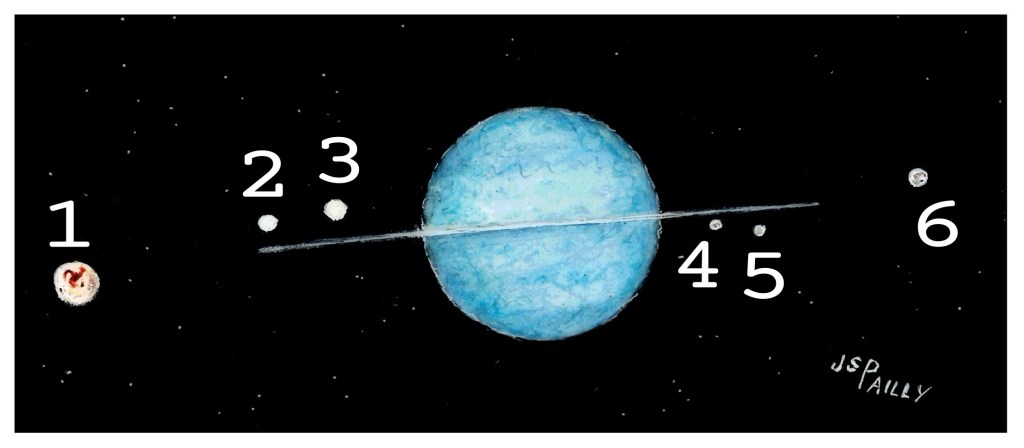
The planet Berzelius is an ice giant located in the Vesper Beta-Beta Star Sector.  It orbits a K-type (orange dwarf) star, and it has an impressive ring system and a family of five moons.

In terms of internal composition and structure, Berzelius has much in common with the planets Uranus and Neptune in our own Solar System; however, unlike Uranus or Neptune, Berzelius is located within the habitable zone of its sun.  Thus, the five moons of Berzelius are capable of supporting life—and at least one of those moons does support life in the form of scrubby, slimy “cyanomolds.”

The planet Berzelius is named in honor of Swedish chemist Jöns Jacob Berzelius, who is widely regarded as one of the founders of modern chemistry.  Berzelius is also closely associated with the discovery of lithium, the third element on the periodic table of elements.  Since lithium mining is such an important part of A.E.I.’s business, the name seemed appropriate.

Now all you lithium fanatics may be wondering why the planet isn’t named in honor of Johan August Arfwedson, the man who actually discovered lithium while working in Berzelius’s laboratory.  Well, don’t worry.  Something’s named after Arfwedson too, but we’ll talk about that when we get to the letter R.

Lastly, before I end this post, I just want to emphasize to you again that the planet Berzelius has five moons.  Count them:

See?  Five moons.

Next time on Tomorrow News Network: A to Z, dealing with emotions can be tough.  It’s even tougher when you’re a cyborg.