Molecular Monday: What Do Aliens Breathe?

Welcome to Molecular Mondays, a relatively new series here on Planet Pailly. Every other Monday, we examine the atoms and molecules that serve as the building blocks of our universe, both in reality and in science fiction. Today, we turn our attention to:

ELECTRONEGATIVITY

Ever since I started this Molecular Mondays series, I’ve wanted to identify chemicals that could serve as alternatives to oxygen in alien biochemistries. My research eventually led me to the concept of reduction potentials, which has now led me to the more fundamental concept of electronegativity.

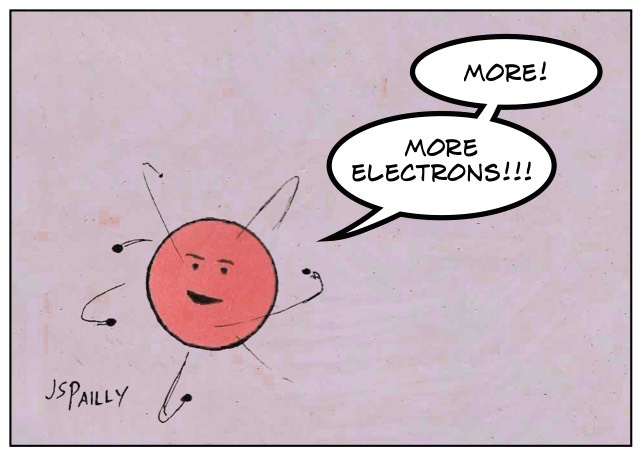
When atoms join together as molecules, they share each other’s electrons, but they rarely share equally. Certain atoms (notably oxygen) tend to hog electrons. Electronegativity measures how much electron hogging an atom is wont to do.

When considering how electronegative an atom is, we should ask two key questions:

  • How many protons are in the nucleus?
  • How many layers of electrons surround that nucleus?

Since protons have a positive charge, an atom with more protons can exert a stronger attractive force on nearby negatively charged electrons.
My08 High Electronegativity

But that attractive force is mitigated by the atom’s own electron shells. More shells mean less electronegativity.
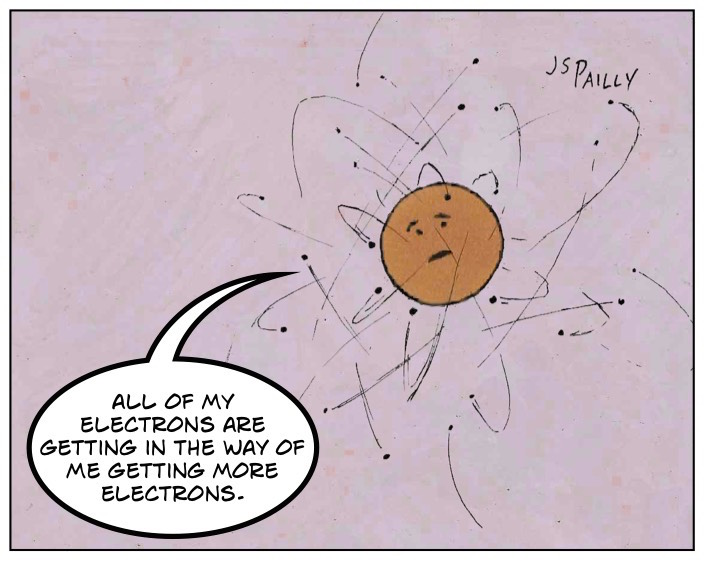
My08 Low Electronegativity

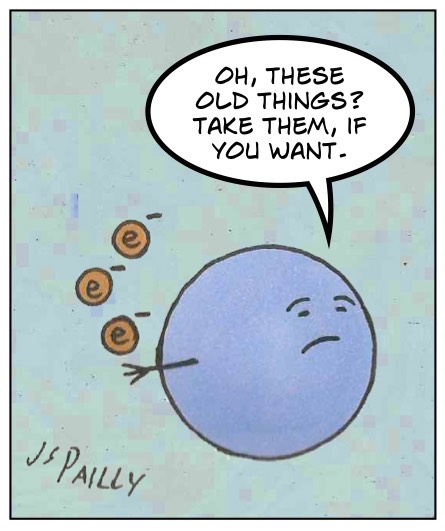
Oxygen’s exceptionally high electronegativity means it’s very eager to participate in any chemical reaction that will give it more electrons, including the biochemical reactions that make multicellular life possible on Earth.

So what do aliens breathe if they don’t breathe oxygen? A quick look at the periodic table shows that several elements have electronegativities in a similar range to oxygen. So in terms of astrobiology, or at least in terms of writing science fiction, I believe two elements deserve special attention: fluorine and chlorine.

Molecular Monday: Oxidation, Part Three

Molecular Mondays are a special series here on Planet Pailly about the atoms and molecules that make up our universe, both in reality and in science fiction. In the last two Molecular Monday posts, we looked at the relationship between oxidation and reduction (Oxidation, Part 1) and the purpose of oxidation states (Oxidation, Part 2). Today, we turn our attention to:

REDUCTION POTENTIALS

Meet an oxidant: a chemical substance that really wants to obtain more electrons.

My02 Mr Oxidant

Also, meet a reductant: a chemical substance that wouldn’t mind losing a few spare electrons.

My02 Mr Reductant

When these two substances combine, the oxidant will oxidize the reductant, and the reductant will reduce the oxidant. Because oxidation and reduction always occur together, the combined reaction is called a redox reaction.

But not all redox reactions are created equal. Some are more energetic than others.

Just how eager two substances are to oxidize and reduce each other can be quantified in terms of reduction potentials. A high reduction potential indicates that a substance really, really wants to gain electrons. A low reduction potential means a substance would be quite happy to lose some electrons.

I won’t go into how chemists determine the reduction potentials of individual substances, but I will point out that reduction potentials are measured in volts. As I currently understand it, the greater the difference between the reduction potentials of two substances, the greater the voltage will be when those substances react.

This, I think, is a pretty good hint as to why living cells use redox reactions for their energy production. Within the context of science fiction, understanding redox chemistry and the significance of reduction potentials can help in the imagining of both futuristic technology and extraterrestrial biochemistry.

This is my final post on redox reactions, at least for now. I won’t pretend that I fully understand redox reactions, nor will I pretend that I’ve fully explained them in these last few Molecular Mondays posts. But I am convinced more than ever that studying this topic is of immense value for science fiction writers like myself.

Molecular Monday: Oxidation, Part Two

Molecular Monday is a special series here on Planet Pailly about the atoms and molecules that make up our universe, both in reality and in science fiction. Today, we’re continuing our investigation of oxidation-reduction reactions by taking a closer look at:

OXIDATION STATES

Most of us will remember from school that when atoms join together as molecules, they share each other’s electrons.

Ap09 Sharing 1

However, atoms don’t always share their electrons equally.

Ap09 Sharing 2

Chemists assign oxidation states to atoms within molecules to represent how many electrons each atom has effectively gained or lost in this unequal sharing.

An atom with an oxidation state of -1 has effectively gained one electron. An atom with an oxidation state of +2 has effectively lost two electrons. (Yes, positive numbers mean losing electrons and negative numbers mean gaining them. This is the convention we’re stuck with, even though it might make more sense the other way around.)

There’s a list of rules to guide you through the process of figuring out the oxidation states of each atom within a molecule. I’m not going to go through those rules here because a) it’s a rather long list and b) if you really want to see it, you can find it easily enough with a Google search.

Studying the rules for oxidation states reminds me of trying to memorize all the rules for comma usage in English grammar. On the surface, the rules seem simple enough, but then there are exceptions, and exceptions to the exceptions, and obscure situations that you’re told you’ll probably never encounter, but if you do enough writing and/or chemistry, I guarantee you’ll encounter those obscure situations eventually.

So oxidation states end up being somewhat messy and complicated, which reflects the rather messy and complicated reality of atoms. I remember getting frustrated in high school chemistry class because chemical reactions (especially oxidation/reduction reactions) never seemed to jive with my preconceived notions about atoms and molecules. But that’s an important truth about science: nature does what it wants and doesn’t care what you or I think about it.

I’m planning one more post on oxidation-reduction reactions. You can expect to see that two weeks from today. Then we’ll be moving on to some of the other chemical reactions that I found so frustrating in school.

Molecular Monday: Oxidation, Part One

With this new Molecular Mondays series, I’m challenging myself to dive into the world of chemistry. As a science fiction writer, I really should know this stuff. Just because I had some bad experiences in high school chemistry class doesn’t mean I can keep avoiding the subject forever.

I have long suspected (and now know for certain) that my biggest problem with chemistry is that I don’t understand oxidation. In school, the concept was explained in a dreadfully confusing way. As I recall, I was told that oxidation has nothing to do with oxygen, and then I was given examples of how the process works, all of which involved oxygen.

So before I go any further with chemistry, I need to get this straightened out.

At this point in my research, I can say that the name oxidation is slightly misleading, as is the name of oxidation’s counterpart chemical process: reduction.

  • Oxidation: an atom (like iron) loses electrons to another atom (like oxygen).
  • Reduction: an atom (like oxygen) gains electrons from another atom (like iron).
  • Redox: since oxidation and reduction always occur together, redox refers to this chemical reaction in its entirety.

Scientists sometimes name newly discovered phenomena before they are fully understood. By the time a phenomenon can be better explained, it’s often too late to change the name. Thus, reduction means gaining electrons and oxidation does not necessarily have anything to do with oxygen.

It seems that the first time oxidation was studied scientifically, oxygen was the main culprit. When oxygen bonds with other atoms, it sort of hogs electrons.

Ap03 Greedy Oxygen

So because of its particular greed for electrons, oxygen does a whole lot of oxidizing. But we now know oxygen is by no means the only element that does so.

The next few editions of Molecular Mondays will continue to focus on oxidation—or rather, redox reactions as a whole. I’ll try my best to keep you updated on how my studies are progressing. Any advice, insight, or encouragement would be greatly appreciated.

P.S.: One of the best chemistry resources I’ve found so far is the YouTube series Crash Course: Chemistry with Hank Green (the guy from Sci Show). Hank has done a great job getting me started on this subject.

If you’d rather learn about something else, there are plenty of other Crash Course series available on YouTube, such as Crash Course: World History and World History 2.

Molecular Monday: Carbon Monoxide vs. Carbon Dioxide

Today’s post is part of a special series here on Planet Pailly called Molecular Mondays. Every other Monday, we take a closer look at the atoms and molecules that are the building blocks of our universe, both in reality and in science fiction. Today’s molecule—or rather, today’s molecules—are:

CARBON MONOXIDE and CARBON DIOXIDE

As I’ve mentioned before, I’m not the best at chemistry. So when someone told me carbon monoxide and carbon dioxide are basically the same thing, I felt pretty sure this was wrong. But not 100% sure. So I did some research.

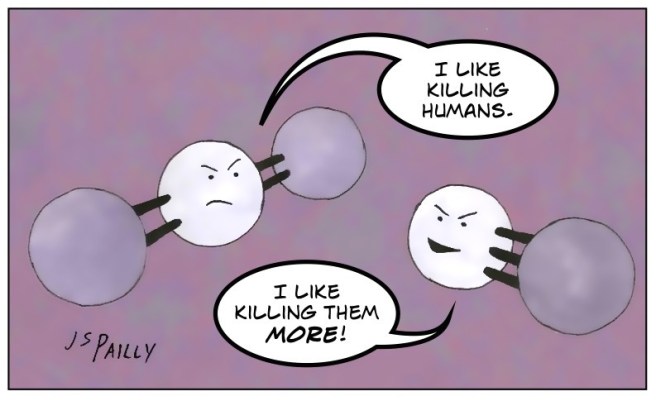
On the surface, carbon monoxide (CO) and carbon dioxide (CO2) do seem kind of similar. They’re both colorless, tasteless, odorless gases. They’re both produced by combustion. And they’re both deadly to humans.

A common conversation between CO2 (on the left) and CO (on the right).

Death by Carbon Dioxide

If you breathe in too much CO2, you’re probably not getting all the oxygen you need. In most cases, this will make you feel a little uncomfortable, and you’ll probably experience an uncontrollable urge to step outside for some fresh air.

It takes a lot of CO2 to kill a human, so unless you’re knocked out or otherwise incapacitated (inhaling large quantities of CO2 could cause you to faint), you’ll probably be okay.

Carbon monoxide, on the other hand, is a more aggressive killer.

Death by Carbon Monoxide

Carbon monoxide loves bonding with the hemoglobin in your blood. It sort of has a fetish for anything that contains iron or similar metals. So inhaling CO reduces your total oxygen intake AND reduces your blood’s capacity to transport whatever oxygen you do get.

This double whammy means it takes a lot less CO to incapacitate and kill a human. Even if you do survive, CO is reluctant to leave your bloodstream once it’s bonded with hemoglobin. So your blood could have diminished oxygen-carrying capacity for a long, long time after exposure.

Similar but Different

So are carbon monoxide and carbon dioxide basically the same thing? In some ways, yes. But if you’re human (or any other respirating animal), there is at least one crucial difference.

Links

Carbon Monoxide from Molecule of the Month.

Why Does Pure CO2 Kill You? from The Naked Scientists.

Inert Gas Asphyxiation from Wikipedia.

Molecular Monday: Venus’s Sulfuric Acid

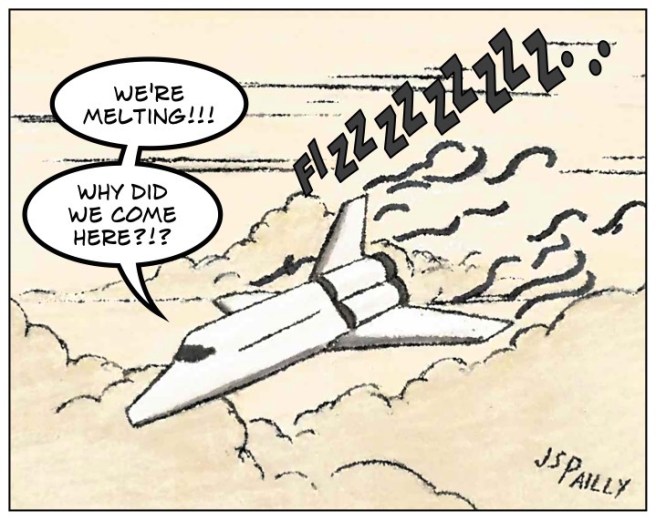
Welcome to the first official installment of Molecular Mondays, a new series here on Planet Pailly where we take a closer look at the atoms and molecules that make up our universe. Today, we’ll be talking about sulfuric acid, specifically the sulfuric acid that is so disturbingly prevalent in Venus’s upper atmosphere.

Mr04 Melting Spaceship

How to Make Sulfuric Acid

The first step is for sulfur dioxide to pick up an extra oxygen atom, creating sulfur trioxide. Sulfur trioxide then reacts with water, yielding sulfuric acid.

SO2 + O -> SO3

SO3 + H20 -> H2SO4

On Earth, we make sulfuric acid in factories, and it has many scientific and industrial uses. But on Venus, this is happening not in tanks or vats but in the open air, far above the planet’s surface.

Venus’s Sulfur Cycle

Sulfur containing chemicals like sulfur dioxide rise through the air on Venus, possibly originating from Venus’s many volcanoes. These chemicals get zapped by ultraviolet radiation from the Sun, causing sulfur and oxygen atoms to separate and recombine. One possible recombination is sulfur trioxide, which then reacts with traces of water vapor hanging around in Venus’s atmosphere.

Sulfuric acid then condenses into clouds. Sooner or later, the clouds condense further, producing rain: the most horrible rain you could possibly imagine. Fortunately, this sulfuric acid rain never reaches the planet’s surface (not that it matters much because if you’re on the surface of Venus, you’re already dead).

Thermal Dissociation of Sulfuric Acid

Because Venus’s surface temperature approaches 900 degrees Fahrenheit, the sulfuric acid rain begins to evaporate. In fact, the temperature is so high that sulfuric acid molecules break apart in a process called thermal dissociation.

What we’re left with are water vapor and sulfur containing chemicals like sulfur dioxide. The water and sulfur compounds start rising through the atmosphere, and the process begins again, repeating over and over, ensuring that Venus’s atmosphere maintains high levels of corrosive acid… forever.

It’s almost like Venus is being deliberately evil.

Mr04 Evil Venus

Links

Sulfuric Acid from Essential Chemistry Industry Online.

Aerosols and Clouds on Earth and Venus from the University of Colorado, Boulder.

Photolysis of Sulphuric Acid as the Source of Sulphur Oxides in the Mesosphere of Venus from Nature Geoscience.

The Sulfur Cycle on Venus: New Insights from Venus Express from the 2009 Lunar and Planetary Science Conference.

Recommended Reading

Venus Revealed: A New Look Below the Clouds of Our Mysterious Twin Planet by David Grinspoon.

Molecular Mondays

Today, I’m announcing a brand new series here on Planet Pailly called Molecular Mondays. Posts in this series will feature specific atoms or molecules, the basic building blocks of our universe.

Fe10 Molecules

I originally conceived the idea for this series several years ago, but I chickened out before I even started writing it.

In school, I took honors biology, honors chemistry, and honors physics. I did well in biology. I did really well in physics, and if not for my greater passion for art and literature, I probably would have pursued a career as a physicist.

But chemistry… I barely passed chemistry. I think I averaged a D+, which became a C- thanks to the generosity of my professor. So yeah… by introducing a chemistry series on my blog, I’m stepping way outside my comfort zone.

But just because a subject is difficult for me doesn’t mean I can keep ignoring it. Almost everything that happens in this universe happens because of chemicals and chemical reactions. If I really want to be a better science fiction writer, I need to learn some of this stuff.

So every other Monday, I’ll be trying my best to handle the atoms and molecules that constitute our physical universe. Two weeks from today, as we continue our ongoing exploration of the Solar System, we’ll take a look at Venus’s infamous sulfuric acid clouds and the chemical processes that ensures that those clouds never, ever go away.