
Today’s post is a special A to Z Challenge edition of Sciency Words, an ongoing series here on Planet Pailly where we take a look at some interesting science or science related term so we can all expand our scientific vocabularies together. In today’s post, X is for:
XENA
In January of 2005, astronomers at the Palomar Observatory in California discovered a new “planet.” Except this planet had a highly inclined (tilted) and wildly eccentric (non-circular) orbit. Pluto’s modestly eccentric, Neptune-crossing orbit was weird enough, but this? Planets aren’t supposed to have orbits like this, are they?
The Palomar Observatory astronomers decided to name their discovery Xena.
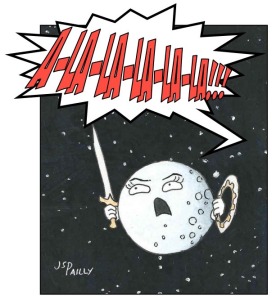
Personally, I think that name fits: a convention defying name for what was, at the time, a convention defying planet. But Xena was only intended to serve as a placeholder until the International Astronomy Union (I.A.U.) could assign an official name, and they chose the name Eris.

In Greek mythology, Eris was the goddess of discord. This name also seems fitting, given the amount of discord that would soon follow, because Eris was officially classified not as a planet but as a dwarf planet, along with Pluto.

There is now a proposal to reclassify Pluto, Eris, and about a hundred other Solar System objects as planets. It’s a proposal I like, for reasons I tried to lay out in a previous post, but it’s not something I expect to go anywhere. Most professional astronomers seem to be against it.
Anyway, the story of Xena/Eris is an example of something that seems to happen a lot in the field of astronomy. New discoveries get temporary names (pop culture references aren’t uncommon here) until the I.A.U. can review the discovery and assign a name officially.
As another example, the team behind NASA’s New Horizons mission came up with a ton of names for geological features on Pluto and its moon, Charon. Many of these names came from Star Trek, Star Wars, Doctor Who, Battlestar Galactica, The Lord of the Rings… apparently there are a ton of nerds at NASA. You can expect the I.A.U. to change most of those names—but perhaps not all of them. Sometimes a pop culture reference gets the I.A.U.’s okay (especially Lord of the Rings references, I’ve noticed).
In the case of Eris, Eris’s moon (originally named Gabrielle) was officially renamed Dysnomia. Dysnomia was the ancient goddess of lawlessness, and Lucy Lawless was the actress who played Xena on T.V. That was apparently an intentional, though rather convoluted, way to honor what could have been Xena: Warrior Dwarf Planet.
Next time on Sciency Words: A to Z, in the beginning there was the Big Bang. Then there was ylem. A whole lot of ylem.
 Planet Pailly
I was so pissed when they didn’t let the name Xena stand. I still call them Xena and Gabrielle, though, because the I.A.U. isn’t the boss of me!
LikeLiked by 4 people
Good for you! Personally, I’m okay with Eris and Dysnomia, but I’d hate for the original names to be forgotten. And there are stars and exoplanets with multiple official names, so there’s precedent for that sort of thing.
LikeLiked by 1 person
I’m sure it’ll always be this way because humans are like that. It’s also one of the reasons I always liked the names of the planets in the Known Space series.
LikeLiked by 1 person
I wasn’t aware of that series, although when I looked it up I discovered it includes Ringworld, so I’m not completely unfamiliar with it.
LikeLike
It was all the short stories that Niven put together prior to writing Ringworld. The novel Protector was also a part of that series, as was A Gift From Earth. Now that’s come to include all the Ringworld and Pupperter novels as well.
LikeLiked by 1 person
I love that bit of trivia about Dysnomia and Lucy Lawless, too. I’m not really a fan of the show, but it’d have been really great if they had left those names. Dysnomia’s a pretty great name. I always like the connections the IAU puts in its name, even if the pop culture is lost. Dysomia is Eris’s daughter. At least a couple of Jupiter’s moons are named after his lovers (I think there’s some crossover here; I always get confused between Roman and Greek naming). Pluto’s the god of the underworld, Charon the boatman on the river Styx, and Styx is one of Pluto’s moons. The modern pop culture might be gone, but these connections are still pretty great.
LikeLiked by 1 person
I do think it’s nice that they still made some reference to the T.V. show, even if it’s a bit convoluted. And even though Xena didn’t make it as a name, there are other pop culture references the I.A.U. has approved. I’m thinking about doing a post on that some time in the near future.
LikeLiked by 1 person
I’d love to read it. I might even read it twice!
LikeLiked by 1 person
I had no idea! I wish they had kept Xena and Gabrielle.
LikeLiked by 1 person
It does kind of feel like a missed opportunity, doesn’t it?
LikeLiked by 1 person
Meet a dwarf planet: Eris
In 2005, astronomers discovered the Solar System’s tenth planet, and they named it Xena.
The International Astronomy Union promptly stepped in and renamed it Eris…
… and reclassified Eris as a dwarf planet.
Eris has a rather wonky orbit. At closest approach to the Sun, Eris travels just inside the orbit of Pluto. Then it journeys far off into space, to a distance almost three times as far away before looping back again.
Combine this high eccentricity with a high inclination. Eris’s orbit is tilted by almost 45º relative to the rest of the Solar System. As a result, while Eris is sometimes called the most massive object in the Kuiper belt, it really isn’t a Kuiper belt object at all. It’s more like a Kuiper belt visitor.
That seems really strange, but if there’s one thing I’ve learned during this 2015 Mission to the Solar System, it’s that what seems strange at first turns out to be quite normal.
Many astronomers would classify Eris as part of the scattered disk. The scattered disk is a collection of objects that are… well… scattered. And there are lots of these scattered objects in wildly eccentric and/or inclined orbits. It’s sort of like our neat and orderly Solar System is surrounded by a swarm of bees.
When I was a kid, the Solar System was easy. Just memorize these nine planets and remember there’s an asteroid belt between Mars and Jupiter. The discovery of Eris marked the beginning of a whole new understanding of the Solar System.
Now we have eight planets, an asteroid belt, the Kuiper belt, the Oort cloud (maybe), and at least two “detached objects” (coming soon to Sciency Words). The Solar System has become crazy complicated, and each new discovery only seems to make things more complicated yet—which is why Eris’s official name is oddly appropriate. In Greek mythology, Eris was known as the goddess of discord.
P.S.: Today’s post is the final post for the 2015 Mission to the Solar System. I have traveled (metaphorically at least) from the Sun all the way out to the Kuiper belt, and I’ve shared some of the fruits of my research here on my blog. I’ve had a lot of fun on this adventure, and I hope you have to. Everyone have a safe and happy New Year, and I’ll see you all in 2016.
LikeLike