Sciency Words: Particle Zoo

Sciency Words Logo

Today’s post is part of a special series here on Planet Pailly called Sciency Words.  Every Friday, we take a look at a new and interesting scientific word to help us all expand our scientific vocabularies together.  Today’s word is:

PARTICLE ZOO

At some point in the last century, scientists thought they had a pretty good grasp on all the subatomic particles.  They knew about protons, neutrons, and electrons, and they thought they understood more or less how these particles interacted.

Then they discovered the photon and the neutrino and the positron and six different kinds of quarks and a few vector bosons and the Higgs boson and the pion and kaon and gluon… this list can go on for awhile.  Particle physics went from being relatively simple to frustratingly complicated very quickly.

Many of these particles cannot be observed directly.  Some have never been observed at all but are predicted to exist by elaborate, mathematical models.  The existence of the Higgs boson, for example, was only recently confirmed by experiment.

There are literally hundreds of different subatomic particles, many of them composite structures made from other subatomic particles.  Some of these particles are truly bizarre, as different from one another as elephants and crocodiles, giraffes and hippopotami.

Some physicists find this embarrassing and derisively refer to the still-growing list of particles as the “particle zoo.”  I prefer to think of this so-called zoo as a beautiful reminder that the universe is far more complicated and interesting than we humans can possibly imagine.

Revisions

1.1 Medusa Effect

It’s been a while since I updated anything on the Tomorrow News Network website.  I’ve been neck-deep in revisions of the 2012 stories for the last few months.  When I started writing T.N.N. over two years ago, I was very much a novice.  I’m not going to claim that I have since mastered the art of writing, but I am far more competent at my craft than I used to be.

I have also started working with an editor who has taught me the difference between “borders” versus “boarders,” “prescribed” versus “proscribed,” and “farther” versus “further.”  My editor has also called my attention to a number of other embarrassing errors that I am now in the process of fixing.

Today, I am happy to announce that the revised versions of the first two Tomorrow News Network stories are available on the T.N.N. website.  Revisions of the third story are coming soon.  In fact, I had a meeting with my editor today concerning story #3, “The Orion War,” and she tells me that the updated version is much stronger than the original.

1.2 99 White Balloons

For those of you who’ve read these stories before, I hope you’ll take the time to read them again and see how they’ve improved.  And if you’re new to T.N.N., I beg your indulgence as this revision process goes forward.  Any typos or grammatical errors you find will be corrected in due time (probably).

Please click here to start reading the new version of “The Medusa Effect,” the “pilot episode” of the series.  Click here to read the new “99 White Balloons,” which focuses on the true story of Roswell.

Sciency Words: Underdetermination

Sciency Words Logo

Today’s post is part of a special series here on Planet Pailly called Sciency Words.  Every Friday, we take a look at a new and interesting scientific word to help us all expand our scientific vocabularies together.  Today’s word is:

UNDERDETERMINATION

This word comes to us not from science itself but from the philosophy of science.  According to the philosophy of science, when we have two competing theories to explain some natural phenomenon, we are supposed to choose which theory is correct based on the evidence available to us.  But what happens when we don’t have enough evidence?

For example, let’s say that I theorize that horses are slow moving animals that can only trot, and you theorize that they are capable of running really fast.  If the only experience either of us has ever had with horses is watching one stand still eating its hay, then our two theories are underdetermined by our lack of experience with horses.

In the recent evolution vs. creationism debate between Bill Nye the Science Guy and Ken Ham of Answers in Genesis, Ken Ham never used the word “underdetermined,” but that is exactly what he was trying to argue: that our choice between evolution and creationism is underdetermined by a lack of evidence.  Of course, that’s not the case at all.  There is an overwhelming amount of evidence in support of evolution and plenty of evidence to refute creationism as well.

One example of genuine underdetermination is in the search for life on Mars, where there are some signs of the possibility of life, some evidence that makes life less likely (but still not impossible), and as of yet no discovery of an actual Martian organism, living or dead.  Another example of underdetermination are the various competing versions of string theory, which as I understand it remain untested and untestable due to the limits of technology.

Underdetermination is always a temporary problem.  It would not take long to prove which of our theories concerning horses is correct.  We’d only have to go to a farm or perhaps a rodeo, or we could simply look up horse videos on YouTube.  As NASA rovers continue exploring Mars, the question of Martian life will be resolved.  As for string theory, I’m sure the necessary technology will be invented eventually.  Of course if some people refuse to accept any evidence that disproves their preferred theory, that is another problem entirely, and the sciency word for that is confirmation bias.

Snow: Good or Bad?

I’ve heard a lot of complaining these last few weeks about snow.  Here in the North Eastern U.S., we got a lot of it.  Far more than we’re used to, and perhaps a bit more than we know how to handle.

Now I certainly understand why some people hate snow.  It’s not only inconvenient; it can also be dangerous.  Snow contributes to people getting sick.  It makes driving more difficult.  It even makes walking difficult.

IMG_1118

At the same time, snow is beautiful.  Just because it’s dangerous doesn’t change its beauty.  The Sun is dangerous, bombarding our planet with high quantities of radiation, but we still think sunshine is beautiful.  The ocean is dangerous, with all those sharks and jellyfish and, of course, the possibility of drowning, yet I think most of us would agree that it is beautiful.  So why should snow be different?

For those of you who harbor a deep, seething hatred for snow, I’m only asking one thing: take a moment to stop, look out at the fluffy, white landscape, and try to enjoy the beauty.  Just for a moment.  You can go back to complaining later, but don’t let your grumbling suck all the joy out of life.

Sciency Words: Osculation

Welcome to this special Valentine’s Day edition of Sciency Words!  Sciency Words is a series here on Planet Pailly where we take a look at new and interesting scientific terms so we can all expand our scientific vocabularies together.  Today’s word is:

OSCULATION

Osculation: noun.  The scientific term for kissing.

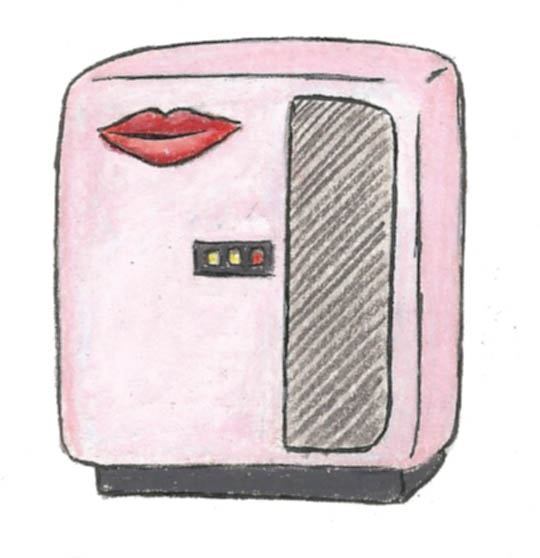
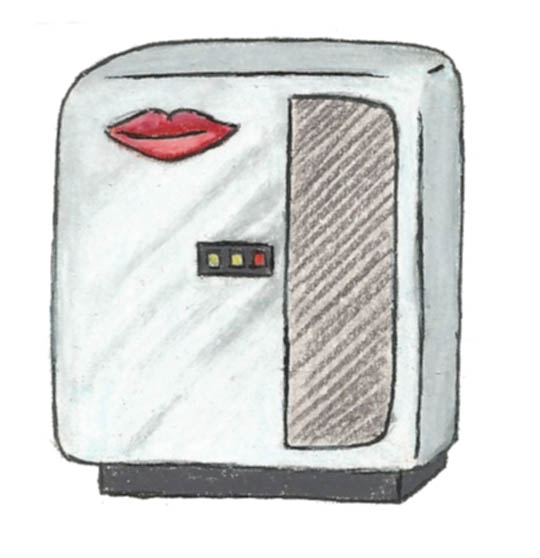
I have no idea why they needed a technical term for this, but I’m glad the word exists because now I know what to call my latest invention.  Ladies and gentlemen, meet the Osculator 5000.

Osculator 500 in Flirty Pink
For all you osculating needs.

Whether you’re spending Valentine’s Day alone or need a little extra practice before tonight’s hot date, this is the machine for you!  The Osculator 5000 comes fully programmed with three settings: peck on the cheek, kiss, and tongue.  To enhance your osculation experience, the Osculator 5000 includes a built in speaker and over a dozen prerecorded sound effects.  Order now, and give the Osculator 5000 a chance to turn you on.

Osculator 500 in Sexy Chrome
Now also available in chrome!

Indie Life: Space Program

IndieLife7Today’s post is part of Indie Life, a blog hop for independent authors hosted by the Indelibles.  Click here to see a list of participating blogs.

* * *

For my Indie Life post from February of last year, I listed several reasons why being an indie writer is like running the space program.

  • Much like NASA scientists, most indie writers have unrealistic concepts about money, making it impossible to write a budget or manage the financial side of the writing business.
  • Indie authors set deadlines that sound reasonable, provide plenty of time to check and double check our work, and ensure our story/spaceship is at peak performance, but somehow we always end up behind schedule.  Maybe it’s due to the weather, maybe it’s due to technological snafus, or maybe it’s because we spend too much time “working” on Angry Birds: Space and lose track of the other stuff we’re supposed to be doing.
  • Just as getting accurate data about the hydrocarbon content of Martian soil may not sound exciting to the general public, some people may not realize how important one book sale, one new contact, one re-tweet, or one positive review on Amazon can be.  Sure, it’s not the same as landing on the Moon, but every small achievement gets us just a little tiny bit closer to our ultimate goal, and those small achievement are always worth celebrating.
  • There will always be someone who thinks this (the space program or the life of an indie writer) is a waste of time and money.  Those people are frustrating, but we have to try to ignore them.  If they don’t understand the value of such bold and ambitious endeavors, they probably never will.

One year later, I can say that I’m happy with the progress of my personal “space program.”  I’m probably better funded than NASA, given how much Congress has slashed NASA’s budget.  I also have the good fortune of having many supportive friends who understand the importance of what I’m doing.  Even the one or two critics in my extended family have decided to keep their mouths shut.

But I still have one ongoing problem: deadlines.  No matter how much time I allot for any given project, it always seems to take twice that long.  This very blog post wasn’t finished until Wednesday afternoon (I’d scheduled it to be complete Tuesday night).  The issue may be that I’m nitpicking small things when I should be moving forward with my writing.

I’m not sure how to overcome this obstacle.  Any suggestions would be welcome, and I’d love to hear how you’re doing with your own personal “space program.”

Evolution vs. Creationism

I am going to say something that may shock you: I believe in God, I believe in Jesus Christ, and I believe in the Theory of Evolution.  And I see no contradiction there.  Despite what common knowledge and popular culture may insinuate about science versus religion, many churchgoing Christians have no objection to evolution or the Big Bang.  Many of us find meaning and value in the Bible without taking it 100% literally.  And many of us cringe when Christian fundamentalists start shoving their beliefs down everyone else’s throats.

This weekend, I sat down and watched the two and a half hour debate between Bill Nye the Science Guy and Ken Ham of Answers in Genesis.  The crux of the matter seems to be a question of authority.  Do we trust the authority of God as presented in the Bible (specifically the English translation of the Bible), or do we trust the authority of human beings like Charles Darwin?  At least this is the question Ham wants us to ask.

According to Ham, science is an effective tool for studying the world as it is today, but we cannot use it to study the past because in the past the laws of physics and nature might have been different.  For example, how old is the Earth?  We can’t use carbon dating to determine the age of our planet because the radioactive decay chain of carbon 14 might have been different a few thousand years ago.  We can’t ask astronomers to measure the age of the universe because the speed of light might have somehow changed.  According to Ham, we can’t even trust tree rings to tell us how old a tree is.

Science is apparently so unreliable that we can’t really know anything for certain, Ham tells us, so we should all just accept a literal interpretation of the Bible.  After all, the Bible is the infallible word of God.  We know this because it says so in the Bible!

If you have any doubt that creationism or intelligent design or whatever it’s called these days is not a subversive attempt to teach religion in science class, please watch this debate.  Take note of how difficult it is for Ham to stay on topic.  Notice how often he strays from the “science” of creationism into a diatribe on how Christ died for our sins, how gay marriage is wrong, and how God will reveal Himself only to His true believers.  Bill Nye showed up for a debate on science.  Ken Ham wanted to talk about other things.

As for Christians like myself who acknowledge evolution, Ham says that we “have a problem.”  I mentioned earlier that the crux of the matter is a question of authority.  Ham described the debate as a debate between the authority of God and the authority of Man, but that is not so.  This was a debate between the authority of Man—specifically one man named Ken Ham—and the authority of science.  And whenever one man claims to speak for God, claims to know God’s mind and understand His intentions—and whenever that man throws the Bible at anyone who would dare to disagree—yes, I “have a problem” with that.

Sciency Words: The Internet

Sciency Words Logo

Today’s post is part of a special series here on Planet Pailly called Sciency Words.  Every Friday, we take a look at a new and interesting scientific word to help us all expand our scientific vocabularies together.  Today’s word is:

THE INTERNET

Okay, yes, I’m sure you already know this word.  Whether you think it was invented by the U.S. Army or scientists at CERN, the European Nuclear Research Agency, or even if you think it was invented by Al Gore, everyone knows what this word means.

What you probably don’t know is that it is “the Internet,” not “the internet.”  Internet is a proper noun, so it is supposed to be capitalized.  Don’t believe me?  Go check the nearest dictionary, or click here to visit dictionary.com.

IWSG: Brain Power

InsecureWritersSupportGroupToday’s post is part of the Insecure Writer’s Support Group, a blog hop hosted by Alex J. Cavanaugh.  It’s a way for insecure writers like myself give each other advice and encouragement.  Click here to see a full list of participating blogs.

* * *

Being a writer is hard, frustrating work.  We have a lot of sleepless nights, we agonize over the proper use of the comma and semicolon, and we spend hours paging through dictionaries and thesauri looking for just the right word to describe how our main character is feeling.  But sometimes, in moments of writerly insecurity, we might wonder why we do this.  What good is all this writing for?  How is the world a better place because of what we writers do?  A recent scientific study may provide an answer.

Researchers at Emory University claim that reading a novel increases the connectivity between different parts of a reader’s brain.  The researchers had nineteen test subjects read the same book, a novelization of the destruction of Pompeii, and monitored their brain activity using an MRI machine.  Each night, the test subjects would read a specified number of chapters; then, in the morning, they’d report for their MRIs.  The results not only showed changes in brain activity while reading but for several days afterward.

Mr Crab Loves to Read

Now it’s worth noting that the experiment has a few problems.  There were only nineteen test subjects, which hardly constitutes a fair sampling of the total population.  There was no control group, meaning we can’t say for certain what other factors might have contributed to the changes in brain activity the researchers observed.  There are also concerns about the “resting state MRI” technique used to collect data for the experiment.

Clearly more research is required, but if I may hazard a purely unscientific guess, I’d say reading does improve brain activity, and it probably does have the long-term effects the researchers at Emory suggest that they’ve found.  I’d even speculate that it doesn’t matter what you read, so long as you read something.  Whether your choice is War and Peace or 50 Shades of Grey, you will experience an increase in brain connectivity that will last for at least several days after you finish reading.

If reading really does improve brain connectivity, just imagine how much smarter the whole world would be if we all read one book per week.  That’s what our writing is good for.  That’s how writers like us help make the world a better place.  The service we provide is not merely a few hundred pages worth of entertainment.  We are giving people a tool that, according to at least one scientific study, creates fundamental changes in people’s brain function.

P.S.: Click here to see the original scientific paper on this subject.

Four Sciency Things

Today, I’d like to share a few science and science fiction related links.

  • NASA asks the public for help searching for extrasolar planets.  Click here to read “NASA’s Crowdsourced Search for Planetary Habitats” from Science in My Fiction.
  • How do you feel about inter-species romance in science fiction?  Are you comfortable with graphic depictions of inter-species sex?  Click here to read “Will Relaxed Sex Standards Help SF on TV?” from A Futurist’s Observations.
  • It’s been twenty years since Babylon 5 first appeared on TV.  In an interview with Zap 2 It, J. Michael Straczynski reflects on how his show changed television.  Click here to read the interview.
  • Lastly, here’s some newly released video of Felix Baumgartner’s freefall jump from low Earth orbit.