Boycotting Ender’s Game

Orson Scott Card is one of my roll models as an author, but not necessarily as anything beyond that.  Specifically, I do not agree with his position against gay marriage, nor do I condone his vehement and sometimes hateful attempts to stop it.  Now there’s a movie coming out based on his greatest book, Ender’s Game (I wrote a post on that yesterday), and there’s an effort to boycott the movie because of Card’s controversial political views.
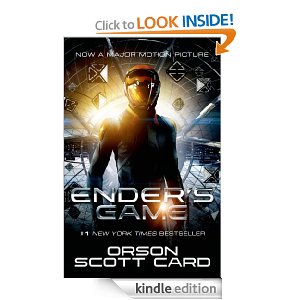
51qrFCx28OL._BO2,204,203,200_PIsitb-sticker-arrow-click,TopRight,35,-76_AA278_PIkin4,BottomRight,-66,22_AA300_SH20_OU01_

Card’s views can be extreme, even to those who favor traditional marriage.  According to the website skipendersgame.com, Card once said that people in the LGBT community “[…] cannot be permitted to remain as acceptable, equal citizens within [a] society.”  As a bookworm, especially a bookworm of Science Fiction books, this puts me in a difficult position.  I love Ender’s Game, but I have far too many gay friends for me to be neutral, and even if that weren’t the case… really, you don’t think they should be citizens?

But Ender’s Game isn’t about this at all.  It has nothing to do with marriage equality.  In fact, it’s a book about learning to understand another person’s point of view, no matter how “alien” that person may seem to you.  It’s about looking at someone you think of as an enemy and finding only a reflection of yourself.  In other words, it’s about tolerance.

It’s strange to get this message of tolerance from a man who, by all appearances, is not very tolerant himself.  So where should we draw the line between an author and the stories he writes?  How much do the political views of writers, actors, artists, or musicians affect the way we perceive and enjoy their work?

Are You Excited for Ender’s Game?

You’ll usually find Ender’s Game and Dune taking top spots on lists of the greatest Science Fiction or Sci-Fi/Fantasy novels of all time.  On my own top ten list, they’re constantly battling over the #2 slot (for me, The Lord of the Rings is unquestionably #1).  Now the movie version of one of those books (Ender’s Game) comes out in theatres this Friday.


But we all know what Hollywood sometimes does to popular books.  Just look at what happened to Dune.  The feature file version is… well… some people liked it, I guess.  So as we approach the release date for Ender’s Game, I’ve been both excited and apprehensive.  Will they ruin Orson Scott Card’s best and most provocative book?

So it was with a great sense of relief and reassurance that I read this interview with Gavin Hood, the director of Ender’s Game.  This is a man who seems to understand what this story is about beyond the epic space battles and explosions and such.  In the interview, he said, “There’s always a theme I’m drawn to, that we humans are not good or bad.  We’re all a mixture of both.  We can have great compassion or commit great violence.”

Ender’s Game is about a lot of things: war, space, childhood, video games… but in that statement, Gavin Hood has captured the soul of Orson Scott Card’s work.  If he can do that in three sentences, I’m sure he can do it in a two-hour movie.

So this Friday, when I walk into the local movie theatre and give them $9.00 of my hard earned cash, I will feel confident that I’ll get to see the real Ender’s Game on the big screen, and not some Hollywood bastardization of the book I love.

Sciency Words: Georgium Sidis

Science fiction uses scientific language as a form of artistic expression.  With that in mind, today’s post is part of a series here on Planet Pailly called Sciency Words.  Every Friday, I’ll bring you a new and interesting scientific word to help us all expand our scientific vocabulary. Today’s word is:

GEORGIUM SIDIS

In the late 18th Century, Sir William Herschel discovered a new planet.  Up until that point, everyone assumed there were only six planets in the Solar System.  When asked what to name this planet, Herschel called it the Georgium Sidis, meaning “George’s Star,” in honor of his patron, King George III of England.
Uranus 2003
Fortunately (or perhaps unfortunately), this name didn’t stick.  Non-English scientists were offended and didn’t want our seventh planet named after an English king, so they re-named it Uranus after the ancient Greek god of the sky.  This choice has worked out great for most of the world, but not for those of us who speak English.  For us, the planet Uranus has become the victim of far too many astronomy jokes.

Incidentally, I named a character in one of my Tomorrow News Network stories George Sidis in honor of Uranus’s original name.  Sidis is a secondary antagonist in “Children of the Swarm,” and yes, I’d describe him as kind of an ass.

* * *

Did you already know this word?  If so, please share another sciency word in the comments below.  That way, we can all keep expanding our sciency vocabularies together!

P.S.: There’s a brand new short story on the Tomorrow News Network website.  3,000 years into the future, the Earth Empire has a new secret weapon: the brain of Albert Einstein.  Click here to start reading “Einstein’s Clone.”

You Can’t Call It That – 3D Printers

A few weeks ago, Sci Show did this segment on 3D printers, and it started me thinking.

It won’t be long before 3D printers become a truly ubiquitous part of our lives, just like televisions, cars, and smart phones.  But the name “3D printer” just doesn’t sound right to me.  It reminds me of “horseless carriage.”  It’s a name that describes a thing by comparing it to another thing that is kind of similar but actually very different.

But just as the term “horseless carriage” was eventually replaced by “car,” I suspect “3D printer” will sooner or later be replaced with some new, more appropriate term.  In Star Trek, they have a machine called a “replicator.”  In the Mass Effect series, they sometimes refer to something called “micro-facturing.”  Those seem like good possibilities.

So what do you think the 3D printer will be called once we get used to having them around?

P.S.: If you’re looking for good science news, there’s no better place than Sci Show.  I often say that I don’t believe anything until I hear Hank Green say it.

Sciency Words: Syzygy

Sciency Words Logo

Science fiction uses scientific language as a form of artistic expression.  With that in mind, today’s post is part of a series here on Planet Pailly called Sciency Words.  Every Friday, I’ll bring you a new and interesting scientific word to help us all expand our scientific vocabulary.  Today’s word is:

SYZYGY

Syzygy: (noun) The word that proves that yes, “y” really is a sometimes vowel.  Whenever three celestial bodies, like the Sun, the Moon, and the Earth, form a straight line, they are in a state of syzygy.  This occurs whenever we have a solar or lunar eclipse, but it can happen in other circumstances as well.  For example, if Venus, Mars, and Jupiter lined up perfectly, that would also be considered syzygy.

The word syzygy has a nice, exotic sound to it, which is appropriate for such a rare astronomical event.  It’s unfortunate you don’t hear the word used more often whenever it actually occurs.  In fact, the word is so obscure that I have never found a way to use it effectively.  It’s almost impossible to make its meaning clear without explicitly giving the definition, which usually means it’s easier to just not use the word at all.

So I challenge you to find a way to fit this word into a story or a casual conversation.  Bonus points to anyone who does it without having to explain what it means.

* * *

Did you already know this word?  If so, please share another sciency word in the comments below.  That way, we can all keep expanding our sciency vocabularies together!

Einstein’s Brain

When Albert Einstein died, his doctors removed his brain so it could be studied.  They carefully dissected it, taking lots of photos, and preserved the pieces of jars.  As disgusting as this may seem to us now, apparently it was common practice at the time whenever an especially intelligent person died.  It also means we now have some idea as to why Einstein was such a genius.

Einstein_portrait

There’s a bundle of nerves called the corpus callosum which connects the right and left hemispheres of the human brain, but according to researchers Einstein had a larger and thicker corpus callosum than most of us.  It’s like the two sides of his brain were connected by rope where the rest of us have only a few tangled strings.

You’ve probably heard about the difference between the left and right brains before.  The left side is supposedly more creative while the right is more analytical.  Left-brained people tend to be artists while right brainers make better scientists and engineers and accountants.  You might assume a theoretical physicist like Einstein would be a right brain type of guy, but it seems he was one of those lucky few who could use both sides equally well.

Of course we already knew this about Einstein, not from the dissection of his brain but from the things he said and did when he was alive.  He was a brilliant physicist, but he also played the violin.  Whenever he was stuck on some vexing mathematical problem, he often wandered over to his piano, played for a few minutes, then went back to his physics with some new insight.  And of course Einstein was most famous for his thought experiments, experiments he conducted not in a laboratory but in his own imagination.

My question I have is this: was Einstein born with his abnormally well wired brain, or is the brain more like a muscle, its parts growing and atrophying depending on how you use them?  Whatever the answer, it seems clear that the key to true intelligence is to try as best as we can to use our whole brains, not just one side or the other.

P.S.: I’m nearing completion of a new Tomorrow News Network story, and this one happens to be about Albert Einstein, specifically his brain and what scientists might do with it in the distant future.  Click here to read a preview scene from the upcoming short story “Einstein’s Clone.”

Sciency Words: Entropy

Sciency Words Logo

Science fiction uses scientific language as a form of artistic expression.  With that in mind, today’s post is part of a new series here on Planet Pailly called Sciency Words.  Every Friday, I’ll bring you a new and interesting scientific word to help us all expand our scientific vocabulary.  Today’s word is:

ENTROPY

Entropy: (noun) A measurement of the amount of disorder in a mechanical system.  This word comes to us courtesy of the second law of thermodynamics, which tells us that the entropy of any closed system will always increase.

Entropy is a term just begging to be used in art or literature.  It has so much potential in our post-modern world.  Imagine talking about the entropy of society or of the modern family or of the American political system.  In a million different ways, the world seems to be increasingly disordered, and as thermodynamics predicts the trend doesn’t seem reversible.

But the second law of thermodynamics is not as absolute as it sounds.  There is a chance—a very, very small chance—that entropy can spontaneously decrease.  So perhaps it can also be said, no matter how entropic our world may appear, that there is always a little bit of hope.

* * *

Did you already know this word?  If so, please share another sciency word in the comments below.  That way, we can all keep expanding our sciency vocabularies together!

Indie Life: BUY MY BOOK!

IndieLife7Today’s post is part of Indie Life, a blog hop for independent authors hosted by the Indelibles.  Click here to see a list of participating blogs.
* * *

Very soon, I’ll have my first indie book published, but I don’t want to become one of those people.  You know who I’m talking about.  The people who go on the Internet, log into Facebook or Twitter, and start screaming at the top of their virtual lungs, “BUY MY BOOK!  BUY MY BOOK!  PLEASE FOR THE LOVE OF GOD BUY MY BOOK!!!”

First of all, those people are annoying.  Second, the “BUY MY BOOK!” marketing strategy doesn’t seem to work.  I’ve gotten plenty of advice on how to market an indie book, and it sounds like the only truly effective method is to trust word of mouth.  If you’ve written something that is really good, people will tell their friends, who then tell their friends, and so forth until suddenly you start making lots of money.

It sounds to me kind of like the chain reaction that takes place inside nuclear bombs.  One neutron collides with a single uranium atom, which causes the uranium atom to release more neutrons, which then collide with more uranium atoms, until you get a massive explosion complete with a mushroom cloud.

So my question to all you indie authors participating in Indie Life today is this: how do you get that first neutron to hit that first uranium atom?


Robo-Snake

Bad news, everyone.  Our worst nightmare is about to come true.  No, I don’t mean the one where you show up to work/school with no clothes on.  I mean that other one.  The one full of robotic super snakes.  Soon, those robo-snakes will be real.

Snake meets Robo-Snake
Snake meets robo-snake.

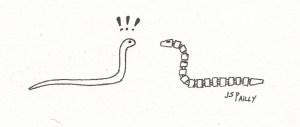
They’re designing these things for the purpose of exploration.  The European Space Agency wants future Mars rovers to bring little, robotic snake companions.  These robo-snakes could slither around on the Martian surface, crawling into those tight spaces rovers just can’t go.

But I think we all know what’s going to happen.  One day, when the robots rise up against us to overthrow humanity, we’ll see swarms of robo-snakes coming at us.  Thanks, European Space Agency.

P.S.: As if robotic snakes weren’t bad enough, scientists are also working on a robotic octopus.  Click here to read about that.

IWSG: What Writers Can Learn from Uranium

InsecureWritersSupportGroupToday’s post is part of the Insecure Writer’s Support Group, a blog hop hosted by Alex J. Cavanaugh.  It’s a way for insecure writers like myself give each other advice and encouragement.  Click here to see a full list of participating blogs.

* * *

Yesterday, I wrote a brief post about the work of Pierre and Marie Curie, the famous physicists who helped determine the true nature of radiation and radioactive elements like uranium.  In my life as a writer, I often find my roll models among great scientists rather than great writers, and the Curies are no exception.

The Curies had a goal: to figure out what was so special about uranium.  This goal became the obsession of their lives, and they sacrificed a lot to achieve it.  As they worked, the Curies made many startling discoveries, such as the discovery that uranium is not the only radioactive element.  In fact, among all the radioactive elements they studied, they found that uranium was one of the least radioactive.  It’s also thanks in part to the Curies, who in their ignorance touched and handled samples of uranium, polonium, and radium with their bare hands, and who kept these things in their home, that we now know how dangerous radiation can be.

As a writer, I have to stick to my goals just as much as the Curies stuck to theirs.  I’ve had to make my own sacrifices, and where the Curies surrounded themselves with radioactive samples, I surround myself with notebooks, dictionaries, and thesauri.  And just as the Curies’ research led to discoveries they never expected, my writing has led me in directions I never thought I would go.

P.S.: Hopefully nothing about my writing is as deadly as prolonged radiation exposure, but I have developed at least one writing related illness: carpel tunnel syndrome.