Arguing with Myself: The Search for Alien Life

Hello, friends!

So a certain argument has been playing out in the back of my mind for a long, long time now.  Whenever I write, there are really two different versions of me who do my writing.  On the one hand, there’s science enthusiast me.  On the other, there’s Sci-Fi author me.  And these two versions of me view science, space exploration, and the universe at large in dramatically different ways.  One of the biggest ongoing disagreements I have with myself involves alien life.

Science enthusiast me believes that extraterrestrial microorganisms are pretty common in the universe.  Science enthusiast me thinks we will find evidence of extraterrestrial microbes in the very near future, perhaps hiding under the ice on Mars or swimming around in the oceans of Europa, Enceladus, or even Titan.  (I almost wrote unambiguous evidence there, but science enthusiast me also expects that confirming the discovery of extraterrestrial microbes will be tricky—just ask the researchers who found (or thought they found) microfossils inside a Martian meteorite back in 1996).

As for complex multicellular life—plants and animals, or whatever the extraterrestrial equivalent of plants and animals might be—science enthusiast me is far less optimistic.  While microorganisms have proven again and again that they can survive almost anything, even direct exposure to the vacuum of space, multicellular organisms seem to be far more fragile, far less resilient.  Earth may be one of the very few worlds where complex, multicellular organisms like us are able to survive and thrive over cosmic timescales.

And intelligent life?  Science enthusiast me believes intelligent life must exist elsewhere in the universe—surely it must!  But the universe is an awfully big place.  Our nearest intelligent and communicative neighbors could be many galaxies away.  Humanity is not alone in the universe, according to science enthusiast me, but we may as well be.

Sci-Fi author me, however, sees things from a different perspective.

Sci-Fi author me wants to write stories where encounters with alien life are commonplace, almost routine—stories where the aliens are sometimes friendly and sometimes not so friendly—stories where all sorts of weird and wacky interspecies adventures are possible!  And Sci-Fi author me takes a particular and peculiar pleasure in handwaving away all the concerns and objections science enthusiast me might have, not just regarding alien life but also in relation to faster-than-light travel, time machines, cybernetics, et cetera, et cetera.  Part of the fun, for Sci-Fi author me, is thinking up clever excuses for why impossible things are now possible (in the context of the story world, at least).

So there is this ongoing argument happening in the back of my mind.  This argument is never going to end, and I’ve decided that that’s okay.  Not every argument needs to have a winner and a loser, nor do arguments necessarily need to end in compromises.  Sometimes a house divided can stand after all.  Science enthusiast me believes the universe is like this; Sci-Fi author me would prefer (for story reasons) if the universe were more like that.  And the tension between these two different versions of myself drives my creativity, both as a science blogger and a science fiction writer.

P.S.: For those of you who might be interested, both the “I Heart Science” and “I Heart Sci-Fi” designs in this post are available in my RedBubble store.  Click here if you heart science, or click here if you heart Sci-Fi.  And remember: nobody’s stopping you from clicking both if you heart both!
#IWSG: Never Say This to Your Muse

Hello, friends!  Welcome to this month’s meeting of the Insecure Writer’s Support Group.  Are you a writer?  Do you feel insecure about your writing?  Then this is the support group for you!  Click here to learn more!

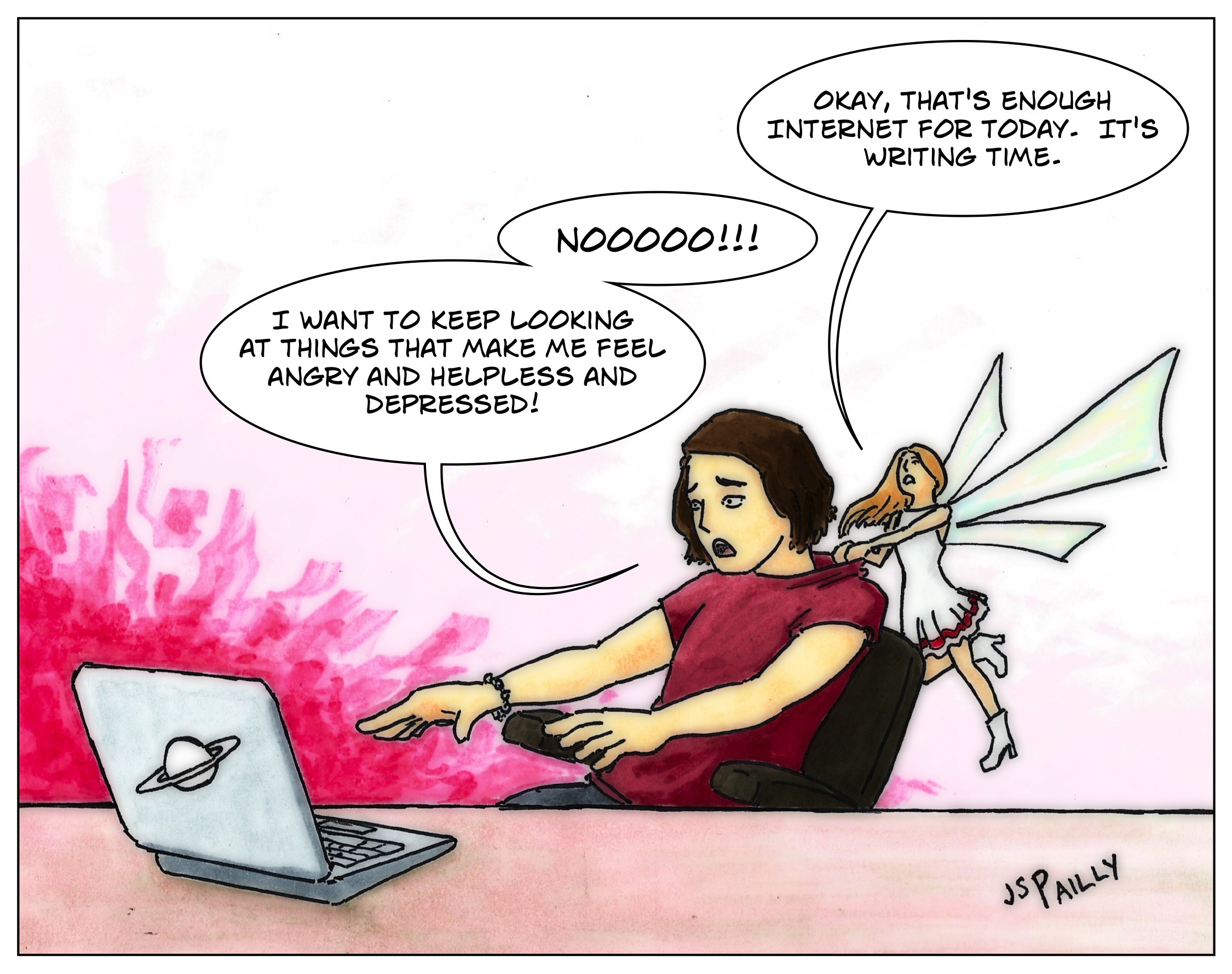
So the other day, I got into an argument with my muse.  I said some things that I regret, and she called me some names that I, quite frankly, deserved.  The whole debacle started because of the Internet.

Almost every day, almost every single time I go on the Internet, even just for a few minutes, I am bombarded with bad news.  Certain headlines pique my interest.  I feel this sense of morbid curiosity.  I start clicking things.  I start reading comment threads.  And slowly, gradually, all that bad news transforms into worse news, until everything becomes the absolute worst news ever.

I was in the midst of this downward bad news spiral when my muse reminded me (kindly but firmly) that I’d promised to do some writing today.  And I refused.  After reading all that bad news, doing my writing no longer seemed important.  How can I do my writing when the world is in so much trouble?  How can I do something as silly as writing when all of human civilization is burning down around me?  “My writing doesn’t matter!” I exclaimed.  “Not at a time like this!”

That, by the way, is the wrong thing to say to your muse.

As I already mentioned, I proceeded to say some things I regret, and my muse proceeded to call me some names that I deserved.  But after we had some time to calm down, my muse and I had a long talk, and my muse said to me: “So bad stuff is happening in the world right now.  Okay.  Do you know how to fix that stuff?  Do you know how to make all the bad things stop or how to make all the bad people go away?  Hmm?  I didn’t think so.  But you are a writer, and you are an artist.  You may not be able to reduce the number of bad things in the world, but you can try to add something good.”

And my muse was right.  It’s one thing to stay informed about current events; it’s quite another to dwell on problems that are beyond your power to solve.  I’m no activist.  I’m no community organizer.  I don’t have the skillset for that sort of work.  But I do know how to tell a story, and I do know how to draw pretty pictures to go with my stories.  The best thing I can do, both for myself and for the world, is to keep writing and to keep drawing—to give myself those comforts and hope that the finished products will give comfort to others as well.

With that in mind, there’s one last thing my muse said to me: “Don’t you ever—ever!—tell me your writing doesn’t matter.  Never say that to me again.  That is the most disrespectful and hurtful thing any writer could ever say to their muse.”

#IWSG: Something Must Change

Hello, friends!  Welcome to this month’s meeting of the Insecure Writer’s Support Group.  Are you a writer?  Do you feel insecure about your writing?  If so, then this is the support group for you!  Click here to learn more!

I’m not doing great right now, to be honest.  I’m stressed, I’m tired, and I’m unhappy.  I wish I could say I’m just having a bad week, but I know the problem runs deeper than that.  This has been going on for months now… for years, even.  And so now I have finally come to the conclusion that something needs to change.

But what?  What is the thing that needs to change?  Is it writing?  I’ve been reluctant to talk about these something-must-change feelings with anyone I know in real life because most of the people I know in real life are quick to tell me that writing is the problem.

“You should take a break from writing,” they’ll say.  But that’s like telling me to take a break from breathing.  “Maybe you should try a different hobby,” they’ll say, as if writing is just a hobby to me.  One family member keeps asking me “Have you considered writing smut?” which… actually, that might be one of the few people I know I.R.L. who gets me.

Something must change.  Something is going to change.  I’m going to make it happen.  But first, I’m making two quick promises to myself:

  • I will not rush into anything, and…
  • I will not sacrifice my writing (or my art).

This post is not me looking for advice.  I’m not writing this for my own benefit but rather for the benefit of anyone else who’s having these something-must-change feelings.  Don’t get me wrong: these are good feelings to have.  These feelings can be the beginning of a new and better life.

But saying that something needs to change does not mean that everything needs to change.  Before you do anything rash, before you go upending your whole life, decide for yourself what’s really important to you.  Decide for yourself what you can and cannot afford to change (and do not allow other people to decide that for you).

For me, the things I cannot afford to change are my writing and my art.  And for you, those things are…

#IWSG: Dear Muse

Hello, friends!  Welcome to this month’s meeting of the Insecure Writer’s Support Group.  Are you a writer?  Do you feel insecure about your writing?  Then this is the support group for you.  Click here to learn more!

Dear Muse,

2021 turned out to be one of the absolute worst years of my life.  I will not go so far as to call it my worst year ever, but I will say that it was a close second.

We didn’t get much writing done, you and I, in the past year.  Plans got derailed.  Opportunities were missed.  Financially speaking, our writing/illustrating business survived, but it will be a real challenge getting back to where we were a year ago.

Couldn’t be helped.  Under the circumstances, things could have ended up being a whole lot worse.  I want to thank you, dear muse, for being patient with me, for biding your time while I struggled, and for waiting until the situation improved.  I needed that time to deal with this past year’s problems, and I needed time to heal from this year’s problems as well.

As I already said, 2021 was only the second worst year of my life.  I’m sure you still remember the first.  I’m also sure you remember what happened next: how our writing and our art flourished, how the year that followed my #1 worst year became one of my absolute creative best!  Nobody asks for hardship, but hardship has a way of preparing us for change and for growth.  After all the problems of 2021, I am eager to see what we can accomplish in 2022.

So in the year to come, dear muse, I’m asking you for a gift: the gift of words.  All the words!  Surprise me—no, shock me with your wildest ideas.  Break the molds I’m used to for all my stories, knock me out of the comfortable grooves I’ve settled into over the years.  Test my limits.  Challenge me.  Make me write things I never imagined I’d write.

This past year was awful for me, but that’s behind me now (I think).  So muse, bring me all the words!  I’m ready!

Forever yours,
Your Writer.

#IWSG: Three Things Writing is Like, and One Thing It’s Not

Hello, friends!  Welcome to this month’s meeting of the Insecure Writers Support Group!  Are you a writer?  Do you feel insecure about your writing?  Then this is the support group for you.  Click here to learn more!

Sometimes I get into conversations with people who are not writers.  It can be hard to explain to non-writers what writing is like.  They tend to vastly underestimate (or vastly overestimate) how much of a struggle writing can be.  Also, a few of them seem to assume that heavy drinking must somehow be involved.

Today, I’d like to share a few of the analogies I use to help explain both the joys and hardships of writing to my non-writer friends.

Writing is like exercise:

I am not exactly a health nut, but exercise is still an important part of my routine, and I do, in fact, enjoy it.  That being said, when it’s time to exercise, I’m rarely enthusiastic about getting started.  Getting started is always the hardest part.  However, once I do get going, exercise gets easier, and by the time I’m finished I usually feel proud of myself for the hard work I’ve done.  Writing is the same.

Also, after a hard workout, your body needs some time to rest.  Your mind also needs time to rest after a long, hard day of writing.

Writing is like NASA:

Specifically, writing is like NASA when it comes to setting schedules and deadlines.  Everything seems to take longer than expected.  Just ask the people working on J.W.S.T.  That thing was supposed to launch like fourteen years ago!  Almost every NASA mission is, in one way or another, attempting to do something different and new, something that has never been done before.  Unanticipated problems and setbacks are bound to happen.  Writing is much the same in that respect.

Also, writing is like NASA in the sense that it involves big goals and bigger dreams.  Not everyone sees the value in those goals or dreams, and some people will tell you (whether you asked for their opinion or not) that you should focus on more down-to-earth concerns instead.

Writing is like meditation:

I have to admit that I’m not as religious or spiritual as I once was (for reasons that are not relevant to this blog post).  Even so, when I say that I need to get myself into a meditative state in order to write, most people seem to understand what I mean.  I treat my personal “writing sanctuary” as if it were a sacred place, and my writing process is highly ritualized.  This helps me clear my mind of distractions and let go of material concerns, so that I can give my story my undivided attention while I write.

And if it sometimes feels as if a supernatural power—a muse of some kind, if you will—is helping me do my writing… well, that fits nicely into the meditation analogy as well.

Depending on the circumstances, I may try using one analogy for one person, and a different analogy for somebody else.  Not everyone meditates.  Not everyone cares about NASA.  And as for exercise, the statement “I enjoy exercise” can be more perplexing to some people than “I’m a writer.”  But usually, at least one of these analogies will communicate to a non-writer what writing is like for me.

Lastly, I want to share one analogy for writing that absolutely does not work.

Writing is like eating cookies:

It’s not.  No, it really isn’t.  Sometimes writing is easy, sometimes it’s hard.  That’s not true about eating cookies.  Nobody has ever said, “I feel like I should spend more time eating cookies, but I’m just so gosh-darn tired right now.  Maybe I’ll eat some cookies tomorrow, if I have the energy for it.”

So what analogies would you use to explain writing to non-writers?  And are there any analogies you can think of (like my cookie analogy) that absolutely do not work?

#IWSG: Scriptophobia and Graphophobia

Hello, friends!  Welcome to this month’s meeting of the Insecure Writer’s Support Group.  If you’re an insecure writer in need of some support, then guess what!  This is the group for you!  Click here to learn more.

I recently learned that there is, in fact, a scientific term for the fear of writing.  Actually, there are two.  Scriptophobia is the fear of writing in public.  Graphophobia is the fear of writing in general.

Honestly, I’m not surprised that these terms exist.  I’ve never understood how some writers can do their writing in the middle of a coffee shop.  I’d feel so self-conscious.  Does that make me scriptophobic?

And graphophobia?  For me, that’s something that comes and goes.  It’s a feeling that I’ve traditionally labeled as writer’s block, but graphophobia (now that I know about that word) seems like a more apt term.  It really is fear that stops me from writing.  Fear that I’ll disappoint myself.  Fear that I’ll disappoint my readers.  Fear that I’m wasting time writing something that no one will ever want to read.

I said that fear stops me from writing, but it would be more accurate to say fear hinders me from starting to write.  Just starting is always the hardest part.  But once I’ve done a few sentences, or a few paragraphs, or maybe a few pages, the words come quickly and easily, and I’m left wondering what I was afraid of in the first place.

Learning new vocabulary is the best kind of learning, in my opinion.  Knowing the right terms and the right names for things makes those things so much easier to conceptualize within one’s own brain, and it also makes it easier to communicate one’s thoughts, feelings, and questions about those things with other people.  That’s why I’m so glad to have discovered the words scriptophobia and graphophobia.  These are going to be very useful terms for me.  I hope you’ll find them useful, too.

Going to Mars is My Dream, But Not My Passion

Hello, friends!

So this post isn’t really about Mars.  I mean, if NASA ever announces that they desperately need to send a writer/illustrator to Mars, I’d volunteer.  I’d love to go to Mars!  That would be awesome!

But I don’t expect that to happen.  Even if we do send humans to Mars, and even if that does happen in my lifetime, those humans will be scientists and engineers.  They’ll be people who are good at math.  I’m not a math person, nor do I wish to become a math person.

So while I dream about standing on the surface of the Red Planet, my passions lie elsewhere.  And I think it’s important to know the difference between your dreams and your passions.  Dreams matter.  Your dreams say a lot about who you are as a person and what you believe (and do not believe) about the world.  Cherish your dreams, but pursue your passions.

I have a passion for writing and also a (slightly lesser) passion for art.  If I could spend every day of my life writing and drawing, that would be glorious.  If I had to spend every day doing math, I’d be miserable.  And that’s why I write blog posts about Mars rather than sitting in a laboratory somewhere trying to figure out how to actually get to Mars.

Of course, no matter what your dreams and passions happen to be, there will still be closed-minded people trying to stand in judgement over you.  Ignore those people.  Cut them out of your life, if you can (maybe consider moving to another planet, if the opportunity comes up).

So what are your dreams, and what are your passions, and what are you doing to pursue them?

What Kind of Writer Do I Want to Be?

Today’s post is about a personal revelation I recently had.  You see, I spend a lot of time researching for this blog, making sure I understand what I’m talking about, and doing my best to explain it all clearly and concisely.  And all this work, in theory, is supposed to benefit my science fiction writing.

But I don’t want to write hard Sci-Fi.  I used to think science fiction existed on a spectrum from hard science fiction, where everything is super scientifically accurate (and here’s a full chapter explaining the math to prove it), to soft science fiction, where everything’s basically space wizards and technobabble magic (lol, who cares if unobtainium crystals make sense?).

I’ve since discovered another way to think about science fiction, and I find that to be more useful.  But sometimes I’m still left wondering why am I doing all this extra work?  What’s it all for if I’m not trying to write hard Sci-Fi?

Recently, I was talking with a new friend, and somehow the conversation turned to quantum physics.  I swear I wasn’t the one who brought it up!  My friend had seen a video on YouTube, and I felt the need to disillusion him of the weird quantum mysticism he’d apparently been exposed to.  I was doing my best to explain what the Heisenberg uncertainty principle actually means, and I ended up digging into what I remembered about the math.

Mathematically speaking, the momentum of a quantum particle is represented by the variable p, its position by the variable q, and the relationship between p and q is often expressed as:

pq ≠ qp

I don’t have the math skills to explain how this non-equivalency equation works.  I think it has something to do with matrices.  My high school math teacher skipped that chapter. To this day, I still haven’t got a clue how a matrix works.  I just know it’s an important concept in quantum theory.

But by this point, my friend was staring at me with a sort of dumbstruck awe, and he said: “Wow, you really do understand this stuff!”

That brought me up short.

“No, not really,” I said, feeling slightly embarrassed. I couldn’t help but recollect the famous line attributed to Richard Feynman: If you think you understand quantum theory, you don’t understand quantum theory.

So I told my friend about this blog and about my writing, and how I use the research I do for my blog to flesh out the story worlds in my science fiction.  And then I said something that I don’t remember ever thinking before or being consciously aware of, but as soon as the words were out of my mouth I knew they were true: “I just want to make sure I know enough so that I don’t make a total fool of myself in my stories.”

And that’s it.  That’s the answer I needed.  I’m okay with stretching the truth if it suits my story.  I’m okay with leaving some scientific inaccuracies in there.  I just don’t want to make a mistake so glaringly obvious to my readers (some of whom know way more about science than I do) that it ruins the believability of my story world.

And now if you’ll excuse me, I have to get back to writing.  The fiction kind of writing, I mean.  And on Wednesday, we’ll have story time here on the blog.