Fly or Die: How Life on Venus Might Survive

Hello, friends!

So I recently found this 100% totally legit JWST image of Venus, revealing some of the weird and scary chemistry that happens in Venus’s atmosphere.  As you can see, Venus sure does love chemicals.  Super noxious, super toxic chemicals.  With all those noxious and toxic chemicals in her atmosphere, you’d think Venus must be a pretty unlikely place to find life.

Now add in a runaway greenhouse effect that makes the surface of Venus hotter than the daytime surface of Mercury.  Now add in atmospheric pressure that rivals the deepest, most-submarine-crushing depths of Earth’s oceans.  Now add in some sort of volcanic activity (the specifics of which remain mysterious) that seems to sporadically spread fresh lava over nearly the entire planet’s surface.

So yes, Venus is an unlikely place to find life.  Venus is among the least likely places in the whole Solar System to find life.  And yet, the possibility of life on Venus does come up in the scientific literature from time to time.  So how would that work?  How could living things survive on a planet so infamously hostile to life?

Have you ever heard the expression “sink or swim”?  Well, if any sort of life exists on Venus today, its motto must be “fly or die.”  Everything about Venus is dangerous and deadly, but the most dangerous and deadly conditions are found at the planet’s surface.  So if you’re a Venusian life form, don’t go to the surface.  Stay aloft in the atmosphere.  At an altitude of about 55 kilometers up, you should be safe safe-ish.  The global lava floods (however frequently or infrequently that happens) will be far below you.  The extreme pressure and temperature will be far below you as well.  You’ll still have to deal with all those scary chemicals in the atmosphere, but if you’re clever (or rather, if evolution is clever for you) some of those scary chemicals might be usable to you as nutrients.

If the idea of perpetually airborne life—of life that never, ever touches the ground—seems farfetched, then I need to tell you that microorganisms can and do live in the upper reaches of Earth’s atmosphere.  That’s not an ideal environment for them.  They’d much rather be down on the ground, where water and nutrients are more plentiful.  But microbes can survive way up there, if they have to.  Earth has a whole “aero-biosphere” of airborne microbes that scientists are only just beginning to understand.

And if Earth has an aero-biosphere, then maybe (maybe!) Venus could have some sort of aero-biosphere, too.  It may not be likely, but it’s not totally impossible.

WANT TO LEARN MORE?

Here’s a link to diagram, originally from a paper on the possible habitability of Venus, showing what the life cycle of Venusian airborne microbes might be like.

And here’s a short press release from the Johns Hopkins Applied Physics Laboratory (A.P.L.) describing the so-called “Venus Life Equation,” which is sort of like the Drake Equation for life in the universe, but for just Venus.

And lastly, regarding the mystery surrounding Venus’s volcanic activity, we know Venus’s surface got “paved over” by fresh lava at some point in the recent past, but we don’t know how frequently this sort of thing happens.  It definitely happened at least one time.  Maybe it’s happened more often than that, or maybe it’s a continuing process that’s still happening today.  Here’s an article from the Planetary Society explaining why the global resurfacing of Venus remains such a big scientific mystery.


P.S.: Okay, I lied.  The image I used at the top of this blog post?  That’s not really from JWST.  Actually, I’m pretty sure JWST cannot safely observe Venus, due to Venus’s proximity to the Sun.  I drew that image myself.  And if you like my drawing of Venus, and if you want to do something to support what I do here on Planet Pailly, please consider visiting the Planet Pailly store on RedBubble.  There, you can buy my “Venus ‘Hearts’ Chemicals” drawing (and other drawings I’ve done) on a T-shirt, pillow case, spiral-bound notebook… personally, I think today’s drawing would look great on a little notebook, maybe for chemistry class!


Never Say Never: Life on Ancient Venus

Hello, friends!  Today’s post is about the planet Venus, but the real lesson today is this: never say never.

Could Venus have supported life at some point in the past?  Yes.  In theory, yes.  Despite being closer to the Sun than Earth, Venus still orbits within the so-called habitable zone of our Solar System (this depends a little on whom you ask; some sources say Venus is inside the habitable zone while others will tell you she’s skirting the habitable zone’s edge).  So it is plausible that, at some point in the distant past, Venus could have had more Earth-like temperatures and more Earth-like surface conditions.

But then something went catastrophically wrong.  Carbon dioxide gas somehow started accumulating in Venus’s atmosphere.  Carbon dioxide is naturally good at trapping heat, so rising CO2 levels caused the temperature to also rise.  Rising temperatures caused more CO2 to outgas from the planet’s crust.  The outgassing of more CO2 caused the temperature to rise further, which caused more outgassing of CO2, which caused temperatures to rise further, which caused more outgassing of CO2, which caused… you get the idea.  This process is known as a runaway greenhouse effect.

Cartoon of Venus, looking eager, and Earth, looking shocked, as Venus says, "Oh, Earth! I used to have 'organisms' crawling on me, too.  But then I filled my atmosphere with CO2, triggering a runaway greenhouse effect.  That killed everything!"

I don’t think anyone knows for certain what started the runaway greenhouse effect on Venus (or at least, I’ve read many different ideas about what the initial cause might have been).  All we know for certain is what Venus is like today: hell.  Insane heat.  Insane atmospheric pressure.  Insane levels of CO2 plus insane weather, most notoriously sulfuric acid rain.  I think it’s safe to say that no planet in the Solar System is more hostile to life as we know it than modern day Venus.

But the runaway greenhouse effect was not the only catastrophe to befall Venus.  Venus also experienced something called a global resurfacing event.  Resurfacing may sound like something you’d do to a parking lot, but when we’re talking about planets, resurfacing means spreading fresh lava over a planet’s surface, essentially paving over whatever surface features might have been there before.

So could Venus have supported life at some point in the past?  Sure.  It’s possible.  But this always seemed like an untestable hypothesis to me.  The runaway greenhouse effect would have killed everything (well, almost everything… see my post script), and the global resurfacing event would have paved over any fossils or other evidence of past Venusian life.  So if there ever was life on Venus, we’d never know about it.  Never.

We now come to the “never say never” part of today’s post.  On Venus, there are patches of rough terrain called tesserae (singular, tessera).  As longtime readers of this blog know, Venus is my favorite planet, so naturally I have heard about the tesserae on Venus before; however, I was previously led to believe tesserae were formed by thrust faults, volcanic eruptions, or some other relatively modern geological activity.  But recently, I read a research paper that mentioned, rather casually, that tesserae might also be the remnants of ancient continental crust jutting up above the otherwise smooth, resurfaced landscape.

So the tesserae we see today could be ancient Venus’s version of the Rocky Mountains, the Alps, or the Himalayas.  They are (or were) the highest of high elevation regions on ancient Venus—regions high enough to survive the global resurfacing event.  If true, then the tesserae of Venus may preserve some hard evidence of what Venus used to be like before the runaway greenhouse effect and the global resurfacing event wrecked the place.

So was there ever life on Venus?  It’s possible, but we don’t know for sure.  I once resigned myself to the belief that we could never know, but you should never say never.  Signs of ancient water and ancient life may be preserved on Venus after all, just waiting for us to discover.

P.S.: Some scientists believe there may be life on Venus today.  There is some very circumstantial evidence of microorganisms floating around in Venus’s upper atmosphere.  I do have some thoughts about that, but I’ll save that for another blog post.

Want to Learn More?

Here is the research paper I mentioned that casually mentions tesserae might be the remnants of ancient continental crust.

And here is a paper I found describing possible signs of water erosion on Venus’s tesserae.  Water erosion could not possibly happen on Venus today, so this would be further evidence that tesserae have preserved something of Venus’s ancient history.

And lastly, just because this “tesserae equals continental crust” idea is new to me, that doesn’t mean it’s new to science.  Here’s a paper from 1990 discussing the possibility.  Even if some of the information in this paper is out of date, I think it’s still worth a look, if only to see how much history this idea has.

Our Place in Space: HAVOC

Hello, friends!  Welcome to Our Place in Space: A to Z!  For this year’s A to Z Challenge, I’ll be taking you on a partly imaginative and highly optimistic tour of humanity’s future in outer space.  If you don’t know what the A to Z Challenge is, click here to learn more.  In today’s post, H is for…

HAVOC

Venus is my favorite planet.  If you’ve been reading this blog for a while, you probably already know this about me.  The Venusian atmosphere is weird and chemically complex.  The surface is mysteriously smooth, hinting at some pretty extreme geological activity.  And did you know Venus is spinning the wrong way?  She rotates clockwise where every other planet in our Solar System has counterclockwise rotation.  In many ways, I feel like Venus is the planet with the most personality (aside from Earth, of course).  So if there’s a realistic possibility of humans colonizing Venus one day, nothing would please me more!

HAVOC stands for High Altitude Venus Operational Concept.  It’s NASA’s very preliminary plan for exploring Venus, first with robots, then with astronauts, with the eventual goal of establishing a permanent human presence.  Most people scoff at the idea of sending humans to Venus.  Surface conditions are hellish.  The surface temperature is 475 degrees Celsius (900 degrees Fahrenheit).  Atmospheric pressure is 90 times greater than what we experience here on Earth.  Sulfuric acid falls from the sky as rain, and don’t forget about that extreme geological activity I mentioned.  Nobody’s sure what’s happening, but the ground is too smooth, as if it gets regularly “repaved” with fresh lava.

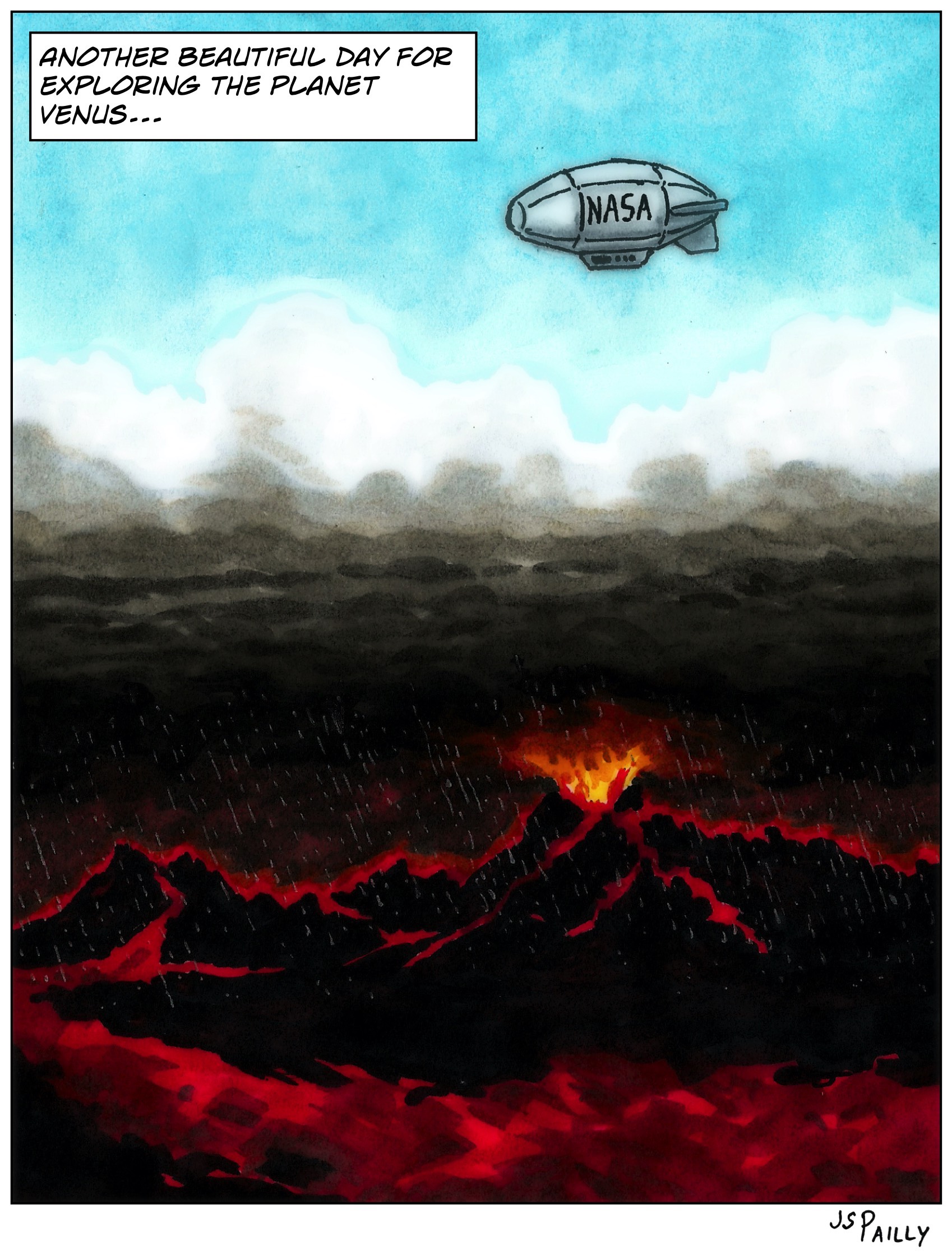
But HAVOC would not involve putting boots on the ground.  Instead, astronauts would explore Venus from the safety of blimps and other airborne habitats.  At an altitude of 55 kilometers above the surface, Venus is quite nice.  You might even call it heavenly.  The temperature and pressure are roughly Earth-normal.  We’d experience Earth-like gravity, too, and Venus would provide almost Earth-like protection from solar and cosmic radiation (a service that the Moon and Mars do not offer).  Also, 55 kilometers up, we wouldn’t have to worry about the sulfuric acid rain; we’d be above the layer of sulfuric acid clouds!

Obviously this is not happening any time soon.  The people at NASA seem to have their hearts set on returning to the Moon in the near future, with a long term goal of getting to Mars.  Still, the idea of exploring Venus with blimps makes sense.  In some ways, Venus might end up being a better second home for humans than Mars—just so long as we stay at that 55 kilometer altitude.

So in the distant future, when humanity is spreading out across the Solar System, don’t be surprised if large numbers of people live in Cloud City-like habitats on Venus.

Want to Learn More?

Check out this paper from the American Institute of Aeronautics and Astronautics, detailing HAVOC as a five phase plan to explore and colonize Venus.

Also, here’s a video from NASA showing what a HAVOC mission might look like, from first arrival in Venusian orbit to safe return back on Earth.

Do Planets Have Genders?

Hello, friends!

So a while back, I got some unsolicited feedback from a person I know in real life.  This person had seen one of the illustrations I’d drawn for this blog, and she was incensed—absolutely incensed—that I would depict the planet Saturn as female.  You see, Saturn is a very masculine planet.  That’s a fact, apparently.

A lot of my thinking about planets—including my thinking on the gender identities of planets—was shaped by a book called Venus Revealed, by David Grinspoon.  That book was my first serious introduction to planetary science.  In a section titled “Men are from Venus, Women are from Mars,” Grinspoon has this to say:

At first I tried being completely gender-neutral in my writing, but this was unsatisfying because, to me, Venus is not just a “thing.”  Venus is not, in my mind, inanimate, and so “Cousin It” will never do to describe him… or her.

In that same section, Grinspoon does a little cross-cultural analysis and finds that Venus has been “a real gender bender” across human cultures and human history.  Sometimes she’s male; other times he’s female, depending on which mythological tradition you’re looking at.  And some cultures have apparently assigned different genders to the Morning Star and Evening Star, thus effectively making Venus genderfluid.

So do planet’s have genders?  No, of course not.  But much like David Grinspoon, I can’t see the planets as purely inanimate objects.  Planets have too much personality for that.  And since I think of the planets as having personalities, then, for better or worse, I also think of them as having genders.

For purely arbitrary reasons, I tend to think of Saturn as female.  But if you’d prefer to think of Saturn as male, or as something else entirely, that’s okay.  I’m not going to fight you over it.  I can love Saturn (and all the other planets, too) just the same, no matter what gender identities we pretend they have.

P.S.: While doing research for this post, I ended up reading a lot about how astrology assigns genders to planets (and also to numbers, elements, constellations, etc). I don’t want to dive too far down that particular rabbit hole, but I thought I should at least share this article on the subject. I used to think astrology was just silly. Now I think it’s problematic for reasons that go beyond mere pseudoscience.

No Gospel Truth in Science

Hello, friends!

So there’s this notion in the popular press that when a new scientific paper comes out, that paper should be taken as the final definitive word on an issue.  Science has spoken.  This is a scientific fact now.  But that is not how science works.

When new research is published, you should expect there will be followup research, and then that followup research will be followed up by even more research.  A new scientific paper really shouldn’t be seen as a proclamation of fact but rather as the beginning of a dialogue among scientists, or perhaps as the continuation of a dialogue that’s already in progress.

The recent detection of phosphine in the atmosphere of Venus has turned out to be a fantastic example of this ongoing dialogue in action.  The initial research was published in two separate papers (click here or here).  Basically, astronomers found the spectral signature of phosphine (PH3) in the Venusian atmosphere, and they were at a loss to explain where all that phosphine could be coming from.

Based on everything we currently know about Venus, those two papers tried to rule out several possible explanations.  Such a large quantity of phosphine could not be created by Venus’s atmospheric chemistry.  It could not be spewing out of volcanoes on Venus’s surface.  It could not be delivered to Venus by asteroids or comets.  One very intriguing possibility that could not be ruled out: maybe there’s life on Venus.  On Earth, phosphine is produced almost exclusively by living things.

But those two papers were not the definitive final word on the matter.  A dialogue had begun.  Soon, followup research came out suggesting that phosphine could be spewing out of volcanoes after all.  It would still be pretty shocking to discover that Venus has enough active volcanoes to produce that much atmospheric phosphine—but it be nowhere near as shocking as discovering Venus has life.

And then even more followup research came out with this paper, which points out possible errors in the original research and suggests that we may be dealing with a false positive detection.  Venus might not have phosphine after all, or maybe it doesn’t have as much as originally believed.

And the dialogue continues.  More research will come.  More responses will be published, and then there will be responses to those responses, and so forth until the scientific community reaches some sort of consensus about this Venusian phosphine business.  And even then, that scientific consensus still might not be the 100% final word on the matter.

Based on the way the popular press reports science news, you could easily get the impression that scientific papers should be treated as gospel truth.  You would be understandably confused, then, when one scientific paper comes out refuting the findings of another.  Subsequently, you may come to the conclusion (as a great many people apparently have) that science must not know anything at all.  Science just keeps contradicting itself, it seems.

But scientific papers are not meant to be taken as gospel truth.  They’re part of an ongoing back-and-forth dialogue.  So the next time you hear about some new scientific discovery on the news, remember that scientific papers are not intended to be bold proclamations of fact.  And when you hear about some new paper refuting older research, you’ll understand what’s going on.

What Color are All the Planets?

Hello, friends!

So as you know, Earth is “the Blue Planet” and Mars is “the Red Planet.”  By my math, that leaves us with six other planets in our Solar System that don’t have color-related nicknames.  Today, I’d like to try and fix that.

Jupiter was the toughest.  He’s actually lots of different colors: red, grey, white, orange… and then the Juno mission recently showed us that Jupiter’s polar regions are blue!  Of course Jupiter is most famous for being red in that one specific spot, but even the Great Red Spot changes colors from time to time, fading from red to pink to white before turning red again.

Anyway, those are my picks for the color-related nicknames for all the planets.  Do you agree with my picks?  Disagree?  Let me know in the comments below!

Sciency Words: VIRA

Hello, friends!  Welcome to Sciency Words, a special series here on Planet Pailly where we take a closer look at some interesting and new scientific term so we can expand our scientific vocabularies together.  Today’s Sciency Word is:

VIRA

You don’t mind if I do one more post about Venus, do you?  Venus is my favorite planet, after all, and the detection of phosphine (a possible biosignature!) in Venus’s atmosphere has got me really excited.  I’ve been reading lots of papers and articles about Venus lately, and many of those papers and articles mention something called VIRA.

VIRA stands for Venus International Reference Atmosphere.  VIRA is actually a book, originally published in 1985 by an international committee on space research.  The purpose of VIRA was to consolidate everything we knew about Venus’s atmosphere at that time into a single, easy to use reference guide.  As planetary scientist David Grinspoon describes it in his book Venus Revealed:

Although not exactly a best-seller, [VIRA] is a cherished reference among students of Venus’s atmosphere, and many a copy has become dog-eared and worn.  The tables and summaries of atmospheric data found therein are still the standard on Earth for Venus models, and the wide use of this standard allows us to make sure that we are comparing apples with apples, when making models and sharing new results.

One thing I don’t understand: why are Venus researchers still relying so heavily on a reference guide from 1985?  I’ve found several scientific papers (like this one or this one or this one) offering updates and improvements to VIRA.  And yet, unless I’m missing something (I feel like I must be missing something), it sounds like the original 1985 VIRA is still used as the gold standard for modeling Venus’s atmosphere.

Anyway, when people say we can’t explain where Venus’s phosphine comes from, in a sense, what they mean is that there’s nothing in VIRA that helps explain it.  So maybe the discovery of phosphine in Venus’s atmosphere will finally give scientists the push they need to update VIRA for the 21st Century.

P.S.: According to this paper, there’s also a Mars International Reference Atmosphere, or MIRA.  And I’m guessing there are similar reference atmospheres for other planets and moons in our Solar System as well.

Sciency Words: Global Resurfacing

Hello, friends!  Welcome back to Sciency Words, a special series here on Planet Pailly where we talk about those wild and crazy words scientists like to use.  Today on Sciency Words, we’re talking about:

GLOBAL RESURFACING

Venus is a mysterious planet.  Ever since the detection of phosphine in the Venusian atmosphere, the mystery du jour has been: does Venus support life?

We’ll circle back to Venus’s phosphine in a moment, but first I’d like to turn our attention to a different mystery concerning Venus: where did all of Venus’s craters go?

Impact craters are a common sight in the Solar System, especially here in the inner Solar System.  You’ll find plenty of craters on the Moon, of course.  You’ll find lots of them on Mercury, Earth, and Mars as well.  Some of those craters look fresh and new.  Others, due to weathering and erosion, look quite old—sometimes extremely old.

But the surface of Venus is relatively crater free, and the few craters we do find appear to be very, very recent.  In his book Venus Revealed, American planetary scientist David Grinspoon describes Venus’s craters thusly:

All the craters on Venus look unnaturally pristine.  Instead of blending into the volcanic plains that cover most of the planet, they seem planted on top as an afterthought, as though a crew had built a cheap movie-set planet and realized at the last minute that they had better throw in some craters.

Grinspoon goes on to explain how this might have happened:

Suppose that half a billion years ago something happened to Venus, wiping out all older craters.  Vast lava flows occurring simultaneously all over the planet would do the trick.  Then, if there has been relatively little surface activity since that time and Venus has been slowly collecting craters all along, things should look as they do.

This sudden event, when the whole surface of Venus got covered in fresh lava, is called “global resurfacing.” That’s a nice euphemism for an apocalyptic event, isn’t it?

Now this is important: Venus should have had little-to-no volcanic activity since her last global resurfacing event.  Otherwise, those younger, fresher, “unnaturally pristine”-looking craters would have gotten resurfaced too.  But in the last few years, circumstantial evidence has emerged suggesting that there are active volcanoes on Venus after all.

And now, finally, we circle back to the detection of phosphine in the Venusian atmosphere.  Some have suggested that that could be evidence of Venusian life.  But according to this preprint paper, that phosphine signature could also be interpreted as further evidence of volcanic activity.  Maybe global resurfacing was not a one-time event half a billion years ago.  Maybe resurfacing is an ongoing process that’s still happening today!

In a previous post, I said that Venus is about to teach us something we did not know: maybe it’ll be a biology lesson, or maybe it’ll be a chemistry lesson.  But now I think there’s a third possibility: maybe it’ll be a geology lesson.

P.S.: Special thanks to Mike Smith from Self Aware Patterns for sending that preprint paper my way.  At this point, it is just a preprint paper waiting to go through the peer review process, so don’t get too excited.  But the more I think about it, the more I feel like the authors of that paper are on the right track.

Sciency Words: The Unknown Absorber

Hello, friends!  Welcome back to Sciency Words, a special species here on Planet Pailly where we talk about those weird and wonderful words scientists like to use.  Today on Sciency Words, we’re talking about:

THE UNKNOWN ABSORBER

We’ve talked about this one before.  Several times now.  But given the recent news about Venus, I feel like this is a topic worth revisiting right now.

In 1974, NASA’s Mariner 10 spacecraft discovered that an unknown chemical in Venus’s atmosphere was absorbing copious amounts of ultraviolet light.  No one could figure out what this chemical could be.  And whenever science can’t figure something out, people’s imaginations tend to run wild.

What if this unknown ultraviolet absorber were a complicated chlorophyll-like molecule?  That would imply that some sort of organism, perhaps something like Earth’s cyanobacteria, was soaking up U.V. light and using it for some sort of alien version of photosynthesis!

Now you may be wondering how anything could live on a planet as absurdly hot as Venus.  Venus’s surface temperature is approximately 460°C (870°F).  But the unknown absorber wasn’t found on Venus’s surface; it was drifting around in the upper layers of Venus’s clouds, where the temperature is about 30°C (80°F)—almost Earth-like!  And as we learned in a previous Sciency Words post, microorganisms can (and do) use clouds as a habitat.

Don’t get too excited, though.  The unknown absorber was a mystery for a time, but in 2016 it was identified as a fairly simple sulfur compound.  At this point, there is no reason to think the formerly unknown absorber has anything to do with photosynthesis or any other biological process.  It’s just another weird chemical among the many, many weird chemicals found on Venus.

So when you hear about the discovery of phosphine in Venus’s atmosphere, and when you hear speculation about where that phosphine might be coming from, remember the story of the unknown absorber.

More Phosphine Fever with Jupiter and Saturn

Hello, friends!  When the news came out that phosphine gas had been discovered on Venus, I’m sure we were all thinking the same thing: So what?  There’s phosphine on Jupiter and Saturn too.  Everybody knows that (don’t they?), and nobody thinks that means Jupiter or Saturn have life.

Fortunately, the authors of this paper from Nature Astronomy address the obvious Jupiter/Saturn issue right away:

[Phosphine] is found elsewhere in the Solar System only in the reducing atmospheres of gas giant planets, where it is produced in deep atmospheric layers at high temperatures and pressures, and dredged upwards by convection.  Solid surfaces of rocky planets present a barrier to their interiors, and PH3 would be rapidly destroyed in their highly oxidized crusts and atmospheres.

In other words, it’s very simple for astrophysicists to explain how Jupiter and Saturn make their phosphine.  Gas giants with hydrogen-rich atmospheres can do this easily. But how does Venus do it?  That’s a much harder question.  The only other small, rocky planet with phosphine in its atmosphere is Earth, and we know where Earth’s phosphine comes from: life.

And that is why the discovery of phosphine on Venus is so exciting, while the presence of phosphine on Jupiter and Saturn is no big deal.