What Color is Neptune?

Hello, friends!

Every now and then, science asks us to unlearn a thing we had previously learned.  Pluto isn’t a planet.  Some dinosaurs were covered in feathers.  And now, according to some newly published research, Neptune is less blue than we thought.  Rather than that rich, royal blue color we usually see in photos, Neptune is more of a light aqua color, similar to the light aqua of Uranus.

The original research, published in the Monthly Notices of the Royal Astronomical Society, was actually more about Uranus than Neptune.  As you probably know already, Uranus is tipped over sideways.  This sideways orientation causes some pretty wild seasonal variations in Uranus’s atmosphere, which leads to changes in Uranus’s color and brightness over the course of a Uranian year (which is equivalent to approximately 84 Earth years).

But aside from the sideways thing, Uranus and Neptune are very similar planets.  They’re about the same size, about the same mass, and they have almost the same chemical compositions.  So if you’re doing research about the atmosphere of Uranus (and the color thereof), then it makes sense to compare and contrast the colors of Uranus and Neptune.  And it’s at this point that the original research paper goes off on a long tangent, explaining that Neptune isn’t as blue as you probably think, and offering reprocessed imaging data to show what Neptune really looks like.

So how did everybody get this wrong for so long?  Well, to make a long story short, somebody at NASA was playing with the color contract.  In 1989, when the Voyager 2 space probe sent the first up close images of Neptune back to Earth, those images revealed some interesting features in Neptune’s atmosphere, like the Great Dark Spot and the South Polar Wave.  Adjusting the color contrast made those features easier to see, and so these color adjusted images were the images that got disseminated to the media and the public.

In NASA’s defense, they did try to call attention to the color adjustments they’d made.  The color enhanced photos originally had captions explaining that they were false color images.  Apparently NASA also showed a true color image of Neptune, side by side with the false color version, at a 1989 press conference.  Still, most people missed the memo, including a lot of people in the scientific community, leading to this popular misconception that Uranus and Neptune are dramatically different shades of blue.

Now I have seen a few amateur astronomy buffs object to this new research, saying that when they look at Neptune and Uranus in their telescopes, Neptune is clearly a darker shade of blue than Uranus.  The research paper does address that.  First, due to differences in atmospheric density, Neptune is a teeny-tiny bit darker than Uranus (but only a teeny-tiny bit).  Additionally, Neptune is farther away from the Sun, which means Neptune gets less sunlight than Uranus.  This makes Neptune look a teeny bit darker still. And also, if you’re observing Neptune from Earth, Neptune will appear to be smaller (and proportionally dimmer) than Uranus, once again due to the fact that Neptune is farther away.

It’s going to take me some time to get used to this, just like it took me some time to get used to the idea of feathered dinosaurs.  I sometimes like to call Uranus “the Turquoise Planet” and Neptune “the Other Blue Planet.”  But I guess I’ll have to change that.  From now on, I’ll have to call Neptune “the Other Turquoise Planet” instead.

WANT TO LEARN MORE?

I don’t normally tell people to just go look at Wikipedia, but I do think the Wikipedia page on Neptune is worth seeing.  Wikipedia was very quick to update its photo of Neptune after this new research was published.

The lead author on the original paper is a professor at the University of Oxford, so here’s the press release from the University of Oxford announcing the paper’s publication.

And here’s a YouTube video with a little more detailed information about Uranus, Uranus’s atmosphere and seasonal variations, and the updated color data for Neptune.

And lastly, for anyone who wants to read the original research paper itself, here’s the link.


P.S.: If you must make a Uranus joke in the comments, I will give you praise and credit if (and only if) it’s a joke I haven’t heard before.

Uranus and Planet Nine: Exploring Two Planets for the Price of One

Hello, friends!

I don’t like to go out shopping.  My time is valuable.  Traffic is frustrating.  Fuel is expensive.  So if I do need to go out for some reason, I plan my route carefully and try to combine multiple errands into one trip.  Believe it or not, this is a lifeskill that I learned from NASA.  When NASA plans missions into outer space, they too plan carefully and try to double, triple, or quadruple up science objectives for a single mission.

In April of 2022, the U.S. National Academy of Sciences advised NASA to send a mission to the planet Uranus, with a launch date in the early 2030’s.  This mission has not been officially approved yet, nor has it officially been named.  As a placeholder name, it’s often called the Uranus Orbiter and Probe mission, or U.O.P.  As this placeholder name implies, the mission would include two spacecraft: an orbiter, to orbit Uranus, and a probe, which would be dropped into the atmosphere to probe Uranus’s interior.

No spacecraft from Earth has visited Uranus since the 1980’s, so a mission like this is long overdue.  The orbiter will spend four to five years orbiting the planet, studying the planet’s rings, measuring the planet’s weird and wonky magnetic field, and visiting all of the planet’s major moons—several of which may contain subsurface oceans of liquid water.  Oh, and if NASA does launch in the early 2030’s, U.O.P. should arrive in time to observe the changing of seasons on Uranus (something which only happens once ever 42 years).

As for the atmospheric probe, it will spend maybe an hour or so plummeting through the planet’s atmosphere before being crushed by the increasing atmospheric pressure.  Right now, scientists can only make educated guesses about Uranus’s interior structure and chemical composition.  The uppermost layer of the Uranian atmosphere is an opaque haze of hydrocarbons.  Neither ground-based nor space-based telescopes can see through that haze, so an atmospheric probe is the only way to find out what the deeper layers of Uranus’s atmosphere are really like.

But as I said at the beginning of this post, NASA likes to double, triple, and quadruple up science objectives whenever they can, and I just read about a really interesting and exciting side quest U.O.P. may be able to complete while on route to Uranus.  For about a decade now, scientists have suspected that we might have nine planets in our Solar System after all.

According to the Planet Nine hypothesis, something very massive—massive enough to be a large planet or, perhaps, a small black hole—is lurking in the outer reaches of the Solar System, somewhere far beyond the orbit of Neptune.  You see, the orbits of many of trans-Neptunian objects (comets, dwarf planets, etc.) seem to be clustered together in a rather peculiar way.  It’s almost as if a very big, very massive something has been pushing all those trans-Neptunian objects around, corralling them together with the power of its gravity.

As of yet, no one has been able to pinpoint the exact location of the mysterious Planet Nine.  But U.O.P. may be able to help!  Remember that Uranus is very, very far away.  The flight from Earth to Uranus will take a very, very long time.  During that long journey through space, U.O.P. will feel the gravitational influence of all the planets in the Solar System—including the gravitational influence of any planets we don’t currently know about.  So by keeping close tabs on U.O.P.’s exact location in space, astronomers should be able to notice any unexpected gravitational forces that may start tugging on U.O.P.

Even a slight gravitational tug should, over the course of the long journey to Uranus, be enough to point us in the direction of Planet Nine, or at least help us zero in on Planet Nine’s most probable location.

WANT TO LEARN MORE?

Here’s a write-up from the Planetary Society about NASA’s most recent “decadal survey” for planetary science, which includes (among other recommendations) the proposed Uranus Orbiter and Probe Mission.

And here’s the research paper I read pitching the idea of using U.O.P. to help search for Planet Nine.

And lastly, here’s an article from Inverse explaining the above mentioned research paper in layperson’s terms.

What Color are All the Planets?

Hello, friends!

So as you know, Earth is “the Blue Planet” and Mars is “the Red Planet.”  By my math, that leaves us with six other planets in our Solar System that don’t have color-related nicknames.  Today, I’d like to try and fix that.

Jupiter was the toughest.  He’s actually lots of different colors: red, grey, white, orange… and then the Juno mission recently showed us that Jupiter’s polar regions are blue!  Of course Jupiter is most famous for being red in that one specific spot, but even the Great Red Spot changes colors from time to time, fading from red to pink to white before turning red again.

Anyway, those are my picks for the color-related nicknames for all the planets.  Do you agree with my picks?  Disagree?  Let me know in the comments below!

Sciency Words: Syzygy

Hello, friends!  Welcome to Sciency Words, a special series here on Planet Pailly where we take a closer look at the definitions and etymologies of scientific terms.  Today on Sciency Words, we’re talking about the word:

SYZYGY

We’ve all seen pictures like this, with all eight planets lined up in a row:

And sometimes, on extra special occasions, the planets really do line up like that, or at least they come very close to it.  When this happens, we call it a grand syzygy.

The word syzygy traces back to ancient Greek.  It originally meant “yoked together,” as in: “The farmer yoked together his oxen before plowing the field.”  According to my trusty dictionary of classical Greek, the word could also mean “pair” or “union.”

Some closely related words in Greek referred to balance, teamwork, sexy times, etc.  And our modern English words synergy and synchronized have similar etymologies.  Basically, what all these words have in common is a sense of people or things coming together, in one manner or another.

For modern astronomers, syzygy means three or more celestial bodies coming together to form a straight line.  The most commonly cited example of this is the alignment of the Sun, Earth, and Moon that occurs during either a new moon or full moon, as observed here on Earth.

But an alignment doesn’t have to be perfectly straight to be called a syzygy, especially when we’re dealing with more than three objects.  According to this article from The New York Times, a syzygy of the Sun, Venus, Earth, Mars, Jupiter, and Saturn occured between March 25 and April 7, 1981.  The Sun and five planets came “within 2 degree of arc from a perfect straight line.”  Apparently that’s close enough.

But while that 1981 syzygy was pretty grand, it was not the grandest of grand syzygies.  The planets Mercury, Uranus, and Neptune were left out.  According to another article from The News York Times, a truly grand syzygy will happen on May 19, 2161, “[…] when eight planets (excluding Pluto) will be found within 69 degrees of each other […].”

So mark your calendars, friends!  You don’t want to miss the grand syzygy of 2161!

P.S.: And if you’re a Star Trek fan, you may recall that 2161 will be an auspicious year for another reason.  That’s the year when the United Federation of Planets will be founded—a political syzygy, one might say, occurring at the same time as an astronomical syzygy.

Sciency Words: Barycenter

Hello, friends!  Welcome to Sciency Words, a special series here on Planet Pailly where we talk about those big, complicated words scientists use.  Today’s Sciency Word is:

BARYCENTER

Excuse me, but I’m going to do that “um, actually” thing that people who think they’re really smart like to do.  Now you may think the Earth orbits around the Sun.  Um, actually… the Earth and Sun both orbit something called the barycenter.

The word barycenter comes from two Greek words meaning “heavy” and “center,” and it refers to the common center of mass for two or more celestial bodies.  Based on sources I found via Google Ngrams, the term started appearing frequently in astronomical journals during the early 20th Century, and it may have been in use as early as the 1880’s.

Let’s say you have two celestial bodies.  One is really massive, the other is much less massive.  In that case, the barycenter will probably be located somewhere inside the more massive object.  This is the case for the Earth and her Moon.  Based on numbers I got from Wikipedia, the Earth-Moon barycenter is about 1000 miles (1700 km) beneath Earth’s surface.  Or to measure that a different way, the barycenter is about 3000 miles (4600 km) away from the center of the Earth.

Now let’s say you have two celestial bodies of roughly equal mass.  In that case, the barycenter will be located somewhere between them.  Something like this has happened with Pluto and his giant moon, Charon.  Once more using numbers from Wikipedia, it looks like the Pluto-Charon barycenter is about 500 miles (960 km) ABOVE the surface of Pluto.

As for the Earth-Sun barycenter, it’s located deep inside the Sun.  So if you say Earth orbits the Sun, you’re not too far from the truth.  But of course Earth is not the only planet in the Solar System, and when you consider the Solar System as a whole, you’ll find the Sun wibbles and wobbles about in weird, loopy patterns.  As you can see in the highly technical diagram below, the Sun wibbles and wobbles so much it can wobble into a totally new position in just a few years.

Click here for an actual diagram of the Sun’s movement relative to the Solar System’s barycenter.

As explained in this paper, this is mainly due to the gravitational influences of Jupiter and Saturn. Over longer time scales (centuries rather than decades), the subtler influences of Uranus and Neptune also have a noticeable effect.

So the next time someone tells you the Earth orbits the Sun, you can do the “um, actually” thing and explain what a barycenter is.  Trust me, it’s a great way to sound smart and make lots of new friends!

Next time on Planet Pailly, what did people in 1962 think we’d find on other planets?

Meet Umbriel, a Moon of Uranus

Lately, I’ve been trying to learn as much as I can about the planet Uranus and its moons.  It’s been a real challenge.  Only one spacecraft has ever visited the Uranian System, and that was back in 1986.

When I do research on most other objects in the Solar System, I usually find plenty of good, highly detailed information to work with.  Geology, chemistry, meteorology (sometimes), seismology (sometimes), astrobiology (more often than you’d think)….  But when it comes to the moons of Uranus… well, we know what color they are!

Today, I’d like to introduce you to Umbriel.  She’s sort of dark grey.  All the moons of Uranus are grey, but Umbriel is the darkest shade of grey out of them all.  In fact, that’s basically what the name Umbriel means: darkness.

According to this paper, Umbriel’s dark grey color might be caused by carbon compounds.  Imagine there’s coal or charcoal dust sprinkled all over Umbriel’s surface.  That’s basically what we think we’re looking at, except unlike coal or charcoal, Umbriel’s carbon compounds probably formed due to the photolysis and/or radiolysis of carbon dioxide, not because of biological activity.

But that dark coloration appears to be only skin-deep. Near the equator, Umbriel has a lighter, icier-looking surface feature.  It’s believed to be the result of a relatively recent asteroid or comet impact.  The color change probably means we’re seeing subsurface material that hasn’t undergone photolysis yet.  Officially, that surface feature is known as Wunda Crater.  Unofficially, it’s called the fluorescent Cheerio. Seriously, I’m not making that up.

Sending a spacecraft to Uranus is a costly and technologically challenging endeavor.  That’s why we’ve only done it once.  But if/when another Uranus mission does get off the ground, investigating that fluorescent Cheerio should be a top priority.  Anything that can tell us what lies beneath the surface of an icy moon like Umbriel is worth a closer look.

Meet Ariel, a Moon of Uranus

I have a friend who’s obsessed with The Little Mermaid.  So if I’m going to write a post about Ariel, one of the moons of Uranus, it would be a real shame if I couldn’t make some sort of Little Mermaid reference.

Unfortunately, we know precious little about Ariel, or any of Uranus’s moons, for that matter.  Only one spacecraft has ever visited: NASA’s Voyager 2, way back in 1986. And the data Voyager 2 sent back gives us a frustratingly incomplete picture.

What I can tell you is that Ariel’s surface is made of ice, specifically water ice and carbon dioxide ice.  One hemisphere appears to have more carbon dioxide than the other, according to this paper from Icarus.  And according to this profile piece from NASA, Ariel is the shiniest of Uranus’s moons–it reflects more sunlight than the others.  Oh, and Ariel’s surface appears to be younger than the surfaces of those other moons as well.  That might be important!

In fact, according to this article from Scientific American:

[The Voyagers 2] flyby revealed Ariel to be relatively smooth, as if its surface was being continually renewed by activity deep within.  It is currently believed to be the only ocean world in the Uranian system.

A word of caution: that Scientific American article says a lot of highly speculative, highly conjectural stuff. Take it with a grain of sodium chloride.

However, in the absence of better, more detailed information about Uranus and its moons, it sounds like Ariel could maybe possibly be Uranus’s version of Europa or Enceladus.  It could possibly be a moon with an icy crust floating atop an ocean of liquid water.  It might even be the kind of environment that could support life.  There might even be….

But no, I shouldn’t make a claim like that.  It would be irresponsible of me as a science blogger.  Voyager 2’s data was too limited, and subsequent observations by Hubble or other Earth-based telescopes can only tell us so much.  Until our next mission to Uranus (whenever that might be), we really can’t say what might be hiding beneath the icy crust of Ariel.

Meet Miranda, a Moon of Uranus

Miranda has been called the Frankenstein’s monster of the Solar System.  There’s just such a jumbled mismatch of landscapes.  You’d almost believe a mad scientist took pieces of several different moons and stitched them together.

Apparently this is a result of sporadic global resurfacing events.  At least that’s the conclusion of this 2014 paper entitled “Global Resurfacing of Uranus’s Moon Miranda by Convection.”  Due to a paywall, I haven’t been able to read that paper in full, but the research is summarized in articles here, here, and here.

Apparently Miranda used to have a more eccentric (non-circular) orbit than she does today.  Thus, the gravitational pull of Uranus would sometimes be stronger, sometimes weaker, causing Miranda to repeatedly compress and relax.  Imagine Uranus using Miranda like a stress ball and you’ll get a sense of what Miranda must’ve felt like.

All that squeezing and unsqueezing created friction and heat in Miranda’s interior.  Miranda’s internal ices got melty.  Convection cells formed underground, much like they do here on Earth, and some sort of tectonic and/or volcanic activity got started on the surface.

Something similar happens on Europa, a moon of Jupiter. As a result, Europa has the smoothest, youngest-looking surface in the whole Solar System.  So how did Europa turn out looking so beautifully smooth while Miranda turned into Frankenstein’s moon?

Based on what I’ve read, it sounds like Miranda’s orbit changed.  Uranus stopped squeezing Miranda like a stress ball, Miranda’s interior cooled off, and the resurfacing process came to a halt.  What we see today is a moon that is only half transformed by global resurfacing.

Personally, after studying reference photos of Miranda, learning about what happened to her, and drawing her portrait myself, I no longer feel comfortable with the whole Frankenstein’s monster thing.

I’d like to suggest a new metaphor: Miranda is the Picasso painting of the Solar System. Miranda does have a weird mishmash of surface features that don’t make a lot of sense together (much like a Picasso painting), but that doesn’t make Miranda monstrous.  It gives her her own strange, confusing beauty.

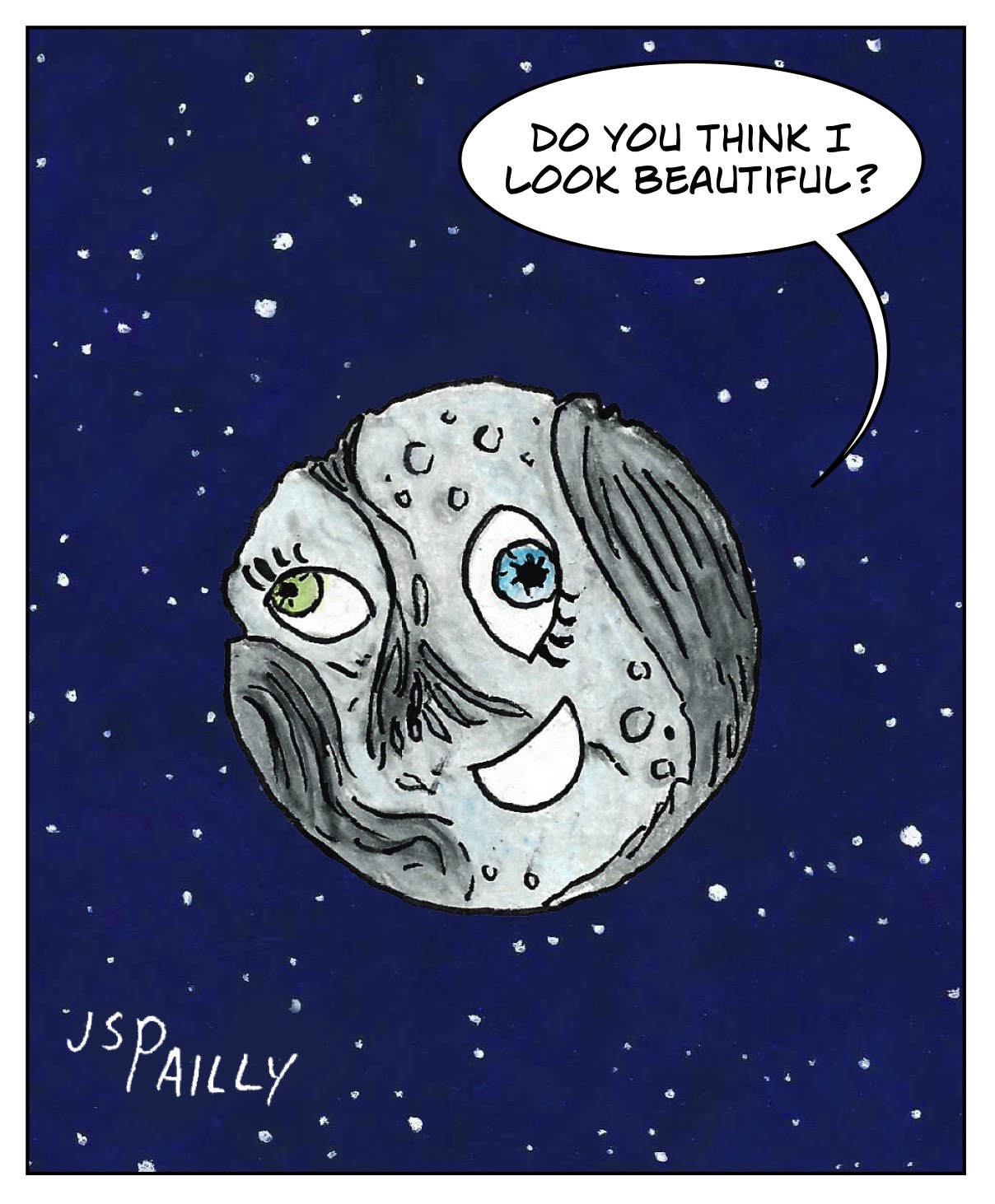
So yes, Miranda, to answer your question: I do think you’re beautiful.

#IWSG: Being a Writer is Soooo Boring!

Welcome to the Insecure Writer’s Support Group!  If you’re a writer, and if you feel in any way insecure about your writing life, click here to learn more about this awesome group!

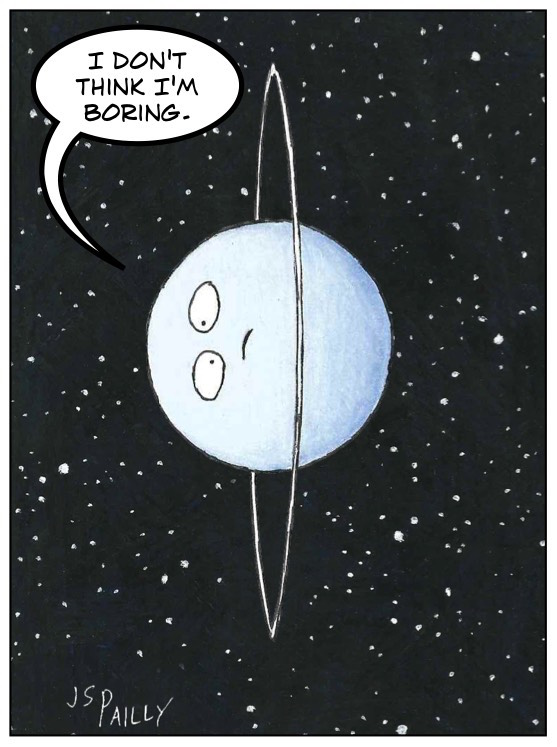
I, J.S. Pailly, stand accused of being a boring person.  Or at least that’s what a few well-meaning friends and acquaintences seem to think.  You see, all I ever do is write and read and do research.  Then I do more research, which is followed up with more writing.

Most people are willing to concede that all the art I do might be fun.  But otherwise my life is soooo boring.  Boring, boring, boring.  I need to get out more, travel, go to loud parties, eat at popular restaurants… or other stuff like that, I guess.

Anyway, I’ve been accused of being boring.  So in my defense, I’m going to talk about something that I find really interesting: space.  And perhaps the story I’m about to tell will serve as a nice little allegory about what it means to be boring or interesting.

In 1986, the Voyager 2 spacecraft became the first—and thus far the only—spacecraft to visit the planet Uranus.  As I’m sure you’re already aware (you may already be giggling), Uranus is a much-maligned planet, because of its name.  Voyager 2’s visit gave us yet another reason to malign our poor seventh planet.

Uranus turned out to be a featureless cyan-blue orb.  There was nothing like Jupiter’s Great Red Spot or Saturn’s polar hexagon.  There were no atmospheric zones or belts.  There was nothing interesting to look at at all! What a boring planet, scientists said.

But of course, this was only true from our limited human perspective.  Our eyes can only see a range of approximately 400 to 700 nanometers on the electromagnetic spectrum (which we perceive as the colors violet to red).

If you observe Uranus only in this 400 to 700 nm range, there’s not much to see.  Switch to ultraviolet, however, and you’ll find a complex and dynamic atmosphere that’s every bit as interesting as Jupiter or Saturn’s.

Whether we’re talking about planets or people, what is boring versus what is interesting is all a matter of perspective.  Will this little anecdote change anybody’s mind?  I’m not sure.  I suspect if you already think I’m a boring person, me talking about sciency stuff only reinforces that belief. But I hope the rest of you get what I’m trying to say.

P.S.: Fun fact!  If you’ve ever wondered why Uranus got stuck with its giggle-inducing name, it’s because the guy who picked the name was German, and he probably didn’t realize what it would sound like in English.

Beneath the Blue-Green Clouds

It would have been the most celebrated discovery in human history: life on another world.  But the press and the late night comedians soon turned what should have been an auspicious occasion into one great big joke.

In February of 2050, NASA’s Herschel spacecraft released a small probe, one of many such probes designed to penetrate the atmospheres of gas giants.  We had learned much about the atmospheres of Jupiter and Saturn in this manner, but the Herschel mission would be a first, in more ways than one.

Among its many scientific instruments, the Herschel probe included a camera.  We expected to see a tranquil layer of blue-green clouds, with a layer of storms underneath.  If we were lucky, we thought we might even see methane ice crystals falling like snow.

But then, in a forty-three second sequence of images, we saw them.  They were giant, shadowy forms lurking in the dark, occasionally backlit by lightning.  They were enormous, easily the size of whales, and there were swarms of smaller organisms all around them, like the krill whales feed upon.

The krill-like life forms are difficult to make out in any detail, but the whales are clearly held aloft by gas bladders, filled with hydrogen, perhaps; and they have fin-like wings which they must use to maneuver. A great multitude of tentacles dangle from their underbellies, tentacles which seem to be writhing violently from one photo to the next, very much as though these animals were busily feeding.

Of all the places in the Solar System, this was the last place we expected to find alien life.  How could these creatures have evolved?  How could such a complex ecosystem sustain itself in the cold, far reaches of the Solar System?  These will have to be questions for some future mission, assuming Congress and the general public will take this seriously enough to support a future mission.

But unfortunately these mysterious and majestic creatures have become the laughing stock of the world, all because of one minor circumstance. All because of the planet where they happen to live.  All because of that planet’s name.

Although, truth be told, who wouldn’t laugh a little when the top headline on every newspaper reads: “Alien life discovered in Uranus.”