What’s Up with Juno?

It’s been awhile since we checked in with Juno, the NASA space probe currently orbiting Jupiter. So Juno, how’s the mission going?

dc20-juno-update-1

Uh-oh. That doesn’t sound good. What happened?

dc20-juno-update-2

Okay, here’s a quick timeline of events:

  • On July 4, 2016, Juno entered orbit of Jupiter. The main engine worked flawlessly at the time.
  • On August 27, 2016, Juno performed its first science pass of Jupiter. All its instruments appeared to be in working order.
  • On October 19, 2016, Juno was supposed to shorten its orbital period from 53 days to 14 days, but there was a problem with the main engine. Plan B was to just do another science pass, but then there was a problem with the main computer.

According to this article from Spaceflight 101, we now know what happened with the computer, and it sounds like it’ll be a fairly easy fix. The malfunction was caused by an instrument called JIRAM. Continuing with our timeline:

  • On December 11, 2016, Juno performed another science pass, this time with JIRAM switched off. All the other science instruments seem to be in working order, and a software patch for JIRAM will be uploaded soon.
  • Coming February 2, 2017, Juno will approach Jupiter again. This will likely be another science pass, since NASA still doesn’t know what’s wrong with the main engine.

The main engine is turning out to be the real problem. According to a press release from October, some pressure valves that should have opened in a matter of seconds took several minutes to open. Until NASA figures out why that’s happening, they’re going to leave Juno’s orbit alone.

Juno can still perform its mission in its current 53-day orbit; it’ll just take longer. We’re looking at five years rather than the original year-and-a-half. That screws up the original science observation calendar, and the prolonged exposure to Jupiter’s intense magnetic field might lead to more computer glitches in the future.

dc20-juno-update-3

Fingers crossed.

Sciency Words: The Zero-One-Infinity Rule

Sciency Words MATH

Today’s post is part of a special series here on Planet Pailly called Sciency Words. Each week, we take a closer look at an interesting science or science-related term to help us expand our scientific vocabularies together. Today’s term is:

THE ZERO-ONE-INFINITY RULE

I came across this term in Time’s special edition on Scott Kelly’s year in space, which I reviewed on Wednesday. The term was used in an article about astrobiology, but it actually originates in the field of computer science.

Zero-One-Infinity in Computer Science

The zero-one-infinity rule is sort of a rule of thumb. It’s credited to Dutch computer scientist Willem Louis Van Der Poel. According to this rule, a computer program should either never allow a certain event (zero), or it should allow it only once (one), or it should allow it an unlimited number of times (infinity).

The logic here is that it makes sense to not allow something to happen. It also might make sense to allow something to happen only once, perhaps as an exception. But programmers shouldn’t create arbitrary limits (according to this rule) on what a program can do. If you’re willing to allow something to happen twice, why not three times? Or four? Or thirty-eight? Or as many times as the user wants (computer memory space permitting)?

I don’t have a whole lot of coding experience, but the zero-one-infinity rule makes sense to me. It seems like a good rule, although I could probably think up more than one exception to the rule if I really wanted to.

Zero-One-Infinity in Astrobiology

Applying the zero-one-infinity rule to the search for alien life is, in my opinion, brilliant. How many locations in the universe can support life? There are really only three answers:

  • Life cannot exist anywhere in the universe (zero).
  • Life can exist only on Earth; Earth is a very special exception in a universe where life is otherwise not allowed (one).
  • Life can exist in an unlimited number of locations in the universe (infinity).

We already know the zero proposition is false.

There was a time (I remember it well) when many a scientist argued that Earth must be an exception: the one and only place in the universe where life could exist. Occasionally, I still hear people try to argue this.

All it would take is to find a second life-bearing world to prove the one proposition wrong (I’m looking at you, Europa). Because once we know about two living worlds, how could anyone argue that there can’t be three? Or four? Or thirty-eight? Or however many the universe feels like having?

Links

Zero-One-Infinity Rule from The Jargon File.

Willem Louis Van Der Poel from Wiki Wiki Web.

Exoplanet Explorer: Orbitar

Today’s post is the first in what I hope will become a semi-regular series about exoplanets: planets that orbit stars other than our Sun. I’ve decided to start with an exoplanet named Orbitar.

dc12-orbitar

In December of 2015, the exoplanet designated 42 Draconis b was officially renamed Orbitar following a public naming contest held by the International Astronomy Union. Orbitar is a gas giant planet orbiting a red giant star approximately 315 light-years away in the constellation Draco.

Discovering Orbitar

The gravitational pull between planets and the stars they orbit causes stars to wobble in place. When the star 42 Draconis was found to wobble at a regular interval of 479 days, it was determined that a large planet with a 479 day orbital period was likely responsible.

Further calculations determined that this planet had an average orbital distance of 1.19 AU and an orbital eccentricity of 38%. The planet’s total mass was estimated to be equivalent to at least 3.88 Jupiters, give or take 0.85 Juptiers.

Life on Orbitar’s Moons?

According to the Brevard Astronomical Society, the group that won the IAU naming contest for Orbitar, “this closely orbiting gas planet could possibly host moons with Earth-like characteristics in the so-called habitable zone.”

Personally, I feel that’s a bit over-optimistic. At an orbital distance of 1.19 AU, Orbitar and its hypothetical moons would certainly would be within our Sun’s habitable zone, but 42 Draconis (which was renamed Fafnir in the IAU contest) is over twice our Sun’s age and has entered the red giant phase of its life cycle.

I may be wrong about this, but I’d expect that Fafnir’s habitable zone would lie well beyond the 1.19 AU distance. Orbitar’s moons (if they exist) should have been charred to cinders by now.

However, that still leaves us with the possibility that Orbitarian life could have existed at some point in the distant past, when Fafnir was still young and still a main sequence star like our Sun.

P.S.: As far as I can tell, the name Planety McPlanetface was not submitted to the IAU’s planet naming contest.

Correction: The “Life on Orbitar’s Moons” section of this post was based on a quote which was misattributed to the Brevard Astronomical Society.  See the comments below.  I can no longer find the original source for that quote.

Links

Orbitar, Really? Some New Exoplanet Names Are Downright Weird from Ars Technica.

Planetary Companion Candidates Around K Giant Stars 42 Draconis and HD 139 357 from Astronomy & Astrophysics.

Name Exoworlds: An IAU Worldwide Contest to Name Exoplanets from the International Astronomy Union.

Sciency Words: Kosmikophobia

Sciency Words MATH

Today’s post is part of a special series here on Planet Pailly called Sciency Words. Each week, we take a closer look at an interesting science or science-related term to help us expand our scientific vocabularies together. Today’s term is:

KOSMIKOPHOBIA

I stumbled upon this word while researching last week’s posts on asteroids (click here or here). Kosmikophobia is the fear of cosmic phenomena.

To be fair, there are cosmic phenomena to be genuinely concerned about, such as potential asteroid impacts, gamma ray bursts, or the kinds of solar storms that could trigger another Carrington Event.

But this is a phobia, meaning its an irrational or over-exaggerated fear. It’s one thing to one thing to worry that an asteroid might one day wipe out human civilization; it’s another to live in existential dread that it might happen at any moment.

Kosmikophoba can also cover totally irrational fears of auroras or eclipses or the phases of the Moon. Or if you’re excessively terrified of comets and planetary alignments because you believe they are bad omens… that could also be considered kosmikophobia.

There are just two things I’m not clear on: first, has anyone actually been diagnosed with kosmikophobia and received treatment for it? And second, why is it spelled with k’s rather than c’s.

Regarding the spelling, I’m guessing the k’s are supposed to be a more authentic transliteration of the original Greek spelling of cosmos. I just can’t find any etymology to back me up on that.

As for the first point, I know not all phobia-words are meant to be taken seriously. For example, hippopotomonstrosesquipedaliophobia (the fear of long words) seems to have been made up as a joke.

Since I can’t find any case studies about patients suffering from kosmikophobia, I can’t be sure how seriously to take this condition. The only thing I can say for certain is that this is a real word. I found it in a real dictionary. And as a space enthusiast, I’m really glad I don’t have it.

Sciency Words: Apollos and Atens

Sciency Words BIO copy

Today’s post is part of a special series here on Planet Pailly called Sciency Words. Each week, we take a closer look at an interesting science or science-related term to help us expand our scientific vocabularies together. Today we’ve got two terms:

APOLLOS and ATENS

Asteroid are classified into different “groups” based on their orbital properties. The Apollo asteroids and Aten asteroids are two such groups, and these groups are of particular interest to anyone who doesn’t want a repeat of the K-T Event (which wiped out the dinosaurs) or the Tunguska Event (which flattened a forest and could have done the same to a whole city).

Technical Definitions

  • Apollo asteroids have a semimajor axis greater than 1.0 AU and a perihelion less than Earth’s aphelion of 1.017 AU. The first known Apollo was 1862 Apollo, for which the group is named.
  • Aten asteroids have a semimajor axis less than 1.0 AU and an aphelion greater than Earth’s perihelion of 0.983 AU. The first known Aten was 2062 Aten, for which the group is named.

Less Technical Definition

  • Apollo asteroids spend most of their time beyond Earth’s orbit, but cross inside at some point.
  • Aten asteroids spend most of their time inside Earth’s orbit, but cross outside at some point.

nv25-apollo-and-aten-orbit-diagrams

The important thing to know is that both Apollos and Atens cross Earth’s orbit at some point. Keep in mind that space is three-dimensional, so their paths don’t necessarily intersect with Earth’s. They might pass “above” or “below” Earth, so to speak.

But the orbits of enough Apollos and Atens do intersect with Earth’s orbital path that they might one day hit us. Atens are particularly worrisome. They spend so much time inside Earth’s orbit, in relatively close proximity to the Sun, that it’s hard for astronomers to find them.

So if a giant asteroid ever does sneak up on us and wipe out human civilization, my guess is it’ll be an asteroid from the Aten group. Those are the asteroids that frighten me the most.

nv25-aten-asteroid

Don’t Panic: It’s Just Another Asteroid

People ask me all the time: “Hey, did you hear about that asteroid?” These people then tell me about some asteroid that’s supposed to “just barely miss us” is the next day or so. Sometimes, they also ask, “Aren’t you worried?”

There are certain kinds of space news that I simply can’t get excited about anymore. This is one of them. Why?

nv23-asteroid-flybys

There’s actually a newsletter about asteroid flybys. It’s called Daily Minor Planet, and I have a subscription (it’s free). Every day in my inbox, I’m notified of the latest asteroid or other object skimming past Earth. Every day. Sometimes there are more than one per day.

Occasionally, one of these objects will pass within the radius of the Moon’s orbit. That’s not an everyday thing, but still… it happens more often than you might think.

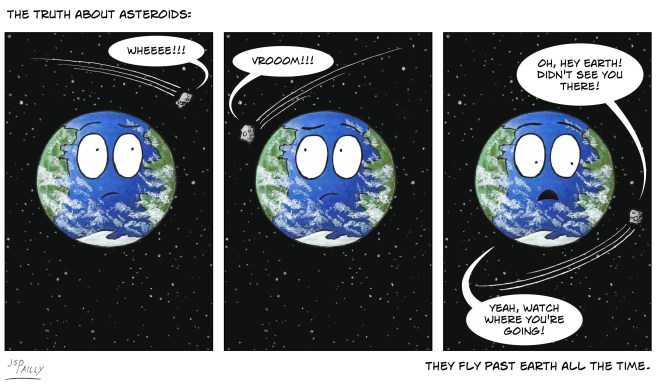
So when people ask if I’ve heard about the latest asteroid flying past Earth, the only thing I can really say is, “Which one?” And if someone asks me if I’m worried, my answer is no. The asteroids that make headlines on the news and the asteroids that appear in Daily Minor Planet… those are asteroids we know about. It’s all the asteroids we don’t know about that scare the bejesus out of me.

Sciency Words: Thalassogen

Sciency Words PHYS copy

Today’s post is part of a special series here on Planet Pailly called Sciency Words. Each week, we take a closer look at an interesting science or science-related term to help us expand our scientific vocabularies together. Today’s term is:

THALASSOGEN

I stumbled upon this term while researching my recent Molecular Monday post on ammonia. The word thalassogen comes from the Greek words for “sea” and “creation,” and it was coined by one of the great luminaries of both science and science fiction: Isaac Asimov.

Basically, a thalassogen is a chemical substance that could, under realistic circumstances, form an ocean on a planet or moon. Obviously water qualifies. Just look at Earth. But what other substances could we call thalassogenic?

First, we need something that can be liquid and is capable of remaining in a liquid state across a reasonable wide range of temperatures and pressures.

We also need a chemical that is reasonably plentiful in the universe. According to Asimov, that rules out something like mercury. Mercury does a great job being a liquid, but it’s so rare that we can’t realistically expect to find a world covered in mercury oceans.

Asimov also wrote that “ideally” a thalassogen should be able to transition from liquid to both solid and gaseous states without too much difficulty. That way, we could have something analogous to Earth’s hydrocycle, with clouds and rain and snow and glaciers. Please note: that’s ideal, but not necessarily a requirement.

nv11-alien-oceans

In my opinion, the most sensible way to use this term is to say that a substance is (or could be) a thalassogen in a specific environment. So methane is a thalassogen on Titan, but not Earth. You might also say water is a thalassogen on Earth but not on Venus. Or water is a thalassogen beneath the surface of Europa, but not on Europa’s surface.

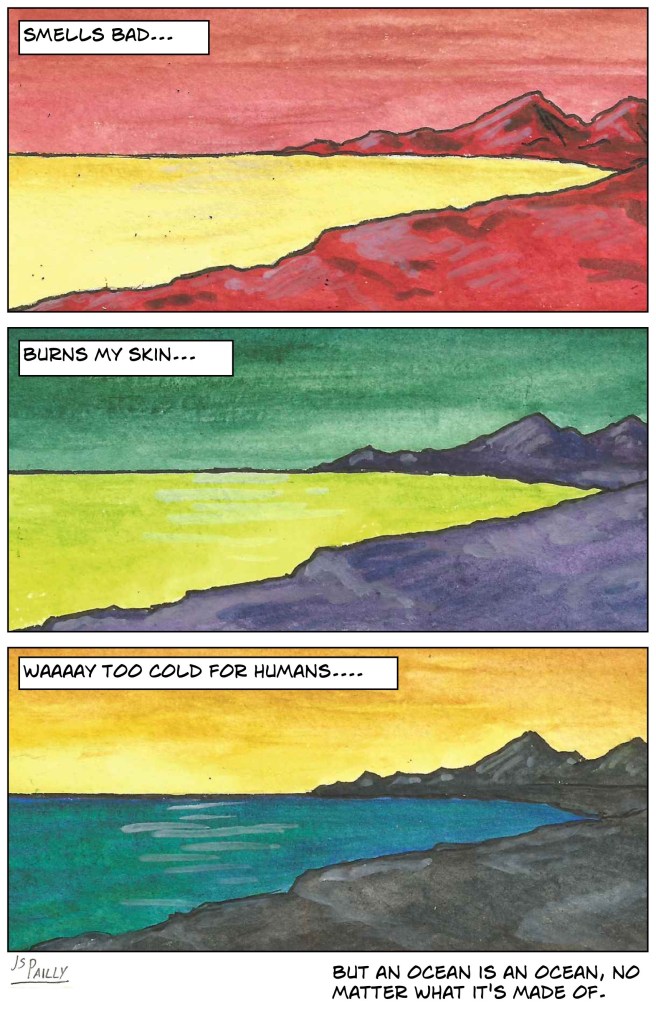
So as we venture out into space, what sorts of chemicals might we find acting as thalassogens on alien worlds? Asimov suggested water, ammonia, and methane as the most likely candidates. Other possibilities include carbon dioxide, sulfur dioxide, and sulfuric acid. We should also consider mixtures of these and other chemicals.

And who knows? Given some of the strange, improbable-seeming exoplanets we’ve discovered so far, maybe Asimov was a little too quick to rule out mercury.

Time: Mission to Mars, A Book Review

A few years back, I picked up a special edition of Time Magazine that was all about Albert Einstein. It had a lot of new-to-me biographical information, and it did a surprisingly good job explaining Einstein’s physics. So when I saw Time’s “Mission to Mars: Our Journey Continues” on the magazine rack, I bought it.

oc31-time-magazine-mission-to-mars

Quick Review

It was just okay.

Longer Review

It’s worth taking stock of the fact that there is so much Mars-related stuff going on, but I think the writers were trying to cram too much into a magazine (booklet?) that’s less than 100 pages.

They touched on the search for Martian life, the Curiosity rover, India’s Mars Orbiter Mission, Scott Kelly’s Year in Space, the competition between SpaceX and Blue Origin, President Obama’s space policy, production of The Martian staring Matt Damon… they touched on all of this stuff, but they didn’t go into detail about any of it.

Any one of those topics could have filled a whole magazine by itself (in fact, Time did do a special edition on the Year in Space mission). If they had narrowed their focus just a little, I think they could have produced a much more interesting and informative publication.

Recommendation

If you don’t know much about Mars and the current state of space exploration, and you want to be better informed, this isn’t a bad place to start. For people like myself who are already huge space enthusiasts, the forward by Buzz Aldrin is worth a look. Otherwise, I’d say give this one a pass.

Sciency Words: H.A.V.O.C.

Sciency Words BIO copy

Today’s post is part of a special series here on Planet Pailly called Sciency Words. Each week, we take a closer look at an interesting science or science-related term to help us expand our scientific vocabularies together. Today’s term is:

H.A.V.O.C.

Given a choice between colonizing Venus or Mars, I might actually choose Venus. Yes, surface conditions on Venus are hellish instant death. Like, literally hellish. It’s even got the sulfur. But a Venusian colony would not be built on the planet’s surface.

Atmospheric conditions at an altitude of about 50 km are actually quite pleasant. The temperature and pressure are about the same as on Earth. So is the gravity. And you wouldn’t need hydrogen or helium to keep your floating cities aloft; on Venus, oxygen is lighter than air.

Life in a Venusian floating city, drifting around right above the Venusian clouds, sounds almost—dare I say it?—heavenly. There’d be plenty of sunlight (solar panels would soak up plenty of energy), and Venus would provide some natural protection from solar and cosmic radiation (at least, more protection than you’d get on Mars).

And thanks to the weird chemical mix in Venus’s atmosphere, you’d be able to collect almost all the natural resources you’d need. Well, aside from water (Mars has got Venus beat there).

I know this sounds crazy, but the more you read about it, the more Venus colonization makes sense. Venus may not get the kind of attention (or funding) that Mars gets, but NASA and other space agencies do take this seriously. NASA has even given the idea a name: the High Altitude Venus Operational Concept, or H.A.V.O.C.

oc28-venus-havoc

So I’m ready to sign up for a mission to colonize Venus. Who’s with me?

Meet a Moon: Dione

Regarding Greek mythology, it seems no one’s really sure who Dione was. Ancient sources contradict each other, and modern scholars think there may have actually been more than one mythical woman who went by that name. But I was able to find out this much: according to Wikipedia, at least one of these Diones was “sometimes associated with water or the sea.”

What that in mind, I’d like to introduce you to Dione, one of Saturn’s moons.

oc24-meet-dione

You sure are, Dione. In fact, I can’t think of a better description for you.

The Waters of Enceladus

Over the last decade or so, one of Saturn’s other moons has become famous for having an ocean of liquid water beneath its surface. That moon is called Enceladus. We know about Enceladus’s water for two reasons:

  • Geysers: Enceladus has a series of cracks (called tiger stripes) in its south polar region, and saltwater shoots out of these cracks at regular intervals.
  • Libration: Enceladus wobbles in place (librates) more than it should. This is best explained by the presence of a layer of liquid separating the moon’s crust from its core.

It’s still a mystery how Enceladus generates enough heat to keep its liquid water from freezing, but at this point, it’s pretty clear the water is there.

The Waters of Dione

Dione doesn’t librate the way Enceladus does, and we haven’t noticed any saltwater geysers, but a recent paper in Geophysical Research Letters says Dione might have a subsurface ocean too.

The authors of the paper created a new theoretical model for icy moons, a model which fits precisely with observations of Enceladus. Then they applied this new model to Dione and concluded that Dione should have a subsurface ocean.

This raises two questions that are fairly easily answered.

  • Where are Dione’s geysers?: Dione may not spew saltwater (anymore), but it does have cracks and fissures in its surface, suggesting that it may have had active “tiger stripe” geysers in the past.
  • What about Dione’s libration?: The new model suggests that Dione should librate, but not as much as Enceladus does. The Cassini spacecraft (currently orbiting Saturn) does not have instruments sensitive enough to detect the predicted libration.

So there you have it. According to at least one theoretical model, Dione should have a subsurface ocean, but we cannot yet confirm that it does. And it’ll probably be awhile before we can send a new spacecraft to Saturn to find out one way or another.

But hey, how appropriate is it that we named this moon, which might have a subsurface ocean, depending on your theoretical model, after a mythical figure that might sometimes have been associated with water, depending on which ancient sources your reading!