Sciency Words A to Z: Viking

Welcome to a special A to Z Challenge edition of Sciency Words!  Sciency Words is an ongoing series here on Planet Pailly about the definitions and etymologies of science or science-related terms.  In today’s post, V is for:

VIKING

You know, I’ve noticed something about those early pioneers in the field of astrobiology.  They thought they knew an lot about what aliens would be like, how aliens would behave.  It seems awfully presumptuous in hindsight.  People even thought they knew how alien microorganisms would behave.

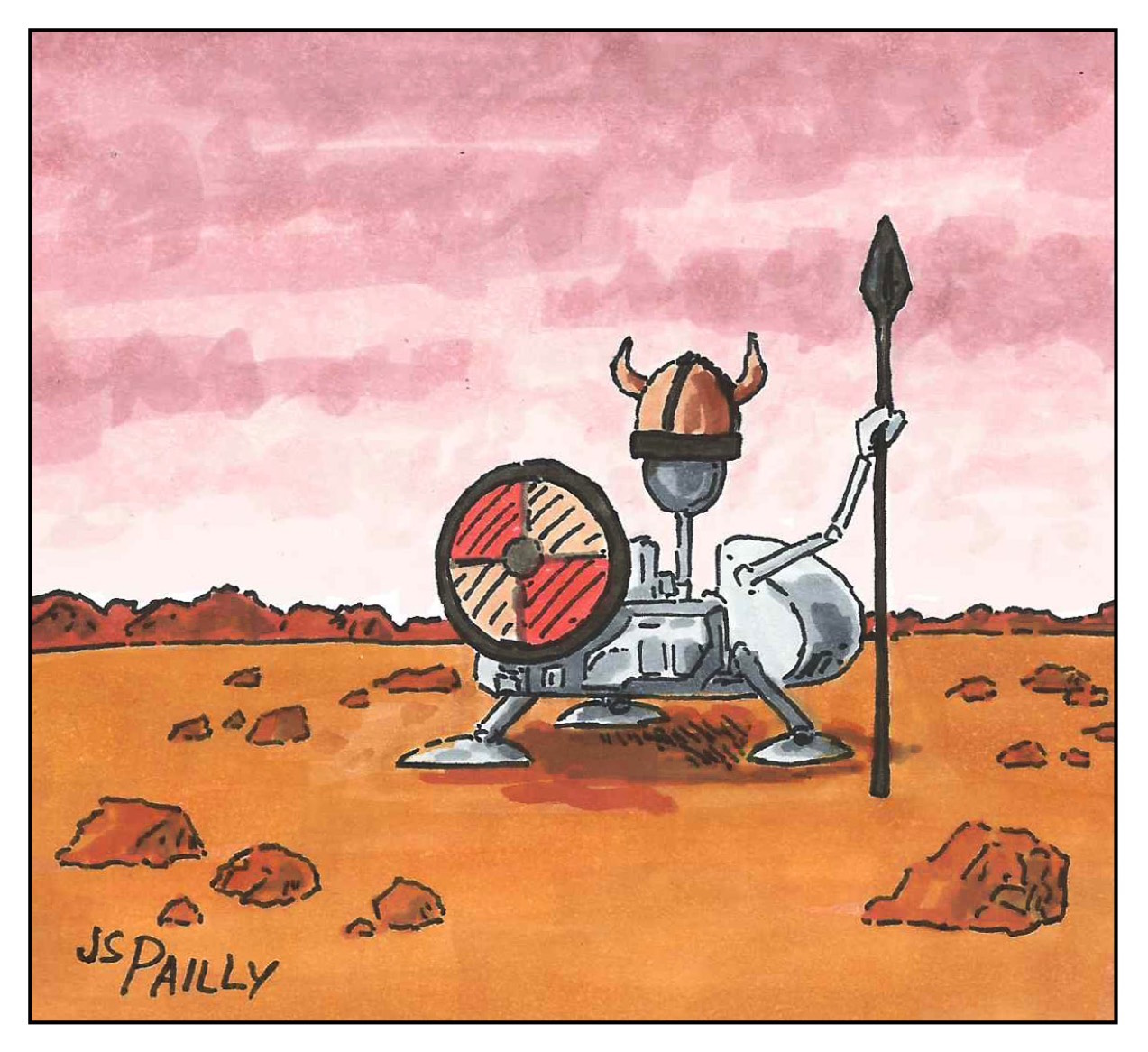
In the late 1960’s, NASA was putting together a mission to Mars, and they decided to name this new mission Viking.
As explained in this book on NASA’s history of naming things:

The name had been suggested by Walter Jacobowski in the Planetary Programs Office at NASA Headquarters and discussed at a management review held at Langley Research Center in November 1968.  It was the consensus at the meeting that “Viking” was a suitable name in that it reflected the spirit of nautical exploration in the same manner as “Mariner” […].

In NASA’s early years, nautical exploration was the theme for naming all missions to other planets.

The Viking 1 and Viking 2 landers arrived on Mars in 1976. They were the first space probes to successfully land (as opposed to crash) on Mars, and they were the first to send back photos from the surface.  They were also the first, and so far the only, space probes to conduct experiments directly testing for Martian life.

And one of those tests came back positive!!!

Except it may have been a false positive.  It was probably a false positive.

This test was called the labeled release experiment, and here’s how it worked: the Viking landers scooped up some Martian soil and added a nutrient mix—in other words, we tried to feed the Martians.  The nutrient mix was “labeled” with a radioactive carbon isotope, so if any Martian microbes were living in the soil, they’d take the food and then release gaseous waste that had this special isotope in it.

But there were some problems with this idea.  How do we know what Martian microbes eat?  How do we know what waste products they produce?  And—here’s the biggest problem of all—given how little we knew about Mars at the time, how do we know our nutrient mix wouldn’t react with some previously unknown chemical in the Martian soil, giving us a false positive result?

These are the kinds of questions that were asked after the labeled release experiment took place (but apparently not before).  As a result, there was wild disagreement about what that positive test result might actually mean.  The general consensus today is that we got a false positive.  Our nutrient mixture must have reacted with something in the soil, something that was not alive.

But while the Viking Mission could not give us a definitive answer about whether or not there is life on Mars, Viking still taught astrobiologists a valuable lesson.  When exploring strange, new worlds, trying to tell the difference between chemistry and biochemistry can be really hard.

Next time on Sciency Words A to Z, wow… just, wow!

Sciency Words A to Z: JUICE

Welcome to a special A to Z Challenge edition of Sciency Words!  Sciency Words is an ongoing series here on Planet Pailly about the definitions and etymologies of science or science-related terms.  In today’s post, J is for:

JUICE

Speaking as a space enthusiast and a citizen of the United States, I have to confess I’m a bit disappointed with the status of the American space program.  While there have been some success stories—New Horizons, Curiosity, Scott Kelly’s year in space—I can’t help but feel like NASA has spent the last decade or so floundering.

However, it’s encouraging to see that so many other space agencies around the world are starting to pick up the slack.  My favorite example of this is the JUICE mission, a project of the European Space Agency (E.S.A.).

Astrobiologists have taken a keen interest in the icy moons of Jupiter.  There’s compelling evidence that one of those moons (Europa) has an ocean of liquid water beneath its surface.  There’s also a growing suspicion that two more of those moons (Ganymede and Callisto) may have subsurface oceans as well.

The original plan was for NASA and the E.S.A. to pool their resources for one big, giant mission to the Jupiter system.  But then the 2008 financial crisis hit.  The U.S. Congress was loath to spend money on anything—especially space stuff.  “Due to the unavailability of the proposed international partnerships […]”—that’s how this E.S.A. report describes the matter.

So the E.S.A. decided to go it alone. Personally, I think this was a very brave move.  E.S.A. has never done a mission to the outer Solar System before, not without NASA’s help.  But there has to be a first time for everything, right?  And so JUICE—the JUpiter ICy moons Explorer—began.  It’s not my favorite acronym, but it works.

According to E.S.A.’s website, JUICE will conduct multiple flybys of Europa and Callisto before settling into orbit around Ganymede.  You may be wondering why JUICE won’t be orbiting Europa.  This is in large part because of the radiation environment around Jupiter.  Europa may be more exciting to astrobiologists, but Ganymede is a safer place to park your spacecraft.

Meanwhile, NASA has recovered much of the funding it lost after the 2008 financial crisis, and they’re once again planning to send their own mission to the Jupiter system.  So maybe NASA and E.S.A. will get to explore those icy moons together after all!  Or maybe not.  According to this article from the Planetary Society, NASA’s budget is under threat once again.

I guess we’ll have to wait and see, but no matter what happens to NASA’s budget, E.S.A. seems fully committed to JUICE.  So speaking as a space enthusiast, at least I have that to look forward to.

Next time on Sciency Words A to Z, how do you measure the size of an alien civilization?

Sciency Words A to Z: B.S.O.

Welcome to a special A to Z Challenge edition of Sciency Words!  Sciency Words is an ongoing series here on Planet Pailly about the definitions and etymologies of science or science-related terms.  In today’s post, B is for:

B.S.O.

When you study the planets, when you really get to know them well, you soon start to feel like they each have their own unique personalities.  Jupiter is kind of a bully, pushing all the little asteroids around with its gravity.  Venus hates you, and if you try to land on her she will kill you a dozen different ways before you touch the ground. And Mars… I can’t help but feel like Mars is kind of jealous of Earth.

I get the sense that Mars wishes it could be just like Earth, and that Mars is trying its best to prove that it has all the same stuff Earth has.

In 1996, Mars almost had us convinced. A team of NASA scientists led by astrobiologist David McKay announced that they’d found evidence of Martian life.

As reported in this paper, McKay and his colleagues found microscopic structures (among other things) within a Martian meteorite known as ALH84001.  They interpreted those structures to be the fossilized remains of Martian microorganisms.

This was a truly extraordinary claim, but as Carl Sagan famously warned: “extraordinary claims require extraordinary evidence.” Or to put that another way, when it comes to the discovery of alien life, astrobiologists must hold themselves and each other to the same standards as a court of law: proof beyond a reasonable doubt.

In follow-up research, those supposed Martian fossils came to be known as bacteria shaped objects, or B.S.O.s for short.  I kind of wonder if somebody was being a bit cheeky with that term. I wonder if someone was trying to say, in a subtle but clever way, that the whole Martian microbe hypothesis was just B.S.  As this rebuttal paper explains:

Subsequent work has not validated [McKay et al’s] hypothesis; each suggested biomarker has been found to be ambiguous or immaterial.  Nor has their hypothesis been disproved.  Rather, it is now one of several competing hypotheses about the post-magmatic and alteration history of ALH84001.

In other words, those B.S.O.s might very well be fossilized Martian microorganisms.  Yes, they might be.  It is possible.  But no one has been able to prove it beyond a reasonable doubt, and therefore no one can say with any certainty that we’ve found evidence of life on Mars. At least not yet.

Still, the ALH84001 meteorite and its B.S.O.s are an important part of the history of astrobiology.  As that same rebuttal paper says:

[…] it will be remembered for (if nothing else) its galvanizing effect on planetary science.  McKay et al. revitalized study of the martian meteorites and the long-ignored ideas of indigenous life on Mars.  It has brought immediacy to the problem of recognizing extraterrestrial life, and thus materially affected preparations for spacecraft missions to return rock and soil samples from Mars.

Next time on Sciency Words A to Z, are we prejudiced against non-carbon-based life?

Super Sexy Spacesuits

The spacesuits of today are cumbersome and uncomfortable.  Worst of all, they’re not stylish.  As a science fiction writer/illustrator, I want my characters to look good when they’re blasting through the vacuum of space, fighting bad guys and ridding the galaxy of evil.  Fortunately, NASA researchers have provided me with a realistic (or at least plausible) excuse for dressing my characters the way I want.

It’s something I call the super sexy spacesuit, but the people who are actually developing the technology call it a mechanical counterpressure (M.C.P.) suit.  Spacesuits today are basically body-shaped spaceships, and the whole interior needs to be pumped full of air to replicate atmospheric pressure. The big selling point for M.C.P. suits is that you wear them like regular clothing.

Almost.  They’re a lot tighter than regular clothing.  Not the way Spandex is tight.  No, they’re way tighter than that.  The fibers in the cloth are supposed to constrict on command, squeezing your body—squeezing so hard they end up exerting one atmosphere’s worth of pressure on your skin.

When you’re in space, you won’t notice that pressure. You’ve lived your whole life under one atmosphere’s worth of pressure, so you’re used to that.  The suit should feel like a second skin, providing you all the comfort and flexibility of being naked (and perhaps the body image anxiety as well).

You’ll also be safer, at least in one sense, because minor damage to the suit wouldn’t cause catastrophic depressurization, the way it can with a contemporary spacesuit.  However, there are still a few parts of the body where mechanical counterpressure won’t work so well. Fingers and toes, and all the small bones of the hands and feet, are really, really not meant to be compressed in this way.  The same is true for your face and head, and mechanical counterpressure in the groin area could also be problematic.

But still, in the future some sort of M.C.P. spacesuit might be a plausible option, not just so we can survive in the vacuum of space but so we can look good doing it.

Or you could forego spacesuits all together and do this instead:

Sciency Words: Karman Line

Sciency Words: (proper noun) a special series here on Planet Pailly focusing on the definitions and etymologies of science or science-related terms.  Today’s Sciency Word is:

THE KARMAN LINE

If I may begin on a personal note, I spent most of 2018 essentially grounded by real life problems.  So for 2019, I’m dusting off the old imaginary spaceship, and I’m ready to launch myself back into outer space.  It seems I have a whole lot of space research I need to catch up on!  But first, where exactly is space?  How far away is it?

In the early 1960’s, Hungarian-American physicist Theodore von Kármán proposed an idea that has come to be known as the Karman line. Basically, the Karman line can be defined as the altitude where you need to stop thinking in terms of aerodynamics and start thinking in terms of orbital mechanics.

A traditional aircraft flying above the Karman line will no longer get enough lift to stay aloft, and a satellite or other space vehicle that dips below the Karman line will experience too much atmospheric drag to maintain its orbit.  Technically speaking, there are still more layers of Earth’s atmosphere above that line, but still this seems like a sensible enough place to define the beginning of outer space.

So how high up is the Karman line?  According to the Fédération Aéronautique Internationale (F.A.I.), which is sort of like the Guinness Book of World Records specifically for air and space flight, the Karman line is 100 km above sea level.  This is the value that seems to be most commonly accepted around the world, but it is not the value accepted by one noteworthy space agency: NASA.

According to NASA, space begins 50 miles above sea level. This 50 miles number is not merely a result of America’s famous disdain for the metric system.  As explained in this paper from Acta Astronautica, calculating the exact altitude where aircraft can no longer fly and satellites can no longer maintain their orbits has been a challenge for many decades; however, an estimate of 80 km (approximately 50 miles) may be closer to the real Karman line than the 100 km estimate set by the F.A.I.

A lot may depend on your spacecraft’s design, the parameters of your orbit, and solar activity, which causes Earth’s atmosphere to puff up slightly at times.  But to quote from that Acta Astronautica paper:

[…] elliptical orbits with perigees at 100 km can survive for long periods. In contrast, Earth satellites with perigees below 80 km are highly unlikely to complete their next orbit.

In other words, a satellite can safely dip below an altitude of 100 km, but if it gets as low as 80 km, that satellite is toast.

So when I climb back into my imaginary spaceship, how far up do I need to go to reach space?  50 miles?  100 km?  Or is there some other number I should be aiming for?

I’m still not sure.  But given the places I’m planning to go with my research in the coming year, maybe it doesn’t really matter.  Me and my imaginary spaceship will be flying well beyond the Karman line, wherever precisely that line is.

Sciency Words: SOHO

Sciency Words BIO copy

Today’s post is part of a special series here on Planet Pailly called Sciency Words. Every Friday, we take a look at a new and interesting scientific term to help us all expand our scientific vocabularies together. Today’s word is:

SOHO

If you want to do any serious research about the Sun, you will soon come across this name: SOHO, short for the Solar and Heliospheric Observatory. It is a project of international cooperation between NASA and ESA (the European Space Agency). The Europeans built it, NASA launched it into space and is now responsible for operating and maintaining it.

SOHO is positioned between the Sun and Earth, and its mission is to monitor and study solar activity. Launched in December of 1995, SOHO was only supposed to be in operation for about two years, yet despite several malfunctions, the thing is still running nearly two decades later.

Much of what we currently know about the Sun is thanks to SOHO (which is why the name came up so often in my research).

  • SOHO observes activity on the Sun’s surface (like Moreton waves), and it has provided us with the first ever images of what’s going on beneath the surface.
  • SOHO is part of our early warning system, helping protect our technologically advanced civilization in case something like the Carrington Event ever happens again.
  • SOHO samples solar ejecta, allowing us to find out what exactly the Sun is spewing into space.
  • Remember that weird thing about the Sun’s temperature? SOHO is helping investigate that too.

Ja12 SOHOSo as we end our month-long adventures with the Sun, let’s give a big round of applause to the SOHO spacecraft, one of the hardest working spacecraft in the Solar System, and let’s hope that it will miraculously keep working for many years to come.

Starting Monday and continuing throughout the month of February, we will turn our attention to the Planet Mercury.

Oh, Please, Please, Please Tell Me There’s Life on Mars!

There are plenty of people who don’t want evolution to be true or who don’t want to believe in global warming, and they’ll latch onto any shred of evidence to support their worldview.  This is sometimes called confirmation bias: the inability to believe anything that challenges your preexisting conclusions.  Scientists and science enthusiasts like myself are supposed to be immune to confirmation bias.  We’re supposed to keep an open mind to new discoveries and new ideas.  We’re supposed to be skeptics.  Except I have a small confession: I have a little confirmation bias of my own.

Mars Near Opposition 1995-2005: 1995
Source: Hubblesite.org

I am firmly convinced there is life on Mars.  I don’t think it’s anything more substantial than bacteria eking out an existence near the polar regions, but that’s still life, damn it.  Maybe, if I’m lucky, something more complex is buried underground, protecting itself from deadly solar radiation and simultaneously from probing, human eyes.

At the moment, scientific evidence seems to support my belief.  The Curiosity rover has found certain chemicals on Mars that suggest life could have evolved there.  Curiosity also recently discovered evidence that there are small quantities of liquid water present in Martian soil, and since Martian sand storms often spread across the whole planet, scientists say it’s likely these traces of water are present everywhere.

A Global Dust Storm on Mars
Mars before a sandstorm and Mars durning a sandstorm.

Source: Hubblesite.org

There’s also the unresolved mystery of the methane gas in Mars’s atmosphere.  Several different probes have detected it, but no one knows where it’s coming from.  It’s possible bacterial life forms produce it.  Unfortunately, the Curiosity rover is now telling us this methane doesn’t exist.  The rover can’t find any sign of it.  This challenges my faith in the existence of Martian bacteria, so when I read about these new test results I quickly commented that Curiosity must have made a mistake.

What will happen if Curiosity’s next experiment further challenges my beliefs?  I’ll tell you what will happen: I’ll be heartbroken.  I don’t think I’ll break down in tears, but I’ll probably feel a tiny bit depressed for a few days if not a few weeks.  I’ll probably go into denial and argue that the new data only means the possibility of life currently existing on Mars is diminished, but it’s still not impossible.  I might also start talking about how native Martian life might be so different from life on Earth that we wouldn’t recognize it even if we did find it.

I try to be a good skeptic.  I try not to jump to conclusions, no matter how awesome those conclusions might be.  So much as I may want there to be life on Mars, I have to try to curb my enthusiasm.  I have to prepare myself for the possibility that I’m wrong.  But it’s really difficult.  I can understand what creationists and global warming deniers are going through.  It’s hard to overcome confirmation bias, no matter what your confirmation bias is about.

P.S.: There is totally life on Mars, and I think some Martian creature probably threw a rock at the Curiosity rover.  Click here to find out more.

Earth Photobombs Saturn

Back in July, NASA’s Cassini spacecraft happened to be in perfect alignment with Saturn and the Sun (the technical term for that is syzygy, by the way!).  This allowed Cassini to take an amazing snapshot of a Saturnian eclipse.  If you haven’t seen this picture yet, you really need to check it out (click on the image below to see a larger, more detailed version).

IDL TIFF file
Click image to see full scale version, courtesy of Astronomy Picture of the Day.

Cassini has taken other pictures of Saturn eclipsing the Sun, but this one is particularly special.  Far off in the background, you can see a tiny, blue speck; namely, Earth.  If you look closely, you might be able to see the even tinier speck beside it: our beloved Moon.  Venus and Mars are also in the photo, meaning that in this one picture you can see half the planets in the Solar System all at once (or almost half, depending on your opinion about Pluto).

But wait, there’s more!  If you click on the image and view the full-scale version, you should be able to find at least three of Saturn’s moons.  Just below Saturn and slightly to the left, you should see a small, tan-colored moon which I’m guessing is Titan, and there’s another moon nearby that’s almost certainly Enceladus (the geysers give it away).  A third moon is located in the upper right, but most of it is in shadow so I can’t guess what its name might be.

We know for a fact that there is life—lots and lots of life—crammed onto that one tiny, blue speck, but we Earthlings might not be alone.  According to recent theories, there are four other places in the Solar System that might be able to support life: Mars, Europa (a moon of Jupiter), Titan, and Enceladus.  So it’s possible that this picture doesn’t just show a bunch of cool planets and moons.  It may also be our first group photo with the Martians, Titanians, and Enceladians.  This picture might be the first to show all the life bearing worlds of the Solar System together (or almost all of them—sorry, Europa—we’ll try to squeeze you in next time).

As you can tell, I’ve spent an embarrassingly large amount of time studying this image and thinking about what it means.  It’s stuff like this that keeps me from getting too bogged down with earthly concerns.  Pictures like this remind me that I’m a citizen of a much bigger, much wider universe.  So I want to send a big thank you to the Cassini spacecraft for sending back such an awesome photo!

P.S.: Click here for another cool picture of Earth and the Moon.  This one’s close enough that we’re not reduced to a tiny, nearly invisible speck, but still far enough away to show how truly small our planet is.  The picture was taken by the MESSINGER spacecraft while on route to Mercury.

The Office of Planetary Protection

I have said before that one day science fiction won’t be science fiction anymore; it will just be fiction.  To some degree, we already live in a sci-fi world.  Look at all the diseases we can now cure, or look at the International Space Station, or just look at everything our cell phones can do.  Today, we’re going to take a look at something else that may sound like science fiction but is in fact 100% real: the Office of Planetary Protection.

The Office of Planetary Protection is sort of like the Environmental Protection Agency for the Solar System.  Its job is to ensure that NASA doesn’t violate the Outer Space Treaty of 1967, which stipulates among other things that any probe sent to another planet must not contaminate that planet with Earth-born bacteria.  The point of this is not only to protect alien ecosystems (if they exist) but also to ensure that if we do discover life on another planet, we can be certain it’s genuine alien life and not something that stowed away on one of our own space vehicles.

Take Mars as an example.  While it’s clear there isn’t anything like deer or grizzly bears on Mars, or even anything as small as a mouse or insect, there could be native Martian bacteria.  These microscopic organisms might live in areas like Newton Crater, where scientists have observed what appears to be liquid water seeping through the soil.  This water might be enough to support an entire ecosystem of microorganisms.

The Planetary Protection Office has another job as well: protecting us from any life forms that might threaten our own ecosystem.  Many nations, including the United States, are planning “sample return missions,” meaning they want to send a spacecraft to another world, have it collect samples, and send those samples back to Earth for further analysis in a laboratory.  Obviously we want to avoid an outbreak of alien bacteria similar to what happened in Michael Crichton’s The Andromeda Strain.  The Planetary Protection Office will make sure that doesn’t happen.

But just as the EPA is the source of a lot of controversy, so too is the Office of Planetary Protection.  Some scientists complain that planetary protection rules are making space exploration prohibitively expensive.  Sending a probe to Mars is costly enough without having to pay so much extra to sterilize every single delicate, mechanical component.  Given the current state of the economy and the current state of NASA’s budget, some say we shouldn’t waste money protecting alien ecosystems that might not even exist.  There are also questions about how effective the Planetary Protection Office really is given the fact that some of the Curiosity rover’s tools may have been contaminated before its launch in 2011.

Dr. Catharine Conley, the person currently in charge of NASA’s Planetary Protection Office, at least has a sense of humor about her work.  She owns a pair of Ray-Ban sunglasses, just like Will Smith from Men in Black.  She got them as a gift her first day on the job.  Despite the controversies, I feel safer knowing she’s there, keeping planet Earth safe from alien bacteria and keeping the alien bacteria safe from us.

Why Newt Gingrich’s Moon Base Still Matters

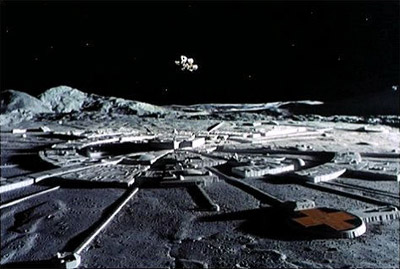
Moon Base Alpha as seen in Space: 1999.

So Newt Gingrich isn’t running for president anymore, and we’re probably better off for that.  Early in his campaign, he promised that if he were elected he would build a Moon Base by 2020 and give America’s lunar colony the opportunity to become a state.  Of course, this sounded ridiculous and probably contributed to Gingrich’s ultimate defeat in the Republican Primary.  However, returning to the Moon and establishing a Moon Base is still a good idea, and it might still happen regardless of who’s president.

Here are five reasons why a Moon Base is a good idea.

  1. The Hubble Space Telescope has provided scientists a great opportunity to study the universe, but soon it will go into retirement.  NASA is building an even more powerful telescope to replace it, but someday that too will go into retirement.  Establishing an observatory on the Moon could provide all the benefits of space telescopes without the hassle of periodically replacing them.  It could also be more cost efficient.  Click here for more on that.
  2. The Moon has an abundance of natural resources, some of which are extremely rare on Earth.  Helium-3, an isotope of helium, is one of them and could be used one day as a carbon-free, radiation-free fuel source.  Click here for more on how to get the Moon’s helium-3.
  3. The Moon can be used as a launch point for further exploration of the Solar System.  The Moon’s gravity is one-sixth that of Earth’s, so launching from the Moon is about six times easier and cheaper than launching from Earth.  A spacecraft could be built using the Moon’s own resources and sent to Mars, Jupiter, or wherever for a fraction of the cost.
  4. Newt Gingrich wanted his Moon Base to become America’s 51st State, but lunar colonization shouldn’t be for Americans only.  The Russian Space Agency has already approached the European Space Agency and NASA to form a Moon Base partnership.  If their proposal works, the next time human beings walk on the Moon it won’t be about one nation competing with another but many nations working together.  That kind of cooperation would not only advance science but change the way we see our own planet.  Click here for more on Russia’s proposal.
  5. This is the most important reason to build a Moon Base, at least in my opinion: the Moon would make an awesome vacation spot!  Hopefully, I’ll see you there at the low gravity tennis court.

Disclaimer: This is not a political blog, and I am not a Newt Gingrich supporter.  It would have been nice, though, to see a serious debate about space policy in our presidential politics, and maybe someday we will.