Our Place in Space: The Rocket Equation

Hello, friends!  Welcome to Our Place in Space: A to Z!  For this year’s A to Z Challenge, I’ll be taking you on a partly imaginative and highly optimistic tour of humanity’s future in outer space.  If you don’t know what the A to Z Challenge is, click here to learn more.  In today’s post, R is for…

THE ROCKET EQUATION

Are you bad at math?  That’s okay.  I’m bad at math too.  I try to avoid talking about math on this blog because I know a lot of my readers are still traumatized by high school math classes, but also because I don’t feel I’m qualified to explain math anyway.  So in today’s post, we’re going to talk about what the rocket equation means and why it’s so important without talking about what the rocket equation actually is or how it works.

As you know, you need fuel to go to space.  If you’re a rocket scientist, the rocket equation tells you how much fuel you need to reach any specific destination in space.  You want to travel from Earth to the Moon?  Plug some numbers into the rocket equation, and the equation will tell you how much fuel you need.  Want to go from the Moon to Jupiter?  Plug new numbers into the equation, and it’ll tell you how much fuel you need for that trip.  It always ends up being an absolutely ridiculous amount of fuel.

When you see space vehicles sitting on the launch pad, something like 85% to 90% of the mass of that space vehicle is fuel.  The rocket equation demands that it be so.  For the sake of comparison, fuel makes up about 30% to 40% of the mass of an airplane, or about 4% of the mass of a car.  NASA famously refers to this as “the tyranny of the rocket equation,” because NASA is the American space agency, and whenever Americans don’t like something that call it tyranny.

With a little creative engineering, rocket scientists can make marginal improvements to a rocket’s fuel efficiency—a 1% or 2% improvement, perhaps!  But that’s about it.  The rocket equation is unforgiving, and it offers very little wiggle room.  In other words, the rocket equation means that space exploration is super expensive, and it always will be, unless and until we invent some totally new Sci-Fi propulsion system that no longer requires rocket engines.

As a science fiction writer, I’m perfectly happy to dream up propulsion systems that ignore the rocket equation.  But for the purposes of this “Our Place in Space” series, I’m trying to stick to more realistic science, which means that the distant future we’ve been exploring in these blog posts is still very much constrained by the rocket equation.

We humans can still do a lot under those constraints.  We can get to the Moon (we’ve done it before!), and we can get to Mars and the asteroid belt as well.  Most of the outer Solar System is within our reach—in time, perhaps the entire outer Solar System could be ours.  But there are limits.  So long as we’re still using rockets for space travel, there will always be limits on how far humans can go.

Want to Learn More?

Check out NASA’s “The Tyranny of the Rocket Equation” article, which goes into more detail about why the rocket equation matters.  There’s also some colorful language in there about “revolting against tyranny.”

And for those of you who do want to see the math, here you go.  Enjoy!

Our Place in Space: NIAC

Hello, friends!  Welcome to Our Place in Space: A to Z!  For this year’s A to Z Challenge, I’ll be taking you on a partly imaginative and highly optimistic tour of humanity’s future in outer space.  If you don’t know what the A to Z Challenge is, click here to learn more.  In today’s post, N is for…

NIAC

So far this month, we’ve talked about some pretty wild ideas for future missions in space.  We’ve talked about building an elevator to space.  We’ve talked about putting a radio telescope on the far side of the Moon.  We’ve talked about sending astronauts to Callisto, one of the moons of Jupiter, and exploring the hydrocarbon lakes on Titan (a moon of Saturn) using a robotic submarine.  As crazy as these ideas may seem, they’ve all received some amount of funding from NASA through a program called NIAC.

NIAC stands for NASA Innovative Advanced Concepts (yes, it’s an acronym that contains another acronym inside it).  NIAC is basically a program that awards grant money to researchers who are testing the limits of what we can do in space using current technology or who are developing new technologies that might one day revolutionize space exploration.  If you ever hear on the news that NASA is funding some project that sounds a little too Sci-Fi to be true, it probably just means that NASA gave somebody some NIAC funding for their research.

I once heard NIAC described as a high-risk/high-reward program.  Many NIAC projects probably won’t work out.  Some of these things really are too Sci-Fi to be true.  But what if a few NIAC projects do work?  What if some crazy idea that sounds like pure science fiction actually works!?!  Even if only a few NIAC funded projects do come to fruition, they could change everything for NASA.  More than that, they could change everything for human civilization.

I’m no expert on finances.  I’m certainly no expert on how the U.S. federal budget works.  I do know that space exploration is expensive.  Very expensive.

I also know that NASA does what it does within a very strict and rather inflexible budget.  I’m actually really impressed that NASA manages to do so much cool science stuff on such a tight budget.  This may seem weird, but I often ask myself “What would NASA do?” when I have to make difficult spending decisions.

Most NIAC projects are definitely not ready to fly and probably won’t be ready to fly for quite a few years to come.  But it makes sense to start planning for the future now.  It makes sense to do some of the research now that could help make a more Sci-Fi future become a reality.  That’s really what NIAC is all about.

Want to Learn More?

Wikipedia has a pretty thorough list of all the research projects that have received NIAC funding over the years, up to 2020.

Additionally, here’s a listing of NIAC funded projects from 2021, and here’s the listing for 2022.

Our Place in Space: The Moon Village

Hello, friends!  Welcome to Our Place in Space: A to Z!  For this year’s A to Z Challenge, I’ll be taking you on a partly imaginative and highly optimistic tour of humanity’s future in outer space.  If you don’t know what the A to Z Challenge is, click here to learn more.  In today’s post, M is for…

THE MOON VILLAGE

The last time humans went to the Moon, it was motivated in large part by the Cold War.  Yes, there were scientific and humanistic reasons to go to the Moon as well, but the Cold War was a big part of it.  There’s no denying that.  Let’s hope that next time will be different.  Let’s hope that next time, human beings will set foot on the Moon as a result of international cooperation, rather than as a result of quasi-militaristic competition.

A few years ago, the European Space Agency proposed building a “village” on the Moon.  This International Moon Village would serve as the logical successor to the International Space Station.  Anyone and everyone who wanted to participate would be welcome to participate in the Moon Village program.  As the E.S.A.’s website explains it:

By “Moon Village” we do not mean a development planned around houses, some shops and a community centre.  Rather, the term “village” in this context refers [to] this: a community created when groups join forces without first sorting out every detail, instead simply coming together with a view to sharing interests and capabilities.

It’s hard to say at this point what the Moon Village would look like.  A lot depends on who decides to participate.  A lot also depends on how the various participants want to use the Moon Village once it is built.  The proposal is very open ended about this stuff.  Government run space agencies could join the program.  So could private companies.  The Moon Village could be used for purely scientific and technological research.  At the same time, it could also be used for economic interests, such as mining the Moon for resources.  Even space tourism would be welcome.

When the Moon Village was first proposed a few years ago, my understanding was that the Russian space agency was going to be a key player in this project.  That’s… ummm… I’m guessing that’s no longer the case.  I’m also a little unclear about whether or not the United States is involved.  It sometimes sounds like NASA’s Artemis Program and E.S.A.’s Moon Village Project are totally working together; other times, it sounds like Artemis and the Moon Village are two completely separate and unrelated projects.

Despite all that, and despite everything else happening in the world today, I get the sense that E.S.A. is still moving forward with their Moon Village plans.  This is a project that really could happen, and I really hope that it does happen.  Anyone who wants to participate in the Moon Village is welcome to participate in the Moon Village.  No one will be excluded.  No one will be left out.  Those are the kind of values humanity needs right now, and in the future, those are the kind of values that will help us secure our rightful place in space.

Want to Learn More?

Check out this brief statement from Jan Woerner, the Director General of E.S.A., describing what the Moon Village would be like and how it might be used.

Our Place in Space: Kraken Mare

Hello, friends!  Welcome to Our Place in Space: A to Z!  For this year’s A to Z Challenge, I’ll be taking you on a partly imaginative and highly optimistic tour of humanity’s future in outer space.  If you don’t know what the A to Z Challenge is, click here to learn more.  In today’s post, K is for…

KRAKEN MARE

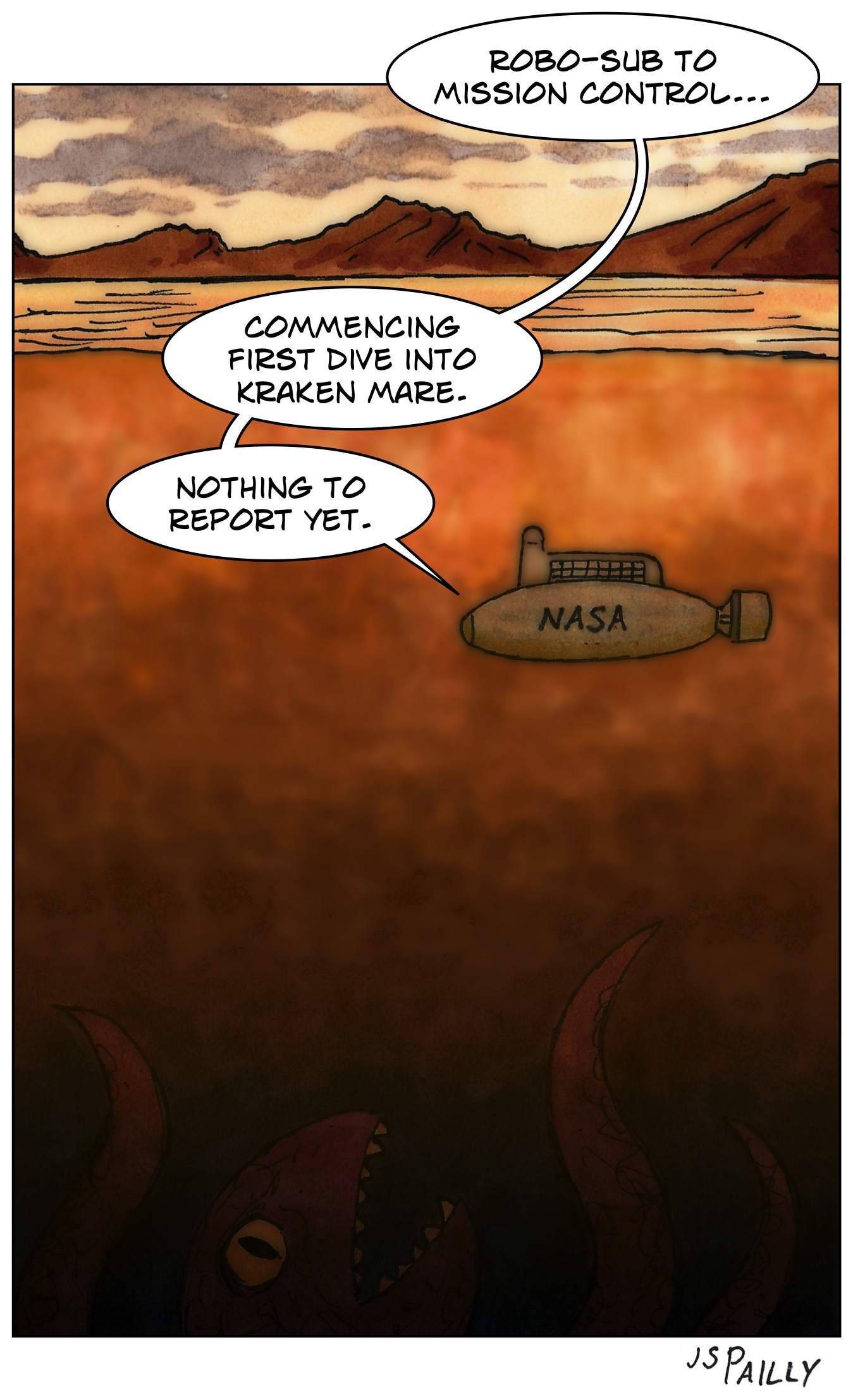
Earth is a pretty special place, what with all this liquid water covering our planet’s surface.  You won’t find that much liquid water on the surface of any other planet or moon in the Solar System (underground, maybe, but not on the surface).  In a similar way, Titan is a special place.  Titan, the largest moon of Saturn, is covered with lakes and rivers of liquid hydrocarbons, a mix of mostly liquid methane and liquid ethane.  You won’t find that much liquid methane/ethane on the surface of any other world in the Solar System.

Kraken Mare is the largest body of… I wanted to say the largest body of water, but that wouldn’t be right, would it?  Kraken Mare is the largest body of liquid hydrocarbons on Titan.  Take all five of North America’s Great Lakes, combine them together—that’s how large Kraken Mare is.  Titan is much smaller than Earth, so Kraken Mare ends up being an enormous surface feature, sprawling across part of Titan’s northern hemisphere.

And nobody knows how deep Kraken Mare is.  Scientists were able to measure the depth of every other lake on Titan using RADAR data collected by the Cassini space probe, but the data for Kraken Mare was inconclusive.  This means either that Kraken Mare is too deep for Cassini’s RADAR equipment to measure, or some unknown substance at the bottom of Kraken Mare absorbed Cassini’s RADAR pings, limiting the data Cassini was able to collect.  Either way, wouldn’t it be fascinating to know what’s down there?

NASA seems to think so, and there are proposals on the table to send some sort of robotic submarine to Titan, to explore Kraken Mare further.  This is another of those space missions that is not actually happening yet.  It has not been approved by NASA.  It does not have the funding to go forward.  But still, it’s an idea that scientists are working on, trying to figure out if it’s feasible, with the hope that someday they can make it happen.

Could there be life on Titan?  Maybe.  Some astrobiologists clearly think it’s possible, though they probably aren’t expecting to find an actual kraken at the bottom of Kraken Mare.  Just some single-celled organisms doing some strange, alternative form of organic chemistry.  Still, that possibility is there, and it’s another reason why diving to the bottom of Kraken Mare seems like a good idea.

Fortunately, NASA has approved a new mission to explore Titan.  Unfortunately, this new mission does not include a submarine, and it won’t be going anywhere near Kraken Mare.  Instead, the Dragonfly  rotorcraft (a robotic mini-helicopter) will explore Titan’s Shangri-La region, a mysteriously dark colored region near Titan’s equator.

Meanwhile, the proposal to put a robotic submarine in Kraken Mare is still on the table.  Sooner or later, that mission is going to happen.  I’m sure of it.  Kraken Mare is simply too big and too mysterious for us humans to leave it unexplored.

Want to Learn More?

Here’s a short article from NASA, which includes a short video, on the Titan Submarine proposal.

And here’s a longer piece from EarthSky.org with more details about Kraken Mare and how we might one day explore its depths.

Our Place in Space: Jezero Crater

Hello, friends!  Welcome to Our Place in Space: A to Z!  For this year’s A to Z Challenge, I’ll be taking you on a partly imaginative and highly optimistic tour of humanity’s future in outer space.  If you don’t know what the A to Z Challenge is, click here to learn more.  In today’s post, J is for…

JEZERO CRATER

Someday, I’d like to help dig up dinosaur fossils.  That’s apparently a thing pretty much anybody can volunteer to do.  Someday, I’d also like to live on Mars.  In the distant future, it may be possible to do both of those things.  Places like Jezero Crater on Mars may be full of ancient Martian fossils!

If you look at satellite images of Jezero Crater, it’s pretty obvious it used to be full of water.  You can see what appears to be a dried-up river bed snaking its way across the Martian landscape.  Where that river meets the crater, there’s a breach in the crater wall and a large river delta where the river would have spilled into the crater basin.

Right now, NASA’s Perseverance Rover is driving around that river delta, scoping the place out, examining the sediments and clays found in the region.

Okay, I may have taken some creative liberties with the cartoon above.  If life ever did evolve on Mars, it would have been short-lived.  All of Mars’s lakes, rivers, and oceans would have dried up fairly early in the planet’s history.  It is highly unlikely that anything as complex as fish or seaweed could have developed, and there certainly wouldn’t have been anything as awesome as a Martian dinosaur.

But in places like Jezero Crater, simple microorganisms could have been plentiful.  These microbes may even have joined together, creating larger structures like the bacterial mats we sometimes find here on Earth.  That’s kind of icky, I know, but it could have happened, and those bacterial mats may still be there, preserved as fossils beneath all that red dust.

I don’t expect questions about life on Mars (past or present) to be answered any time soon.  Even if one of our Mars rovers did stumble upon something that looked like a fossilized bacterial mat, there would be scientific debates for years—decades, even—over what that fossil-looking-thing really is and what it’s presence on Mars really means.  We’ve been through this before, when scientists found “bacteria shaped objects” inside a Martian meteorite.  Something can look like a fossilized bacterium, and yet not be a fossilized bacterium.

But someday in the distant future, we will know, one way or the other, if life ever existed on the Red Planet.  And perhaps in that distant future, humans living on Mars will volunteer to help dig up fossils in Jezero Crater, or other places very much like it.

Want to Learn More?

Here’s an interactive map from NASA showing the Perseverance Rover’s current location.  You’ll have to zoom out a little to see all of Jezero Crater.  If you do, you’ll see that the dried-up river (marked Neretva Vallis) and river delta I mentioned are pretty obvious.

And here is a NASA press release from a few years back, announcing Jezero Crater as the Perseverance Rover’s landing site and explaining why the crater was selected.

Also, here’s an article from Space.com about that Martian meteorite I mentioned, the one with those “bacteria shaped objects” inside.

Our Place in Space: HAVOC

Hello, friends!  Welcome to Our Place in Space: A to Z!  For this year’s A to Z Challenge, I’ll be taking you on a partly imaginative and highly optimistic tour of humanity’s future in outer space.  If you don’t know what the A to Z Challenge is, click here to learn more.  In today’s post, H is for…

HAVOC

Venus is my favorite planet.  If you’ve been reading this blog for a while, you probably already know this about me.  The Venusian atmosphere is weird and chemically complex.  The surface is mysteriously smooth, hinting at some pretty extreme geological activity.  And did you know Venus is spinning the wrong way?  She rotates clockwise where every other planet in our Solar System has counterclockwise rotation.  In many ways, I feel like Venus is the planet with the most personality (aside from Earth, of course).  So if there’s a realistic possibility of humans colonizing Venus one day, nothing would please me more!

HAVOC stands for High Altitude Venus Operational Concept.  It’s NASA’s very preliminary plan for exploring Venus, first with robots, then with astronauts, with the eventual goal of establishing a permanent human presence.  Most people scoff at the idea of sending humans to Venus.  Surface conditions are hellish.  The surface temperature is 475 degrees Celsius (900 degrees Fahrenheit).  Atmospheric pressure is 90 times greater than what we experience here on Earth.  Sulfuric acid falls from the sky as rain, and don’t forget about that extreme geological activity I mentioned.  Nobody’s sure what’s happening, but the ground is too smooth, as if it gets regularly “repaved” with fresh lava.

But HAVOC would not involve putting boots on the ground.  Instead, astronauts would explore Venus from the safety of blimps and other airborne habitats.  At an altitude of 55 kilometers above the surface, Venus is quite nice.  You might even call it heavenly.  The temperature and pressure are roughly Earth-normal.  We’d experience Earth-like gravity, too, and Venus would provide almost Earth-like protection from solar and cosmic radiation (a service that the Moon and Mars do not offer).  Also, 55 kilometers up, we wouldn’t have to worry about the sulfuric acid rain; we’d be above the layer of sulfuric acid clouds!

Obviously this is not happening any time soon.  The people at NASA seem to have their hearts set on returning to the Moon in the near future, with a long term goal of getting to Mars.  Still, the idea of exploring Venus with blimps makes sense.  In some ways, Venus might end up being a better second home for humans than Mars—just so long as we stay at that 55 kilometer altitude.

So in the distant future, when humanity is spreading out across the Solar System, don’t be surprised if large numbers of people live in Cloud City-like habitats on Venus.

Want to Learn More?

Check out this paper from the American Institute of Aeronautics and Astronautics, detailing HAVOC as a five phase plan to explore and colonize Venus.

Also, here’s a video from NASA showing what a HAVOC mission might look like, from first arrival in Venusian orbit to safe return back on Earth.

Our Place in Space: The DART Mission

Hello, friends!  Welcome to Our Place in Space: A to Z!  For this year’s A to Z Challenge, I’ll be taking you on a partly imaginative and highly optimistic tour of humanity’s future in outer space.  If you don’t know what the A to Z Challenge is, click here to learn more.  In today’s post, D is for…

THE DART MISSION

So far this month, I’ve been telling you about things that I think will happen (or plausibly could happen) at some point in the distant future.  But today, I’m going to talk about something that’ll happen in the not-so-distant future.  Something that will happen in the very near future, actually.  Later this year, in fact!  In late September or early October of 2022, a NASA space probe named DART will deliberately crash into an asteroid named Dimorphos.

Dimorphos is a relatively small asteroid orbiting a much larger asteroid named Didymos.  Basically, Dimorphos is Didymos’s moon.  These two asteroids will be passing fairly close to Earth later this year.  Now I want to be 100% clear about this: neither Didymos nor Dimorphos are going to collide with our planet.  We are in no danger.  But these asteroids will be coming close enough that we could do a little experiment—an experiment to see just how well we could defend our planet from a dangerous, mass-extinction-causing asteroid, should such an asteroid ever come our way.

DART stands for Double Asteroid Redirection Test.  As you can see in the highly technical diagram below, the plan is for the DART spacecraft to have a head-on collision with Dimorphos.

This head-on collision should cause Dimorphos to lose some orbital momentum, which should alter Dimorphos’s orbit around Didymos.  How different will Dimorphos’s new orbit be?  Hard to say.  The exact angle of impact… the astroid’s mineral composition… the amount of debris produced by the collision… all of these things may factor into what Dimorphos’s new orbit looks like.

Astronomers can do all the computer simulations they like, but until we throw a real life projectile at a real life asteroid, we won’t really know what will happen.  Not with any kind of precision.  Ergo, we need to do this experiment.

Looking once more into the distant future, I believe that humanity is going to spread out across space.  Large numbers of people will eventually be living on the Moon and Mars, as well as on other planets and moons of our Solar System.  But I also believe these humans in the distant future will take good care of the Earth.  Among other things, they will know how to defend Earth from incoming asteroids and comets, so that what happened to the dinosaurs never has to happen again.  And that capability—the capability to keep Earth safe from killer asteroids and comets—begins with a little NASA experiment scheduled to occur later this year.

Want to Learn More?

Here are a few papers that I’ve been reading about the upcoming DART Mission.  This is where I got most of the information for today’s post:

Protect Europa!

Hello, friends!  We’ve reached the end of October, which means we’ve reached the end of Europa month here on Planet Pailly.  We still haven’t determined whether or not Europa is home to alien life, but I hope I’ve persuaded you to take the possibility of life on Europa seriously.

One question that came up a few times this month was whether or not we should send humans to Europa.  The answer, in my opinion, is no.  First off, as we discussed in a previous post, the radiation environment on Europa is crazy dangerous.  We humans would also struggle with the extreme cold and the very low surface gravity.  I’m not saying a colony on Europa is impossible, but there are far safer and easier places we could choose to go.  The neighboring moons of Ganymede and Callisto, for example, would serve as safer and more comfortable bases of operation for humans.

But there’s another reason why colonizing Europa seems like a bad idea to me.  It’s not a science reason.  It’s a legal issue.  There’s an international agreement in place (Article IX of the 1967 Outer Space Treaty) which forbids space agencies like NASA, the E.S.A., or Roscosmos from contaminating other worlds with our Earth germs.  The same agreement also forbids contaminating Earth with germs from other planets.

Some missions are considered riskier than others, contamination-wise.  For example, Article IX doesn’t really apply to NASA’s Parker Solar Probe.  There’s no chance Earth germs will be able to contaminate the Sun (and since the probe will not be returning to Earth, there’s no chance any lifeforms from the Sun could contaminate Earth).  There’s actually a whole risk categorization system in place, with five different categories of risk, and a bunch of sub-categories, too.  Click here if you want to know more details about that.

The important thing for our purposes is that any mission to Europa will involve a very high risk of contamination.  We may not know yet if alien life exists on Europa, but the possibility should be taken seriously.  The people who wrote the Outer Space Treaty made it clear that they’d learned the lessons of history and did not want to repeat the mistakes of the past.  We would not want Earth germs to endanger an alien ecosystem on Europa (nor would we want Europa germs endangering Earth-life).

So for the foreseeable future, I think Europa will be off limits to humans.  Europa might even be declared an interplanetary wilderness preserve, or something like that, and if there’s scientific research to be done on Europa, it can be done remotely from bases on Ganymede or Callisto.

There are easier places in the Solar System for us humans to colonize.  There’s no need for humans to go there.  So unless and until someone shows the contamination risk on Europa is zero, let’s leave Europa alone.

WANT TO LEARN MORE?

As part of my research for this post, I read the two papers listed below.  If you’re interested in how Earth laws work (or don’t work) in outer space, these papers are worth a look.  Also, if you’re interested in writing Sci-Fi, these papers may get the wheels of your Sci-Fi writer brain turning.

October Is Europa Month Here on Planet Pailly!

Hello, friends!  Let’s talk about aliens!

If we want to find alien life, where should we look?  Well, if money were no object, I’d say we should look anywhere and everywhere we can.  Phosphorous on Venus?  Could be aliens.  Let’s check it out.  Melty zones beneath the surface of Pluto?  Let’s check that out too.  Ariel?  Dione?  Ceres?  Let’s check them all for signs of alien life!

But money is an object.  We simply don’t have the resources to explore all of these places.  Space exploration is expensive.  Space exploration will always be expensive so long as we’re stuck using rocket-based propulsion.  The Tsiolkovsky rocket equation makes it so.

Whenever you’re working within a restrictive budget, you need to think strategically.  With that in mind, astrobiologists (scientists who specialize in the search for alien organisms) have focused their efforts on four worlds within our Solar System.  Their names are Mars, Europa (moon of Jupiter), Enceladus (moon of Saturn), and Titan (another moon of Saturn).

This month, I’m going to take you on a deep dive (no pun intended) into Europa.  In my opinion, of the four worlds I just listed, Europa is the #1 most likely place for alien life to be found.  I don’t mean to denigrate Mars, Enceladus, or Titan.  There are good reasons to think we might find life in those places, too.  But there are also good reasons to think we might not.

  • Mars: Life may have existed on Mars once, long ago.  But then the Martian oceans dried up.  We’re unlikely to find anything there now except, perhaps, fossils.
  • Enceladus: Enceladus’s age is disputed.  She may be only a few hundred million years old, in which case she may be too young to have developed life.
  • Titan: If you want to believe in life on Titan, you have to get a little imaginative about how Titanian biochemistry would work.

Europa doesn’t have those issues.  Unlike Mars, Europa has an ocean of liquid water right now, in modern times.  Unlike Enceladus, Europa’s age is not disputed; she’s definitely old enough for life.  And unlike Titan, Europa doesn’t require us to get imaginative about biochemistry.  The same carbon-based/water-based biochemistry we use here on Earth would work just as well for the Europans.

There are still good reasons to search for aliens on Mars, Enceladus, and Titan.  Finding fossils on Mars would be super exciting!  Enceladus’s age is, as I said, in dispute, with some estimates suggesting she’s very young, but others telling us she’s plenty old.  And while life on Titan would be very different than life on Earth, scientists don’t have to imagine too hard to find plausible ways for Titanian biochemistry to work.

But if I were a gambler, I’d put my money on Europa.  And if I were in charge of NASA’s budget, I’d invest heavily in Europa research and Europa missions.  Europa just seems like the safest bet to me, if we want to find alien life. And in the coming month, I plan to go into more detail about why I feel that way.

WANT TO LEARN MORE?

If you’re interested in learning more about the Tsiolkovsky Rocket Equation, you may enjoy this article from NASA called “The Tyranny of the Rocket Equation” (because NASA is the American space agency, and anything Americans don’t like is tyranny).

As for astrobiology, I highly recommend All These Worlds Are Yours: The Scientific Search for Alien Life, by Jon Willis.  Willis frames the search for alien life just as I did in this post: alien life could be anywhere, but you only have a limited budget to use to find it.  So how would you spend that money?

Sciency Words: Heartbeat Tone

Hello, friends!  Welcome back to Sciency Words, a special series here on Planet Pailly where we talk about those weird and wonderful terms scientists use.  Today’s Sciency Word is:

HEARTBEAT TONE

Last week, I watched NASA’s live coverage of the Perseverance rover landing on Mars.  Naturally, I had a notepad ready, and I picked up quite a few new scientific terms.  My absolute favorite—the one that brought the biggest smile to my face—was “heartbeat tone.”  I love the idea that Perseverance (a.k.a. Percy, the Mars Rover) has a heartbeat.

As this article from Planetary News describes it, Percy’s heartbeat tone is “similar to a telephone dial tone.”  It’s an ongoing signal just telling us that everything’s okay.  Nothing’s gone wrong, and everything’s still working the way it’s supposed to.

Of course, other NASA spacecraft use heartbeat tones as well.  According to two separate articles from Popular Mechanics, the Curiosity rover on Mars and the Juno space probe orbiting Jupiter also send heartbeat tones back to Earth.  And that article about Juno offers us a little bit of detail about what Juno’s heartbeat actually sounds like: a series of ten-second-long beeps, sort of like very long dashes in Morse code.

Based on my research, it seems like the earliest NASA spacecraft to use heartbeat tones (or rather, the earliest spacecraft to have this heartbeat terminology applied to it) was the New Horizons mission to Pluto, which launched in 2005.  As this article from Spaceflight 101 explains it, New Horizons’ onboard computers monitor for “heartbeat pulses” that are supposed to occur once per second.  If these pulses stop for three minutes or more, backup systems kick in, take over control of the spacecraft, and send an emergency message back to Earth.

So, I could be wrong about this, but I think this “heartbeat pulse” or “heartbeat tone” terminology started with New Horizons.  To be clear: I’m sure spacecraft were sending “all systems normal” signals back to Earth long before the New Horizons mission.  I just think the idea of using “heartbeat” as a conceptual metaphor started with New Horizons.  But again, I could be wrong about that, and if anyone has an example of the term being used prior to New Horizons, I would love to hear about it in the comments below!

P.S.: I recently wrote a post about whether or not planets have genders.  With that in mind, I was amused to note in NASA’s live coverage that everyone kept referring to Perseverance using she/her pronouns.  However, the rover has stated a preference for they/them on Twitter.  So going forward, I will respect the rover’s preferred pronouns.