#IWSG: My Love/Hate Relationship with Writing

Hello, friends!  Welcome to this month’s meeting of the Insecure Writer’s Support Group, a group that supports writers who might feel a little insecure about their writing.  If you’d like to learn more about IWSG and see a list of participating blogs, click here.
This may be one of the hardest thing for people to understand: sometimes, two mutually contradictory statements can both be true.  Here’s an example.  I love writing.  Also, I hate writing.  Let me unpack what I mean.

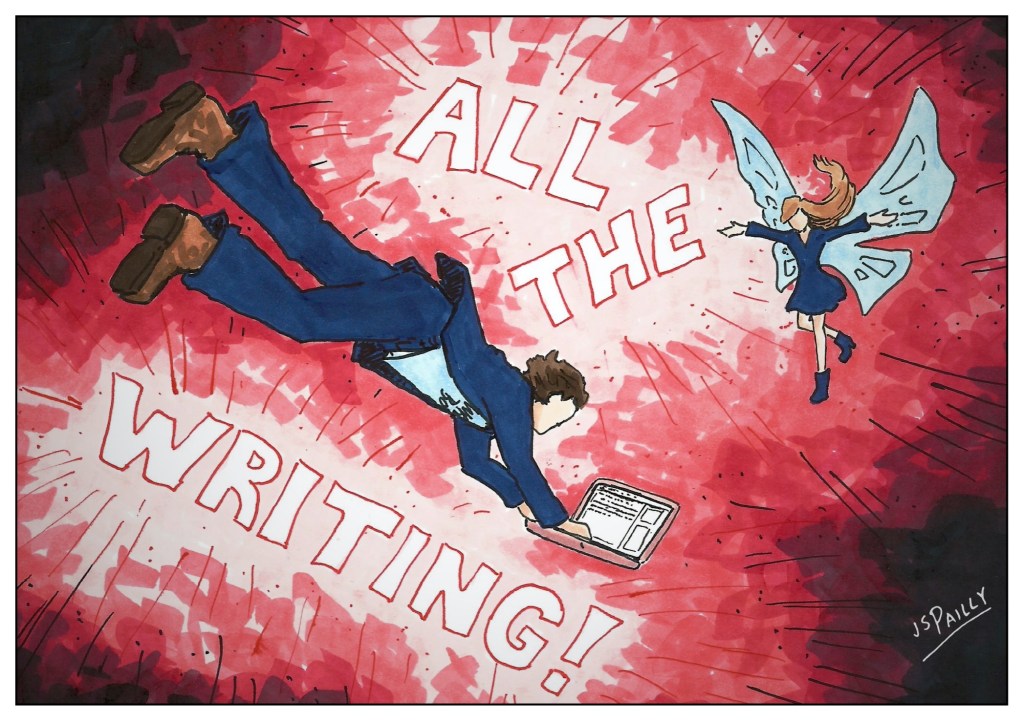
First off, I really do love writing.  It’s the single greatest source of joy and pleasure in my life.  Being something of an ethical hedonist, I’ve been trying for years now to maximize the joys and pleasures of my life.  In other words, I’ve been trying to squeeze more writing time into my schedule (as well as more time for other sources of personal joy, like drawing and reading).

I cannot take full credit for this pun.  Versions of this have been circulating the Internet for years.

In order to keep maximizing my writing time, I’ve slowly been transitioning from writing as a hobby to writing as a career.  But (this is the tricky part) if writing is my job now, if I’m not writing purely for my own amusement anymore, then I have to set a production schedule.  I have to deal with word count quotas and deadlines and other boring stuff like that.

And when I’m up against a deadline (self-imposed or otherwise), it tends to stunt my creativity and spoil my fun.  Writing starts to feel like a chore.  I am not at my writerly best when writing feels like a chore.  I don’t want to do it anymore.  All of a sudden, I hate writing.

It really are the deadlines that ruin writing for me.  Case in point: I’m writing this IWSG post well in advance of IWSG day, rather than scrambling to get it done the night before.  And I feel like this is turning out to be a much more expressive and honest post than what I typically write for IWSG.  Or at least, I feel a lot happier with this post than I normally do.

But if I want to make a career out of writing (and I do!), then I will have to learn to accept the bad with the good.  I have to learn to live with this tension in my writing life: I love writing, and also I hate writing.  I’m not really looking for advice here, by the way.  I am merely acknowledging to myself and to you that this is the way things are, and I’m trying to be very zen about the whole situation.

So this is what the writing life is like for me.  Perhaps some of you, my fellow insecure writers, understand what I’m talking about.

#IWSG: Frank Herbert, Will You Be My Beta Reader?

Hello, friends!  Welcome to September’s meeting of the Insecure Writer’s Support Group, a support group for insecure writer’s like myself.  If you’d like to learn more about this amazing group, click here!

This month’s optional I.W.S.G. question is:

If you could choose one author, living or dead, to be your beta partner, who would it be and why?

I’d have to pick Frank Herbert, the author of Dune, one the greatest science fiction novels of all time.  Of course there are other Sci-Fi authors I’d love to meet and chat with.  I wish I could talk politics with Mary Shelley and H.G. Wells, and I feel like Arthur C. Clark and Isaac Asimov would be great people to turn to for career advise.  But for the purposes of beta reading, it’s got to be Herbert.

First off, have you read Dune?  I mean, forget about all the Sci-Fi stuff.  Forget about all those planets and spaceships and psychic superpowers.  Forget about the giant sandworms and Fremen warriors and the plans within plans within plans.  At the most basic, most fundamental level, the way Frank Herbert strings a sentence together is marvelous.  It’s prose elevated almost to the level of poetry.  Even if Herbert wrote in some other genre, I’d love getting feedback from someone who had such mastery over the English language!

But of course, Frank Herbert does (I mean, did) write science fiction, and there are precious few Sci-Fi authors who handle the sciency stuff so artfully.  When you read Dune, you might not even notice all the ecology lessons sprinkled throughout the book.  That’s real science.  You’re learning real science!  But the science is integrated seamlessly into the story, like any other aspect of setting or plot would be.   I’d love to get a little guidance from a man who could pull off a trick like that!

Now I’ve worked with a lot of beta readers over the years, some good, some not so good.  The not-so-good ones make writing feel like a chore, with lots of rules and regulations.  Based on what I’ve read about Frank Herbert, I don’t think he’d be like that.  Shortly after Herbert’s death in 1986, Sci-Fi author Ben Bova wrote this about him:

He knew pain.  But to Frank, pain was something you got around, one way or the other, so you could get on with the main business of life: having fun.  Creating great novels was fun.  Being with friends was fun.  Living life to its fullest was the real goal of existence, and he did exactly that.  Life was a banquet, as far as Frank was concerned; his advice was to pull up a chair and enjoy yourself.

Someone who sees writing as fun—pure fun—just another part of the sheer joy of living?  Now that sounds like the best recommendation for a beta reader anyone could ever make.

P.S.: Oh, and if I were beta partners with Frank Herbert, that would mean I could give him a little feedback too, right?  Because I would like to talk with him, just a bit, about gender roles in his books.  That’s one thing I think he could’ve handled better.

#IWSG: Confidence

Hello, friends!  Welcome to the Insecure Writer’s Support Group.  If you’re a writer and if you feel in any way insecure about that, click here to learn more about this amazingly supportive group!

I’m feeling a little confused right now, both about my “real” life and my writing life.  A lot of stuff seems to be happening.  Very little of it makes any sense to me.  I wasn’t sure what I wanted to say for this month’s IWSG post, but then I saw the optional IWSG question:

Quote: “Although I have written a short story collection, the form found me and not the other way around. Don’t write short stories, novels or poems. Just write your truth and your stories will mold into the shapes they need to be.” 

Have you ever written a piece that became a form, or even a genre, you hadn’t planned on writing in? Or do you choose a form/genre in advance?

Oh, that’s an easy one!  I always know I’m writing science fiction.  I have never been interested in writing anything else, not even for a moment, not even once!

At various points in my life, writing teachers have tried to convince me to be more flexible.  They’d ask me to try something different.  Sometimes they would insist, as teachers do.  “You never know,” they’d say.  “You might like it!”  But I did know.  I was not going to like it.  Not unless I could sneak a Sci-Fi element into the assignment somehow.

I’ll admit I was surprised to discover how much I enjoy writing short stories and novella length fiction.  When I was young, I assumed I wanted to write Sci-Fi novels.  But by writing in shorter forms, I can tell more Sci-Fi stories.  And that’s the thing I want most.  That’s the thing I’ve always wanted most: to tell more and more and more Sci-Fi stories!

And you know, with all the weird and confusing stuff going on right now, it is nice to feel confident about at least one thing.  I write science fiction.  That’s the only thing I’ve ever wanted to write.  That’s the only thing I ever will want to write.  I may be questioning a bunch of other stuff about myself right now, but I can at least feel confident about that one thing.

#IWSG: Apology to a Muse

Hello, friends!  Welcome to July’s meeting of the Insecure Writer’s Support Group.  If you’re a writer and if you feel in any way insecure about your writing, then click here to learn more about this amazingly supportive group!

Dear Muse,

I’m sorry.  These last few weeks, I haven’t been doing much writing.  I haven’t been doing much drawing either.  I’ve fallen behind schedule on so many of the creative projects you wanted me to work on, and for that I owe you an apology.

Some big changes are happening in my life right now.  Good changes.  The biggest and most obvious change is, of course, that my first book is out.  I’m a published author now, and I’ve had my first taste of that sweet, sweet writing income!

But any kind of change, even the good kind of change, can be confusing and disruptive, at least at first.  I’m saying this not as an excuse but as an explanation.  I neglected my work.  I skipped drawing sessions and writing sessions.  You kept trying to give me ideas, and I kept finding other things to do instead of writing or drawing. There’s no excuse for that.

I understand if you’re mad.  I understand if you don’t want to talk to me right now since, from your perspective, it seems like I’ve stopped listening to you.  But I promise I am listening.  Things are starting to settle down in my life again.  In some ways, things will be better than they ever were before… for both of us!

So dear muse, I’m eager to get back to writing, and I’m eager to get back to drawing.  And if your you’re willing to forgive me, I would really appreciate your help.

Sincerely yours,
Your Writer.

#IWSG: I Wish I Were a Cyborg

Hello, friends, and welcome to another meeting of the Insecure Writer’s Support Group.  Do you feel insecure about your writing?  Are you looking for support?  Then this might be the right group for you!  Click here to learn more!

Each month, the Insecure Writer’s Support Group offers an optional question, something to help get these I.W.S.G. posts started.  This month’s question has to do with secrets.  What secrets do we writers have that our readers would never know based on our work?

At the moment, my biggest secret is that I’m suffering from a bad case of imposter syndrome.  My first book is coming out pretty soon.  In fact, it comes out tomorrow.  I worked really hard on it, and… well, I just hope people like it.

But what if they don’t!?!  Oh no!  People will think I’m a hack writer, a fraud, or something equally reprehensible!!!

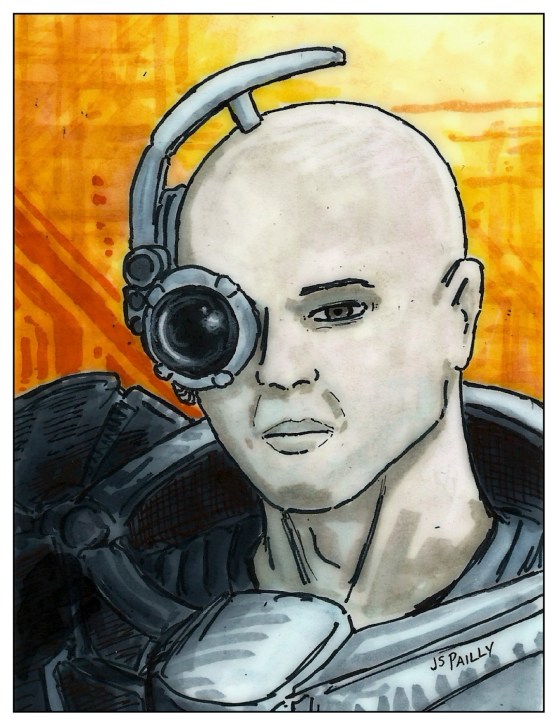
A lot of my friends, both online and in real life, have been congratulating me and telling me how excited I must feel.  And yes, I do feel excited.  But I’m feeling other emotions as well.  There’s a cyborg character in my book who can select which emotions he wants to experience and which emotions he does not.  He can turn his emotions on and off with the flick of a switch.

I wish I could do that.  I’d leave my excitement running and switch everything else off.  But I’m no cyborg.  I’m only human, and being human is not so easy.  The best I can do is set those other emotions aside with the promise that I will deal with them later.  In the meantime, I need to keep blogging.  I need to keep marketing my work.  And above all else, I need to keep writing, because this book that comes out tomorrow—that book is just the beginning.

P.S.: For those of you who may be interested, my book is a novella-length Sci-Fi adventure story entitled The Medusa Effect.  It’s the first in a series of novella-length Sci-Fi stories about a journalist who travels through time, covering the galaxy’s biggest news stories before they happen.  Click here to buy the book on Amazon, or you can read it for free with Kindle Unlimited.

#IWSG: This-or-That-ism

Hello, friends, and welcome to another meeting of the Insecure Writer’s Support Group!  If you’re a writer and if you feel in any way insecure about your writing life, click here to learn more about this amazingly supportive group!

This month, I should be bragging about finishing the A to Z Challenge. Also, I should probably be plugging my novella-length Sci-Fi story, which is now available for preorder on Amazon (click here!!!).  But there’s something else I want to talk about today.  Something more important.

There’s a certain attitude that I’m sure we’ve all encountered on the Internet, but it’s troublingly common in everyday life too.  I call it this-or-that-ism.  In the mind of a this-or-that-ist, everything is either this or that.  There’s no middle ground.  There’s no spectrum or continuum of possibilities.  There are no shades of grey.  And if you don’t conform to the standard definition of this, then you must be that.

This-or-that-ists come down hard on a lot of people, but in my experience they come down hardest on creative folks: artists, actors, writers, poets, musicians, etc….  This is especially true when creative people are relatively new to their craft.  Why?  Because when you’re just starting out, you obviously aren’t a huge mega success yet; therefore, you must be an abject failure.

As you may have guessed, there are a few this-or-that-ists in my life, people who feel the need to inform me that I’m no J.K. Rowling, no Stephen King, no James Patterson.  And since I’m not one of those super rich, super famous authors, well… I think you know what the this-or-that-ists are insinuating.

Fortunately, there’s always been a little voice in my head—I call her my muse—who keeps encouraging me.

So today, I’d like to say the same thing to you, because if a few words from my imaginary friend can help me, then perhaps a few words from some guy on the Internet can help you.  So to anyone who may need to hear this:

Whoever you are, whatever you’re trying to achieve, I believe in you.  I think you can do it.  I know you can do it.  So your work isn’t perfect yet?  That doesn’t mean it’s a disaster.  You aren’t a runaway mega-success?  That doesn’t make you a failure.  Keep practicing, keep learning, and keep improving.  And no matter where your own journey takes you, remember that you are worthy of respect and you are worthy of love, and your work deserves a chance to be seen or read or heard.

In a world full of this-or-that-ism, these are things that need to be said more often to all creative folks.

Next time on Planet Pailly, is this COVID-19 thing over yet?  No?  Okay, then I am not lowering my guard.

#IWSG: The Writing Lesson I Never Learned

Hello, friends!  Welcome to another episode of the Insecure Writer’s Support Group!  If you’re a writer, and if you feel in any way insecure about your writing, click here to learn more about this wonderful group!

This month, my muse and I have reason to celebrate.  I mean, any time writing gets done, my muse and I have reason to celebrate.  But this month in particular, we have an especially good reason to celebrate.  My manuscript is done, and it is now in the hands of my editor.

At some point, obviously, my editor will hand that manuscript back to me along with a big old list of things that need to be fixed.  But in the meantime, I don’t have to worry about it, and that’s a nice feeling.

Except turning my manuscript over to my editor did not feel like the triumphant moment I thought it would.  Why not?  Because my manuscript was late.  Very late.  I’m taking the self-publishing route with this book, so it’s not like I’m in breech of contract or anything like that.  The only deadline I missed was a deadline I imposed on myself.

But still, I’m really shocked by how long it actually took me to finish that manuscript.  And since I have other self-imposed deadlines looming on the horizon, I’m a little concerned.  Am I going to stay on schedule?  Are those self-imposed deadlines not as realistic as they seem?

Which brings me to one of the very first lessons I (supposedly) learned on my writing journey.  This comes from author/blogger Jon Gibbs.  I attended one of his writing seminars back in 2006 or 2007, and he told me—told a whole group of us young, naive writers—that however much time you think you need to write something, double it.  That’s how you set a deadline.

More often than not, that lesson has proven to be true.  Just about everything takes twice as long as I think it should.

So when I set my deadline for my manuscript, did I follow Jon Gibbs’ advice?  No.  And the two deadlines I have coming up in March and May?  Did I follow Gibbs’s advice for those?  Nope.  So my muse and I are going to have to cut the celebration short and get back right back to work.

Next time on Planet Pailly, have you noticed how windy it is in outer space?

#IWSG Judge Not and You Shall Not Be Judged

Hello, friends!  Welcome the first posting of the Insecure Writer’s Support Group for 2020!  If you’re a writer, and if you feel in any way insecure about your writing life, click here.  I.W.S.G. is an awesome organization for insecure writers like us!

For years now, I’ve used these I.W.S.G. posts to tell you about the relationship I have with my muse.  She’s a clever muse.  She can also be really annoying sometimes.  But my muse is also a little bit more than just my muse.  She’s also my conscience.

If you’ll allow me to get religious for a moment, I’d say my muse has a favorite Bible verse.  It’s from the Gospel of Luke.  It’s the “judge not and you shall not be judged” part.

I have to admit I have a tough time with this.  Other people can be so stupid, so crass, so self-centered and inconsiderate.  I can’t help but feel a teeny bit judgmental.  I think it may be part of human nature.  We can’t help but judge each other.

But the muse does not accept my “human nature” excuse.  Every time I start to get judgy, my muse reminds me that I am a writer.

As a writer, I have a responsibility to see how everyone is the hero of their own story (or at least I have a responsibility to try).  No matter what horrible things my gut instinct may tell me about other people, other people have their own reasons for doing what they do or being the way they are.  Other people have backstories.  Other people have motivations.  They have needs and wants, and maybe their needs are in conflict with their wants.  And they have inner monologues that, regardless of what I might think, must make logical sense to them.

This is not meant to be a Bible-themed blog post.  This isn’t about being a better Christian.  It’s not even about being a better human being.  This is simply a matter of becoming a better writer, because if you can learn to sympathize with other people in real life, then, miraculously, your readers will find it easy to sympathize with the characters you put into your stories.

At least that’s what my muse keeps telling me.

Next time on Planet Pailly, the Earth orbits the Sun… right?  Right?

#IWSG: Write, Rest, Repeat

Welcome to the Insecure Writer’s Support Group!  If you’re a writer, and if you feel in any way insecure about your writing life, click here to learn more about this awesome group!

For today’s episode of the Insecure Writer’s Support Group, I’m going to turn things over to my muse.  She has something to say, and maybe it’s something your muse needs to hear.

My fellow muses, I’m sure you all remember what they taught us during muse training: writers are weak-willed and lazy.  They’ll invent all sorts of excuses to avoid writing.  So it’s up to us to use whatever deception, manipulation, or coercion we can in order to force our writers to do their writing!

But after spending so much time out in the real world working with a real life writer, I’ve discovered that what they told us in training isn’t quite true.  Writers want to write.  They really, really do.  The problem is that they set their expectations too high and then feel disappointed and discouraged when they fall short of their goals.

My own writer is obsessed with tracking his daily and weekly word counts.  He’s also started keeping a tally of the total number of words he writes per year.  Word counts can be a great way for writers to measure their own progress.  However…

I know many of you have been dealing with similar problems.  Maybe your writer just “lost” NaNoWriMo, or worse… maybe your writer “won” and is now stuck with a total mess of a manuscript.  Either way, your writer may be feeling a bit frustrated, a bit discouraged—even a little bit (dare I say it?) insecure right now.

Challenges like NaNoWriMo can test your writer’s limits and help them grow.  However—and this is the part I wish they’d teach us in muse training—writers also need recovery time.  This past year, I have allowed my writer to settle into a rhythm of intense writing days followed by periods of slower, more relaxed writing.

My writer didn’t like this new rhythm at first.  He thought I was being too easy on him.  Truth be told, I was a bit nervous about this myself because, as I said, this really isn’t what they taught us in muse training.  But then my writer noticed that, while his daily word counts were all over the place, his weekly word counts were steadily going up.  He stopped complaining, and I stopped worrying.

Write, rest, and repeat!  That’s our writing mantra now.  So if you’re having trouble with your writer, don’t presume they’re being lazy.  Don’t be too hard on your writer, and don’t let your writer be too hard on him/herself.  Let your writer rest.  Give your writer a chance to recover.  Then move on to the next writing challenge!

#IWSG: Contract with a Muse

Welcome to the Insecure Writer’s Support Group!  If you’re a writer, and if you feel in any way insecure about your writing life, click here to learn more about this awesome group!

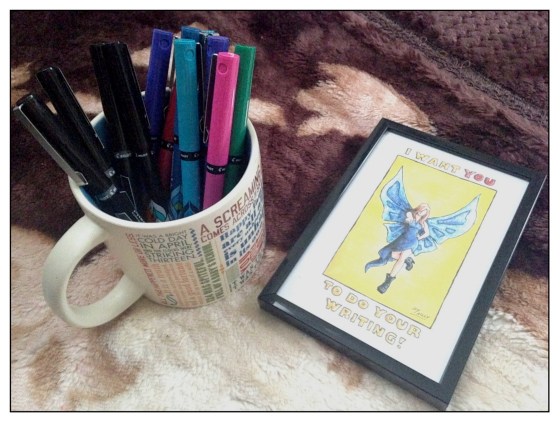
Ladies and gentlemen, I have an imaginary friend.  Those of you who regularly read my Insecure Writer’s Support Group posts have already met her.  She’s my muse.  Here’s her picture:

And here’s her picture sitting in my writing zone, next to my coffee mug full of pens.  I always have a picture of my muse with me when I’m writing.

But not all writers believe in muses.  In fact, not all writers even approve of the belief in muses.  I was recently listening to a writing podcast where the host went off on a tirade against the very concept of muses.

You can’t sit around waiting for your muse, this podcast host said.  You’ll never get any writing done that way.  Writing is work.  You have to do it every day, whether you feel inspired or not!

Of course my muse and I have heard all this before.  Perhaps you have too.  But I think all this anti-muse stuff is based on a fundamental misunderstanding about how muses do their jobs.  You see, my muse and I have something like a contractual relationship.

I do have to do my writing every day.  That’s the promise I made to my muse, and in exchange she has promised to keep bringing me the shiniest of shiny new ideas.  If I don’t fulfill my side of the bargain, why should my muse fulfill hers?

So writers, you can’t sit around being lazy and expect your muse to do all the work for you.  Show some initiative.  Go write.  It might feel like a struggle, but the muse will reward you in the end.

P.S.: And muses, remember you have an obligation to your writer too.  If your writer is making a real effort, do not be stingy with the good ideas!