Mercury A to Z: Graphite

Hello, friends!  For this year’s A to Z Challenge, I’m giving you a guided tour of the planet Mercury, perhaps the Solar System’s most under-appreciated planet.  In today’s post, G is for:

GRAPHITE

I did not know this prior to doing my research for this A to Z series, but apparently Mercury is the least reflective, darkest colored planet in the Solar System.  For a long time, scientists assumed Mercury’s dark color must have something to do with iron.  Thanks to the planet’s unusually high density, we know that Mercury is an iron-rich planet, after all.  However, NASA’s MESSENGER spacecraft was unable to detect significant amounts of iron on the planet’s surface.

After rethinking their assumptions and reanalyzing MESSENGER’s data, scientists now believe that Mercury’s crust might be covered in carbon, specifically carbon in the form of graphite.  The same material used in pencils.  So how did this happen?  How did Mercury get covered in graphite?

Let’s go back in time.  Billions of years ago, when the Solar System was still forming, Mercury would have been just a giant ball of liquid magma.  During that time, heavier elements, like iron, would have sunk down toward the center of the planet; meanwhile, lighter elements, like carbon, would have floated up toward the planet’s surface.  As a result, when the planet started to cool off and solidify, a significant amount of carbon would have been incorporated into the planet’s crust.

Something similar must have happened on Venus, Earth, and Mars; however, Venus, Earth, and Mars continued to be geologically active for a long time after they formed (fun fact: Earth is still geologically active today!).  Mercury didn’t.  So while volcanic eruptions, plate tectonics, and the like allowed Venus, Earth, and Mars to transform their carbon rich surfaces into more mineralogically mixed planetary crusts, Mercury’s crust stayed more or less the same.

I don’t want to make it sound like Mercury didn’t try.  Some amount of volcanic activity did happen on Mercury, long ago.  And in some cases, asteroid impacts punched through the planet’s crust, causing lava to spill out onto the planet’s surface (remember my post on Caloris Basin?).  But even in regions where Mercury’s original crust has been resurfaced by lava, small asteroid impacts have re-exposed the graphite layer underneath.  Those asteroid impacts have also scattered graphite dust over the surfaces around craters.

Based on what I read, it seems that NASA’s MESSENGER spacecraft was not well equipped to study the graphite on Mercury.  And why would it be?  When MESSENGER was launched, no one knew the graphite was there, and given how expensive space exploration is, you don’t want to load up a spacecraft with equipment that you don’t think you’ll need.  And honestly, who would have expected to go to another planet and find the place is covered in pencil lead?

Anyway, hopefully ESA/JAXA’s BepiColombo Mission will be able to follow up on this when it arrives in Mercury orbit in 2025.

WANT TO LEARN MORE?

Here’s an article from The Conversation about the discovery of graphite on Mercury.

And here’s the original research paper reporting on the discovery.

Also, if it’s true that Mercury is covered in graphite, then the force of asteroid impacts might have turned some of that graphite into diamonds.  Click here to learn more about that.
Sciency Words: Europa Edition

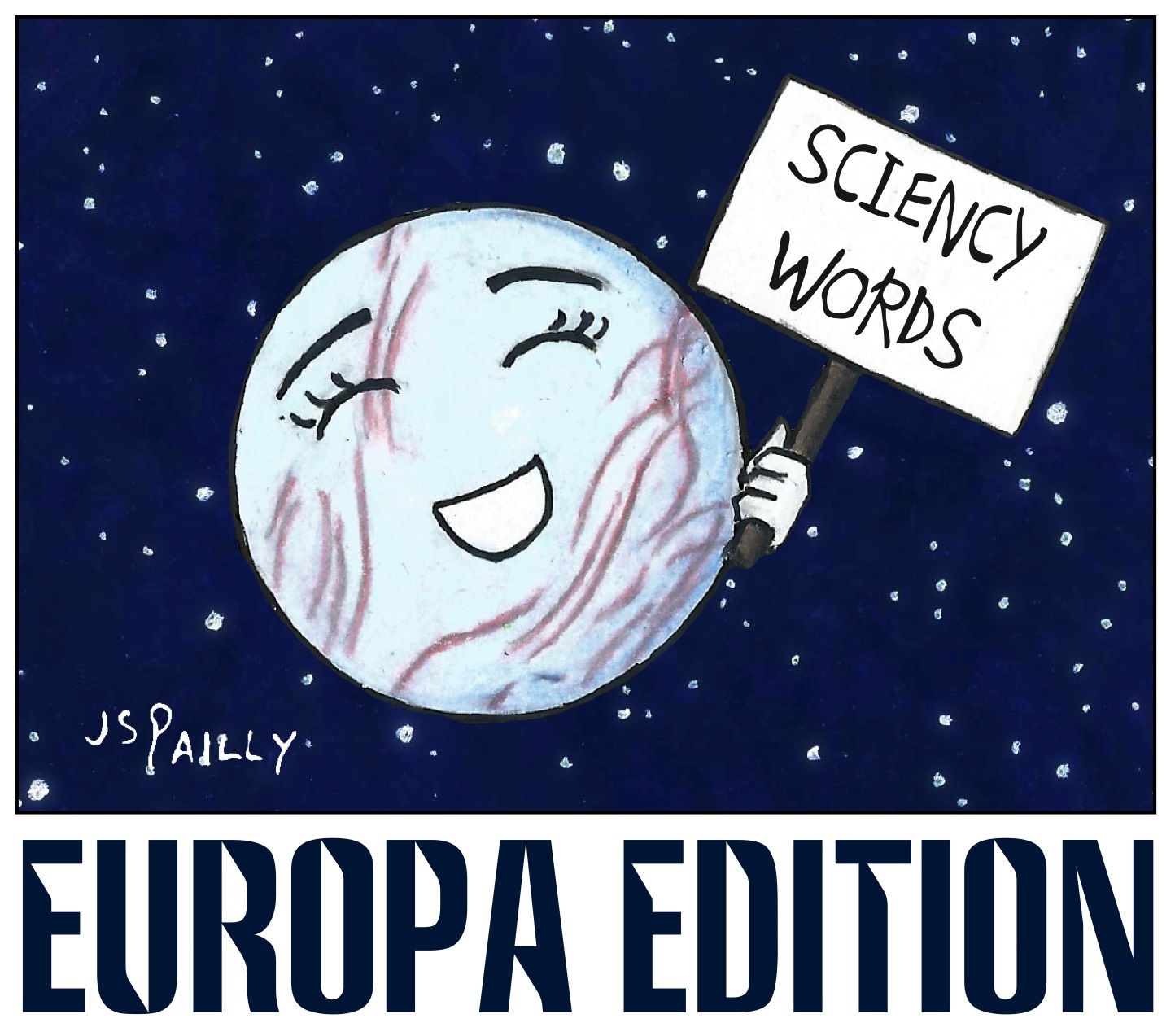
Hello, friends, and welcome back to Sciency Words!  That’s right, Sciency Words is back!  I’m going to handle this series a little differently than I did before.  I could explain what those differences are, but I think it’s better if we just dive right in so you can see for yourselves.

Since this is officially Europa Month here on Planet Pailly, we’re going to turn our attention to Europa, the sixth moon of Jupiter.  When exploring alien worlds, scientists sometimes discover geological features that are not found here on Earth.  When that happens, scientists need to invent new words to describe what they’re seeing.  Here are a few of the terms used to describe geological surface features seen on Europa.

Chaos Terrain: For the most part, Europa’s surface is made of very smooth, very fresh-looking ice.  But in some regions, we find these big, broken chunks of ice in a state of chaotic disarray.  Imagine a bunch of icebergs breaking loose from a glacier.  Now imagine that, before the icebergs drift too far, the water around them freezes, locking those icebergs in place.  That’s basically what chaos terrain looks like.  Oh, and chaos terrain tends to be discolored with some sort of reddish-brown substance.  Click here to see some chaos terrain on Europa.

Linea (plural, lineae): From the Latin word for line, linea means… line.  Reddish-brown lineae crisscross the surface of Europa.  They appear to be cracks in Europa’s icy surface, cracks which have been filled in by a mixture of freshly frozen ice and more of that reddish-brown substance.  Click here to see a color enhanced view of Europa’s lineae.

Lenticula (plural, lenticulae): From the Latin word for freckles, lenticulae are small, reddish-brown spots scattered all over the surface of Europa.  They tend to be round, but they don’t appear to be impact craters, which means they’re probably caused by something happening beneath Europa’s surface.  Click here to see a cluster of lenticulae on Europa’s surface.

Macula (plural, maculae): From the Latin word for spot, maculae are spots of discoloration on the surface of a planet or moon.  Europa’s maculae are irregularly shaped blotches of reddish-brown color.  At least one macula (known as Thera Macula) has been identified as a possible region of active chaos terrain formation.  Click here for a closer look at Thera Macula.

It’s extremely cold in the outer Solar System, so cold that water behaves almost like a kind of rock.  When thinking about icy worlds like Europa, it can be helpful to conceptualize water in that way.  Water is a kind of rock.  With that in mind, Europa’s icy surface is much like the rocky crust we have here on Earth, and Europa’s subsurface ocean of liquid water is sort of like the layer of molten rock that lies beneath Earth’s crust.  And thus the surface features we see on Europa might be caused by processes similar to the tectonic and volcanic activity we experience here on Earth.

There are, of course, other geological terms associated with Europa, but for this post I wanted to focus on just these four.  Europa’s chaos terrain, lineae, lenticulae, and maculae all have something important in common: that reddish-brown discoloration.  Next time on Planet Pailly, we’ll try to figure out what, exactly, that reddish-brown stuff on Europa is.

Sciency Words: Geologic Periods of Mars

One of the reasons I write this Sciency Words series is to introduce you to terms that I know (or at least suspect) we’ll be talking about in upcoming blog posts. Right now, I’m just getting started with my special mission to Mars series, so I think this is a good time to introduce you to not one but four interesting scientific terms.

Today, we’re looking at the four major periods of Mars’s geological history (based primarily on this article from ESA and this article from the Planetary Society).

PRE-NOACHIAN MARS (4.5 to 4.1 billion years ago)

This would have been the period when Mars, along with the rest of the Solar System, was still forming.

NOACHIAN MARS (4.1 to 3.7 billion years ago)

This period was characterized by heavy asteroid/comet bombardment, as well as plenty of volcanic activity. Most of the major surface features we see today formed during this time: the Tharsis Bulge, Valles Marineris, several of the prominent impact basins in the southern hemisphere, and also the vast northern lowlands—or would it have been the northern oceans? Also valley networks that formed during this time look suspiciously like river channels.

HESPERIAN MARS (3.7 to 3.0ish billion years ago)

Around 3.7 billion years ago, it seems asteroid and comet impacts on Mars died down, and volcanic activity kicked it up a notch. We also see a lot of surface features called “outflow channels” corresponding to this time, rather than the river-like valleys that appeared during the Noachian. These outflow channels may have been created by sudden and violent floods, which may have been caused by melting ice dams releasing lake water.

AMAZONIAN MARS (3.0ish billion years ago to today)

The Amazonian Period began when the northern lowlands, specifically a region called Amazonis Planitia, was “resurfaced,” covering up any impact craters or other surface features that may have been there before. Mars experts disagree about when this happened, but most estimates seem to be in the neighborhood of three billion years ago. Any obvious volcanic or geologic activity ceased during the Amazonian, and for the most part all of Mars’s water has either frozen solid or evaporated into space.

On Earth, if you want to talk about the age of the dinosaurs, what you’re really talking about is the Mesozoic Era, which is subdivided into the familiar Triassic, Jurassic, and Cretaceous Periods. And so if you’re looking for dinosaur fossils, you need look for Mesozoic Era rocks.

At this point we only have a rough sketch of the geologic history of Mars. We don’t know enough to make the kinds of divisions and subdivisions that we’ve made for Earth. But if you want to go looking for Martian dinosaurs (by which I mean fossilized Martian life of any kind, even if its only microbial) then I can tell this much: look for Noachian and Hesperian aged rock formations. Those are the rocks that would have formed back when Mars still had oceans and lakes and rivers (or at least random, violent floods).

At least, landing near some Noachian and/or Hesperian rocks seems to be a high priority for NASA’s Mars 2020 rover.

Sciency Words: Holocene (An A to Z Challenge Post)

Today’s post is a special A to Z Challenge edition of Sciency Words, an ongoing series here on Planet Pailly where we take a look at some interesting science or science related term so we can all expand our scientific vocabularies together. In today’s post, H is for:

HOLOCENE

Real dinosaur fans can tell you that dinosaurs lived in the Mesozoic Era, a geological era that is subdivided into the Triassic, Jurassic, and Cretaceous Periods.

Real fans of humans can tell you that humans live in the Cenozoic Era, in a subdivision called the Quaternary Period, in a further subdivision known as the Holocene Epoch—a name which can be translated from Greek to mean “entirely recently.” Again, scientists, you can be more creative than that.

This “entirely recent” epoch began approximately 11,700 years ago, a time which corresponds loosely to the end of the most recent ice age and also corresponds loosely to what archeologists call the mid to late Stone Age.

Major developments during the Holocene include melting glaciers, the extinction of animals like the woolly mammoth and saber-toothed tiger, and of course the rise and spread of human civilization.

The Holocene ends with… well, obviously we don’t know how it ends. Or maybe we do.

There’s an ongoing debate among geologists about whether or not the Holocene has ended already. Some say a new geological epoch—called the Anthropocene—has begun. Anthropocene is derived from the Greek word for human, and it would be characterized by the effects human activities are having on the geology of this planet.

The International Commission on Stratigraphy is in charge of naming geological time periods and defining their start and end points, and the I.C.S. has a working group studying the Holocene vs. Anthropocene issue.

If the Anthropocene is accepted as an official geological epoch by the I.C.S., then the Holocene may have ended about two hundred years ago with the beginning of the Industrial Revolution. There’s an alternative proposal that would have the Holocene end in the mid-20th Century with the dawn of the nuclear age, because changing levels of radioisotopes in rock strata would make the boundary between the two epochs easier to identify. And there’s a proposal to make the Anthropocene a subdivision within the Holocene, rather than making it its own separate epoch.

Whatever the I.C.S. decides to do, their decision will probably be controversial. But it won’t be the first time an international organization like this stirred up controversy over how to define scientific terms. More on that tomorrow.