Sciency Words A to Z: B.S.O.

Welcome to a special A to Z Challenge edition of Sciency Words!  Sciency Words is an ongoing series here on Planet Pailly about the definitions and etymologies of science or science-related terms.  In today’s post, B is for:

B.S.O.

When you study the planets, when you really get to know them well, you soon start to feel like they each have their own unique personalities.  Jupiter is kind of a bully, pushing all the little asteroids around with its gravity.  Venus hates you, and if you try to land on her she will kill you a dozen different ways before you touch the ground. And Mars… I can’t help but feel like Mars is kind of jealous of Earth.

I get the sense that Mars wishes it could be just like Earth, and that Mars is trying its best to prove that it has all the same stuff Earth has.

In 1996, Mars almost had us convinced. A team of NASA scientists led by astrobiologist David McKay announced that they’d found evidence of Martian life.

As reported in this paper, McKay and his colleagues found microscopic structures (among other things) within a Martian meteorite known as ALH84001.  They interpreted those structures to be the fossilized remains of Martian microorganisms.

This was a truly extraordinary claim, but as Carl Sagan famously warned: “extraordinary claims require extraordinary evidence.” Or to put that another way, when it comes to the discovery of alien life, astrobiologists must hold themselves and each other to the same standards as a court of law: proof beyond a reasonable doubt.

In follow-up research, those supposed Martian fossils came to be known as bacteria shaped objects, or B.S.O.s for short.  I kind of wonder if somebody was being a bit cheeky with that term. I wonder if someone was trying to say, in a subtle but clever way, that the whole Martian microbe hypothesis was just B.S.  As this rebuttal paper explains:

Subsequent work has not validated [McKay et al’s] hypothesis; each suggested biomarker has been found to be ambiguous or immaterial.  Nor has their hypothesis been disproved.  Rather, it is now one of several competing hypotheses about the post-magmatic and alteration history of ALH84001.

In other words, those B.S.O.s might very well be fossilized Martian microorganisms.  Yes, they might be.  It is possible.  But no one has been able to prove it beyond a reasonable doubt, and therefore no one can say with any certainty that we’ve found evidence of life on Mars. At least not yet.

Still, the ALH84001 meteorite and its B.S.O.s are an important part of the history of astrobiology.  As that same rebuttal paper says:

[…] it will be remembered for (if nothing else) its galvanizing effect on planetary science.  McKay et al. revitalized study of the martian meteorites and the long-ignored ideas of indigenous life on Mars.  It has brought immediacy to the problem of recognizing extraterrestrial life, and thus materially affected preparations for spacecraft missions to return rock and soil samples from Mars.

Next time on Sciency Words A to Z, are we prejudiced against non-carbon-based life?
Sciency Words: The Sagan Effect

Sciency Words: (proper noun) a special series here on Planet Pailly focusing on the definitions and etymologies of science or science-related terms.  Today’s Sciency Word is:

THE SAGAN EFFECT

This year’s A to Z Challenge is fast approaching. I’ve already revealed my theme: Sciency Words, specifically scientific terms related to the search for alien life.  And with that theme in mind, there’s one person whom I expect we’ll be talking about a lot: Carl Sagan.

Sagan deserves a lot of credit for making astrobiology a respected branch of modern science, and he invented some of the scientific terms we’ll be talking about next month.  But Sagan himself was not as well respected by his peers as he should have been.

Why not?  Because he wrote too many books.  Because he was on television all the time, giving interviews, hosting his own T.V. show, and waxing poetic about our place in the universe.

Apparently that led to a perception among the scientific community that Sagan must not be spending much time doing actual scientific research.  As a direct consequence of that perception, Sagan was denied membership to the U.S. National Academy of Sciences, and it’s widely believed that this is also why he was denied tenure at Harvard.

And Sagan is not the only working scientist to suffer from what is now known as the Sagan Effect.  As described in this article from the Journal of Neuroscience, quite a few researchers have lost grant money or been reprimanded by their supervisors or faced other career-derailing consequences simply for giving a TED Talk or having too many followers on Twitter or writing a few articles for popular science magazines.

This despite the fact that there is a growing awareness in the scientific community that scientists do need to engage with the public. To quote from that same article from Neuroscience:

Most scientists agree that science communication is important, and some even say that it is a scientist’s duty to interact with the media and the tax-paying public.  Yet, the concern remains that science dissemination may be incompatible with a successful academic career, particularly if the scientist is a junior or pretenture investigator.

So it would seem that if you’re a scientist and you want to engage with the public, you’re damned if you do and damned if you don’t.

The frustrating thing is that Carl Sagan was no slacker when it came to science.  The oft cited statistic is that he produced, on average, one peer-reviewed paper per month.  All that work he did to popularize science was on top of his regular workload as a scientist, not instead of it.

And the same could be said of many “popularizers” today, according to this paper titled “Scientists who engage with society perform better academically.”  Yes, the scientific community has been researching itself, and the evidence shows that scientists who engage with the public do not slack off with their regular work.  Quite the opposite: they outperform their less publically engaged colleagues!

Even so, the Sagan Effect remains in play. Scientists seem to have embraced certain stereotypes about themselves, and, quoting again from this Neuroscience article, “deviating too much from the idealized image of the single-minded, focused academic is still considered problematic.”  But I think it’s time we all let that stereotype go, because if you’re a working scientist today you can do your research AND help inspire the next generation of scientists (and give people like me ideas for cool Sci-Fi stories)—just like Carl Sagan did!

Where Are the Earthlings?

Have you ever looked up at the night sky and wondered if maybe, somewhere out there, someone might be looking back at you?  Well, I’m here to tell you the answer to that question is yes.  Or at least there are aliens out there who are trying very hard to find us.  I even have video evidence to prove it!

For us Earthlings, it’s pretty obvious that there’s life on this planet.  How could you possibly miss it?  But for aliens observing Earth from a distance—perhaps a very great distance—the most obvious biosignatures are frustratingly difficult to detect.

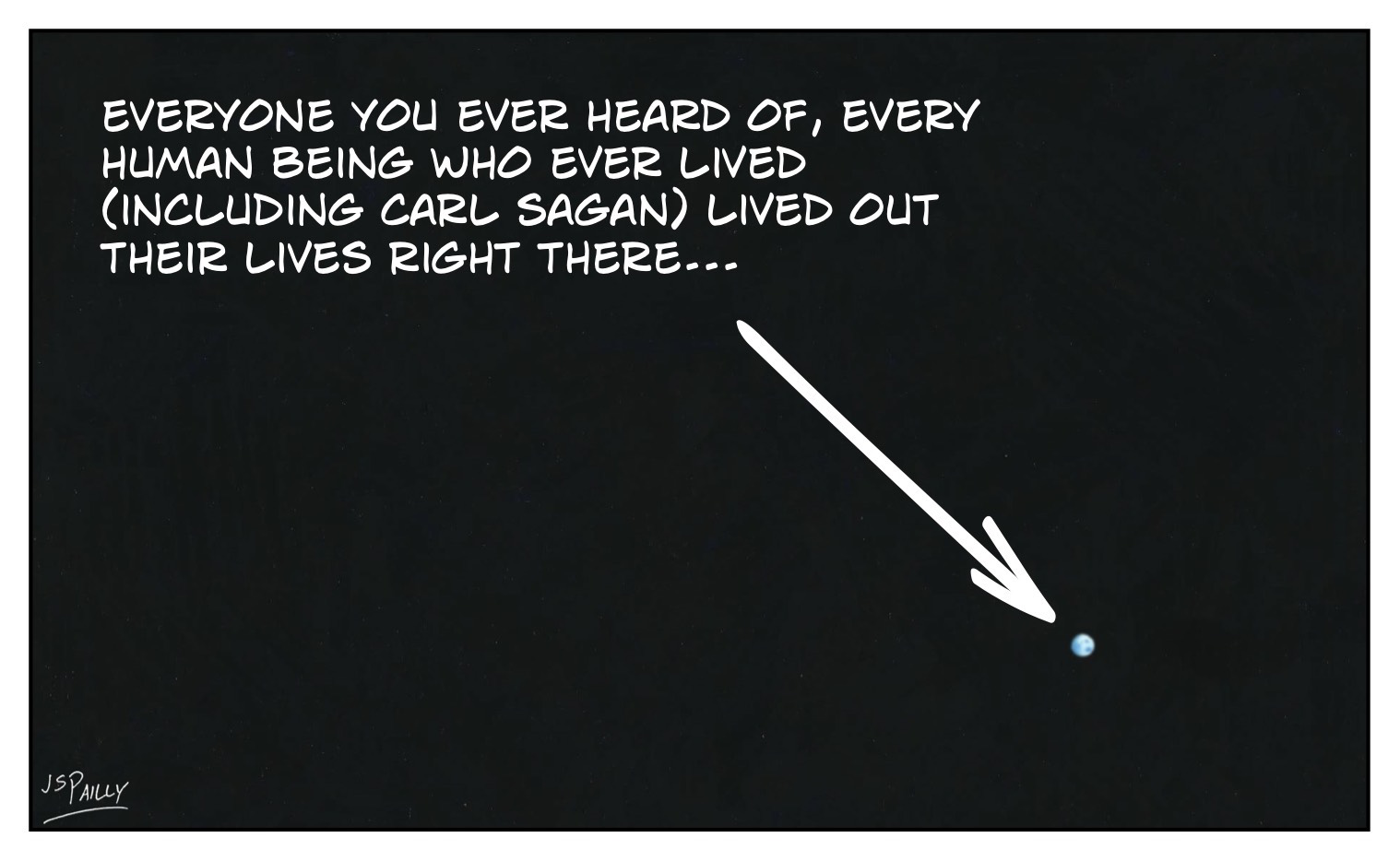
In the early 1990’s, Carl Sagan wrote a famous paper about this problem.  One of NASA’s own space probes, which was heading out to Jupiter, briefly turned all its instruments back on Earth.  Based on that data alone, without any prior knowledge about this planet, you could probably figure out there’s life on Earth. Probably.

This more recent paper published in The Astrophysical Journal follows up on Sagan’s work.  Assuming the aliens are smart (a big assumption, based on what the video evidence shows us), they should be looking for a planet with both an oxidizing gas AND a reducing gas in its atmosphere.

Oxidizing and reducing agents should react with each other relatively quickly, removing each other from the planet’s atmosphere.  So in order to have those two things coexisting long term, some exotic process (like biological activity) must be constantly replenishing them.

A spectroscopic analysis of Earth’s atmosphere would reveal a whole lot of the chemicals in our air, but not all of them. Apparently some spectral signatures are so strong they cover up others, which I think is an important thing to know.  But oxygen (an oxidizing gas) should still be detectable in the visible light part of the spectrum, and methane (a reducing gas) should show up in visible and infrared.

But still, it sounds like difficult work, teasing the signatures of oxygen and methane out of all the other spectral signatures you’d get from Earth’s atmosphere.  This could be why the aliens are having such a hard time finding us, and also why we are having such a hard time finding them.