How Proxima b Lost Its Ozone Layer

Hello, friends!

Today we’re visiting Proxima Centauri, one of three stars in the Alpha Centauri system, the star system right next door to our own.  And it turns out Proxima has at least one planet.  Not only that: Proxima’s planet is orbiting within the habitable zone.  That planet may have liquid water on its surface, and perhaps even life!

Proxima’s planet, known officially as Proxima b, orbits about 0.05 AU away from its star.  That puts Proxima b closer to its star than Mercury is to our Sun.  But that’s okay.  Proxima Centauri is much smaller, dimmer, and colder than our own Sun, so everything balances out.

But I have bad news.  The temperature might be right for life, but the radiation environment is all wrong.  Proxima Centauri is a very angry little star.  It’s much angrier than our Sun.  Solar flares, solar wind, and solar radiation are a whole lot worse than anything Earth would normally have to worry about.

In March of 2016, Earth-based astronomers observed a “superflare” on Proxima Centauri.  As you can see in the highly technical diagram below, that superflare would have done serious damage to Proxima b’s ozone layer (assuming Proxima b had an ozone layer in the first place).

According to this 2018 paper on ozone loss, if superflares like that are normal for Proxima Centauri, we should expect Proxima b to lose 90% of its ozone layer in just five years (again, assuming Proxima b had an ozone layer in the first place).  Without an ozone layer, incoming ultraviolet radiation would thoroughly sterilize Proxima b’s surface (much like it does on Mars).

And it gets worse.  Earth’s magnetic field deflects a lot of harmful solar and cosmic radiation away.  But according to this 2016 paper on space weather, Proxima b’s magnetic field (assuming Proxima b has a magnetic field) is taking a real beating.  The magnetic field would be badly weakened and compressed.  As a result, Proxima b’s atmosphere would start eroding away, due to the solar wind, and if those UV rays haven’t already killed everything on the surface, all that solar and cosmic radiation would have a chance to finish the job.

Even the most extreme of extremophiles here on Earth would have a tough time surviving on Proxima b.  But the situation is not hopeless.  That 2016 paper on space weather and that 2018 paper on ozone loss both acknowledge that there are still plausible scenarios where life could evolve and thrive on Proxima b.  But in order to do it, the Proxima b-ians must have done one of two things:

  • Life on Proxima b must be very specifically adapted to that radiation environment, or…
  • Life on Proxima b must have found a good hiding place, perhaps deep underwater or underground, where the radiation can’t reach it.

Next time on Planet Pailly, it’s a bird!  It’s a plane!  It’s… oh no, it’s a killer asteroid!!!
Something Worth Knowing

Hello, friends!

Today I’d like to share a very old video I found on YouTube.  It’s a series of man (and woman) on the street interviews where people are asked if they think we’ll find life on other planets.

According to the video description, this was filmed in 1962.  It’s interesting to me to hear people talk about the possibility of finding “vegetable” and/or “animal” life on Venus.  At that time, the Soviet Union’s Venera 1 spacecraft would have already visited Venus; however, due to a technical glitch, Venera 1 failed to transmit any data about Venus back to Earth.  So surface conditions on Venus were still unknown to us Earthlings.

But setting aside the Venus stuff in particular, in general people’s opinions about space exploration and extraterrestrial life have not changed much since 1962.  Some people are enthusiastically optimistic, others think it’s all nonsense, and a lot of people don’t seem to care one way or the other.

Then, of course, you get the one guy who swears he’s seen a U.F.O.  And then, of course, you get the guy who’s “working off the theory of the Bible,” where it says God only created life on one planet (F.Y.I., I’ve read the Bible too, and I don’t remember it ever saying that).  So again, not much has changed since 1962.

But my favorite is the woman at 1:40 who says she doesn’t expect we’ll find any life on Venus, but then goes on to say we’ll still find “something worth knowing.”  I’d say she was right on both counts!

Personally, I do think there’s life on other planets, and also on other moons (I’m looking at you, Europa).  But regardless of whether or not we find alien life out there, we should absolutely keep searching and keep exploring.  I suspect we will continue to learn all sorts of things that are worth knowing!

Next time on Planet Pailly, we’ll learn how to dance like binary stars.

Sciency Words: The Silurian Hypothesis

Sciency Words: (proper noun) a special series here on Planet Pailly focusing on the definitions and etymologies of science or science-related terms.  Today’s Sciency Word is:

THE SILURIAN HYPOTHESIS

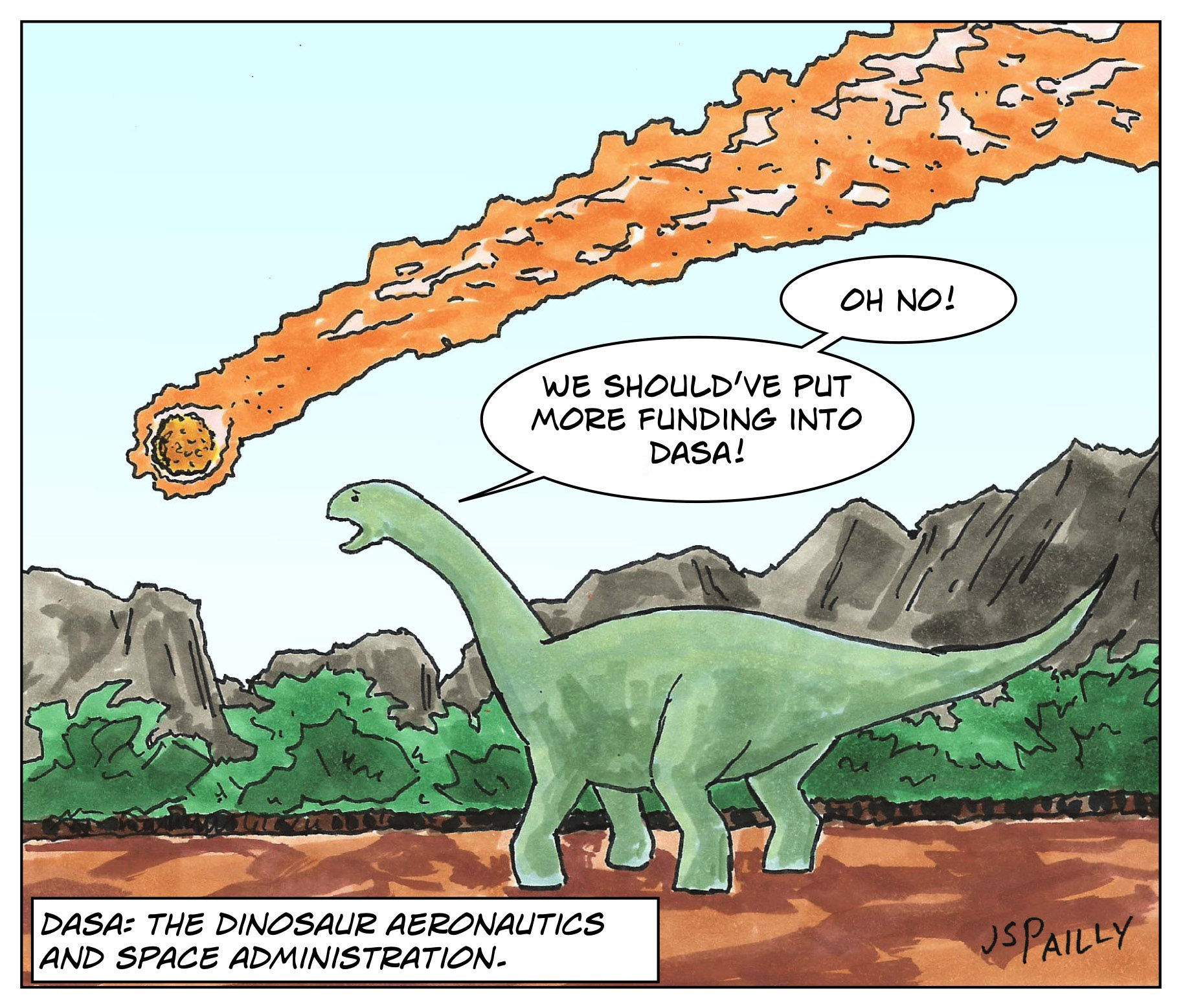
I’ve heard several variations on this joke.  Why did the dinosaurs go extinct?  Because they didn’t put enough money into their space program.

But what if that isn’t a joke?  What if the dinosaurs (or some other prehistoric creatures) did establish an advanced civilization right here on Earth millions of years before we came along?  Could such a civilization come and go without leaving any trace for us modern humans to find?  Or could the traces be there for us to see, and we just haven’t recognized them yet?

In 2018, NASA astrobiologists Gavin Schmidt and Adam Frank presented this idea in a formal scientific paper titled “The Silurian Hypothesis: Would it be possible to detect an industrial civilization in the geological record?”  As Schmidt and Frank explain in a footnote:

We name the hypothesis after a 1970 episode of the British science fiction TV series Doctor Who where a long buried race of intelligent reptiles “Silurians” are awakened by an experimental nuclear reactor.  We are not however suggesting that intelligent reptiles actually existed in the Silurian age, nor that experimental nuclear physics is liable to wake them from hibernation.

Schmidt and Frank go on to examine some of the ways human industrial activities have changed this planet, and how those changes are being recorded geologically.  They also examine a few of the oddities and anomalies in the geological record as we currently know it.

To be clear, there is absolutely no definitive evidence that another advanced civilization existed on Earth before our own.  Schmidt and Frank go to great pains to emphasize that they don’t actually believe their own hypothesis to be true.

The Silurian Hypothesis is intended to be more of a thought experiment than anything else.  It’s meant to help us better understand how human civilization is changing this planet, and also (remember Schmidt and Frank are NASA astrobiologists) how alien civilizations might be changing their own worlds.

P.S.: The Silurian Hypothesis is also a wonderful example of how science fiction can inspire real life science.

Beware Wishful Thinking: A Science Lesson

This may seem like a contradiction. Astrobiologists are actively searching for alien life.  It’s their job.  And yet whenever new evidence of alien life is presented, astrobiologists are the first and most vocal skeptics about it.  If your job is to search for alien life, why would you be so quick to doubt any evidence that alien life actually exists?

This goes back to the famous “extraordinary claims require extraordinary evidence” line from Carl Sagan, or the whole proof beyond a reasonable doubt thing I kept saying during my recent A to Z series on the search for alien life.  Astrobiologists very much do want to find alien life.  They’re eager to find it.  Perhaps a little too eager.

And thus, astrobiologists have to be careful.  They have to be extra skeptical, because they have to be on guard against their own wishful thinking.

And really, this is not only true in the field of astrobiology; it’s true of science in general.  And frankly, it’s a valuable lesson for us all, even if you’re not a scientist.

I can’t tell you how many times I’ve really wanted to believe something.  I’ve really wanted to believe that some girl likes me, or that I’ve put my money in sound investments, or that I’ve voted for the right people.  And when you really want to believe something, you’ll latch onto whatever flimsy evidence you can find to prove to yourself that it’s true.

Astrobiologists know this.  Scientists know this (or at least they’re supposed to).  And I think it’s good advice for us all to live by.  The more you want to believe something, the more you should question and doubt it.  Always, always, always be on guard against your own wishful thinking.

Sciency Words A to Z: The Zero-One-Infinity Rule

Welcome to a special A to Z Challenge edition of Sciency Words!  Sciency Words is an ongoing series here on Planet Pailly about the definitions and etymologies of science or science-related terms.  In today’s post, Z is for:

THE ZERO-ONE-INFINITY RULE

All month, we’ve been talking about astrobiology, SETI, and the possibility that we are not alone in the universe.  I’d like to end this series with a prediction for the future, and conveniently my prediction is related to a Z-word: the zero-one-infinity rule.

The zero-one-infinity rule was originally created by Dutch computer scientist Willem Louis Van Der Poel.  For the purposes of computer programming, the rule has to do with how many times a user is allowed to do a thing (whatever that thing might be).

It makes sense for a user to never be allowed to do a certain thing (zero), or it makes sense for a user to do a thing only once (one).  But if you’re going to allow a user to do a thing more than once, you may as well let the user do that thing as many times as the user wants.  As a rule of thumb, the zero-one-infinity rule means there’s no reason to impose arbitrary limits on what users can do.

The zero-one-infinity rule has been adapted to many other scientific fields, including the field of astrobiology.  How many places can life exist in the universe?

  • Zero: the universe might not allow life to exist at all.  Of course we already know this isn’t  true, otherwise we wouldn’t be here.
  • One: the universe might only allow life to develop once.  In this view, Earth is a crazy exception, a one-time fluke in a universe that otherwise does not allow life to exist.
  • Infinity: the universe allows life to exist anywhere and everywhere it can.  Life might still be rare in this view, but there are no arbitrary limits imposed on life.

I remember in the 80’s and early 90’s there were a lot of people (including one of my science teachers) who honestly believed our Solar System might be unique.  No other star except our Sun was known to have planets. Maybe that was because there were no other stars with planets.  In short, our Solar System was a “one” in the zero-one-infinity rule.

Then in 1992, astronomers announced the discovery of the first known exoplanets—planets orbiting a star other than our Sun. At the time, we still had no idea just how many exoplanets we might find, but if the universe had allowed two solar systems to form, why not three?  Why not a dozen, or a thousand, or a million?  As soon as the case for “one” crumbled, the possibilities were suddenly limitless.

I predict the same thing will happen when we finally discover alien life.  Maybe it will be microorganisms on Mars, or sea monsters on Europa, or ham radio enthusiasts in the constellation Sagittarius.  It won’t matter which kind of life we find, specifically. Any alien life will do.

In this special edition of Time Magazine, there’s a brief mention of the zero-one-infinity rule.  In that article, NASA scientist Chris McKay sums up the whole field of astrobiology by saying, “So what we’re searching for is two.”  Because once we know that life developed on not one but two worlds… why not three?  Why not a dozen, or a million?  The possibilities will be truly limitless.

Sciency Words A to Z: Young Surface

Welcome to a special A to Z Challenge edition of Sciency Words!  Sciency Words is an ongoing series here on Planet Pailly about the definitions and etymologies of science or science-related terms.  In today’s post, Y is for:

YOUNG SURFACE

Imagine a nice, smooth, clean sheet of asphalt: a parking lot, maybe, with no cracks or potholes or blemishes of any kind.  Just looking at it, you would know, with a reasonable degree of certainty, that this asphalt had been laid down recently. It’s new.  It is, in effect, a young surface.

In much the same way, planetary scientists can look at the surface of a planet or moon and infer, with a reasonable degree of certainty, how young or old that surface must be.  Look at the Moon or Mercury; they’re covered in craters, showing that their surfaces must be very, very old.  Or look at Mars, where some regions are more heavily cratered than others, implying (intriguingly) that some surfaces are relatively old and some are relatively young.

And then there’s Europa, one of Jupiter’s moons. Europa may be covered in weird, orangey-red cracks, and it may have a few other orangey-red blemishes, but overall it’s surprisingly smooth, and there are very few craters.  This makes Europa look a whole lot younger than it actually is.  In fact, Europa is said to have the youngest-looking surface in the whole Solar System.

Europa’s surface is made of ice, specifically water ice.  This is not so uncommon for a moon in the outer Solar System.  It’s so cold out there that water behaves like a kind of rock.

But unlike most other icy moons, Europa must be doing something to get rid of old, crater-y surface ice and replace it with new, clean, smooth ice.  And once you really start thinking of water as a kind of rock, you might be able to guess what Europa’s doing.  As stated in this paper from Nature Geoscience: “[…] Europa may be the only Solar System body other than Earth to exhibit a system of plate tectonics.”

Except unlike Earth’s techtonic plates, which float atop a layer of magma (liquid rock), Europa’s plates would be floating atop “magma” that is actually liquid water—twice as much liquid water as we have here on Earth, according to some calculations.

And while liquid water may or may not be necessary for life, we do have good reason to suspect that any place that has liquid water might also have life.  Personally, based on everything else I’ve learned about Europa, I’d be more surprised if we didn’t find something living there.

Next time on Sciency Words A to Z, I have a prediction for the future.

Sciency Words A to Z: SETI

Welcome to a special A to Z Challenge edition of Sciency Words!  Sciency Words is an ongoing series here on Planet Pailly about the definitions and etymologies of science or science-related terms.  In today’s post, S is for:

SETI

In September of 1959, Italian physicist Giuseppi Cocconi and American physicist Philip Morrison published this paper, titled “Searching for Interstellar Communications.”  That paper is essentially the founding document for SETI, the search for extraterrestrial intelligence, which is now considered a subfield of astrobiology.

The SETI Institute, on the other hand, was established in 1984 by Thomas Pierson and Jill Tarter.  As stated in this report on the proper use of SETI nomenclature:

SETI should not be used as a shorthand for the SETI Institute, which is an independent entity and should be referred to by its full name to avoid confusion.

And let me tell you, this SETI vs. SETI Institute distinction… that really can cause a lot of confusion.

A few years back, I saw a report on the news.  SETI (the Institute, I presumed) had picked up a signal form outer space, from a star located 94 light years away.  According to the news lady on TV, a SETI spokesperson had this to say, and that to say, and some more stuff to say about this amazing discovery.  “Oh cool,” I thought, and I quickly went to the SETI Institute’s webpage to learn more.

There was nothing—absolutely nothing—about it.

Another day or two went by, and then this article was posted on the SETI Institute’s website.  Some Russian radio astronomers had picked up what they thought was a SETI signal (it eventually turned out to be a satellite).  Somehow the media picked up on this story and ran with it, apparently without contacting the SETI Institute—or speaking with any actual SETI Institute spokesperson—to find out if any of this were true.

I should probably mention that in my day job, I work in the T.V. news business.  This sort of sloppy journalism infuriates me, but I’ve found that it’s quite typical of how the popular press handles science news.

However, to be fair, prior to that misleading news report, I didn’t know to make a clear distinction between SETI and the SETI Institute myself. But I’ve tried to be more careful about this ever since.  Language can be a messy way to communicate, so it’s important to try to be clear about what we mean.  Otherwise, someone (perhaps even someone from the media) will get the wrong idea and run with it.

Next time on Sciency Words A to Z, the first astronauts on Titan may find themselves in a very sticky situation.

Sciency Words A to Z: Rare Earth Hypothesis

Welcome to a special A to Z Challenge edition of Sciency Words!  Sciency Words is an ongoing series here on Planet Pailly about the definitions and etymologies of science or science-related terms.  In today’s post, R is for:

THE RARE EARTH HYPOTHESIS

Once upon a time, it was believed that the Sun, Moon, planets, and all the stars revolved around the Earth.  This was known as the geocentric theory.

Copernicus, Galileo, Kepler, and others set us straight about our planet’s physical location in space.  However, it is still sometimes asserted that Earth is special or unique in other ways.  Such assertions are often referred to in a derogatory sense as “geocentrisms.”

It’s tempting to dismiss the Rare Earth Hypothesis as just another geocentrism.  The idea was first presented in 2000 in a book called Rare Earth: Why Complex Life is Uncommon in the Universe by Peter Ward and Donald Brownlee.  In that book, Ward and Brownlee go through all the conditions they say were necessary for complex life to develop on this planet.  Crucially, they point out all the ways things could have gone wrong, all the ways complex life on Earth could have been prematurely snuffed out.

In other words, we are very, very, very lucky to be here, according to Ward and Brownlee, and the odds of finding another planet that was as lucky as Earth must be astronomically low.  Sure, there might be lots of planets where biology got started. Simple microorganisms may be quite common.  But complex, multicellular life like we have here on Earth—that’s rare.  And intelligent life forms like us are rarer still.  Perhaps intelligent life is so rare that we’re the only ones.

My favorite response to the Rare Earth Hypothesis comes from NASA astronomer Chris McKay.  In All These Worlds Are Yours, McKay’s argument is described as the Rare Titan Hypothsis.

Imagine intelligent life has developed on Titan (such a thing seems unlikely, I know, but there may be something living on Titan).  Titanian scientists look through their telescopes and soon realize that no other world in the Solar System is quite like their own.  Earth, for example, if too hot for life as the Titanians know it, and there’s far too much of that poisonous oxygen in the atmosphere anyway.  Furthermore, water would wreak havoc on what the Titanians would consider a biomolecule.

Perhaps a pair of Titanian scientists then decide to publish a book.  They list all the conditions required for complex life to develop on Titan, point out all the ways Titanian life could have been snuffed out prematurely, and argue that the odds of finding another Titan-like world must be astronomically low.

Personally, I think there’s some validity to the Rare Earth Hypothesis, but McKay’s point is worth bearing in mind.  There could be many different ways for life to develop in our universe.  Earth is but one example.  Planets that are just like Earth may indeed be rare—extremely rare—but there’s no reason to conclude that Earth-like life is the only kind of complex life out there.

Next time on Sciency Words A to Z… oh my gosh, we’ve finally made it to S!  It’s finally time to talk about SETI!

Sciency Words A to Z: Panspermia

Welcome to a special A to Z Challenge edition of Sciency Words!  Sciency Words is an ongoing series here on Planet Pailly about the definitions and etymologies of science or science-related terms.  In today’s post, P is for:

PANSPERMIA

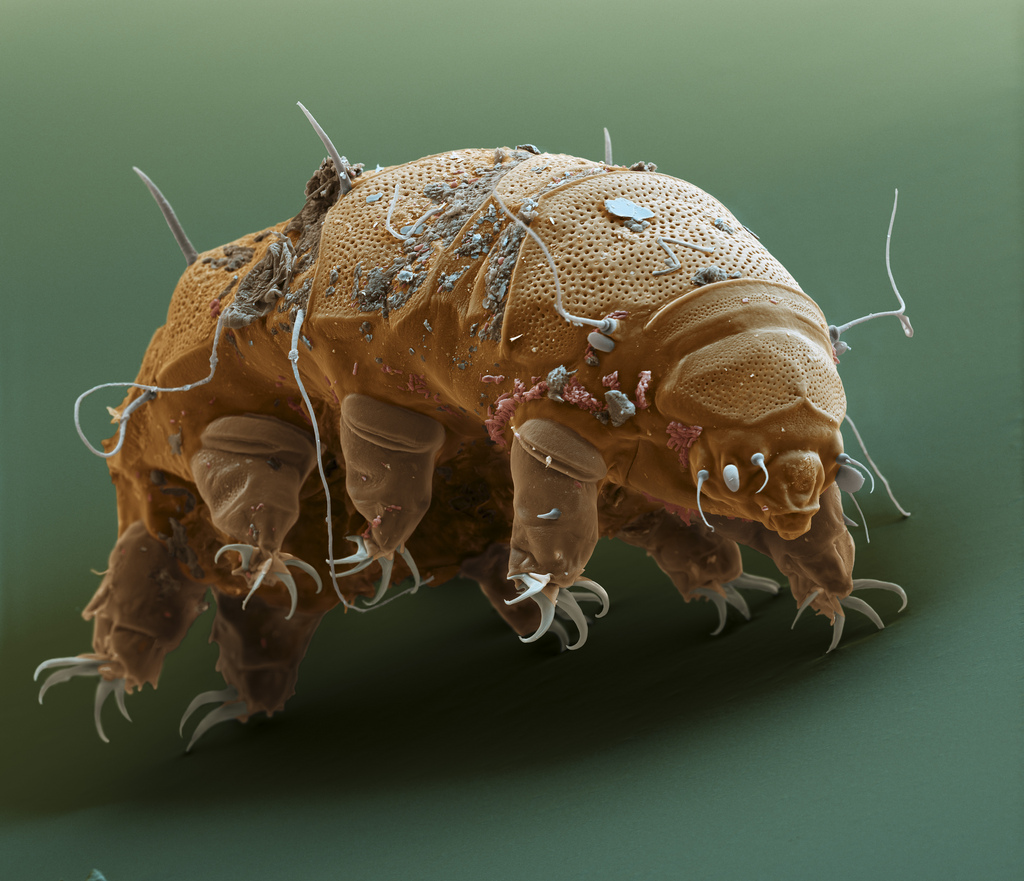
Pictured above is a tardigrade, also known as a water bear.  Tardigrades are pudgy-looking, almost cuddly-looking (depending on the photograph) microorganisms that reside here on Earth.  But due to some alleged confusion about their genetic lineage, it was at one time speculated that tardigrades might have come from somewhere else.  Perhaps they migrated to Earth through a process called panspermia.

The word panspermia goes all the way back to ancient Greece, and it can be translated to mean “seeds everywhere,” as in the seeds of life have spread all over the universe.  According to this article by Chandra Wickramasinghe, one of the leading proponents of the panspermia hypothesis, serious scientific discussion of the idea began in the late 1800’s.  In Wickramasinghe’s article, Lord Kelvin is quoted thusly:

… Hence, and because we all confidently believe that there are at present, and have been from time immemorial, many worlds of life besides our own, we must regard it as probable in the highest degree that there are countless seed-bearing meteoritic stones moving through space.  If at the present instant no life existed upon the Earth, one such stone falling upon it might, by what we blindly call natural causes, lead to its becoming covered with vegetation.

While Lord Kelvin and other late 19th and early 20th Century scientists may have taken panspermia seriously, the idea soon fell out of vogue.  Yes, from time to time, perhaps a “meteoritic” impact or a volcanic explosion (or maybe even a really strong gust of wind) might loft a few bacterial spores into a planet’s upper atmosphere.  Perhaps those spores could then escape into space.  But surely those spores would not survive for long after that.

It was British astronomer Fred Hoyle and Sri Lankan-born British astronomer Chandra Wickramasinghe who repopularized panspermia in the 1970’s and 80’s.  As explained in this paper, titled “Progress Towards the Vindication of Panspermia,” the Hoyle-Wickramasinghe interpretation of panspermia is founded on two basic premises: that microorganisms “have an almost indefinite persistence and viability,” and that once they find themselves in the right environment, “microbes can replicate exponentially.”

I’d say both of those premises make sense.  We all know how rapidly microbes can replicate given the chance.  As for their “almost indefinite persistence and vitality”… tardigrades famously survived in the vacuum of space.  No air, no water, extreme temperatures, extreme radiation… the tardigrades handled space quite well. Other microorganisms also survived similar experiments.

But could these microbes survive the thousands or perhaps millions of years it would take to travel from one planet to another?  Hoyle and Wickramasinghe clearly thought so, and they made some pretty outrageous claims about how much biological material we should expect to find drifting through open space.

[…] by 1983 we inferred confidently that some 30 percent of the carbon in interstellar dust clouds had to be tied up in the form of organic dust that matched the properties of degraded or desiccated bacteria.

Panspermia is now one of the most important concepts in the field of astrobiology.  It’s gained a lot of credence, especially since the discovery of those bacteria shaped objects in the ALH84001 meteorite.  However, although it is an important concept, it also remains highly speculative.  As I’ve said several times now in these A to Z posts, astrobiologists must hold themselves to the same standards as a court of law: proof beyond a reasonable doubt.  And there are still plenty of reasonable doubts about panspermia.

Next time on Sciency Words A to Z, call me old fashioned, but I prefer it when planets have names.

Sciency Words A to Z: Noachian

Welcome to a special A to Z Challenge edition of Sciency Words!  Sciency Words is an ongoing series here on Planet Pailly about the definitions and etymologies of science or science-related terms.  In today’s post, N is for:

NOACHIAN

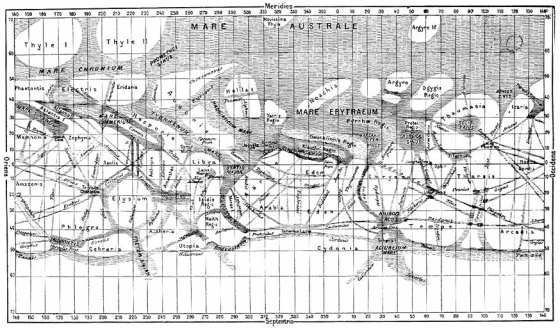
In the 1870’s, Italian astronomer Giovanni Schiaparelli began producing the most detailed and accurate maps of Mars anyone had ever seen.  Schiaparelli also assigned many of the names we still use today for Martian surface features today. One of those regions on Schiaparelli’s map got the name Noachis Terra—the Land of Noah.

In my opinion, no other name could have turned out to be more apt.  Schiaparelli got many of his names from the Bible, and I’m sure you remember the biblical story of Noah and the Great Flood.

Schiaparelli’s map of Mars.

Much like the geological history of Earth, Mars’s geological history is divided up into different periods.  Noachis Terra spawned the name for Mars’s Noachian Period, a time that roughly corresponds with the Archean Eon here on Earth—the time when the very first microbes were appearing on our planet.

So what was happening on Noachian Mars?  Based on the evidence presented in this textbook on Astrobiology, it wasn’t quite like the Great Flood in the Bible, but it was close!  Most if not all of Mars’s northern hemisphere was probably covered in water.  Circumstantial evidence of shorelines can be seen today.

And in the southern hemisphere, in regions like Noachis Terra, we see unambiguous evidence of ancient flowing water.  Craters show obvious signs of erosion.  There are dried up lakes and rivers, and those rivers appear to have been fed by tributaries, which tells us it used to rain on Mars.

And there’s more.  Many Noachian-aged minerals and rock formations are most easily explained if we assume there was water.  In some cases, water is the only possible explaination.  Our Mars rovers have found mudstone, clay minerals, sedimentary rock… iron and magnesium carbonate… hematite, jarosite, and more!  Some of these minerals would have required a hot and slightly acidic environment, like you might find in a hot spring or near a hydrothermal vent.

We shouldn’t jump to conclusions.  After all, there’s still so much we don’t yet know about Mars, and new discoveries are being made all the time.  But I’m going to go ahead and call a spade a spade here: Noachian Mars sounds an awful lot like Arcean Earth, and it’s easy to imagine that whatever was happening on Arcean Earth (by which I mean LIFE!!!) must’ve also been happening on Noachian Mars.

However, the Noachian Period did not last long—a mere 400 million years.  Earth and Mars have had very different geological histories since then.  After the Noachian, Mars rapidly lost its internal heat, its atmosphere, and its oceans.  By the time of Earth’s Cambrian explosion, when complex, multi-cellular organisms really “exploded” onto the scene, Mars had fully transformed into the barren, inhospitable world we know today.

Modern day Mars has been trying really hard to get our attention and convince us that it might still support life.

And maybe that’s true.  During the Noachian, life had a great opportunity to get started on Mars, and it’s possible that some isolated remnant of a Noachian ecosystem has persisted to this day.  But in my opinion, it’s far more likely that we’ll find fossils left over from the Noachian Period (assuming we haven’t found some already).

Next time on Sciency Words A to Z, did you know there’s a deadly chemical in the air you breathe?  It’s called oxygen.