Sciency Words: Centaur (An A to Z Challenge Post)

Today’s post is a special A to Z Challenge edition of Sciency Words, an ongoing series here on Planet Pailly where we take a look at some interesting science or science related term so we can all expand our scientific vocabularies together. In today’s post, C is for:

CENTAUR

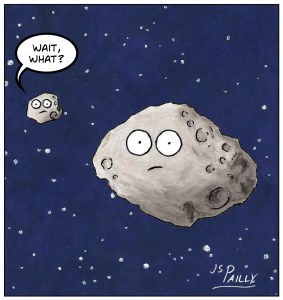
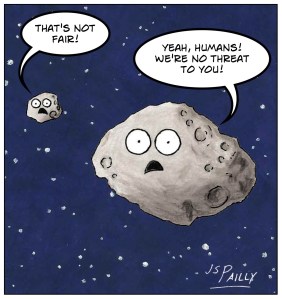
As I mentioned in my first Sciency Words: A to Z Challenge post, some scientific terms are kind of dumb. This isn’t one of them. I actually think this one’s pretty clever. There’s a class of large objects in the Solar System that astronomers have decided to call centaurs.
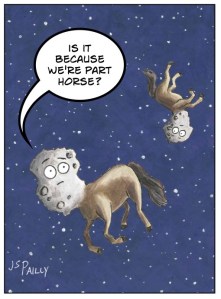
Eh… no. These objects have nothing to do with horses, but they are sort of half one thing and half another! When they were first discovered, astronomers were confused because centaurs appeared to have the characteristics of both asteroids and comets.

I first learned about centaurs in this article from Discovery News. It’s now believed that centaurs originally came from the Kuiper belt—a sort of second asteroid belt that lies beyond the orbit of Neptune. Basically, they came from Pluto’s neighborhood.

Due to gravitational interactions with the gas giants, these objects were pulled inward. The now have highly unstable orbits crossing between the orbits of Neptune and Jupiter. Eventually, further gravitational interactions may hurl a centaur into the inner Solar System, putting it within melting distance of the Sun and transforming it into a full-fledged comet.

Originally, the International Astronomy Union wanted to name all the centaurs after actual centaurs from Greek mythology. But they quickly ran out of names. Now the official naming theme includes all mythical hybrids and/or shape-shifters. Examples include Typhon (half man, half dragon), Ceto (half woman, half sea monster) and Narcissus (a man who transformed into a flower).

Next time on Sciency Words: A to Z Challenge, we’ll find out why dimetrodon is not a dinosaur.
Sciency Words: Frost Line

Welcome to a very special holiday edition of Sciency Words! Today’s science or science-related term is:

FROST LINE

When a new star is forming, it’s typically surrounded by a swirling cloud of dust and gas called an accretion disk. Heat radiating from the baby star plus heat trapped in the disk itself vaporizes water and other volatile chemicals, which are then swept off into space by the solar wind.

But as you move farther away from the star, the temperature of the accretion disk tends to drop. Eventually, you reach a point where it’s cold enough for water to remain in its solid ice form. This is known as the frost line (or snow line, or ice line, or frost boundary).

Of course not all volatiles freeze or vaporize at the same temperature. When necessary, science writers will specify which frost line (or lines) they’re talking about. For example, a distinction might be made between the water frost line versus the nitrogen frost line versus the methane frost line, etc. But in general, if you see the term frost line by itself without any specifiers, I think you can safely assume it’s the water frost line.

Even though our Sun’s accretion disk is long gone, the frost line still loosely marks the boundary between the warmth of the inner Solar System and the coldness of the outer Solar System. The line is smack-dab in the middle of the asteroid belt, and it’s been observed that main belt asteroids tend to be rockier or icier depending on which side of the line they’re on.

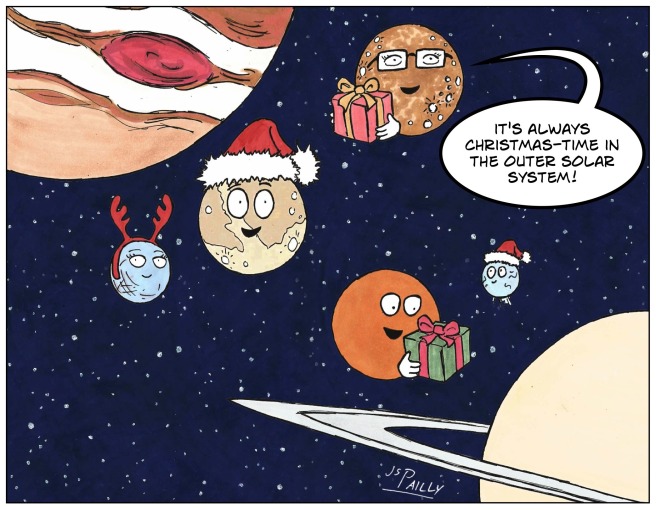
It was easier for giant planets like Jupiter and Saturn to form beyond the frost line, since they had so much more solid matter to work with. And icy objects like Europa, Titan, and Pluto—places so cold that water is basically a kind of rock—only exist as they do because they formed beyond the frost line. This has led to the old saying:

dc23-outer-solar-system-christmas-party

Okay, maybe that’s not an old saying, but I really wanted this to be a holiday-themed post.

Sciency Words: Apollos and Atens

Sciency Words BIO copy

Today’s post is part of a special series here on Planet Pailly called Sciency Words. Each week, we take a closer look at an interesting science or science-related term to help us expand our scientific vocabularies together. Today we’ve got two terms:

APOLLOS and ATENS

Asteroid are classified into different “groups” based on their orbital properties. The Apollo asteroids and Aten asteroids are two such groups, and these groups are of particular interest to anyone who doesn’t want a repeat of the K-T Event (which wiped out the dinosaurs) or the Tunguska Event (which flattened a forest and could have done the same to a whole city).

Technical Definitions

  • Apollo asteroids have a semimajor axis greater than 1.0 AU and a perihelion less than Earth’s aphelion of 1.017 AU. The first known Apollo was 1862 Apollo, for which the group is named.
  • Aten asteroids have a semimajor axis less than 1.0 AU and an aphelion greater than Earth’s perihelion of 0.983 AU. The first known Aten was 2062 Aten, for which the group is named.

Less Technical Definition

  • Apollo asteroids spend most of their time beyond Earth’s orbit, but cross inside at some point.
  • Aten asteroids spend most of their time inside Earth’s orbit, but cross outside at some point.

nv25-apollo-and-aten-orbit-diagrams

The important thing to know is that both Apollos and Atens cross Earth’s orbit at some point. Keep in mind that space is three-dimensional, so their paths don’t necessarily intersect with Earth’s. They might pass “above” or “below” Earth, so to speak.

But the orbits of enough Apollos and Atens do intersect with Earth’s orbital path that they might one day hit us. Atens are particularly worrisome. They spend so much time inside Earth’s orbit, in relatively close proximity to the Sun, that it’s hard for astronomers to find them.

So if a giant asteroid ever does sneak up on us and wipe out human civilization, my guess is it’ll be an asteroid from the Aten group. Those are the asteroids that frighten me the most.

nv25-aten-asteroid

Don’t Panic: It’s Just Another Asteroid

People ask me all the time: “Hey, did you hear about that asteroid?” These people then tell me about some asteroid that’s supposed to “just barely miss us” is the next day or so. Sometimes, they also ask, “Aren’t you worried?”

There are certain kinds of space news that I simply can’t get excited about anymore. This is one of them. Why?

nv23-asteroid-flybys

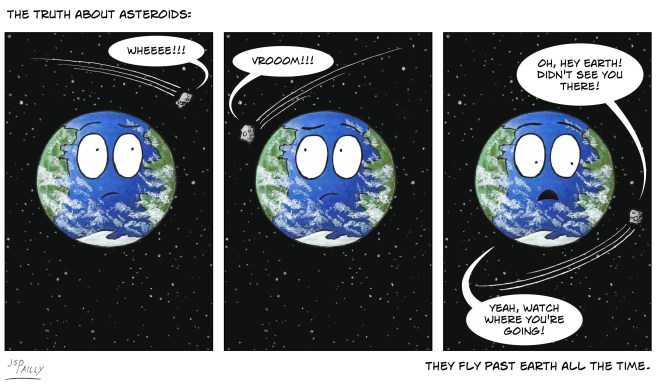
There’s actually a newsletter about asteroid flybys. It’s called Daily Minor Planet, and I have a subscription (it’s free). Every day in my inbox, I’m notified of the latest asteroid or other object skimming past Earth. Every day. Sometimes there are more than one per day.

Occasionally, one of these objects will pass within the radius of the Moon’s orbit. That’s not an everyday thing, but still… it happens more often than you might think.

So when people ask if I’ve heard about the latest asteroid flying past Earth, the only thing I can really say is, “Which one?” And if someone asks me if I’m worried, my answer is no. The asteroids that make headlines on the news and the asteroids that appear in Daily Minor Planet… those are asteroids we know about. It’s all the asteroids we don’t know about that scare the bejesus out of me.

Space Harpoons: They’re a Real Thing

If the future of space exploration requires an economic incentive, look no further than asteroid mining. All the rare and valuable minerals and metals contained in a single asteroid (except those lousy S-type asteroids) could be worth billions.

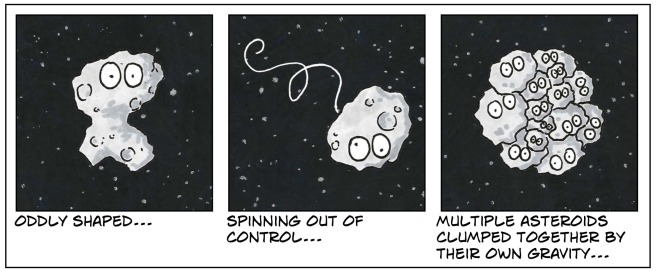
But catching an asteroid and landing on it for mining purposes… that’s much easier said than done. You see, no two asteroids are exactly alike, and they each present a host of challenges for asteroid hunters of the future.

Jn22 Crazy Asteroids

There are several ideas for how to catch an asteroid. You could throw a net around it, assuming the asteroid isn’t too big. Or you could latch on with magnets, assuming the asteroid has a high enough metal content.

But the most common idea that I’ve seen is the shoot the asteroid with a harpoon. It makes the whole endeavor feel oddly reminiscent of old timey whaling. You know, like in Moby Dick. Or Star Trek IV.

As I understand it, the harpoon has a cable attached, so once you’ve harpooned yourself an asteroid you can reel your spacecraft in to a secure landing. Or in the case of those wildly spinning asteroids, the asteroid will reel you in by wrapping the cable around itself (what could go wrong?).

So the next time you’re in space trying to grab billions of dollars worth of asteroid, remember to bring a harpoon. And a really strong cable.

P.S.: Also, if an asteroid somehow manages to bite off your leg, maybe it’s best to let it go. As Mission Commander Ahab will tell you, vendettas against whales and asteroids never lead to happy endings.

Sciency Words: Pixie

Sciency Words BIO copy

Today’s post is part of a special series here on Planet Pailly called Sciency Words. Each week, we take a closer look at an interesting science or science-related term to help us all expand our scientific vocabularies together. Today’s term is:

PIXIE

The Future

It is the year 2217. The mining vessel Belvedere approaches a large, rocky body in the outer Solar System. The object is dark in color, barely visible against the inky blackness of space. It has every appearance of being a carbonaceous asteroid, no doubt rich in volatiles. It may even contain that most precious of substances in space: water.

The crew of the Belvedere stand to make a substantial profit, but the science officer reports that she’s getting a lot of strange readings. The asteroid may not be what it seems. “I recommend keeping our distance,” she says.

The Present

“Pixies” are part of the whole commercialization of space thing that’s going on right now. They’re made by a company called Asteroid Initiatives LLC, and they’re intended for use in asteroid prospecting and, ultimately, asteroid mining.

Basically, pixies are a new kind of space probe. As you might guess from the name, they’re really small. They’re sometimes referred to as femto-spacecraft, though they’re not actually femto-scale (that would make them smaller than atoms).

In terms of size, they’re often compared to credit cards, cell phones, or TV remote controls. In other words, a pixie spacecraft could fit in the palm of your hand.

Pixies may be going on their first mission soon. They’re under consideration to be part of the AIDA mission to the asteroid Didymos and its moon, Didymoon. If approved, a swarm of forty pixies will either surround Didymoon or land on its surface.

Granted, pixies are too small to carry much sensor equipment, but there will be forty of them. That’s forty extra data feeds, forty extra points of view, forty extra perspectives on how Didymoon responds during AIDA’s impact experiments. That’s a lot of additional information without putting any expensive hardware at risk.

The Future

The captain of the Belvedere steeples his fingers. He can’t pass up the opportunity to mine such a large carbonaceous asteroid, but if his science officer is right… if there’s any danger….

On the view-screen, the large, rocky object drifts through space. The captain comes to a decision. There’s a way to get more data without putting the ship at risk.

The captain issues the order: “Release the pixies!”

Earth vs. Asteroids

My25 Earth vs Asteroids

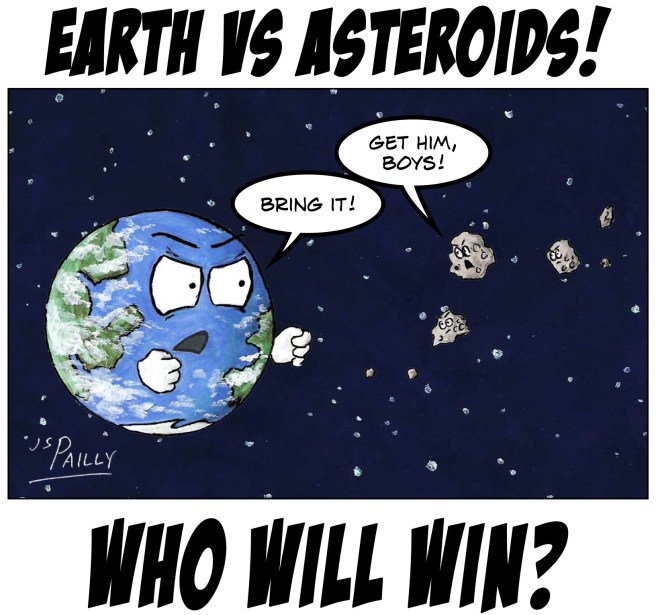
Is your planet safe? Nobody wants another Tunguska Event. Certainly we don’t want another K-T Event. So what are we doing to protect ourselves?

Thanks to grant money from NASA, the University of Hawaii has started setting up a series of telescopes specially designed to hunt for Near Earth Objects (N.E.O.s). These are objects, such as asteroids, with orbital paths that approach or cross Earth’s orbit.

The University of Hawaii’s new telescopes are collectively known as ATLAS (Asteroid Terrestrial-impact Last Alert System). Once fully operational, ATLAS promises to provide us with several weeks notice for large, incoming asteroids. For smaller, though still hazardous asteroids, ATLAS should give us at least a few hours warning.

So is our planet safe?

As more and more programs like ATLAS come online, we should get better coverage of the night sky and longer warning times for incoming objects. But there will still be a problem—a huge problem.

You see, you can’t really do astronomy during the day. That means asteroids coming at us from a sunward direction will go completely undetected. You may remember back in 2013 when a significantly-sized asteroid exploded over Russia, shattering windows and injuring over a thousand people. That asteroid came from a sunward direction.

No amount of ground-based telescopes could have detected that 2013 asteroid. But perhaps a space telescope, similar to the SOHO telescope we use to monitor solar flares, could help plug this gap in our planet’s defenses.

Sciency Words: The K-T Event

Sciency Words MATH

Today’s post is part of a special series here on Planet Pailly called Sciency Words. Each week, we take a closer look at an interesting science or science-related term to help us all expand our scientific vocabularies together. Today’s term is:

THE K-T EVENT

You already know this story. It was 65 million years ago. There were dinosaurs, there was an asteroid…

It’s easily the most famous asteroid impact in Earth’s history, and it’s called the K-T Event, or sometimes the K-Pg Event.

In geology shorthand, the letters stand for:

  • K: the Cretaceous period, which is spelled with a K in German. This was the last period of geological history in which dinosaurs roamed the Earth.
  • T: the Tertiary period, which immediately followed the Cretaceous. According to the International Commission on Stratigraphy (ICS), we’re not supposed to use this name anymore, but people still do. It’s sort of like how some people keep calling Pluto a planet, no matter what the International Astronomy Union (IAU) says.
  • Pg: the Paleogene period, which is the period immediately following the Cretaceous according to the ICS’s new list of geological periods. Please note, the Tertiary and Paleogene are not really interchangeable terms. They have the same starting point, but different end points.

Geologists and paleontologists puzzled for decades over a layer of clay separating Cretaceous and Tertiary (or Paleogene) rock. They called it the K-T boundary. There were several competing hypotheses about what might have caused this boundary and how it related to the mass extinction event that killed off the dinosaurs.

Then in 1980, a paper came out entitled “Extraterrestrial Cause for the Cretaceous-Tertiary Extinction.” This paper reported the discovery that the K-T boundary contained abnormally high levels of the element iridium.

Platinum group metals like iridium are extremely rare on Earth (except in the planet’s core) but common in asteroids. So whenever you find lots of iridium in Earth’s crust, you can justifiably assume an asteroid put it there.

The most likely scenario is that a large asteroid, about 10 km in diameter, smashed into Earth, flinging dust and debris high into Earth’s atmosphere. Enough to block out the sun worldwide for several years. This global dust cloud would have included plenty of material from the asteroid itself, which would have been partially vaporized by the heat of the impact.

A major problem with the original 1980 paper was that, at the time, no known impact crater of the appropriate age was sufficiently large. But of course, that was back in 1980. The crater has since been found in the Yucatan Peninsula, and now just about everybody knows the story of the K-T Event (even if they don’t know it’s called that).

P.S.: The K-T Event is not to be confused with the Katie Event. You know, that time your BFF Katie had waaaaay too much to drink and threw a temper tantrum of apocalyptic proportions.

Addendum: While there does seem to be general, widespread consensus that the K-T asteroid impact either caused the extinction of the dinosaurs or contributed significantly to their demise, there is not universal agreement. As Planetary Defense Commander notes in the comments, there are other possibilities worth considering.

Sciency Words: Didymoon

Sciency Words PHYS copy

Today’s post is part of a special series here on Planet Pailly called Sciency Words. Each week, we take a closer look at an interesting science or science-related term to help us all expand our scientific vocabularies together. Today’s term is:

DIDYMOON

Let it not be said that scientists don’t have a sense of humor. When they discovered that the asteroid 65803 Didymos has its own moon, they named that moon Didymoon.

My06 Didymoon 1

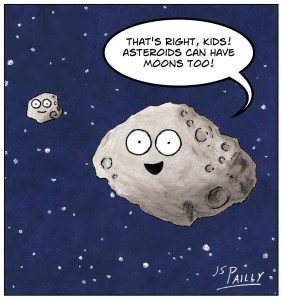
Yes, asteroids can have their own moons, but we knew that for many years before the discovery of Didymoon. The important thing you need to know is that we humans are planning to use Didymoon for target practice.

My06 Didymoon 2

Multiple space agencies around the world, including NASA, are collaborating on a mission called the Asteroid Impact and Deflection Assessment mission (AIDA). Didymos and Didymoon will pass near Earth in October of 2022. As they approach, AIDA will launch, and it will try to hit Didymoon really, really hard to see how much we can shift its orbit.

AIDA is a crucial test. Are we capable of changing the orbits of objects in space? Can we protect our planet from incoming asteroids and comets?

My06 Didymoon 3

Didymos and Didymoon are correct. They’re not like the asteroid from the K-T Event, which wiped out the dinosaurs, or the object from the Tunguska Event, which leveled an astonishing number of trees.

But if we can adjust Didymoon’s orbit around Didymos, we’ll be better prepared to adjust the trajectories of other asteroids that might be heading our way.

Sciency Words: The Tunguska Event

Sciency Words PHYS copy

Today’s post is part of a special series here on Planet Pailly called Sciency Words. Each week, we take a closer look at an interesting science or science-related term to help us all expand our scientific vocabularies together. Today’s term is:

THE TUNGUSKA EVENT

June 30, 1908, was a bad day to be a tree. At least, it was a bad day for a heck of a lot of trees in the middle of nowhere, Russia.

My03 Tunguska Event

Something—there’s debate over what exactly is was—fell from space that day. It didn’t make it to the ground. Instead, it exploded midair above the Tunguska River.

According to human eyewitnesses, who were many miles away, the sky appeared to be split in two by fire. They heard a series of loud booms. The ground shook, and there was a sudden and intensely hot burst of wind so strong it apparently knocked people off their feet.

According to tree eyewitnesses… actually, we can’t ask the trees what they saw. They died. About 2,000 square kilometers (almost 800 square miles) of forest were scorched and flattened.

Scientific debate continues over what caused the Tunguska Event. It could have been an asteroid; however, asteroid debris can usually be identified by the presence of certain rare metals, such as iridium and osmium. These metals have not been found in the Tunguska region, at least not in quantities that would be atypical for Earth.

Another possibility (which makes the most sense to me) is that is was a comet. Comets are composed of lighter, more volatile chemicals like water. So when the Tunguska comet exploded, it would have been completely vaporized, leaving no debris.

The absurdly huge asteroid that killed the dinosaurs gets a lot of attention in popular culture, but asteroids (and comets) don’t have to be mass-extinction-sized to cause considerable damage. If the Tunguska Event had been the New York Event, there would be no more New York. And if something that big fell over the ocean, the resulting tsunamis could obliterate hundreds of miles of nearby coastlines.

Much like the Carrington Event of 1859, the Tunguska Event serves as a warning. Space is dangerous. Space is deadly. Earth can’t protect us from everything.