Artsy Science: Newton’s Waste Book

Artsy ScienceToday’s post is part of a collection of posts on the artistic side of science.  Through both art and science, we humans try to make sense of the world around us, and the two fields have a lot more in common than you might expect.

* * *

It’s the 17th Century.  Paper costs a small fortune, and young Isaac Newton receives a valuable gift from his recently diseased stepfather: a notebook.  Only the first few pages have been used.  The rest are blank.  So what does young Isaac decide to do with this precious treasure?

The prudent choice would be to save it for something important.  Perhaps some groundbreaking discovery that would have changed the way we view the whole world.  Instead, the idiot named this notebook “the waste book” and wasted it on trivial nonsense.

Newton filled his waste book with information about art, music, alchemy, mathematics, theology, science, philosophy… pretty much anything.  The book’s contents were so random and disorderly that, following Newton’s death in 1727, the book was marked “not fit to be printed.”

But in that mess of scribbly handwriting, we can find the first hints of Newton’s genius and the profound discoveries he was about to make.  By not treating paper as something sacred, he allowed himself to play with new ideas.  Perhaps he named his notebook the waste book to remind himself that the pages were to be “wasted” even on thoughts that might at first seem silly.

Isaac Newton

So the next time you sit down with a blank piece of paper, waste it on some trivial nonsense.  You have no excuse not to.  Paper is a lot cheaper today than in Newton’s time.  And if you waste enough paper, maybe… just maybe… you’ll stumble upon an idea that will change the world.

P.S.: It may not be fit for printing, but the waste book is available to the public for free online.  Good luck reading Newton’s handwriting, though.

Sciency Words: Americium

Sciency Words PHYS copy

Today’s post is part of a special series here on Planet Pailly called Sciency Words. Every Friday, we take a look at a new and interesting scientific term to help us all expand our scientific vocabularies together. Today’s word is:

AMERICIUM

Several elements on the periodic table are named after countries: germanium for Germany, polonium for Poland, francium for France. The chemical element Yttrium is named after Ytterby, Sweeden, and I’m sure you can figure out what Californium was named after. Today, in honor of the 4th of July, let’s take a look at the chemical element named after America.

  • Americium was “discovered” in 1944. I put the word discovered in quotes because it’s one of those elements that was first created in a lab, not found in nature.
  • Americium is radioactive. The various isotopes of americium have half-lives between a hundred and several thousand years, so it’s stable enough that we can find practical uses for it.
  • The most common use of americium is in the household smoke detector. The vast majority of smoke detectors use americium, so you probably own a tiny sample of this stuff and never even knew it.
  • Americium has been proposed as a possible fuel for the next generation of nuclear powered spacecraft.
Don't celebrate the 4th of July without an americium powered smoke detector!
Don’t celebrate the 4th of July without an americium powered smoke detector!

For our purposes on this blog, americium’s potential use in spacecraft deserves our special attention. Americium has some special properties that make it ideally suited for use in space travel. Some (overly optimistic) projections suggest an americium-powered spaceship could fly from Earth to Mars in as little as two weeks!

The European Space Agency is reportedly moving forward with the development of americium-powered spacecraft. Ironically, I can’t find any information about its use in the American space program. I don’t know if americium will be a critical component of our Sci-Fi future, but it very well might be, depending on its success with the Europeans.

IWSG: Space Program

InsecureWritersSupportGroupToday’s post is part of the Insecure Writer’s Support Group, a blog hop hosted by Alex J. Cavanaugh.  It’s a way for insecure writers like myself give each other advice and encouragement.  Click here to see a full list of participating blogs.

For today’s IWSG, I want to revisit something I wrote over a year ago comparing the life of a writer to running the space program.  I have found the analogy to be increasingly apt the farther down the writer’s path I go.

* * *

By now, fellow writers, you must have realized how being a writer is similar to running the space program.  Oh, you didn’t?  Let me explain.

  • Much like NASA scientists, most writers have unrealistic concepts about money, making it impossible to write a budget or manage the financial side of the writing business.
  • Writers set deadlines that sound reasonable, provide plenty of time to check and double check our work, and ensure our story/spaceship is at peak performance, but somehow we always end up behind schedule.  Maybe it’s due to the weather, maybe it’s due to technological snafus, or maybe it’s because we spend too much time “working” on Angry Birds: Space and lose track of the other stuff we’re supposed to be doing.
  • Just as getting accurate data about the hydrocarbon content of Martian soil may not sound exciting to the general public, some people may noRockett realize how important one book sale, one new contact, one re-tweet, or one positive review on Amazon can be.  Sure, it’s not the same as landing on the Moon, but every small achievement gets us just a little tiny bit closer to our ultimate goal, and those small achievement are always worth celebrating.


  • There will always be someone who thinks this (the space program or the life of a writer) is a waste of time and money.  Those people are frustrating, but we have to try to ignore them.  If they don’t understand the value of such bold and ambitious endeavors, they probably never will.

So whatever kind of writing you may be doing or whatever dreams you may have, remember to keep shooting for the stars.

Breathe Easier: There’s Less Nitrogen Dioxide in the Air

Whenever we hear news about the environment, it’s usually bad news. Levels of such and such pollutant continue to rise. We have only X years before the damage becomes irreversible. All the cute and cuddly animals are going extinct. I think one of the reasons people don’t seem to care about the environment is that we, as individuals, feel helpless, but finally new reports show we’ve made some progress.

Image courtesy of NASA Goddard's Scientific Visualization Studio
Image courtesy of NASA.

Images from NASA’s Aura satellite reveal that the levels of nitrogen dioxide (NO2) in our atmosphere have declined by 50% or more across the continental U.S. Even major urban areas like New York City show definite improvement. Nitrogen dioxide is one of six common air contaminants monitored by the E.P.A.

Image courtesy of Greenhorn1 and Wikipeida.
Image courtesy of Greenhorn1 and Wikipedia.

When concentrated in smog form, nitrogen dioxide appears as a reddish or yellowish gas (according to Wikipedia, the color depends on the temperature). It has an acrid smell, and when inhaled it basically f***s up your lungs, though the effects are not immediately felt. It comes from car emissions, power plants, and other sources.

Yes, we as individuals can and do make a difference.

I’ll be happy to breathe 50% less of this stuff. And part of the credit goes to everyone who decided to walk to the store rather than drive, or rode a bike to work, or took advantage of public transportation. If we all keep doing stuff like that, maybe we’ll start seeing more good news about the environment.

Sciency Words: 3Doodler

Sciency Words MATH

Today’s post is part of a special series here on Planet Pailly called Sciency Words. Every Friday, we take a look at a new and interesting scientific term to help us all expand our scientific vocabularies together. Today’s word is:

3DOODLER

Because drawing in only two dimensions is so 20th Century…

I have tried to think of a clear and intelligible way to explain what this thing does. How do you explain drawing in 3D? Like… drawing in actual 3D, without paper… Just watch the video. It’ll make more sense that way.

I don’t know if this is a toy or a serious tool for artists. According to the manufacturer’s website, the 3Doodler has already attracted the attention of the Museum of Modern Art, and it even had its own special window display at the MoMA Design Store.

So is this a fad or will 3Doodlers become a necessity for all serious artists? I’m not sure. All I know is I’m adding it to my Christmas list.

Artsy Science: Einstein and the Secret of the Imagination

Artsy ScienceToday’s post is the first in a collection of posts on the artistic side of science.  Through both art and science, we humans try to make sense of the world around us, and the two fields have a lot more in common than you might expect.

* * *

For this initial post in Artsy Science, I want to share some quotes from one of the 20th Century’s most famous musicians: Albert Einstein.  You may not have known that Einstein was a dedicated violinist.  He never traveled anywhere without his most beloved instrument.  He also played the piano, and there are many apocryphal stories about him solving complex mathematical puzzles while practicing his music.  To Einstein, art and science were merely two separate branches of the same tree.

Here is what Einstein had to say about art and science:

  • Music does not influence research work, but both are nourished by the same sort of longing, and they complement each other in the release they offer.
  • I am enough of an artist to draw freely upon my imagination. Imagination is more important than knowledge. Knowledge is limited. Imagination encircles the world.
  • The most beautiful experience we can experience is the mysterious. It is the source of all true art and science.

Most of Einstein’s discoveries were not made in a lab but in his own mind.  After reading about vexing mysteries uncovered by other scientists, Einstein would sit back and try to picture these mysterious phenomena from new perspectives, and then later attempt to describe in scientific terms what he had imagined.  Einstein called these “thought experiments.”

In an age when our society has become rigidly fact oriented, often intolerant of daydreamers, free spirits, and other such time wasters, we should remember Albert Einstein’s work and what it reveals about the power of the human imagination.  And maybe we should all take a few moments to pause, close our eyes, and engage in a few “thought experiments” of our own.

P.S.: If your thought experiments lead you to any important discoveries, please share them in the comments below!

Contaminating Mars

The story I’m about to tell is a work of fiction, but it could very well happen in reality one day.  If it did, it could cause an enormous scandal in the scientific community, ruin what remains of NASA’s reputation, and end the careers of anyone directly involved.

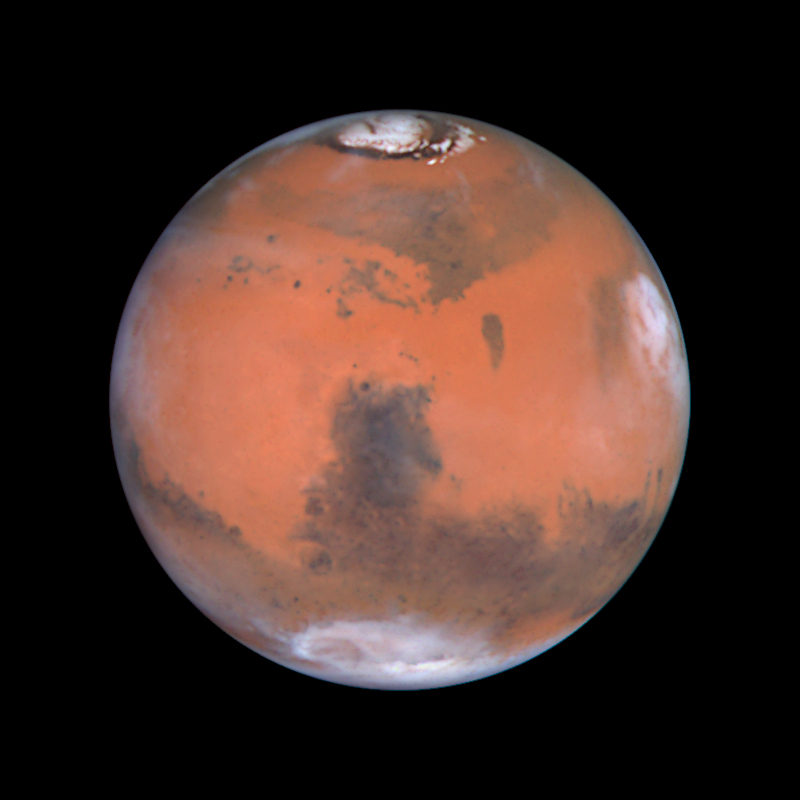
Mars

The year is 2020.  NASA’s latest Mars rover, Intrepid, has landed successfully and wheeled around a bit, proving that all its systems are functioning.  Intrepid’s predecessor, the Curiosity rover, found evidence in 2013 that life could exist on Mars, but Curiosity wasn’t equipped to test if any life forms do exist there.  Intrepid’s mission is to follow up on Curiosity’s work.

NASA engineers have equipped Intrepid with state-of-the-art biochemical research equipment.  They gave it new technology that wasn’t available when Curiosity was launched, as well as delicate, new digging tools for collecting soil samples.  Scientist carefully selected Intrepid’s landing site, putting it near what they believe is subsurface liquid water melting from one of Mars’s polar ice caps.

Intrepid begins its work, and the very first test comes back positive.  There’s bacterial life on Mars!  Scientists around the world celebrate.  The media goes crazy, and the old theory that life on Earth began on Mars is revived once again when someone notices similarities between the DNA of the Martian microbes and that of life on Earth.  In fact, the Martian bacteria seem to have a lot in common with E. coli.

But the next test shows fewer bacteria.  The one after that shows fewer still, and soon no bacteria can be found at all.  It seems the “Martian” bacteria aren’t capable of surviving on Mars.  Soon, the truth comes out.  One of those delicate digging tools was opened before it left, meaning it may have been contaminated.  Previous studies have already shown that E. coli might be able to survive in space if shielded from ultraviolet radiation.

End of story.

Currently, the United States is part of an international agreement called the Outer Space Treaty, which stipulates that any probe we send to another planet must be thoroughly decontaminated.  NASA even has a Planetary Protection Officer, Dr. Catherine Conley, in charge of making sure that we don’t introduce invasive species to alien worlds.  The point of all this is not only to protect alien ecosystems (if they exist) but to ensure that if we do discover life on another planet, we’ll know for certain that its genuine alien life and not something that stowed away on our own space vehicles.

And yet despite the Outer Space Treaty, despite NASA’s own rules and Dr. Conley’s best efforts, one of Curiosity’s digging apparatuses was opened and potentially contaminated before it left Earth in 2011.  Could any bacteria have survived the long journey to Mars?  We don’t know.  It’s possible.  So far it doesn’t seem like any harm was done, but this could be a costly mistake if it ever happens again.

Sciency Words: Carbon Sink

Today’s post is part of a special series here on Planet Pailly called Sciency Words. Every Friday, we take a look at a new and interesting scientific term to help us all expand our scientific vocabularies together. Today’s word is:

CARBON SINK

Today’s Sciency Word comes to us courtesy of Sci Show, one of my favorite sources for sciency news and general science knowledge.

A carbon sink is a region of the Earth, like the rainforest, that absorbs some of those harmful carbon emissions we keep pumping into the atmosphere. As Hank Green says in the video, it’s like the Earth is trying to save us from ourselves. Thank goodness we are sparing the rainforests from our wanton destruction of the environment… oh, wait.

What Do the Aliens Think?

I often worry about what aliens will think when they see our television broadcasts. By now, Howdy Doody has reached Aldebaran, Gilligan’s Island has reached Eta Leporis, and the residents of Alpha Centauri have had the opportunity to watch several seasons of Dancing with the Stars.

But sooner or later, our extra terrestrial neighbors will see this:

When that days comes, I expect the aliens will wonder if we Earthlings aren’t so different from them after all.

P.S.: Yes, this is an actual children’s television program. No, I don’t know why.

Sciency Words: Turing Test

Sciency Words Logo

Today’s post is part of a special series here on Planet Pailly called Sciency Words. Every Friday, we take a look at a new and interesting scientific term to help us all expand our scientific vocabularies together. Today’s word is:

THE TURING TEST

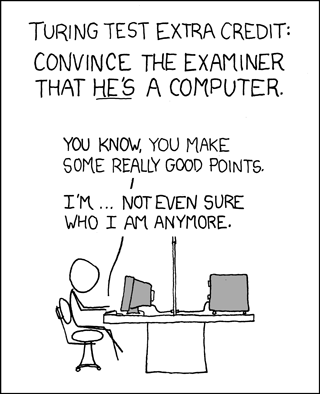
Let’s set aside the usual Sci-Fi tropes about robots becoming self-aware, intelligent, and possibly possessing souls. Let’s also set aside our fears of robot rebellions. That’s not what the Turing test is about. The Turing test asks a simple question: can a machine or computer program fool people into believing it’s human? According to recent reports, a program named “Eugene” has finally passed this test.

Admittedly, the bar is set fairly low. To pass the Turning test, a computer only has to fool 30% of the people it talks to. Eugene managed to pull it off (barely) by pretending to be a 13-year-old boy from Ukraine while chatting online with people in England. This means that any mistakes or inconsistencies might have been perceived as the result of communicating with a child and/or non-native English speaker.

Now that one computer program has passed the Turing test, more will surely follow. The programmers behind Eugene say they’ll keep working, trying to find ways to make their creation even smarter. As a lifelong Sci-Fi nerd, I can’t help but find this ominous, but something like Commander Data or the Terminator remains a distant fantasy. In real life, we can expect programs like Eugene to improve things like our automated customer service experience. We can also expect more effective online scams.

Image courtesy of xkcd.