Sciency Words: SOHO

Sciency Words BIO copy

Today’s post is part of a special series here on Planet Pailly called Sciency Words. Every Friday, we take a look at a new and interesting scientific term to help us all expand our scientific vocabularies together. Today’s word is:

SOHO

If you want to do any serious research about the Sun, you will soon come across this name: SOHO, short for the Solar and Heliospheric Observatory. It is a project of international cooperation between NASA and ESA (the European Space Agency). The Europeans built it, NASA launched it into space and is now responsible for operating and maintaining it.

SOHO is positioned between the Sun and Earth, and its mission is to monitor and study solar activity. Launched in December of 1995, SOHO was only supposed to be in operation for about two years, yet despite several malfunctions, the thing is still running nearly two decades later.

Much of what we currently know about the Sun is thanks to SOHO (which is why the name came up so often in my research).

  • SOHO observes activity on the Sun’s surface (like Moreton waves), and it has provided us with the first ever images of what’s going on beneath the surface.
  • SOHO is part of our early warning system, helping protect our technologically advanced civilization in case something like the Carrington Event ever happens again.
  • SOHO samples solar ejecta, allowing us to find out what exactly the Sun is spewing into space.
  • Remember that weird thing about the Sun’s temperature? SOHO is helping investigate that too.
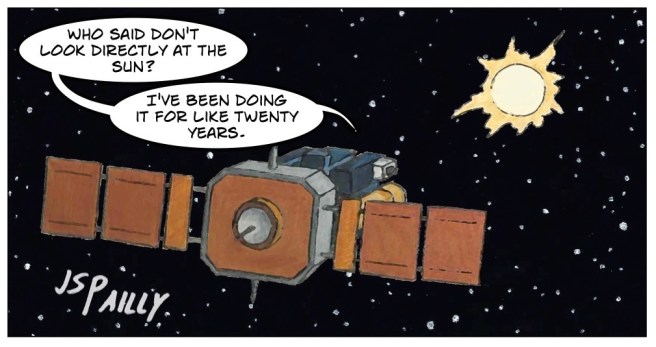
Ja12 SOHOSo as we end our month-long adventures with the Sun, let’s give a big round of applause to the SOHO spacecraft, one of the hardest working spacecraft in the Solar System, and let’s hope that it will miraculously keep working for many years to come.

Starting Monday and continuing throughout the month of February, we will turn our attention to the Planet Mercury.

The Corona Mystery

The Sun. It’s right there in the middle of the Solar System. We’ve got spacecraft monitoring it 24 hours a day. You’d think we know just about everything there is to know about it, but the Sun harbors a great scientific mystery.

Before we go into that, let’s define some key terms.

  • The photosphere: the surface layer of the Sun.
  • The convective zone: the layer directly beneath the photosphere.
  • The corona: the Sun’s “atmosphere,” located above the photosphere.

As heat radiates out from the Sun’s core, the temperature gradually decreases. In the convective zone, it’s several million degrees Celsius. In the photosphere, the temperature drops to merely a few thousand degrees Celsius.

That makes sense. As we get farther away from the source of all that heat, we’d expect the temperature to cool off a bit. So the corona should be cooler still, right?

Wrong. The temperature rapidly increases from a few thousand degrees to tens of thousands of degrees, and then peaks back in the range of several million degrees Celsius.

Ja08 Hottest Hot Hotter

Why? I don’t know why. Nobody knows why, though it may have something to do with the Sun’s magnetic field. More recent research suggests “nanoflares” might have something to do with it.

But the truth is we do not know the reason for this temperature discrepancy. It is (at least for now) a scientific mystery.

Sources

The Sun’s Corona from NASA’s Imagine the Universe.

Explain the Coronal Heating Mystery from the Stanford Solar Center.

Layers of the Sun from The Sun Today.

Sun’s Magnetic Secret Revealed from Space.com.

Tiny “Nanoflares” May Solve Sun Mystery from Space.com.

Twinkle, Twinkle, Little Dark Matter Particles

Atoms have unique fingerprints called absorption and emission spectrums. We touched on this in last week’s post entitled “What Color is the Sun?” Pictured below are rough approximations of the absorption and emission spectrums of hydrogen atoms.

All the colors of the rainbow, except a few are missing.  This is an absorption spectrum.
All the colors of the rainbow, except a few are missing. This is an absorption spectrum.
No rainbow, just a few specific colors.  This is an emission spectrum.
No rainbow, just a few specific colors. This is an emission spectrum.

But atoms, or at least atoms as we know them, only make up a tiny percentage of the physical universe. The rest is composed of dark matter, an invisible yet ubiquitous substance that has puzzled scientists for decades.

We’re aware of dark matter mainly due to its gravitational effects, but also because of its incessantly childish taunting.

Now, astronomers in Switzerland and the Netherlands report that they have detected x-ray flashes in regions of space where large masses of dark matter are predicted to exist. X-ray flashes that look an awful lot like an emission spectrum but do not match the spectrum of any known atom or any other known physical phenomenon.

I know what you’re thinking: holy @$&%, we just found dark matter! But we’re talking about science, which means we have to wear our skeptical hats. Hold off any parties or celebratory gunfire until these observations are confirmed by other researchers and scientists have ruled out alternative explanations for these emission lines. We don’t want to repeat the mistakes we made after BICEP2’s “discovery” of gravity waves.

But still… holy @$&%, we may have found dark matter!

Sources

X-Ray Signal from Andromeda, Other Galaxies Could Be Evidence of Dark Matter from Sci-News.com.

New Signal May Be Evidence of Dark Matter, Researchers Say from Universe Today.

Sun Surfing (Sciency Words: Moreton Waves)

Ja09 Sun Surfing

Okay, so the Sun can’t really go surfing, but maybe you could go surfing on the Sun.

Ja09 Surfing on the Sun

Okay, so you can’t really go surfing on the Sun, but if you could, the Sun’s got some pretty sick waves. It’s time for this week’s edition of Sciency Words, where we take a look at a new and interesting scientific term to help us all expand our scientific vocabularies together. Today’s term is:

MORETON WAVES

Sometimes, a solar flare will be so powerful, so intense, that it will cause the surface of the Sun to ripple. Sometimes it will throw up enormous tidal waves of scalding hot plasma. These waves are called Moreton waves, named after Gail Moreton, the astronomer who first discovered them.

In 2009, NASA astronomers observed a Moreton wave (or “solar tsunami,” as they called it) that was 60,000 miles high (100,000 km) traveling at a speed of 150 miles per second (250 km/s). That observation ended any doubts scientists had about the existence of these waves.

So in conclusion, do not go surfing on the Sun.

What Color is the Sun?

Ja11 Andy Warhol Sun

As much as I’d like to give you a straightforward answer to this question, I can’t. I can’t just say the Sun is yellow or white or purple. To really understand the color of the Sun, we need to talk about absorption and emission spectra.

Light from the Photosphere

Atoms absorb light. To be more accurate, different kinds of atoms absorb specific wavelengths of light, letting all the other wavelengths continue on their merry way. The result is what we call an absorption spectrum.

All the colors of the rainbow, except a few are missing.  This is an absorption spectrum.
All the colors of the rainbow, except a few are missing. This is an absorption spectrum.

The light we see coming from the Sun’s surface (a.k.a. the photosphere) has an absorption spectrum. The overall appearance is white or, according to some experts, a slightly greenish white.

But there’s more to the Sun’s color than just the photosphere.

Light from the Chromosphere

Sometimes, when an atom receives energy, it emits light. To be more accurate, different kinds of atoms emit light in specific wavelengths. We call this an emission spectrum.

No rainbow, just a few specific colors.  This is an emission spectrum.
No rainbow, just a few specific colors. This is an emission spectrum.

The glowing plasma that surrounds the Sun is called the chromosphere. The chromosphere appears to be a red or pink color, due mainly to light emitted by hydrogen atoms.

The light of the chromosphere is not nearly as intense as the light from the photosphere, but that doesn’t mean the chromosphere doesn’t contribute to the Sun’s overall color—whatever that color is.

There’s one more factor that influences the Sun’s color, at least as far as our Earthly perception is concerned.

Earth’s Atmosphere

Earth’s atmosphere tends to scatter blue light (which is why the sky is blue). So we see the Sun as a yellow-orange color because most of the blue light has scattered away, while reds, oranges, and yellows follow a more or less direct path straight from the Sun to your eye.

The Color of the Sun

So what color is the Sun? It’s every color, or rather it’s every color except a few that were absorbed in the photosphere, plus a touch of reddish pink from the chromosphere, minus a whole lot of blue if you’re observing the Sun from Earth.

Sources

Lecture 9: The Sun’s Photosphere and Chromosphere from Dmitri Pogosian at the University of Alberta.

Spectra and What Scientists Can Learn from Them from NASA’s “Imagine the Universe.”

Photosphere from Wikipedia

Chromosphere from Wikipedia

What Color is the Sun? from Fraser Cain, publisher of Universe Today (YouTube video).

What Color is the Sun? from the Stanford Solar Center.

Stare Directly at the Sun

On Friday, we talked about the Carrington Event. A massive solar storm triggered a geomagnetic storm that wrecked the technological infrastructure of the time. Fortunately, this happened in 1859, and the infrastructure that was wrecked were telegraph wires and related equipment.

But what if something like the Carrington Event happened today? Several mini-Carringtons have caused blackouts, the most notable happening in Quebec in 1989, and in 2012 a frighteningly large solar storm just barely missed us. Even minor solar flare activity can wreak havoc on our modern technology.

The good news is that the National Oceanic and Atomospheric Administration (N.O.A.A.) has a Space Weather Prediction Center, located in Boulder, Colorado. Their job: to stare directly at the Sun (using satellites, space probes, and special telescopes). With sufficient warning from the N.O.A.A., we can protect our technologically advanced civilization from the Sun’s temper tantrums.

Ja07 Watching the Sun

Thanks to the N.O.A.A., the power stays on, airplanes can navigate safely, and our satellites don’t get fried. In fact, the N.O.A.A.’s Space Weather Prediction Center is so good at what it does that most of us don’t even notice when a solar storm hits, unless it’s to check out the auroras.

P.S.: I said we can protect our technology, and we can; but we haven’t seen anything like the Carrington Event hit Earth since 1859. No one’s entirely sure how well prepared we are for something like that.

Sources

Education and Outreach Videos from the Space Weather Prediction Center.

S.W.P.C. Frequently Asked Questions from the Space Weather Prediction Center.

The Sun’s Wrath: Worst Solar Storms in History from Space.com.

Near Miss: The Solar Superstorm of July 2012 from NASA Science.

Sciency Words: The Carrington Event

Sciency Words PHYS copy

Today’s post is part of a special series here on Planet Pailly called Sciency Words. Every Friday, we take a look at a new and interesting scientific term to help us all expand our scientific vocabularies together. Today’s word is:

THE CARRINGTON EVENT

In 1859, British astronomer Richard Carrington was studying the Sun when he observed two bright flashes of light. This turned out to be a major solar storm. As luck would have it, the brunt of the storm was aimed directly at Earth.

Here’s the good news: the world didn’t end.

The bad news is that when the massive cloud of solar ejecta hit Earth, it triggered what’s called a geomagnetic storm, the worst geomagnetic storm on record.

Solar storms like the Carrington Event, pictured above, don’t hit Earth directly.  Instead, they mess with Earth’s magnetic field, which in turn messes with our technology.
Solar storms like the Carrington Event, pictured above, don’t hit Earth directly. Instead, they mess with Earth’s magnetic field, which in turn messes with our technology.

Telegraph wires picked up and transmitted energy from the geomagnetic storm, causing mayhem for telegraph operators around the globe. Operators received nasty electric shocks. Their equipment melted and/or emitted sparks. In some cases, those sparks ignited fires.

The global economy (such as it was in 1859) was disrupted, as were news services and personal correspondences, but things soon returned to normal. As I said, the Carrington Event was not the end of the world.

But imagine if such a thing happened today, with all our phone lines, Internet connections, power grids, airplanes, and satellites? What would happen to our computers, televisions, and microwave ovens? Fortunately for us, the National Oceanic and Atmospheric Administration is on top of this issue, and their Space Weather Prediction Center will be the subject of Monday’s post.

P.S.: If you love learning new words as much as I do, please check out Michelle Joelle’s blog Stories and Soliloquies.  Today (assuming I got the date right), she’s launching a new series called the Philosopher’s Lexicon, so now we can all expand our philosophical vocabularies together!

Sources

The 1859 Carrington Event from Tempo.

Monster Radiation Burst from the Sun from BBC News.

The Solar Storm of 1859 from Wikipedia.


Artsy Science: Darwin’s Photographs

Artsy ScienceToday’s post is part of a collection of posts on the artistic side of science. Through both art and science, we humans try to make sense of the world around us, and the two fields have a lot more in common than you might expect.

* * *

After coming up with the theory of evolution, Charles Darwin turned his mind toward another pressing topic of research: why do we blush? Why do we shrug? Why do we laugh or cry or tremble in fear? Why do we express emotions in the ways that we do, and do our animal cousins share any of these behaviors?

In 1872, Darwin published The Expression of Emotions in Man and Animals. As part of his research, Darwin took advantage of a relatively new art form: photography. He also included photographs in his book to demonstrate key concepts. Science and photography have been together ever since.

Caption: Photos from Darwin’s book (public domain, published before 1923).

Using photography for scientific purposes was a revolutionary idea. A camera can capture a split-second moment in time, freezing all the details that happen too quickly for the human eye to observe. This would have helped Darwin identify which facial muscles make you laugh or grimace or furrow your brow. (I mean, seriously… photography had been around for decades. Why didn’t anyone think of this before?)

Of course, there’s a reason you’ve probably never heard of this book before. Apparently Darwin’s theories on emotions didn’t hold up as well as that other theory he’s famous for. As for whether or not Darwin was right to conclude that certain animals do in fact express human-like emotions, I think the answer is obvious to anyone who’s ever owned a pet.

Sources

How Darwin’s Photos of Human Emotions Changed Visual Culture from Brain Pickings.

Darwin in the World of Emotions from the Journal of the Royal Society of Medicine.

Darwin’s “Expression of Emotions in Man and Animals” – A book review from 1873, posted online by The Alfred Wallace Russell Page.

Sunlight Can Kill You!

We all know the Sun produces U.V. rays and that if you spend too much time sunbathing, you’ll probably get skin cancer. Well, the Sun spews a lot of other stuff into space too. Ultraviolet radiation may be the least of your worries if you happen to live in space.

In addition to U.V. rays, the Sun also produces:

  • X-rays: sort of like U.V. rays, only with more energy and, therefore, more harmful.
  • Gamma rays: even more energetic and harmful than X-rays.
  • Solar ejecta: solar flares and other nasty explosions on the Sun can accelerate protons, electrons, and other little bits and pieces of atoms to ludicrous speeds. Do not stand in their way!

Fortunately, Earth’s atmosphere and magnetic field protect us from most of the Sun’s deadly radiation. Even the crew of the International Space Station are in a low enough orbit that Earth still keeps them safe. Well, safe-ish.

But all this radiation makes human space exploration beyond low Earth orbit extremely hazardous. Before sending astronauts to the Moon, NASA had to wrestle with their collective conscience over how much radiation exposure should be considered acceptable. Now, NASA is wrestling with its conscience again as it plans to send astronauts to Mars.

Current technology cannot protect humans from solar radiation. The problem gets worse with increased solar flare activity. One of the things science fiction writers (like myself) have to figure out is how to keep our characters from dying of radiation sickness within the first few chapters of our books.

P.S.: Starlight can kill you too. In addition to solar radiation, astronauts have to worry about cosmic radiation: radiation from other stars, quasars, and God knows what else.

Sciency Words: Ejecta

Sciency Words MATH

Today’s post is part of a special series here on Planet Pailly called Sciency Words. Every Friday, we take a look at a new and interesting scientific term to help us all expand our scientific vocabularies together. Today’s word is:

EJECTA

This is the fancy, technical term for stuff that gets thrown around whenever violent things happen. For example:

  • All the stuff that spews out of volcanoes… that’s ejecta.
  • When a meteor hits, the debris that gets thrown into the air is ejecta.
  • Whenever I get writer’s block, all the crumpled papers strewn around my office are ejecta.

Ja03 Ejecta

Since we’ll be spending most of January talking about the Sun, I figured this is a term we should all know. The Sun gets pretty violent and produces lots of solar ejecta, which is bad news for anyone who lives in space (it’s not exactly good news if you live on Earth either).