Planet Nine from Outer Space

Dang it, I thought I was finished exploring the Solar System. Now there’s another planet!?! Are we sure this isn’t yet another false alarm over Planet X?

To escape the hype over this alleged ninth planet, I decided to find the original source for this story, a paper entitled “Evidence for a Distant Giant Planet in the Solar System.” It was published on January 20, 2016, in The Astronomical Journal (click here).

First off, this paper does not announce the discovery of a new planet. Instead, it examines a peculiar trend astronomers have noticed in a region of the Solar System called the scattered disk (a region which partially overlaps the Kuiper belt). This odd trend is offered as circumstantial evidence that an extra planet might exist.

For the purposes of today’s post, I’ve named this hypothetical planet “Neo-Pluto.”

If Neo-Pluto is Real…

Billions of years ago, as the Sun shed its first rays of sunlight, a certain number of planets coalesced from the protoplanetary disk. That number was greater than eight. It was also greater than nine. A lot greater.

Like unruly children, these early planets jostled around in their orbits, pushing and pulling each other with their gravity, and sometimes colliding. One such collision led to the formation of Earth’s moon. Another probably knocked Venus into its retrograde rotation, and another may have tipped Uranus sideways.

Jupiter likely formed at the outermost edge of the protoplanetary disk, but it didn’t stay there. As this giant planet migrated inward, it wreaked havoc on the young Solar System. Smaller objects that wandered too close were either gobbled up, adding to Jupiter’s already considerable mass, or they were hurled out of the Solar System by Jupiter’s colossal gravity.

Neo-Pluto was one of those unlucky objects to be ejected from its original orbit, but it was not sent into total exile. It managed to stay within the gravitational influence of the Sun, and today it lingers in the cold depths of space, brooding over its fate.

Ja09 Neo-Pluto

But Neo-Pluto isn’t exactly a lightweight either. At approximately ten Earth masses, it has considerable gravity of its own, and the effects of that gravity have been noticed in the scattered disk.

Scattered disk objects (SDOs) are… well… scattered. They have highly eccentric (non-circular) and highly inclined (tilted) orbits; however, many known SDOs have almost the same perihelion (point of closest approach to the Sun). That can’t be a coincidence. It seems that just as Jupiter perturbs the orbits of asteroids in the asteroid belt, Neo-Pluto has pushed scattered disk objects into certain orbital trajectories, causing their perihelia to cluster.

Or so it seems. This all assumes that Neo-Pluto exists.

If Neo-Pluto Is NOT Real…

The authors of this “Distant Giant Planet” paper use a hypothetical planet to explain what’s happening in the scattered disk, and they clearly prefer that explanation, but they do acknowledge other possibilities.

  • Instead of one large planet, there could be a great many smaller planets and/or dwarf planets affecting the scattered disk.
  • A passing star might have disrupted the scattered disk long ago.
  • Observational bias may be at work, meaning that SDOs with a specific perihelion might be easier to see from out vantage point here on Earth. It’s unclear why that might happen, but a more thorough survey of the scattered disk could reveal a more random distribution of perihelia.

The best way to prove that Neo-Pluto exists is to find it. Alternatively, we could continue studying the scattered disk to see if this perihelion-clustering trend continues.

Until then, all we can say for certain is that the Solar System has at least eight planets.

P.S.: In part because of this latest new planet “discovery” as well as other rumored “discoveries” in recent months, today Sci-Fi Ideas is reposting my Sciency Words article on “Planet X.” Click here to check that out.
Molecular Monday: Putting the Amino in Amino Acid

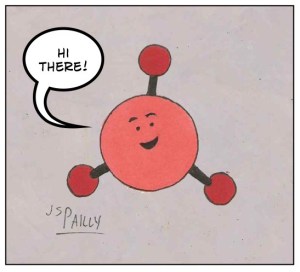
So I wanted to start talking about amino acids today. But let’s face facts: amino acids are complicated. They’re also hard to draw. So instead, let’s talk about ammonia. Here’s a drawing of an ammonia molecule:

Ja08 Ammonia

It’s just one nitrogen atom with three hydrogen atoms attached. Nice. Friendly. Easy to draw.

Let’s make it even easier! Let’s take away one of those hydrogen atoms.

Ja08 Primary Amine

This is no longer an ammonia molecule. Instead, chemists call this an amine. With that hydrogen out of the way, this amine is free to bond with something else. Perhaps something more interesting than an ordinary hydrogen atom.

How about we take away another hydrogen atom?

Ja08 Secondary Amine

This is called a secondary amine (the amine from before was a primary amine). It can bond with two other chemicals, allowing for the construction of some sort of weird, complicated super molecule.

Okay, let’s take away the third hydrogen…

Ja08 Tertiary Amine

… and now we have a tertiary amine (also known as a nitrogen atom). I bet we could build some really wacky (and useful) large molecules out of this.

By now, you can probably guess why I’m writing about these amines for my first post on amino acids. It’s because amines give amino acids their name (or at least the first part of their name). Primary, secondary, and tertiary amines are key structural components in all amino acids.

In the next edition of Molecular Mondays, we’ll talk about the other key structural component of amino acids: the acid part.

* * *

Today’s post is part of a special series here on Planet Pailly called Molecular Mondays. Every other Monday, I struggle valiantly to understand and explain some concept in the field of chemistry. Please note: I suck at chemistry, but I’m trying to learn. If I made a mistake, please, please, please let me know so I can get better.

Sciency Words: Planetary Protection

Sciency Words PHYS copy

Today’s post is part of a special series here on Planet Pailly called Sciency Words. Each week, we take a closer look at an interesting science or science-related term to help us all expand our scientific vocabularies together. Today’s word is:

PLANETARY PROTECTION

I swear this isn’t science fiction. The Office of Planetary Protection is a real department at NASA which follows the guidelines set by COSPAR, an international council with jurisdiction over the safe and responsible exploration of space.

The three core tenets of planetary protection are:

  • Don’t contaminate other worlds (we don’t want to harm alien life, if it exists).
  • Seriously, don’t contaminate other worlds (it would suck if the “alien life” we discover on Mars turns out to be E. coli).
  • While you’re at it, don’t contaminate Earth either (have you seen the Andromeda Strain?).

Under COSPAR rules, different mission categories require different levels of planetary protection. Categories I, II, and III require only minimal precautions. Nobody cares if we contaminate Venus. Nothing lives on Venus (probably). Category VI covers missions on the surfaces of worlds that could theoretically support life, and category V is for sample return missions that could theoretically bring alien organisms back to Earth.

Until recently, planetary protection has been a fairly esoteric concern. But now we know there’s water on Mars, and scientists really, really want to get a closer look at that!

Ja07 Curiosity on Mars 1

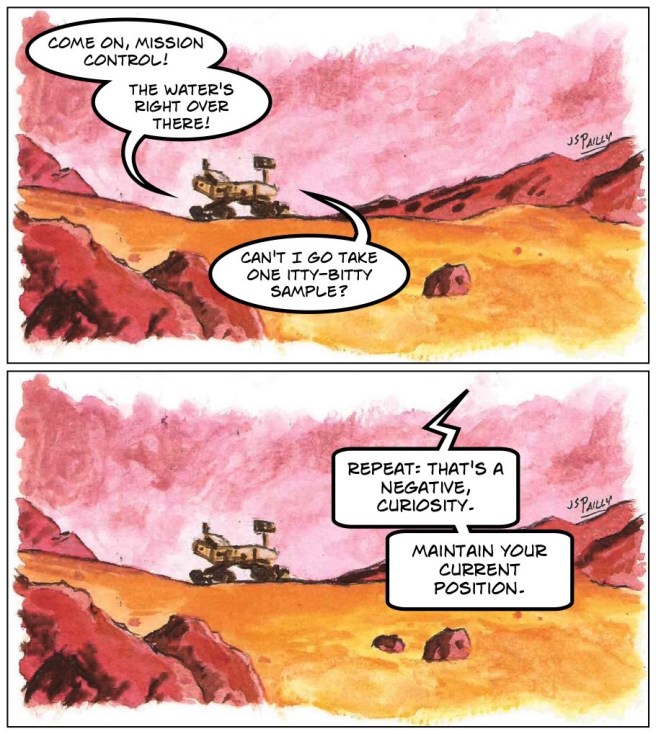
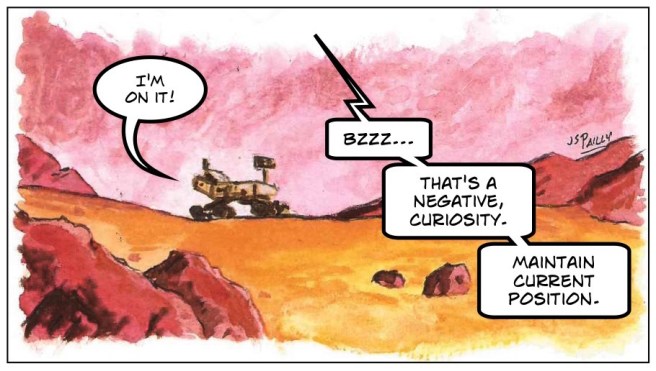
The Curiosity rover is currently located near a potential recurring slope line (RSL) site, meaning it’s only a few kilometers from what appears to be actively flowing water. But NASA won’t allow Curiosity to investigate.

First off, I should mention there is a logistical concern. Remember the slope part of recurring slope linea. The slope may be too steep for Curiosity to climb.

But the bigger issue is planetary protection (I mean, we could let Curiosity at least try to climb that hill). Under current planetary protection rules, the exploration of an RSL zone is a category IV mission. Specifically, it’s a category IVc. Curiosity is only rated for category IVb, because at the time of launch no one knew there was water on the surface of Mars. So there is a chance—a remote chance, but a chance nonetheless—that it is carrying live bacteria from Earth.

In my opinion, Curiosity should be allowed to investigate the RSL site anyway. It would be a miracle if any microorganism from Earth could survive on Mars. There’s too much radiation, and the water is brimming with toxic perchlorate salts. And the idea that organisms from cushy, comfortable Earth might outcompete native Martian life forms—life forms that are perfectly adapted to the harsh environment found on Mars—sounds 100% preposterous to me.

Ja07 Curiosity on Mars 2

At the same time, I know any evidence of life Curiosity might find would be justifiably suspect. We could never rule out the possibility of a contaminated sample.

So what do you think? Should Curiosity keep its distance from potential RSLs, or are COSPAR and the Office of Planetary Protection being over-precautious?

Links

The Office of Planetary Protection (official website).

COSPAR Planetary Protection Policy from COSPAR and the IAU.

Water on Mars: NASA Faces Contamination Dilemma over Future Investigations from The Guardian.

A Tale of Two Marses, Part Two

Mars

The discovery of water on Mars has forced us to reevaluate everything we thought we knew about the Red Planet. Right now, scientists have to be cautious when talking about Mars. Too much remains unknown or uncertain.

But I’m no scientist. I’m a science fiction writer. Yesterday, I took you on an imaginative tour of one possible version of Mars: a Mars that managed to trap immense quantities of water deep underground, protecting it from the ravages of the solar wind.

Today, let’s visit a rather different kind of Mars.

MARS: AN ATMOSPHERIC WATER WORLD

Ancient Mars possessed a dense atmosphere of carbon dioxide and vast oceans of liquid water. This environment supported a fledgling ecosystem of anaerobic bacteria, much like that found on ancient Earth.

But unlike Earth, Mars lost its protective magnetic field, most likely due to the natural cooling of the planet’s interior. As the magnetic field collapsed, the solar wind began ravaging the planet’s surface, stripping away most of that CO2 and water.

At this point, our story diverges from yesterday’s account. Little if any water was trapped underground. Mars managed to retain its polar ice caps, but that was basically it. Just a little ice—no liquid—beneath a dusting of frozen CO2.

It’s hard to believe anything could have survived in this scenario, and yet life is resilient. Like many microorganisms on Earth, some Martian microbes could enter a state of suspended animation, waking up to feed and mate only when conditions become favorable to them.

Though the Martian atmosphere is thin, there’s enough atmospheric pressure to allow liquid water to exist within a narrow temperature range. During the Martian spring and summer, the polar ice starts melting, and the polar CO2 starts sublimating.

The sudden influx of CO2 into the atmosphere stirs up weather patterns, triggering Mars’s infamous sandstorms but also spreading minute traces of water from the poles to every corner of the planet’s surface.

Perchlorate salts, which are ubiquitous on Mars, have a way of sucking water right out of the air and trapping it in the Martian soil. And because they’re salts, they also lower water’s freezing point, expanding slightly the narrow temperature range in which liquid water can exist.

And so every spring and summer, as melt water trickles from the poles and is carried upon the Martian winds, Martian microbes emerge from their suspended animation and go into a frenzy of eating, breathing, and mating.

Most of these microbes live in the permafrost surrounding the poles, where seasonal melt water is a little more dependable. Others eek out an existence farther afield, perhaps even in and around the recurring slope lineae (RSLs) that we humans have only just noticed on the surface of Mars.

* * *

Once again, this is a bit of a stretch. Could there really be enough seasonal melt water to sustain life on Mars? Maybe not, but as a science fiction writer, I can take a few liberties with the currently available scientific facts.

So which version of Mars is closer to the truth? Yesterday’s or today’s? It all depends on what we can learn from those RSLs. Does RSL water seep up from underground, or is it sucked out of the air by perchlorate salts?

If only we had some kind of robot on the surface of Mars, a robot equipped with an assortment of scientific instruments, a robot conveniently located near an RSL.

Ja06 Mars in Watercolor

Turns out the Curiosity rover is just the robot we need, currently located within a few kilometers of a possible RSL site. But NASA won’t let Curiosity anywhere near it. Why not? We’ll find out in Friday’s edition of Sciency Words.

P.S.: In honor of Mars’s water, the above illustration of Curiosity traversing the Martian landscape is painted in watercolor.

A Tale of Two Marses, Part One

Mars

Mars is not the dry, desiccated corpse of a planet we thought it was. In just the last few months, our whole understanding of the Red Planet has changed. There’s water! Liquid water!!! On the surface!!! Seriously, why isn’t everybody freaking out about this?

So if Mars isn’t the absolute desert world we thought it was, then what is it? A lot depends on further investigation of recurring slope lineae (or RSLs). Does RSL water seep up from subterranean reservoirs, or is it sucked out of the atmosphere by chemicals in the surface sands?

Right now, scientists are understandably circumspect when talking about Mars. Too much remains unknown. Too many things that we thought we understood we no longer understand. But I’m not a scientist. I’m a science fiction writer. So let’s now take an imaginative tour of one possible version of Mars.

MARS: A SUBTERRANEAN WATER WORLD

Ancient Mars possessed a dense atmosphere of carbon dioxide and vast oceans of liquid water. This environment supported a fledgling ecosystem of anaerobic bacteria, much like that found on ancient Earth.

But unlike Earth, Mars lost its protective magnetic field, most likely due to the natural cooling of the planet’s interior. As the magnetic field collapsed, the solar wind began ravaging the planet’s surface, stripping away most of that CO2 and water.

And yet, not all was lost. Enough of Mars’s water was trapped underground, shielded from the solar wind, that life still had a chance to survive. The environment would be forever cold and dark, but not so inhospitable that life couldn’t evolve and adapt.

Lingering geothermal heat could provide the Martian survivors the energy they needed to keep going, or perhaps they generated their own energy through chemical reactions using perchlorate salts (strong oxidizers that are ubiquitous in Martian soil).

Much as oxygen (another strong oxidizing agent) enabled the evolution of complex multicellular life on Earth, perchlorate-based respiration could lead to the development of multicellular Martian organisms. And so today, fungus-like plants with elaborate root systems and earthworm-like animals with a keen instinct for finding water may dwell deep underground, concealed from the view of humanity’s most sophisticated landers and rovers and orbiters.

* * *

Okay, this is all a bit of a stretch. Especially that last paragraph. But as a science fiction writer, I’m allowed to stretch the currently available scientific facts.

However, this entire scenario depends on one big assumption: that RSL water comes from somewhere underground. While that seems to be the prevailing wisdom, there is another compelling possibility. What if the water we’ve observed on the surface of Mars has an atmospheric origin?

Tomorrow, we’ll take an imaginative tour of a rather different kind of Mars, and perhaps we’ll encounter a very different kind of Martian.

Sciency Words: Recurring Slope Linea (RSL)

Sciency Words MATH

Today’s post is part of a special series here on Planet Pailly called Sciency Words. Each week, we take a closer look at an interesting science or science-related term to help us all expand our scientific vocabularies together. Today’s word is:

RECURRING SLOPE LINEA

By now, I’m sure you’ve heard the news. In fact, this is kind of old news. There’s water on Mars. Liquid water. On the planet’s surface. It was discovered through spectral analysis of something called a recurring slope linea or RSL (plural: recurring slope lineae or RSLs).

I suppose recurring slope linea is really three words, so lets examine each word individually:

  • Recurring: these things go away and come back, apparently due to the changing of the Martian seasons.
  • Slope: they appear on sloped terrain, usually with inclines between 25º and 40º.
  • Linea: this is a fancy Latin word meaning straight line. In both geology and astronomy, lineae are lines on the surfaces of planets or moons, like the criss-crossing pattern of lines on Europa.

So RSLs are straight lines, only a few feet wide but often many miles long, that appear and disappear on sloped surfaces on Mars in correlation with seasonal temperature changes. It seems Mars has an embarrassing problem. The Red Planet just can’t keep itself from…

Ja04 Mars Interrupts

Anyway, this raises a big question, something for scientists and science fiction writers alike to ponder. Where is all that water coming from?

The obvious answer is that RSLs are just the tip of the iceberg (pun intended). Vast quantities of water must be trapped beneath the planet’s surface. Much of this water—though perhaps not all of it—is frozen, and during warmer seasons the top most layer of ice starts melting.

As much as I like that explanation and what it implies about Mars’s habitability, there’s a problem. If RSL water is coming from underground, we should expect it to first appear at lower elevations. Instead, RSLs tend to originate uphill and slowly trickle downward.

An alternative explanation is that the water has an atmospheric origin. Perchlorate salts are common in Martian soil, and these salts have a way of sucking water vapor out of the air.  While this would mean that water is present uphill, downhill, and everywhere in between, significant water flow might only be noticeable on sloped surfaces.

But there’s a problem with that explanation too. I mean, have you seen Mars? Do you really think the Martian atmosphere contains that much water vapor? It seems unlikely, but some scientists say it’s not completely impossible.

So we’re left with an enigma. We now know Mars has liquid water, at least seasonally. But where the heck does it come from?

Correction: I previously stated that water accumulates in Martian soil due to the condensation of atmospheric water vapor into frost, overlooking the role perchlorate salts play.  Condensation is not currently believed to be an important factor in the formation of RSLs.

Molecules: Can’t Live With Them, Wouldn’t Exist Without Them

I have a confession: I really hate Molecular Mondays. Chemistry was my worst subject in school, and it’s still not exactly fun for me today.

Last year, I started writing this Molecular Mondays series as a way to force myself to do a little chemistry research. I agonized my way through a long chain of posts on oxidation/reduction and an even longer chain on the assorted properties of water. I also studied sulfuric acid on Venus, hydrogen peroxide on Mars, and platinum group metals in the asteroid belt.

I’m still trying to figure out my writing plans for 2016. I was secretly hoping I could quietly cancel Molecular Mondays and never have to do chemistry research again! But as much as I hate this series, I cannot deny that I’ve learned something from it.

Having at least a basic understanding of chemistry makes many other aspects of science easier to follow. A lot of things that used to go right over my head now make sense to me. When I read scientific papers, I get a whole lot more out of them.

So I have decided (grudgingly) to keep Molecular Mondays going. And thanks to a few papers I recently tried to read (and failed to understand) concerning life on Titan, I think I know what my next research focus needs to be.

So get ready. Two weeks from today, we’re going to start meeting the amino acids.

P.S.: And at some point in the more distant future, once I know what the heck I’m talking about regarding amino acids, I promise to revisit Titan and see if anyone’s home.

Sciency Words: Solar Wind

Sciency Words MATH

Today’s post is part of a special series here on Planet Pailly called Sciency Words. Each week, we take a closer look at an interesting science or science-related term to help us all expand our scientific vocabularies together. Today’s word is:

SOLAR WIND

The Sun produces more than just sunlight. In addition to boring, electrically neutral photons of various wavelengths, the Sun also unleashes a near constant onslaught of electrically charged particles that wreak havoc upon the Solar System.

These charged particles are collectively known as the solar wind, and they come in two groups: slow and fast. The slow solar wind originates mainly from the Sun’s equator and travels at a leisurely 400 kilometers per second. The fast solar wind moves at almost twice that speed. It comes from coronal holes (low density regions of the corona) which tend to form near the Sun’s poles.

Both types of solar wind exert a slight pressure on everything they touch, from planets and moons to comets and asteroids. This is a slight pressure, but over long stretches of time it’s enough to nudge asteroids off course, clear dust and debris from the inner Solar System, and strip away entire planetary atmospheres.

Luckily for us, Earth can protect itself. Remember: the solar wind is composed of electrically charged particles, and Earth has a global magnetic field. As a result, the solar wind cannot blast Earth directly. For the most part, the magnetic field either repels solar wind particles away or directs them toward Earth’s poles (where the particles trigger auroras).

That’s good news for us humans, but don’t relax yet. The solar wind varies in intensity, turning from a gentle breeze into explosive solar storms.

Ja03 Ejecta

Earth’s magnetic field still protects our planet during these storms, but not our technology. We learned this the hard way in 1859 when a huge coronal mass ejection struck Earth head on. It was too much, and Earth’s magnetic field sort of freaked out, overloading the global network of telegraph wires. If this happened again today, with our fancy Internet and power grids and satellites, it would… actually, no one really knows what would happen.

Also, the solar wind is a form of radiation, composed primarily of broken pieces of hydrogen and helium atoms. The crew of the International Space Station are still protected (somewhat) by Earth’s magnetic field, and the Apollo Missions to the Moon were brief enough to keep total radiation exposure for astronauts fairly low.

But the future of human space exploration, both in reality and in science fiction, very much depends on this question: how do we protect ourselves from the solar wind?

What the Heck am I Doing? (An Insecure Writer’s Support Group Post)

In 2015, I completed a yearlong research project here on my blog called the “2015 Mission to the Solar System.” Month by month, I traveled through space exploring the Sun, the asteroid belt, and all the planets (also Pluto). Now the mission is over…

Ja01 Mission Accomplished

… and I’m not quite sure what to do with myself.

I don’t know what the heck I want to do next with my writing. In fact, this is the first time since I can’t remember when that I don’t have a New Year’s resolution, writing related or otherwise. I’ve always been so obsessed with planning ahead that it feels weird having no plan at all for 2016.

But I think I’m okay with that.

I can say this: I want to continue blogging about space and science, but without a specific mission itinerary like the one I had last year. I’ll just go wherever the wind takes me… or rather, wherever the solar wind takes me.

Meanwhile, I think it’s time to get back to the fiction part of science fiction. That means figuring out what I’m doing with Tomorrow News Network. Do I want to continue that project, or is it time to start something new? I do have a new story idea, based on all that planetary science research I did in 2015, and I kind of want to explore that idea further.

So right now, I have only a vague sense of where I’m going: a little science, a little fiction. But no specifics. I’ll just have to feel my way forward, one small step at a time, and hope that if I get lost my muse will point me in the right direction.

Ja01 Wrong Direction
Scientific fact: muses, like all imaginary beings, can survive in a vacuum without space suits.

So what are your priorities for 2016? Do you have a plan, or are you just winging it like I am?

* * *

InsecureWritersSupportGroup

Today’s post is part of the Insecure Writer’s Support Group, a bloghop hosted by Alex J. Cavanaugh and co-hosted this month by a surprisingly long list of people: L.G. Keltner, Denise Covey, Sheri Larson, J.Q. Rose, Chemist Ken, and Michelle Wallace. It’s amazing and exciting to see how much IWSG has grown and how many people are now involved!

Click here for more information about IWSG and to see a full list of participating blogs. Click here to find out about the IWSG Anthology Contest (winners are being announced today!).

Meet a Dwarf Planet: Eris

In 2005, astronomers discovered the Solar System’s tenth planet, and they named it Xena.

Dc09 Planet Xena

The International Astronomy Union promptly stepped in and renamed it Eris…

Dc09 Planet Eris

… and reclassified Eris as a dwarf planet.

Dc09 Dwarf Planet Eris

Eris has a rather wonky orbit. At closest approach to the Sun, Eris travels just inside the orbit of Pluto. Then it journeys far off into space, to a distance almost three times as far away before looping back again.

Combine this high eccentricity with a high inclination. Eris’s orbit is tilted by almost 45º relative to the rest of the Solar System. As a result, while Eris is sometimes called the largest most massive object in the Kuiper belt, it really isn’t a Kuiper belt object at all. It’s more like a Kuiper belt visitor.

That seems really strange, but if there’s one thing I’ve learned during this 2015 Mission to the Solar System, it’s that what seems strange at first turns out to be quite normal.

Many astronomers would classify Eris as part of the scattered disk. The scattered disk is a collection of objects that are… well… scattered. And there are lots of these scattered objects in wildly eccentric and/or inclined orbits. It’s sort of like our neat and orderly Solar System is surrounded by a swarm of bees.

When I was a kid, the Solar System was easy. Just memorize these nine planets and remember there’s an asteroid belt between Mars and Jupiter. The discovery of Eris marked the beginning of a whole new understanding of the Solar System.

Now we have eight planets, an asteroid belt, the Kuiper belt, the Oort cloud (maybe), and at least two “detached objects” (coming soon to Sciency Words). The Solar System has become crazy complicated, and each new discovery only seems to make things more complicated yet—which is why Eris’s official name is oddly appropriate. In Greek mythology, Eris was known as the goddess of discord.

P.S.: Today’s post is the final post for the 2015 Mission to the Solar System. I have traveled (metaphorically at least) from the Sun all the way out to the Kuiper belt, and I’ve shared some of the fruits of my research here on my blog. I’ve had a lot of fun on this adventure, and I hope you have to. Everyone have a safe and happy New Year, and I’ll see you all in 2016.