IWSG: Confession of a Perfectionist

Insecure Writers Support Group Badge

Today’s post is part of the Insecure Writer’s Support Group. It’s a blog hop where insecure writers like myself can share our writing worries and offer each other advice and encouragement. Click here to find out more about IWSG, see a full list of participating blogs, and maybe sign up yourself.

* * *

What if journalists could travel through time? That’s the premise of my Tomorrow News Network series. T.N.N. reporter Talie Tappler and her cyborg cameraman, Mr. Cognis, cover the biggest, most earth-shattering stories in galactic history before they happen.

Sometimes their stories are literally Earth-shattering.

Talie's Violet Eyes

I’m currently preparing to relaunch this project in ebook form. Tomorrow News Network, Volume One, will include the first five short stories. Volume Two will include the next five, and so forth.

It’s important to me that I get this right. It’s really, really important to me that I get this right. And that’s been a problem.

My fear of getting this wrong, even in some minor detail, has seriously held me back. So my plan is to get over my perfectionism and take a chance, knowing that I’ll probably make some stupid mistakes along the way.

I’m relaunching Tomorrow News Network, personal fears and insecurities be damned. And if I do screw this up, I’ll call it a learning experience and try to move on. Because there’s one thing I know for certain: I won’t learn anything if I just sit here worrying about my imperfections as a writer.

Sciency Words: Pixie

Sciency Words BIO copy

Today’s post is part of a special series here on Planet Pailly called Sciency Words. Each week, we take a closer look at an interesting science or science-related term to help us all expand our scientific vocabularies together. Today’s term is:

PIXIE

The Future

It is the year 2217. The mining vessel Belvedere approaches a large, rocky body in the outer Solar System. The object is dark in color, barely visible against the inky blackness of space. It has every appearance of being a carbonaceous asteroid, no doubt rich in volatiles. It may even contain that most precious of substances in space: water.

The crew of the Belvedere stand to make a substantial profit, but the science officer reports that she’s getting a lot of strange readings. The asteroid may not be what it seems. “I recommend keeping our distance,” she says.

The Present

“Pixies” are part of the whole commercialization of space thing that’s going on right now. They’re made by a company called Asteroid Initiatives LLC, and they’re intended for use in asteroid prospecting and, ultimately, asteroid mining.

Basically, pixies are a new kind of space probe. As you might guess from the name, they’re really small. They’re sometimes referred to as femto-spacecraft, though they’re not actually femto-scale (that would make them smaller than atoms).

In terms of size, they’re often compared to credit cards, cell phones, or TV remote controls. In other words, a pixie spacecraft could fit in the palm of your hand.

Pixies may be going on their first mission soon. They’re under consideration to be part of the AIDA mission to the asteroid Didymos and its moon, Didymoon. If approved, a swarm of forty pixies will either surround Didymoon or land on its surface.

Granted, pixies are too small to carry much sensor equipment, but there will be forty of them. That’s forty extra data feeds, forty extra points of view, forty extra perspectives on how Didymoon responds during AIDA’s impact experiments. That’s a lot of additional information without putting any expensive hardware at risk.

The Future

The captain of the Belvedere steeples his fingers. He can’t pass up the opportunity to mine such a large carbonaceous asteroid, but if his science officer is right… if there’s any danger….

On the view-screen, the large, rocky object drifts through space. The captain comes to a decision. There’s a way to get more data without putting the ship at risk.

The captain issues the order: “Release the pixies!”

Earth vs. Asteroids

My25 Earth vs Asteroids

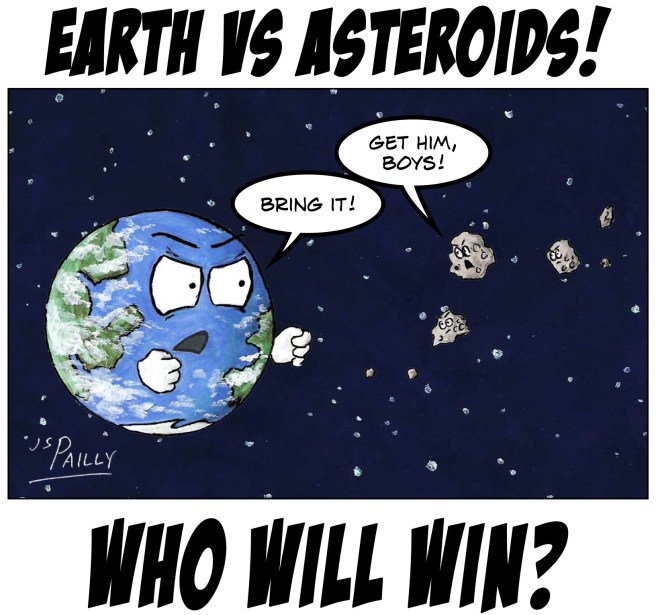
Is your planet safe? Nobody wants another Tunguska Event. Certainly we don’t want another K-T Event. So what are we doing to protect ourselves?

Thanks to grant money from NASA, the University of Hawaii has started setting up a series of telescopes specially designed to hunt for Near Earth Objects (N.E.O.s). These are objects, such as asteroids, with orbital paths that approach or cross Earth’s orbit.

The University of Hawaii’s new telescopes are collectively known as ATLAS (Asteroid Terrestrial-impact Last Alert System). Once fully operational, ATLAS promises to provide us with several weeks notice for large, incoming asteroids. For smaller, though still hazardous asteroids, ATLAS should give us at least a few hours warning.

So is our planet safe?

As more and more programs like ATLAS come online, we should get better coverage of the night sky and longer warning times for incoming objects. But there will still be a problem—a huge problem.

You see, you can’t really do astronomy during the day. That means asteroids coming at us from a sunward direction will go completely undetected. You may remember back in 2013 when a significantly-sized asteroid exploded over Russia, shattering windows and injuring over a thousand people. That asteroid came from a sunward direction.

No amount of ground-based telescopes could have detected that 2013 asteroid. But perhaps a space telescope, similar to the SOHO telescope we use to monitor solar flares, could help plug this gap in our planet’s defenses.

Molecular Monday: Keeping It Peppy with Peptide Bonds

I’ve been working hard this year to understand the secret world of amino acids. But amino acids are kind of useless all by themselves. It’s the way they join together that makes them so vitally important for life, or at least for life on Earth.

We’ve already looked at the anatomy of an amino acid. For today’s post, the crucial components are the amino group of one amino acid and the carboxyl group of another.

My23 Peptide Bond 1

First, we remove one oxygen atom (the red ones) from the carboxyl group and two hydrogens (the white ones) from the amino group. One oxygen plus two hydrogens equals a water molecule: H2O.

My23 Peptide Bond 2

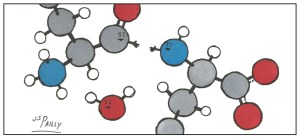
Next, the carbon (in grey) in the carboxyl group reaches out for the nitrogen (in blue) in the amino group. When the two come together, they form what’s called a peptide bond.

My23 Peptide Bond 3

This can happen over and over and over. One amino acids links up with another, which in turn links up with a third, which links with a forth and a fifth and a sixth….

I said at the beginning of this post that amino acids are kind of useless by themselves. That’s not quite fair. They can do plenty of fun, interesting chemistry on their own; but it’s this ability of theirs to form long peptide chains that makes them so useful (especially in a structural sense) for living organisms.

It’s entirely possible, in this big, wide universe of ours, that life exists without amino acids. But life without peptide bonds or something similar? Life without some easy way to string molecules together? Why, that would be pure science fiction!

P.S.: Or pure science fantasy, depending on how you define those terms.

Sciency Words: The K-T Event

Sciency Words MATH

Today’s post is part of a special series here on Planet Pailly called Sciency Words. Each week, we take a closer look at an interesting science or science-related term to help us all expand our scientific vocabularies together. Today’s term is:

THE K-T EVENT

You already know this story. It was 65 million years ago. There were dinosaurs, there was an asteroid…

It’s easily the most famous asteroid impact in Earth’s history, and it’s called the K-T Event, or sometimes the K-Pg Event.

In geology shorthand, the letters stand for:

  • K: the Cretaceous period, which is spelled with a K in German. This was the last period of geological history in which dinosaurs roamed the Earth.
  • T: the Tertiary period, which immediately followed the Cretaceous. According to the International Commission on Stratigraphy (ICS), we’re not supposed to use this name anymore, but people still do. It’s sort of like how some people keep calling Pluto a planet, no matter what the International Astronomy Union (IAU) says.
  • Pg: the Paleogene period, which is the period immediately following the Cretaceous according to the ICS’s new list of geological periods. Please note, the Tertiary and Paleogene are not really interchangeable terms. They have the same starting point, but different end points.

Geologists and paleontologists puzzled for decades over a layer of clay separating Cretaceous and Tertiary (or Paleogene) rock. They called it the K-T boundary. There were several competing hypotheses about what might have caused this boundary and how it related to the mass extinction event that killed off the dinosaurs.

Then in 1980, a paper came out entitled “Extraterrestrial Cause for the Cretaceous-Tertiary Extinction.” This paper reported the discovery that the K-T boundary contained abnormally high levels of the element iridium.

Platinum group metals like iridium are extremely rare on Earth (except in the planet’s core) but common in asteroids. So whenever you find lots of iridium in Earth’s crust, you can justifiably assume an asteroid put it there.

The most likely scenario is that a large asteroid, about 10 km in diameter, smashed into Earth, flinging dust and debris high into Earth’s atmosphere. Enough to block out the sun worldwide for several years. This global dust cloud would have included plenty of material from the asteroid itself, which would have been partially vaporized by the heat of the impact.

A major problem with the original 1980 paper was that, at the time, no known impact crater of the appropriate age was sufficiently large. But of course, that was back in 1980. The crater has since been found in the Yucatan Peninsula, and now just about everybody knows the story of the K-T Event (even if they don’t know it’s called that).

P.S.: The K-T Event is not to be confused with the Katie Event. You know, that time your BFF Katie had waaaaay too much to drink and threw a temper tantrum of apocalyptic proportions.

Addendum: While there does seem to be general, widespread consensus that the K-T asteroid impact either caused the extinction of the dinosaurs or contributed significantly to their demise, there is not universal agreement. As Planetary Defense Commander notes in the comments, there are other possibilities worth considering.

Picasso and the Moon Landing

I wish I’d been around to see the Moon landing. The good news is I’ll probably be alive to see the first humans land on Mars. That’s exciting. It’s hard for me to imagine not being excited about these things.

So it was with some shock that I read this quote from Pablo Picasso. Apparently in 1969, the New York Times asked Picasso what he thought about the Apollo 11 mission, and he said:

It means nothing to me. I have no opinion about it, and I don’t care.

Now it’s not like Picasso didn’t have some appreciation for science. Based on what I know about art history, I’m given to understand that the weirdness of Picasso’s work was influenced, to some extent, by the weirdness of Einstein’s physics.

The multiple perspectives unified in a Picasso painting supposedly reflect the multiple frames of reference that are unified in the theory of relativity. Or at least, that’s what I’ve read in art history books and in books on the history of science.

So why did Picasso think so little of the Moon landing? I think I can guess. “It means nothing to me. I have no opinion about it, and I don’t care.” I sense a touch of bitterness in those words. Maybe Picasso was just upset he didn’t get to go to the Moon himself.

If so, then I can understand where he’s coming from.

Sciency Words: Didymoon

Sciency Words PHYS copy

Today’s post is part of a special series here on Planet Pailly called Sciency Words. Each week, we take a closer look at an interesting science or science-related term to help us all expand our scientific vocabularies together. Today’s term is:

DIDYMOON

Let it not be said that scientists don’t have a sense of humor. When they discovered that the asteroid 65803 Didymos has its own moon, they named that moon Didymoon.

My06 Didymoon 1

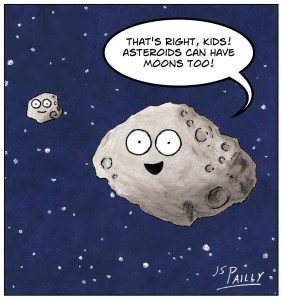
Yes, asteroids can have their own moons, but we knew that for many years before the discovery of Didymoon. The important thing you need to know is that we humans are planning to use Didymoon for target practice.

My06 Didymoon 2

Multiple space agencies around the world, including NASA, are collaborating on a mission called the Asteroid Impact and Deflection Assessment mission (AIDA). Didymos and Didymoon will pass near Earth in October of 2022. As they approach, AIDA will launch, and it will try to hit Didymoon really, really hard to see how much we can shift its orbit.

AIDA is a crucial test. Are we capable of changing the orbits of objects in space? Can we protect our planet from incoming asteroids and comets?

My06 Didymoon 3

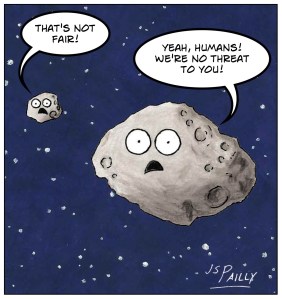
Didymos and Didymoon are correct. They’re not like the asteroid from the K-T Event, which wiped out the dinosaurs, or the object from the Tunguska Event, which leveled an astonishing number of trees.

But if we can adjust Didymoon’s orbit around Didymos, we’ll be better prepared to adjust the trajectories of other asteroids that might be heading our way.

John Oliver Talks About Science

The popular press misrepresents 93% of the scientific findings it reports on. This according to a new paper in the journal My Imagination. But seriously, science gets misreported by the media a lot.

I’ve wanted to write something about this for a while now. Fortunately, I don’t have to. John Oliver from Last Week Tonight just did it for me. Thanks, Mr. Oliver!

Molecular Monday: When Protons Get Lonely

An acid is a chemical that can give up a proton to another chemical. Two out of three textbook definitions agree on this (we can worry about the Lewis definition some other time). But why are there so many chemicals out there giving away free protons?

The story begins with a hydrogen atom (one proton, one electron).

My04 Hydrogen

A second electron would complete hydrogen’s valence shell, which is something all atoms want to do. So hydrogen will try to bond with another atom, in the hope that by sharing electrons through chemical bonds, it can get the extra electron it so desperately needs.

Sadly, this arrangement doesn’t always work out in hydrogen’s favor. Rather than getting to borrow some other atom’s electron, sometimes hydrogen gets cheated out of the one electron it already had. This can happen for several reasons, such as:

  • Greedy Atoms: Some atoms, especially oxygen, chlorine, and fluorine, tend to hog electrons from other atoms. I described this electron-hogging tendency in a previous post on electro-negativity.
  • Electrons Gone Wild: Some molecular structures allow electrons to run around inside the molecule. This is called electron delocalization, or sometimes electron resonance.

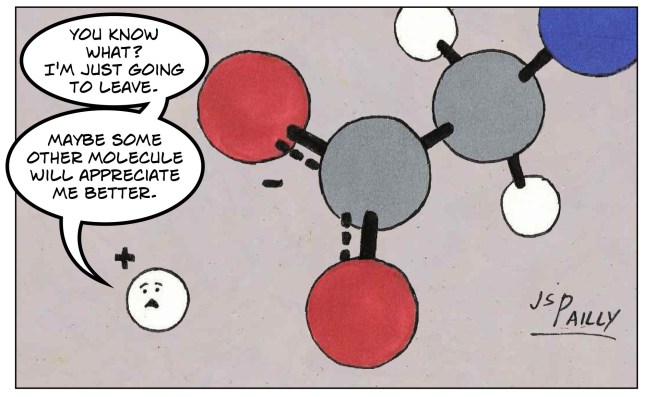
Whether due to electron delocalization, electro-negativity, or electro-something else, the single proton of a hydrogen atom can end up feeling neglected and lonely. And the more neglected and lonely that proton feels, the more likely it is that this will happen:

My04 Deprotonation

And the more likely it is that this will happen, the more acidic the chemical in question is said to be.

* * *

Today’s post is part of a special series here on Planet Pailly called Molecular Mondays. Every other Monday, I struggle valiantly to understand and explain some concept in the field of chemistry. Please note: I suck at chemistry, but I’m trying to learn. If I made a mistake, please, please, please let me know so I can get better.