Sciency Words: Futurism

Sciency Words MATH

Today’s post is part of a special series here on Planet Pailly called Sciency Words. Each week, we take a closer look at an interesting science or science-related term to help us all expand our scientific vocabularies together. Today’s term is:

FUTURISM

Sometimes I think I know what a word means, only to discover that it has a second definition. Such is the case with futurism.

Previously, I only know about futurism the art style, which dates back to the early 20th Century. It was an art movement obsessed with the latest cutting edge technology. You know, cutting edge technology like aeroplanes and automobiles. That version of futurism is now, ironically, just another part of art history.

Whenever I’ve seen or heard the word futurism, I’ve mistakenly assumed that it harkens back to that early, avant-garde art movement. And when you think you already know what a word means, you don’t feel much need to grab a dictionary and investigate further.

But it turns out that there’s a different kind of futurism (sometimes called futurology) which straddles the line between art and science. I only found out about this other futurism from a recent episode of Writing Excuses (the best podcast for writers… ever!)

The Writing Excuses crew interviewed Trina Marie Phillips, a professional futurist. Her job is to look at the current trends in science and technology and try to extrapolate what might happen over the next 10, 20, or 30-plus years. Fortune 500 companies pay her to help them prepare for the technological advancements that are coming in the near future.

My favorite part of this: professional futurists like Phillips use storytelling—as in science fiction stories—to illustrate to their clients how new technology might affect their customers, or their business models, or the global economy in general. Truly, this is where science meets fiction.

P.S.: I get the sense that futurism is a deep, deep rabbit hole. I have not researched this subject as thoroughly as I probably should have for today’s post, but I was so excited about this that I had to share.

Can You See Saturn from Titan?

As I continue my exploration of Titan, there’s something I was really hoping to see.

Ag10 Saturn in the Sky

Like Earth’s moon, Titan is tidally locked. That means as Titan orbits Saturn, the same side of the moon is always oriented toward the planet.

So in theory, all I have to do is make my way to the Saturn-facing hemisphere, look up in the sky, and behold the majesty of the Ringed Planet.

I’m sorry to report that today science has crushed my dreams. Titan is shrouded in a haze of aerosol particles called tholins. The tholin haze is not as dense as you might assume (which is why I thought I might be able to see Saturn).

But this diffuse haze extends from the surface all the way up to an altitude of approximately 300 km. For the sake of comparison, typical Earth clouds form at altitudes between 3 and 12 km, and the unofficial boundary between Earth’s atmosphere and space is about 100 km up. So you could say that Titan’s haze is 200 km taller than Earth’s entire atmosphere (and Titan still has a few more atmospheric layers above the haze too).

Dense or not, there’s more than enough tholin haze overhead to block my view of Saturn. In fact, it’s enough that I can’t tell which way the sun is.

Ag10 Saturn Not in the Sky

Of course, Titan does experience seasonal changes which can affect the tholin haze. Maybe if I came back at a different time of year (Titan’s year equals almost 30 Earth years), I might be able to see something. But I doubt it.

First Steps on Titan

Your first steps on a new world should be an auspicious occasion. With that in mind, I have just landed on Titan. I’ve opened the hatch of my spaceship. I’m descending the ladder. I’m taking my first step….

Ag08 First Steps on Titan

I should have expected this. Titan may be too cold for liquid water, but it’s the right temperature and pressure for liquid methane.

There’s enough liquid methane (and also liquid ethane) to form lakes and rivers. It rains liquid hydrocarbons, and the ground is saturated with this stuff. Add tholins to the mix, and you’ve really got yourself in a sticky situation.

When the Huygens probe landed on Titan in 2005, it found surface conditions that the Huygens team compared to crème brûlèe: a layer of soft, gooey material with a thin, hardened crust on top.

No one can say for sure if the Huygens landing site is truly representative of the entire surface of Titan, but still… I should have expected to get my space boots dirty.

And here’s another thing I should have expected. You see, Titan has an atmosphere (approximately 95% nitrogen, less than 5% methane). In fact, Titan’s atmosphere is slightly denser than the atmosphere on Earth, so sound waves travel pretty well. Which means that as I trudge across the Titanian landscape, I can actually hear my space boots squishing in the mud.

P.S.: One more thing I should’ve thought about sooner. I’m going to have to figure out a way to clean my spacesuit before getting back into my spaceship. All this hydrocarbon gunk is going to become a real fire hazard once I’m back in an oxygen-rich environment.

Sciency Words: Tholin

Sciency Words BIO copy

Today’s post is part of a special series here on Planet Pailly called Sciency Words. Each week, we take a closer look at an interesting science or science-related term to help us all expand our scientific vocabularies together. Today’s term is:

THOLIN

My travels through the Solar System have once again brought me to Titan, Saturn’s largest moon. My spacecraft has commenced landing procedures, and I am currently descending through a haze of aerosol particles called tholins.

The term tholin was coined in a 1979 paper co-authored by Carl Sagan. The word comes from two similar sounding Greek words, one meaning vault (as in the great vault of the heavens) and the other meaning mud. Apparently Sagan toyed with the idea of naming this stuff “star-tar.”

Back on Earth, tholins can be created in the lab. Just take some simple organic compounds like methane and ethane and zap them with UV light or an electric current. You’ll end up with this yucky, orange gunk all over the bottom of your test chamber.

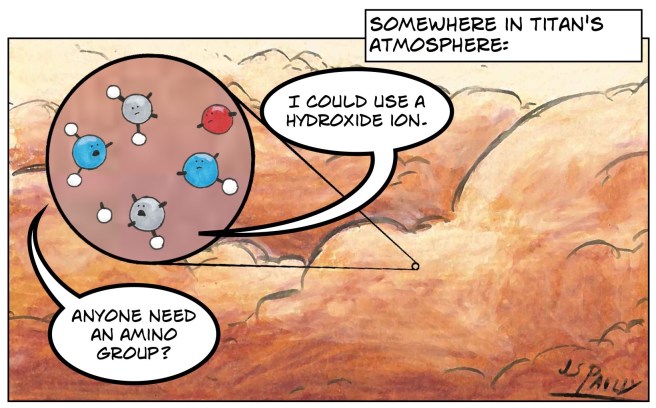
Here on Titan, the same thing is happening due to photolysis. When chemicals like methane (CH4), ethane (C2H6), ammonia (NH3), and formaldehyde (CH2O) get irradiated by sunlight, they break apart and recombine as new, more complex structures.

Ag05 Tholins on Titan

Tholins fill the air as a dense, orange haze. They cover the ground below as orange sludge. They’re also starting to coat the viewport of my spaceship with an orangey film that, I suspect, will be a real pain to scrub off.

While tholins have been notoriously difficult to analyze in the lab, they seem to be a mishmash of organic molecules. It’s hard to say which organic molecules are present, but some of them appear to be extremely large, extremely complicated organic compounds.

It’s easy to imagine amino acids, peptide chains, or even some sort of proto-DNA emerging from tholins, provided the tholins are allowed to dissolve in some sort of aqueous solution (note to self: double check Titan’s liquid methane lakes for dissolved tholins).

I can’t say for certain if there’s life on Titan, but I have to admit with all these tholins lying around, conditions are ripe for some sort of biochemistry to get started.

Links

What in the World(s) are Tholins? from the Planetary Society.

How Titan’s Haze Help Us Understand Life’s Origins from Astrobiology Magazine.

IWSG: You Are a Good Writer

Insecure Writers Support Group Badge

Today’s post is part of the Insecure Writer’s Support Group. Click here to find out more about the group and to see a full list of participating blogs.

* * *

In the past, I’ve written a lot of IWSG posts about my muse. Mostly, I’ve written about how much we fight. We quarrel over what to write, how to write, when to write (sorry, muse, but 2 a.m. is not the appropriate time).

But today, I just want to take a moment and say something to my muse. Something I don’t say often enough.

Ag03 Muse Chat 1

Of course these muse posts are hyper metaphorical. They represent the inner triumphs and turmoils of the creative life. I don’t actually believe a magic fairy whispers ideas in my ear.

Ag03 Muse Chat 2

Metaphorical or not, the relationship between a writer and muse can become strained. Writing is hard. Tensions run high. It’s upsetting when words just don’t fit together the way they’re supposed to.

You might start to think you suck as a writer. Your writing sucks. You life sucks. You blame your muse for withholding inspiration; your muse blames you for lacking persistence. And then things get nasty.

That’s why it’s so important to stop and affirm to yourself, as often as you can, in whatever metaphorical or non-metaphorical terms you prefer, that you are good at what you do, and that you’re getting better. Go ahead. Do it now.

It might seem silly at first, but the power of positive thinking is real. It won’t solve every problem, but it is the best defense against the chronic negativity that afflicts so many of us as writers.

Molecular Monday: Are There Amino Acids on Titan?

Molecular Mondays Header

Welcome to Molecular Monday! On the first Monday of the month, we take a closer look at the atoms and molecules that make up our physical universe. Today, we’re looking at:

AMINO ACIDS ON TITAN

Captain’s Log

Stardate 8116.3

My spaceship has completed orbital insertion at Saturn. During last year’s Mission to the Solar System, I missed the opportunity to explore Saturn’s largest moon, Titan, in any detail. I intend to correct that error.

Titan may or may not support life, but one thing is certain: it is a chemically active world. And that chemical activity is vaguely reminiscent to the biochemistry found on Earth.

While my spaceship is still on approach to Titan, this seems like a good time to review what I’ve learned so far about amino acids.

Anatomy of an Amino Acid

  • Amino Group: a structure on one side of an amino acid that can serve as a base in acid/base chemistry.
  • Carboxyl Group: a structure on the opposite side of the amino acid that can serve as an acid for acid/base chemistry.
  • Alpha Carbon: A single carbon atom separating the amino and carboxyl groups, preventing them from accidentally reacting with each other. Some amino acids also include a beta carbon, a gamma carbon, or even a delta carbon, further separating the amino and carboxyl groups.
  • The Side Chain: A chain of atoms dangling from the alpha carbon. These side chains vary in composition and complexity, giving each amino acid its own unique flavor (sometimes literally).

Functionality of Amino Acids

  • Peptide Bonds: The amino group of one amino acid can link up with the carboxyl group of another, forming a peptide bond (a water molecule is produced as a byproduct). This process can be repeated over and over, forming incredibly long peptide chains.
  • Proteinogenic Amino Acids: While there are hundreds (perhaps thousands) of different amino acids, life on Earth uses only twenty-three of them in the formation of proteins. We humans use only twenty-one.
  • Chirality: Side chains can be attached to one side of an alpha carbon or the other. Life on Earth only uses amino acids with side chains on the “left” side. Right-sided side chains are incompatible with our DNA, and we can’t use them for the construction of proteins (though our bodies can use some of them for other purposes).

When I arrive on the surface of Titan, I do not know what I will find. Amino acids? Probably. Peptide bonding? Maybe. Long peptide chains, like some sort of proto-DNA? It’s possible.

We’ll just have to wait and see what happens when I get there.

Sciency Words: Photolysis

Sciency Words PHYS copy

Things have been a bit hectic lately, so welcome to a rare Saturday edition of Sciency Words.

Every Friday (normally), we take a closer look at an interesting science or science-related term to help us all expand our scientific vocabularies together. Today’s term is:

PHOTOLYSIS

Last year, when I did my special Mission to the Solar System, I fell in love with one planet in particular: Venus. I guess I’ve always had a soft spot for sciency girls, and Venus is about as sciency as they get. She’s really, really into chemistry.

Jy30 Venus Does Chemistry

Photolysis (also known as photo-dissociation) is one of Venus’s favorite chemistry tools. Photolysis occurs when high-energy photons ram into chemical bonds, causing those bonds to break.

By high-energy photons, of course, I mean light. Specifically ultraviolet light, X-rays, and gamma rays. On Venus, UV rays from the Sun cause the photolysis of sulfur compounds, contributing to the sulfur cycle that causes Venus’s infamous sulfuric acid rain.

Jy30 Photolysis on Venus

The same process breaks apart oxygen molecules in Earth’s stratosphere, allowing them to recombine as ozone, thus generating the ozone layer. Photolysis is also probably responsible for the chemical changes on Jupiter that make the Great Red Spot look red (or sometimes other colors).

And speaking as an artist, photolysis is something I have to guard against. Paints are just a mix of chemicals, and the photolytic break down of those chemicals can, over time, cause paints and other pigments to fade or change color.

Photolysis by any other name…

The term photolysis is sometimes used as a blanket term for similar kinds of chemical bond breaking. For example, very little sunlight reaches the surface of Venus, but sulfur compounds still vigorously break apart and recombine due to the intense heat.

Some academic sources I’ve read still call that photolysis, though I prefer the term thermal dissociation. Calling a chemical reaction that occurs in a near pitch-black environment “photolysis” feels awkward.

Just my opinion.

Photolysis here, photolysis there, photolysis everywhere…

When I first learned about photolysis, I didn’t fully appreciate its significance. I understood only that it (and also thermal dissociation) played key roles in Venus’s extra special chemistry projects.

Then I encountered the word again while researching other planets. And then it popped up in an art textbook I was reading. I’ve gradually come to understand that it is a fundamental concept in science, or at least in chemistry.

Next week, I’ll be revisiting Saturn’s largest and orangest moon: Titan. I have a sneaking suspicion that we will once again see photolysis in action.

Links

Photolysis of Sulphuric Acid as the Source of Sulphur Oxides in the Mesosphere of Venus from Nature Geoscience.

The Sulfur Cycle on Venus: New Insights from Venus Express from the 2009 Lunar and Planetary Science Conference.

Enjoy Juno While You Can

In case you haven’t guessed, I am super excited about the Juno Mission. I’m looking forward to writing (and drawing) about it a lot over the coming years.

Jy26 Jupiter and Juno 1

But for the moment, we’re sort of stuck in a holding pattern.

Juno successfully entered orbit of Jupiter on July 4, 2016; however, it will have to complete a second engine burn, scheduled for October 19, before the science mission really begins.

In the meantime, I thought I’d run through some of Juno’s equipment and some of the mission objectives I’m most excited about.

  • Juno Cam: It’s a camera. It takes pretty pictures. Nothing to get too excited about, except Juno’s orbit takes it extremely close to Jupiter. We should be getting some stunning close-ups.
  • JEDI and JADE: Juno has two instruments, named JEDI and JADE, which will detect ionized particles in Jupiter’s magnetosphere. JADE will focus on low-energy particles; JEDI will cover the high-energy stuff. As a science fiction writer, I’m looking forward to knowing precisely what sort of radiation dangers my characters will face near Jupiter specifically and gas giant planets in general.
  • UVS and JIRAM: Juno can see in ultraviolet (using its UVS instrument) and infrared (using JIRAM). So yes, Juno can “see right through” Jupiter, or at least it can see through some of the topmost layers of clouds. Also, observations in UV and IR will help us identify the chemical composition of the clouds. Maybe we’ll finally find out what makes the Great Red Spot red.
  • Gravity Science: By monitoring subtle variations in Jupiter’s gravity, Juno can determine how matter is distributed in the planet’s interior. There are a lot of hypothetical new states of matter that might exist in the interiors of gas giants (like metallic hydrogen); Juno’s gravity experiments could tell us if our hypotheses are correct.

Juno is scheduled to make a suicide dive into Jupiter’s atmosphere on February 20, 2018.

Jy26 Jupiter and Juno 2

I’d hoped there might be a possibility for a mission extension. The Cassini mission got an extra nine years to study Saturn. But NASA doesn’t want to risk contaminating any of Jupiter’s moons (especially Europa).

So over the next two years, we better make the most of Juno while we still have her.

P.S.: JEDI stands for Jovian Energetic particle Detection Instrument. The Star Wars reference is surely a coincidence; it’s not like there are any nerds working at NASA.

Sciency Words: Hot Spots of Jupiter

Sciency Words MATH

Today’s post is part of a special series here on Planet Pailly called Sciency Words. Each week, we take a closer look at an interesting science or science-related term to help us all expand our scientific vocabularies together. Today’s term is:

HOT SPOT

This is Jupiter.

Ag05 Great Red Spot

And this is Jupiter in infrared.

Jy22 Infrared Jupiter

In 1995, the Galileo spacecraft dropped a small probe into Jupiter’s atmosphere. It was supposed to sample the chemicals in Jupiter’s clouds, but in a case of extraordinary bad luck, the probe fell into an empty gap between cloudbanks and collected virtually no data.

I like to imagine the clouds separating before the probe, like Moses parting the Red Sea, but I’m sure that’s not how it actually happened.

These gaps in the Jovian clouds are called hot spots. The thin atmospheric gases in these regions are actually quite cold, but when viewed in infrared, they appear hot due to the intense heat of Jupiter’s interior shining through.

The hot spots form—they always form—about seven degrees north of the equator. Eight to ten of them will appear at a time, evenly spaced along that seven degrees north longitude line, wrapping all the way around the planet.

This has led scientists to conclude that Jupiter’s hot spots are caused by a standing wave (more technically, a Rossby wave) in Jupiter’s atmosphere. The peaks and troughs of the wave correspond to the thickening and thinning of the surface clouds.

The Juno spacecraft’s JIRAM instrument (Jovian InfraRed Auroral Mapper) is specifically designed to study Jupiter’s aurorae (as the name implies) and also the hot spots. By staring straight down into a hot spot with an infrared spectrometer, scientists hope to identify the chemical composition of the deeper atmospheric layers. Among other things, they believe they’ll find a layer of water clouds.

Of course the Great Red Spot is a weird and mysterious phenomenon too. It deserves the high level of scrutiny it gets. But of all the spots on Jupiter, the hot spots may turn out to be the most interesting and revealing of the planet’s features.

Links

Jupiter’s Atmosphere Has Weird Hot Flashes from Space.com.

“Hot Spots” Ride a Merry-Go-Round on Jupiter from NASA.gov.

Juno: What’s in a Name?

Why is NASA’s current mission to Jupiter called Juno? The answer might seem obvious to anyone with even a passing familiarity with Roman mythology. Jupiter was the king of the gods, and Juno was his queen. Except NASA was a bit cleverer than that.

In this press release from 2011, NASA reminds us that the legendary Jupiter (a.k.a. Zeus) would hide his mischief from his wife, Juno (a.k.a. Hera), by concealing himself and said “mischief” in a veil of clouds.

Jy19 Mythical Juno

By mischief, of course, NASA means mistress, and the veil of clouds routine didn’t work one bit. I believe NASA is specifically referring to the story where Jupiter seduces Io, one of Juno’s own high priestesses!

As for the planet Jupiter, NASA would really like to take a peek beneath the thick clouds of the upper atmosphere. That is precisely what the Juno spacecraft is designed to do, using a variety of techniques from gravity mapping to infrared spectroscopy.

Jy19 Scientific Juno

Also, Juno will not be approaching or interacting with any of Jupiter’s moons (not even Io). In fact, Juno’s mission plan was designed to avoid any close encounters with the moons (most of which are named after Jupiter’s other “mischiefs”) due to planetary protection concerns.

This too strikes me as symbolically appropriate in light of the ancient mythology.