Stronger Together

Last Wednesday, the day after the election, my muse may or may not have wanted to write. I’m not really sure.

nv15-day-after-the-election

A few years back, I saw Jonathan Maberry at a writing conference, and he gave out some advice to new writers, particularly writers new to blogging and social media. One of the things he said was don’t talk about politics.

So I don’t talk about politics, at least not on this blog, not unless there’s some direct relevance to the kind of science or science fiction I write about. But after doing some soul searching this past week, I’ve decided that I do need to say something about the election, because it is relevant to my writing.

For me, this election was about the future. What sort of future do we want? What sort of future do we believe in? I happen to be white and male. Over the last year, certain other white males looked at me and seemed to presume that I was “one of them” and that I’d be receptive to the vision of the future they wanted.

But I do not believe in a future where everyone looks like me, nor do I believe in a future where people who are different than me are safely cordoned off. I believe in a future where people of all races, religions, sexual orientations, and genders or gender identities are united in our common humanity. I do not see our diversity as a problem. I do not think our differences make us threats to each other.

Now I’m given to understand that not everyone saw this election the way I did. For some, economic anxieties or national security or corruption in Washington took priority. That’s okay. I’ve made my peace with that, and I hope that over the next four years those issues are addressed in a productive manner.

It will probably be awhile before I blog about politics again because I agree with Jonathan Maberry. Political posts just alienate readers. Besides, when was the last time the major issues of the day were resolved in a comment thread?

But as my muse and I get back to work, I have to acknowledge to myself and others that this election has changed me. Whether I intend it or not, those changes with affect my writing. Right now, the only thing I can say for certain is this: as a science fiction writer, I have a renewed commitment to depict a future that is not populated by white men only and to tell stories in which humanity is stronger together.

Molecular Monday: Life in an Ammonia Ocean

Molecular Mondays Header

Welcome to Molecular Monday! On the first Monday of the month, we take a closer look at the atoms and molecules that make up our physical universe. Today, we’re looking at:

AMMONIA AND ALIEN LIFE

Water, Water Everywhere…

You know how water has that Mickey Mouse shape? That shape is really important. That slight asymmetry allows electrical charges to accumulate on opposites sides of the water molecule.

nv07-water-front-view

The polarization of water molecules makes water a good solvent for other polar molecules, like amino acids. This is a big reason why water is essential to life (or at least, life on Earth). Without the ability to dissolve amino acids, we’d have an awfully hard time getting them to form peptides or proteins or DNA molecules.

But could life on some alien planet substitute another chemical for water?

Ammonia, Ammonia Everywhere…

This is an ammonia molecule (chemical formula NH3).

nv07-ammonia-front-view

At first glance, you might think ammonia molecules are symmetrical, with three hydrogen atoms evenly spaced around the central nitrogen atom. Symmetrical molecules have all their electrical charges perfectly balanced, and therefore are non-polar and do not act as good solvents for amino acids.

But when you turn the ammonia sideways, things look rather more promising.

nv07-ammonia-side-view

The three hydrogen atoms bend toward each other, just as the two hydrogens in water do. There’s a slight asymmetry, meaning electrical charges can form. Ammonia is a polar molecule after all!

And ammonia has a few other things in common with water:

  • They’re both fairly common in the universe (though water is more common).
  • They both can be liquid under fairly ordinary temperature/pressure ranges (though water’s liquid phase is wider than ammonia’s).
  • They can both act as a base, meaning they can accept a proton from an acid (though ammonia is slightly more basic than water).
  • They can both act as an acid, meaning they can both donate a proton to a base (though water is slightly more acidic than ammonia).

The most noteworthy difference seems to be that ammonia burns easily in the presence of oxygen. That could pose serious challenges to the evolution of complex, multi-cellular organisms that need the extra kick of energy oxygen provides.

Still, water and ammonia are similar enough to attract the attention of astrobiologists, and a lot has been written about the possibility of life emerging on some distant planet in an ammonia sea.

Links

Hypothetical Types of Biochemistry from Wikipedia.

Alternatives to Water from Xenology: An Introduction to the Scientific Study of Extraterrestrial Life, Intelligence, and Civilization.

Thalassogens from Xenology: An Introduction to the Scientific Study of Extraterrestrial Life, Intelligence, and Civilization.

* * *

A special thank you to Kirov99 for suggesting this topic. My research tends to focus on the planets and moons of the Solar System, rather than hypothetical environments we might find elsewhere in the universe, so without the recommendation I would have probably missed this.

Sciency Words: Zoosemiotics

Sciency Words MATH

Today’s post is part of a special series here on Planet Pailly called Sciency Words. Each week, we take a closer look at an interesting science or science-related term to help us expand our scientific vocabularies together. Today’s term is:

ZOOSEMIOTICS

Sometimes with these Sciency Words posts, I feel like I’ve bitten off more than I can chew. This is one of those times.

Semiotics is a field of study related to linguistics, but more focused on the creation of signs and symbols and how these signs and symbols can be used to communicate meaning. Zoosemiotics is the study of how animals do that.

Think of birdsong or whale-song, or the dance of bees, or ants laying down scent trails, or dogs marking their territory, or squid rapidly changing colors, or all the crazy displays animals put on to attract mates. Or think of the way pets very pointedly stare at you while you’re eating.

There are three basic types of communication that zoosemioticians study:

  • Intraspecies zoosemiotics: communication between animals of the same species.
  • Interspecies zoosemiotics: communication between animals of different species.
  • Anthropological zoosemiotics: communication between animals and humans.

In each case, we have an animal engaging in some sort of behavior that symbolically expresses meaning. On the other side of the equation, we have another animal (or animals) trying to interpret that behavior. If the behavior is interpreted correctly, we have communication!

And when animals communicate frequently, relationships can develop. A sort of culture might start to emerge. Animals may even form a kind of social order. Studying the culture and social orders of animal groups is also part of zoosemiotics’ domain, and this is where I think things get tricky.

It’s a little too easy to anthropomorphize animals, to assign human emotions and human motivations to their natural animal behavior. So just how human-like are animal communications? How human-like are animal “cultures” and “social orders,” according to zoosemiotics? Or should we rather ask how animal-like are humans?

This starts getting into a lot of heavy philosophical territory that I’m probably not qualified to talk about. I mean, I’m not a zoosemiotician. I only learned about this term a week ago, and I have a lot more research to do. For now, I’m just happy to have a new word to add to my scientific vocabulary.

P.S.: Xenosemiotics doesn’t seem to be a word yet, but it totally should be.

IWSG: The Best/Worst Thing About Writing

Insecure Writers Support Group Badge

For today’s Insecure Writer’s Support Group post, I’d like to share a quote:

The mind can proceed only so far upon what it knows and can prove. There comes a point where the mind takes a leap—call it intuition or what you will—and comes out upon a higher plane of knowledge, but can never prove how it got there.

This quote comes from Albert Einstein. It first appeared in an article from Life Magazine in 1955. As I understand it, Einstein was talking about more than just scientific discovery here.

I like this quote because it encapsulates what I believe is the best—and worst—thing about writing.

The Best Thing About Writing

Writing is a struggle.

I could elaborate on that, but I don’t think I need to. If you’re part of the Insecure Writer’s Support Group, you already know what I mean.

But there comes a moment when the struggle is suddenly over. Your story problems seem to solve themselves, and all your plot points just fall into place. You might not understand how this happened, but that’s okay because at that moment you are a writing god (or goddess)!

This experience really is like coming out upon some higher plane of knowledge. We writers get to have that experience over and over again, and that’s the best part about being a writer.

The Worst Thing About Writing

Except you never really understand how you reached this higher plane of knowledge. Some sort of subconscious voodoo happened that was beyond your control. It was intuition, as Einstein said. It was a leap of faith.

And that’s a bit frightening, and more than a bit frustrating, because when you can’t remember how you solved a problem, you have no idea what to do when that same problem happens again. So much for feeling like a writing god/goddess.

At that point, the only thing left to do is trust some fickle subconscious intuition nonsense will come through for you again. And who knows when or if that’ll happen?

* * *

Today’s post is part of the Insecure Writer’s Support Group, a blog hop where insecure writers like myself can share our worries and offer each other advice and encouragement. It’s a safe place, and it’s the best. Please click here to learn more about the group and to see a list of participating blogs.

Time: Mission to Mars, A Book Review

A few years back, I picked up a special edition of Time Magazine that was all about Albert Einstein. It had a lot of new-to-me biographical information, and it did a surprisingly good job explaining Einstein’s physics. So when I saw Time’s “Mission to Mars: Our Journey Continues” on the magazine rack, I bought it.

oc31-time-magazine-mission-to-mars

Quick Review

It was just okay.

Longer Review

It’s worth taking stock of the fact that there is so much Mars-related stuff going on, but I think the writers were trying to cram too much into a magazine (booklet?) that’s less than 100 pages.

They touched on the search for Martian life, the Curiosity rover, India’s Mars Orbiter Mission, Scott Kelly’s Year in Space, the competition between SpaceX and Blue Origin, President Obama’s space policy, production of The Martian staring Matt Damon… they touched on all of this stuff, but they didn’t go into detail about any of it.

Any one of those topics could have filled a whole magazine by itself (in fact, Time did do a special edition on the Year in Space mission). If they had narrowed their focus just a little, I think they could have produced a much more interesting and informative publication.

Recommendation

If you don’t know much about Mars and the current state of space exploration, and you want to be better informed, this isn’t a bad place to start. For people like myself who are already huge space enthusiasts, the forward by Buzz Aldrin is worth a look. Otherwise, I’d say give this one a pass.

Sciency Words: H.A.V.O.C.

Sciency Words BIO copy

Today’s post is part of a special series here on Planet Pailly called Sciency Words. Each week, we take a closer look at an interesting science or science-related term to help us expand our scientific vocabularies together. Today’s term is:

H.A.V.O.C.

Given a choice between colonizing Venus or Mars, I might actually choose Venus. Yes, surface conditions on Venus are hellish instant death. Like, literally hellish. It’s even got the sulfur. But a Venusian colony would not be built on the planet’s surface.

Atmospheric conditions at an altitude of about 50 km are actually quite pleasant. The temperature and pressure are about the same as on Earth. So is the gravity. And you wouldn’t need hydrogen or helium to keep your floating cities aloft; on Venus, oxygen is lighter than air.

Life in a Venusian floating city, drifting around right above the Venusian clouds, sounds almost—dare I say it?—heavenly. There’d be plenty of sunlight (solar panels would soak up plenty of energy), and Venus would provide some natural protection from solar and cosmic radiation (at least, more protection than you’d get on Mars).

And thanks to the weird chemical mix in Venus’s atmosphere, you’d be able to collect almost all the natural resources you’d need. Well, aside from water (Mars has got Venus beat there).

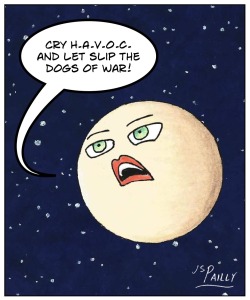
I know this sounds crazy, but the more you read about it, the more Venus colonization makes sense. Venus may not get the kind of attention (or funding) that Mars gets, but NASA and other space agencies do take this seriously. NASA has even given the idea a name: the High Altitude Venus Operational Concept, or H.A.V.O.C.

oc28-venus-havoc

So I’m ready to sign up for a mission to colonize Venus. Who’s with me?

Meet a Moon: Dione

Regarding Greek mythology, it seems no one’s really sure who Dione was. Ancient sources contradict each other, and modern scholars think there may have actually been more than one mythical woman who went by that name. But I was able to find out this much: according to Wikipedia, at least one of these Diones was “sometimes associated with water or the sea.”

What that in mind, I’d like to introduce you to Dione, one of Saturn’s moons.

oc24-meet-dione

You sure are, Dione. In fact, I can’t think of a better description for you.

The Waters of Enceladus

Over the last decade or so, one of Saturn’s other moons has become famous for having an ocean of liquid water beneath its surface. That moon is called Enceladus. We know about Enceladus’s water for two reasons:

  • Geysers: Enceladus has a series of cracks (called tiger stripes) in its south polar region, and saltwater shoots out of these cracks at regular intervals.
  • Libration: Enceladus wobbles in place (librates) more than it should. This is best explained by the presence of a layer of liquid separating the moon’s crust from its core.

It’s still a mystery how Enceladus generates enough heat to keep its liquid water from freezing, but at this point, it’s pretty clear the water is there.

The Waters of Dione

Dione doesn’t librate the way Enceladus does, and we haven’t noticed any saltwater geysers, but a recent paper in Geophysical Research Letters says Dione might have a subsurface ocean too.

The authors of the paper created a new theoretical model for icy moons, a model which fits precisely with observations of Enceladus. Then they applied this new model to Dione and concluded that Dione should have a subsurface ocean.

This raises two questions that are fairly easily answered.

  • Where are Dione’s geysers?: Dione may not spew saltwater (anymore), but it does have cracks and fissures in its surface, suggesting that it may have had active “tiger stripe” geysers in the past.
  • What about Dione’s libration?: The new model suggests that Dione should librate, but not as much as Enceladus does. The Cassini spacecraft (currently orbiting Saturn) does not have instruments sensitive enough to detect the predicted libration.

So there you have it. According to at least one theoretical model, Dione should have a subsurface ocean, but we cannot yet confirm that it does. And it’ll probably be awhile before we can send a new spacecraft to Saturn to find out one way or another.

But hey, how appropriate is it that we named this moon, which might have a subsurface ocean, depending on your theoretical model, after a mythical figure that might sometimes have been associated with water, depending on which ancient sources your reading!

Sciency Words: Fault Tree

Sciency Words PHYS copy

Today’s post is part of a special series here on Planet Pailly called Sciency Words. Each week, we take a closer look at an interesting science or science-related term to help us all expand our scientific vocabularies together. Today’s term is:

FAULT TREE

The Future

The chief engineer marched herself up to the captain’s ready room, saluted, and stood at attention. The captain leaned back in his chair, reading the chief engineer’s report.

“So the starboard engine pod just exploded?” the captain said. “For unknown reasons?”

“Yes, sir,” the engineer replied. “I cannot explain it. My team has no idea what happened. The circumstances of the explosion are so unusual that we don’t even know where to start.”

“Well, couldn’t you start with a fault tree analysis?”

“Sir?”

The Present

I first encountered the term “fault tree” in an article about the recent Space X rocket explosion (click here, it’s an interesting read). I then read more about fault tree analyses in NASA’s Fault Tree Handbook for Aerospace Applications (click here, but I’ll warn you it’s pretty dull reading).

Basically, a fault tree analysis is a method of evaluating all the things that could go wrong to produce an undesirable result (like your engine pod mysteriously blowing up). Fault trees are sort of like flow charts, and they look something like this:

oc21-fault-tree

As I understand it, you start from the bottom of the chart are work your way up. Which subsystems failed? How did those subsystem failures affect the main systems, potentially leading to the “top event” on your chart?

One of the key advantages to using a system like this is that it can show how two or more seemingly unimportant problems can combine to cause bigger problems farther up the tree.

According to NASA’s Fault Tree Handbook, fault tree analyses have become fairly standard for space flights ever since the space shuttle Challenger disaster in 1986. A good, well thought out fault tree can not only help figure out what caused an accident, but it can also help determine what might go wrong before an accident even occurs.

The Future

“Oh, right,” the chief engineer said, chuckling at her own foolishness. “A fault tree analysis! That’s been standard procedure since, what… the the 20th Century?”

The captain nodded.

“Sorry, Captain. Sometimes I forget I’m a real engineer and not a character in a science fiction story.”

“Happens to the best of us,” the captain said. “Carry on.”

P.S.: I have been having a really rough writing week this past week. I wonder if writer’s block can be diagrammed with a fault tree.

Sciency Words: Shadow Biosphere

Sciency Words MATH

Today’s post is part of a special series here on Planet Pailly called Sciency Words. Each week, we take a closer look at an interesting science or science-related term to help us all expand our scientific vocabularies together. Today’s term is:

SHADOW BIOSPHERE

Crazy Talk

We are not alone on planet Earth. There are aliens among us. Their existence has gone unnoticed and unsuspected for millions of years.

Truth be told, I shouldn’t call them “aliens.” They evolved here on Earth, side by side with what we, in our arrogance, call “organic life.”

They’re everywhere. There’s a whole biosphere of these weird creatures sharing our planet with us. It’s called the shadow biosphere.

Not Crazy Talk

I first heard about the shadow biosphere on an episode of SciShow, and I’ve been seeing the term more and more lately. It seems like some sort of astrobiology buzzword at the moment.

The idea is that an alternative form of life could have evolved here on Earth, and we just haven’t discovered it yet. Maybe it lives in areas totally inaccessible to us, like deep beneath the Earth’s crust. Or maybe it’s so different from us that we don’t yet recognize it as a life form.

Personally, I take this as more of an astrobiology thought experiment than a serious hypothesis about life on our planet. It’s a way of reminding us how limited our understanding of life is and show how difficult it might be to identify alien life should we happen to find it.

You see, to determine if something is alive, we must try to identify ways in which it is similar to other living things. Does it move? Grow? Reproduce? On a more fundamental level, is it cellular in structure? Does it have a carbon-based biochemistry? A DNA-like genetic code?

oc14-pet-rocks
Little did the humans suspect that their “pet rocks” were in fact silicon-based life forms.

But all these questions presuppose that newly discovered life forms will be similar to life forms we already know about. What if we’re dealing with a life form totally dissimilar to life as we know it? What if they’re non-cellular, non-carbon-based organisms that don’t have anything resembling DNA?

Why, such organisms might be so strange to us that they could exist all around us, even right here on Earth, and we wouldn’t know it. Or so this type of thought experiment may lead you to conclude.

Back to Crazy Talk

It’s not just a thought experiment. The shadow biosphere is real. It’s real, I tell you! Wait, where are you taking me? No, I don’t want to take my medicine. Are you working for them? Did the pet rocks send you?

Science in the Chronoverse

Here on Planet Pailly, I write about real science, or at least I try to. That’s not so much the case on my other blog.

Today on the Tomorrow News Network website, I’m starting a series of posts about the “science of the chronoverse.” It’s basically the made-up science I use to justify time machines and faster-than-light travel in my stories.

illith-class-starship

The first post is on primitive science. Although actually, “primitive science” is just classical physics, so I guess I’m not making stuff up yet. But I will be soon!