Are We Alone in the Universe?

Hello, friends!

I have only recently returned to regular blogging, and in several recent posts I’ve alluded to the fact that I’m planning to take my Sci-Fi writing in a new creative direction.  A lot of things are changing for me right now.  A lot of the things I’m doing (or trying to do) are new.  With that in mind, I feel like this is a good time to restate some of my views and beliefs about science and the universe, starting with my views and beliefs about extraterrestrial life.

When people ask “Do you think we’re alone in the universe?” I get slightly annoyed by that question.  It’s too big a topic to reduce to a simple yes or no question.  In Humanity’s search for extraterrestrial life, there are really three kinds of life we might find out there:

Microbial Life: Almost as soon as Earth existed, terrestrial microorganisms existed, too.  Microbes developed so swiftly and so easily on this planet that the same thing must have happened elsewhere.  For this reason, I believe extraterrestrial microorganisms are plentiful across the cosmos.

Multicellular Life: Complex multicellular organisms—fish, plants, bugs, etc—exist on Earth due to a happy accident.  About 2.4 billion years ago, some of Earth’s microbes started burping up oxygen.  To those microbes, oxygen was a waste product, but that waste product could also be used in biochemical reactions to create energy.  Lots of energy.  Enough energy to make complex multicellular life possible.  If multicellular life requires this sort of happy accident in order to exist, then I suspect multicellular life must be rare across the universe.

Intelligent Life: I’m going to define intelligence as the ability of a species to make and use tools, to communicate complex ideas, and to generally improve upon its knowledge and technology over time.  As far as we can tell, life like that only evolved one time on our planet.  Given the vastness of the entire universe, I think intelligent life must exist elsewhere, but I also think it must be extremely rare.

Some time around 1950, nuclear physicist Enrico Fermi famously asked “Where is everybody?” in reference to alien life.  As Fermi saw it, advanced alien civilizations should be out there, and their activities in space should be obvious to us.  And yet when we look out into the universe, we see nothing.  This apparent contradiction—aliens should be everywhere, and yet they seem to be nowhere—is today known as the Fermi Paradox.

So I guess my answer to questions like “Where is everybody?” or “Are we alone in the universe?” depends on what kind of alien life we’re talking about.  If we’re talking about alien microorganisms, I think they’re plentiful, and I think it’s only a matter of time before we find evidence of alien microbes on Mars or on one of the icy moons of the outer Solar System.  If we’re talking about multicellular life, that sort of life is rare.  And intelligent life must be rarer still—so rare, in fact, that our nearest intelligent neighbors may be hundreds, thousands, or even millions of lightyears away.

But these are just my opinions.  My opinions about this topic have changed over time, and as I keep learning, my opinions and expectations will, no doubt, change again.

So, friends, what are your opinions and expectations concerning extraterrestrial life?  Do you think I’m on the right track, or is there something I’ve missed that you think I should learn more about?
Sciency Words: Hydrogen

Hello, friends!  Welcome to Sciency Words, a special series here on Planet Pailly where we talk about the definitions and etymologies of scientific names and terms.  In today’s episode of Sciency Words, we’re talking about:

HYDROGEN

I want to start this with a personal story.  Imagine me, twenty years ago, fresh out of college with a degree in television and film production.  One of my first jobs was working for a company that made educational cartoons for children.  At one point, I ended up being assigned to a two minute animated music video about water.  The name of the video: “Water Can Never Be New.”

Now I’m no scientist.  I cannot call myself an expert (I’m just very enthusiastic about this subject).  And twenty years ago, I was even less of an expert than I am today.  Still, even way back then, I had a nagging suspicion that this “Water Can Never Be New” video was a lie.  Which brings me to the subject of today’s post: hydrogen.

Definition of hydrogen: Hydrogen is the very first element on the periodic table of elements.  Typically, hydrogen atoms consist of one proton orbited by one electron.  Molecular hydrogen consists of two hydrogen atoms bonded to each other.  Under Earth-like temperatures and Earth-like atmospheric pressure, hydrogen is a gas.  It’s also rather rare here on Earth; elsewhere in the universe, it’s extremely common.  In fact, hydrogen is by far the most common, most abundant chemical element in the universe.

Etymology of hydrogen: Hydrogen was first discovered in 1671 by British natural philosopher Robert Boyle.  Boyle referred to this new kind of air he discovered as “inflammable air,” because of how easily he could light it on fire.  Over a century later, French chemist Antoine Lavoisier found that burning “inflammable air” somehow produced water vapor as a byproduct.  Thus, Lavoisier changed the name of “inflammable air” to hydrogen, from two Greek words meaning “water” and “creation.”

It’s hard to imagine today just how much the discovery of hydrogen must have rocked the world of science (a.k.a. natural philosophy) back in the 17th and 18th Centuries.  Up until that point, the Aristotelian view of world had prevailed.  According to Aristotle, four elements—fire, earth, air, and water—were the fundamental building blocks of nature.  Then Robert Boyle comes along with a new kind of air (can we really call air a fundamental element if there are different kinds of it?), and Lavoisier subsequently demonstrates that you can use this new kind of air to make water (is water really a fundamental element if you can make it out of other stuff?).

Today, we know more about what happens when you light hydrogen gas on fire.  The heat energy from the flame causes hydrogen to react with oxygen, producing H2O molecules.  Water, in other words.  New water.  And, in fact, many chemical reactions involving hydrogen and oxygen-containing compounds will produce water molecules as a byproduct.  Due to the energy involved in these reactions, this new water may be too hot to form a liquid, but water vapor is still water (and it will condense into a liquid eventually, once it has time to cool off).

Of course, hydrogen does much more than help make new water molecules.  Hydrogen is the fuel that keeps the Sun shining.  It’s a necessary component in the organic compounds that make life as we know it possible, and hydrogen ions play an important role in acid-base chemistry (not counting Lewis acids and bases).  Given the wide variety of jobs that hydrogen does, you may wonder why we stick to using a name that means, simply, “water generator.”

But the discovery of hydrogen and its water generating ability helped upend some deeply entrenched and woefully inaccurate scientific ideas.  The name seems appropriate to me as a way to honor that moment in the history of science when the old Aristotelian view of nature really started to crumble.  It’s a shame more people don’t know about this story.  Maybe somebody should make an educational cartoon for children about it.

Nuclear Fusion: A Light at the End of the Tunnel

Hello, friends!

I’m not an expert about, well… anything.  I love space.  I love science.  I love learning about space and science, and I love talking about the stuff I learn (whether the people around me want to hear about it or not).  Still, I’m not an expert.  With that in mind, let me tell you about nuclear fusion.

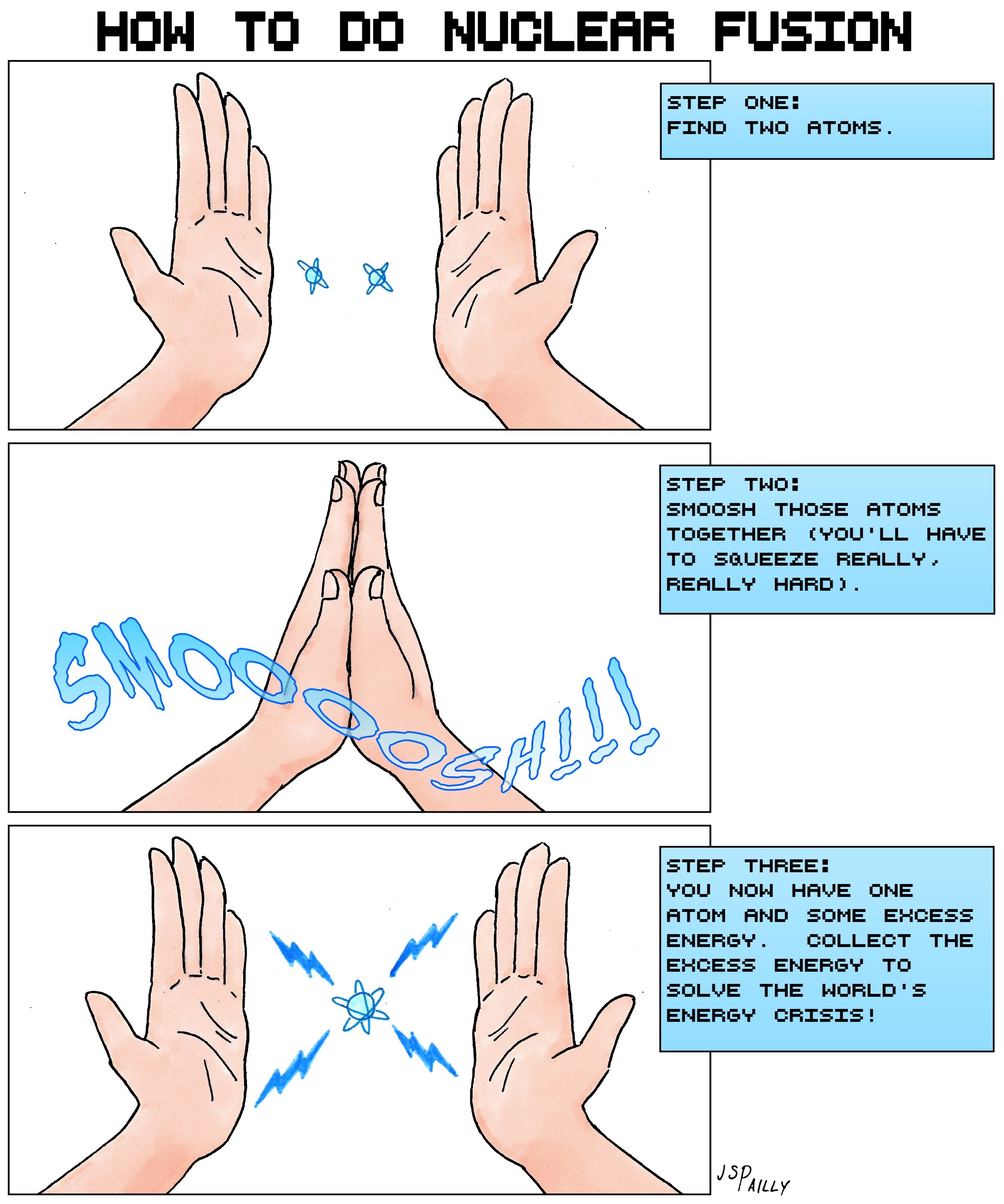
Nuclear fusion is super easy.  Here, let me show you.

The tricky thing is that you do need to squeeze really, really, really hard to make this work.  Atomic nuclei have matching magnetic charges—positive and positive—so whenever you want to fuse atoms together, you have to overcome the force of magnetic repulsion.  It takes enormous amounts of energy to do that.  Like, in the demonstration above, when I squeezed those two atoms together with my hands, I burned a ton of calories doing that.  Yes, the fusion reaction produced some energy at the end, but not as much energy as it took to make the reaction happen in the first place.  All things considered, this was a net energy loss for me.

But on December 5, 2022, researchers at the National Ignition Facility (NIF) in California—i.e., actual experts on this topic—caused a nuclear fusion reaction where the energy output exceeded the energy input.  How did they do it?  For one thing, they didn’t squeeze atoms together with their hands.  They did it with an elaborate system of lasers.  Specifically, they focused 192 lasers on one tiny capsule full of hydrogen isotopes.  It reportedly took 2.05 megajoules of energy to make the reaction happen, and 3.15 megajoules of energy came out of it.

This sort of nuclear fusion reaction, where hydrogen isotopes are fused together to make helium nuclei, does not produce radioactive waste.  There’s no carbon footprint.  If anything ever goes wrong, the reaction automatically stops itself; there’s no chain reaction that would lead to a Chernobyl-style or Three Mile Island-style nuclear meltdown.  NIF researches say that they should be able to improve the lasers, design better reaction capsules, and generally refine and perfect their nuclear fusion technique.  In a few decades, we should expect large scale nuclear fusion reactors to become commercially viable.

For anyone who (like me) worries about the climate and humanity’s growing energy needs, nuclear fusion sounds like a near perfect solution.  But I have learned, both in my personal life and by being a citizen of this planet, that whenever you solve one problem you inevitably create new problems.  You just have to hope your new problems are less problematic than the old ones.  When nuclear fusion becomes a commercially viable technology, it will be economically disruptive.  Companies will go out of business.  People will lose their jobs.  Also, one of the isotopes used in NIF’s experiment (a hydrogen isotope called tritium) is radioactive.  So in the future, nuclear fusion reactors may still require radioactive fuel, even if they don’t produce radioactive waste.

All that being said, commercially viable nuclear fusion is one of those Sci-Fi pipe-dreams that I never really expected to see happen in my lifetime.  Now, for the first time ever, I feel like there’s a light at the end of the tunnel when it comes to climate change and the energy crisis.  We’ll still have to survive the next few decades, and nuclear fusion will create new problems for us even as it solves some of our old ones.  But this is as near perfect a solution to our current problems as I can realistically imagine us finding.

However, as I said at the beginning of this post, I’m not an expert.  There’s still a lot I need to learn about nuclear fusion, climate change, and all the other stuff I mentioned in this post.  All I can say for certain right now is that I feel optimistic—more optimistic about humanity’s future than I have felt in a long, long time.

WANT TO LEARN MORE?

While researching this post, I saw a surprising amount of cynicism in the popular press.  I guess some people think if fusion can’t offer an immediate and 100% perfect solution to climate change, then it doesn’t offer a solution at all.  So if you want to learn more about this, I recommend watching this press conference from the U.S. Department of Energy and the following panel discussion with some of the researchers who were involved in NIF’s experiment.  Together, the press conference and panel discussion are about an hour and a half long, but you’ll be hearing straight from the people who did the work what they did and what it means.

Sciency Words: Barycenter

Hello, friends!  Welcome to Sciency Words, a special series here on Planet Pailly where we talk about those super weird (but super cool) words scientists like to use.  Today’s Sciency Word is:

BARYCENTER

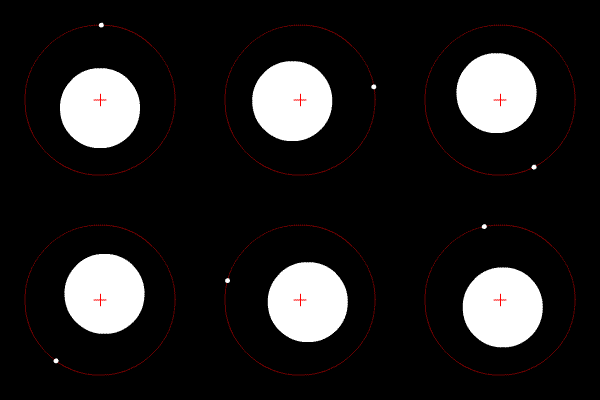
Tell me if you’ve heard this one: every action has an equal and opposite reaction.  This is true even for moons orbiting planets, or planets orbiting stars.  Whenever a star exerts gravitational force on a planet, that planet exerts an equal and opposite gravitational force on the star.  As a result of this ongoing gravitational tug-of-war, we end up with a planet and a star spinning round and round their common center of mass, a point which scientists call a barycenter.

Definition of barycenter: In astronomy, a barycenter is the center of mass of two or more objects in space that are gravitationally bound together.  

Etymology of barycenter: The word barycenter traces back to a Greek word meaning “weighty” or “heavy.”  The word barometer has a related etymology (barometers measure atmospheric pressure—the “weight” of the atmosphere, in other words).

Sometimes a barycenter will be located deep inside the more massive of two celestial bodies, in which case the more massive body will appear to wobble in place.  This is the case for the Earth and the Moon.  The Earth-Moon barycenter is approximately 1700 km beneath Earth’s surface.  Other times, the barycenter will be somewhere in the empty space between objects.  For an example, look at Pluto and its largest moon, Charon.  The Pluto-Charon barycenter is more than 900 km above the surface of Pluto.

The concept of a barycenter dates back to Isaac Newton (though I can’t find any sources saying he coined the word, nor could I find any evidence that he ever used the word himself).  Newton’s Principia Mathematica, originally published in 1687, briefly discusses the Sun-Jupiter barycenter, saying, “[…] the common centre of gravity of Jupiter and the sun will fall upon a point a little without the surface of the sun.”  Newton also discusses the Sun-Saturn barycenter, which he describes as “[…] a point a little within the surface of the sun.”

And then there’s the barycenter of the Solar System as a whole: the “common centre of gravity of all the planets,” as Newton calls it.  Due to the combined gravitational forces of all the planets (most especially that of the giant planets: Jupiter, Saturn, Uranus, and Neptune), the Sun is constantly being pulled in multiple directions at once.

As a result, the Sun does not sit still in the middle of our Solar System.  It is “agitated by perpetual motion,” to quote Newton one last time.  Sometimes, as the Sun moves about, it happens to pass through the Solar System’s barycenter. Other times, it loops and spirals around the barycenter, as if performing an elaborate dance.

WANT TO LEARN MORE?

Here are a few articles that go into a little more detail about barycenters:

And here’s a link to the translation of Newton’s Principia Mathematica that I quoted in this post.  The relevant section is titled “Proposition XII.  Theorem XII.”

#IWSG: Perpetual Self Doubt Machine

Are you a writer?  Do you feel insecure about your writing life?  Well then the Insecure Writer’s Support Group is the support group for you!  IWSG is a monthly blog hop created by Alex J. Cavanuagh and co-hosted this month by Jemima Pett, Debs Carey, Kim Lajevard, Sarah Foster, Natalie Aguirre, and T. Powell Coltrin.  If you want to learn more about this amazingly supportive group and see a full list of participating blogs, click here.

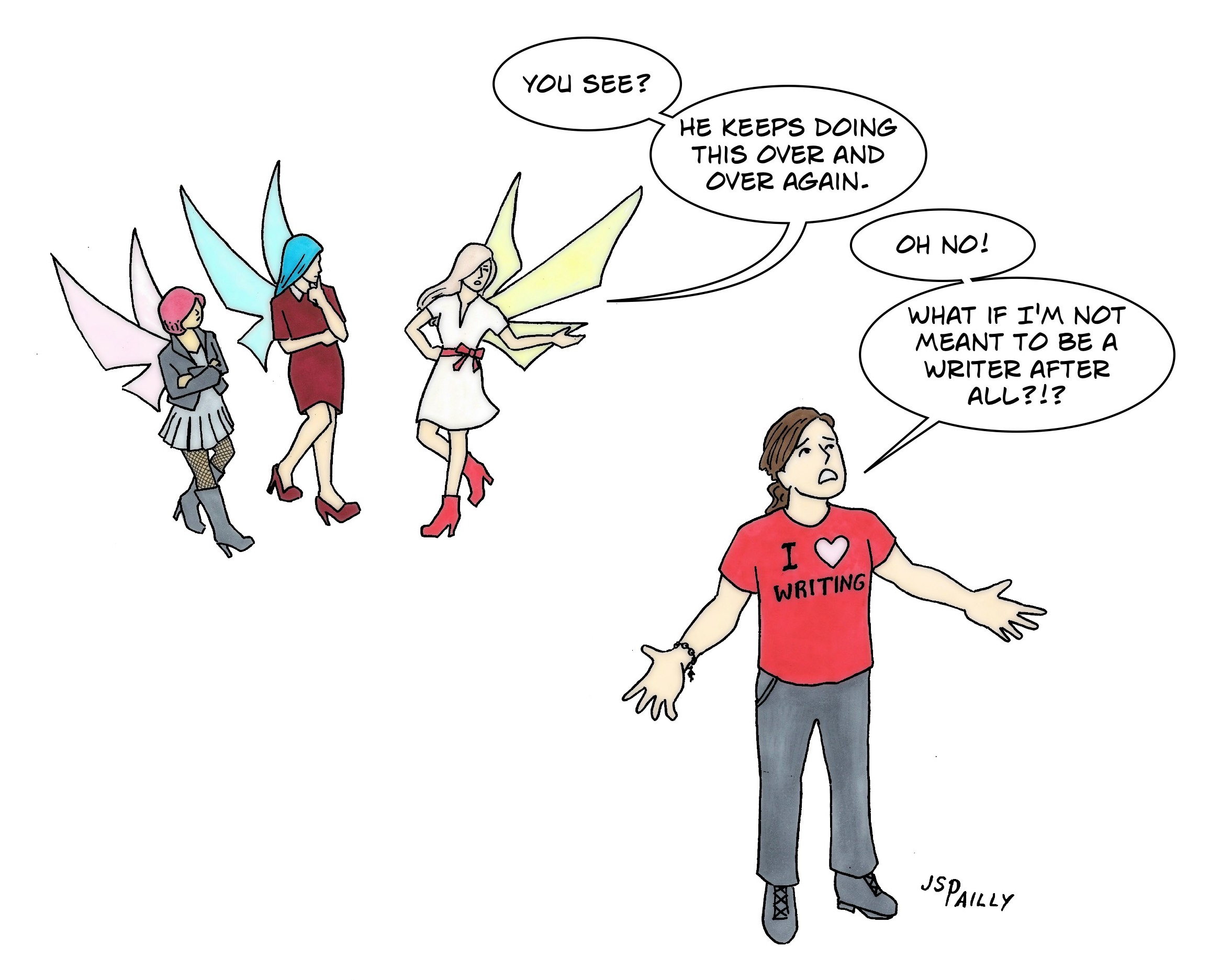
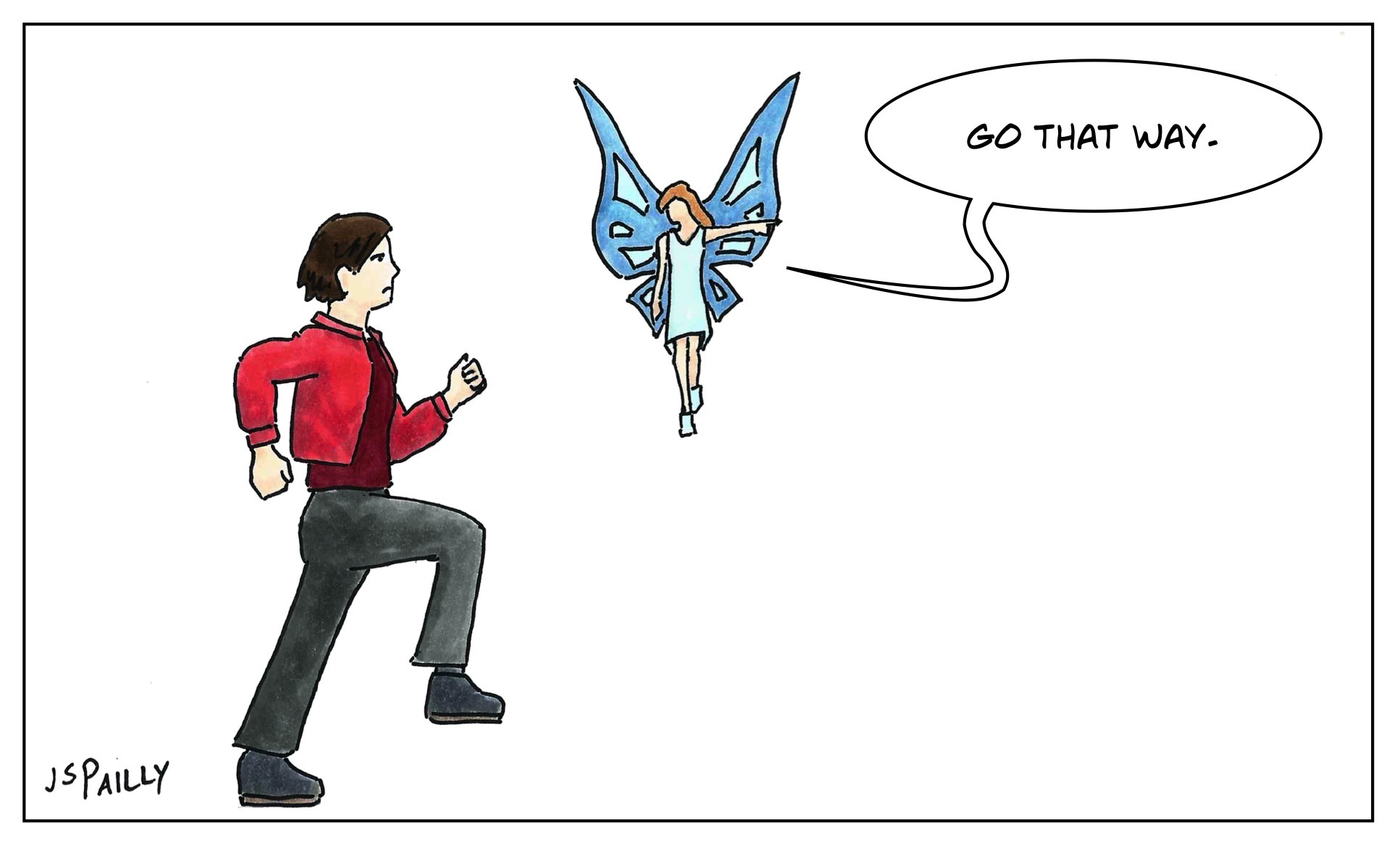
Hello, friends!  For today’s IWSG post, I’ve decided to turn the floor over to my muse, the magical fairy person who encourages me (sometimes by brute force) to do my writing.  She has something to say, and perhaps it’s something your muse would like to hear.

* * *

My fellow muses, what do you do when your writer stops believing that they’re a writer?  Writers write.  It’s the most natural and normal thing for them to do.  And yet many writers (my own included) make themselves miserable with self doubt.  My writer often starts asking himself questions like “Is writing really worth it?” or “Why am I doing this to myself?” or “What if it’s time to quit writing?”

From talking with other muses, I’ve learned that many creative humans struggle with these questions.  If only there were a way self doubt could be used to generate energy, the perpetual self doubt of writers and artists could be used to solve the humans’ energy crisis.

Recently, another human said a thing to my writer.  An insensitive and cruel thing.  As a direct result of this thing that was said, my writer started asking himself more frequently and fervently: “Should I give up on writing?”  Again and again, day and night, for weeks on end: “Should I give up?  Should I give up?  Should I give up?”

Obviously, the answer is no, but it was equally obvious that doubts and insecurities of this kind had been simmering beneath the surface for a long time already.  Otherwise, one single, careless comment would not have caused so much duress.  So rather than simply saying “no” to all this self-doubting and self-questioning, I offered a different question: “Should you, perhaps, give up on writing this one project—this one particular project that you’ve been stuck on for the past two or three years?”

That gave my writer pause.  That got my writer thinking again, got him wondering what he might write instead of that old writing project.  It got him to consider ideas that were fresh and new, ideas that are true to the person my writer is today, rather than the person he used to be several years ago.  Of course, my writer did not come up with these fresh new ideas without help.  I contributed to the process.  I am his muse, after all.

So, my fellow muses, if your writer keeps getting stuck on questions like “Should I give up on writing?” a simple “no” may not be sufficient.  A better answer may be to change or rephrase the original question.

A Brave New Year

Hello, friends!  Welcome to 2023!

I have big plans for the year to come, both for writing/blogging and for life stuff.  But first, I have a few announcements to make, and I’m not sure how you, dear reader, are going to react to some of this stuff.  Just please be assured that I didn’t make any of these decisions lightly.

My New Blogging Schedule

In 2023, I will continue to participate in the Insecure Writer’s Support Group (IWSG).  I will also continue to write Sciency Words.  My blog schedule should work something like this:

  • IWSG posts will come out on the first Wednesday of the month, as always.
  • On non-IWSG weeks, I plan to do two or three blog posts about science and/or science fiction.
  • Sciency Words posts will come out on Mondays, except during IWSG weeks.
  • Once a month, I’m going to do a post updating you about any new artwork available for sale in my RedBubble store.  If you’re not interested in these “advertisement” blog posts, you can ignore them.  I won’t be offended.

Also, I plan to participate in the A to Z Challenge again this year.  I’m still trying to narrow down what my theme will be, but I can tell you it will have something to do with space.  Obviously.

Experimenting with Social Media

I deleted my Facebook account a long time ago, and I have now also deleted my account on Twitter.  I used to really like Facebook.  I used to really like Twitter.  But these two social media platforms are just not fun anymore.  Not for me, at least, and so I’m moving on.

I’m a little commitment-shy with social media platforms right now, but I am genuinely enjoying Mastodon.  I’m also starting to play with Hive Social.  We’ll see how that goes.  If you want to connect with me on either of those platforms, my Mastodon address is @JSPailly@universeodon.com.  On Hive Social, I’m @JSPailly.

And if there are other social media platforms you think I should look into, let me know.  I plan to experiment with multiple platforms in the coming months, so I’m very open to suggestions.

The Future of Tomorrow News Network

This is the part I’m most nervous to tell you about.  A few years ago, I published a novella-length Sci-Fi story on Amazon.  The plan was for that story to be the first in a series of novella-length stories, all set in the same universe.  But then some stuff happened in my personal life, which messed up my writing agenda, and now I can’t follow through on that original plan.  I’m not the same person I was before, and my heart is just not in it.

So I’ve developed a new plan.  I’m super excited about this new plan.  It uses some of the same concepts and characters that appeared in the novella-length story I published before, but I’m taking those concepts and characters in a completely new and different direction.  Unfortunately, this creates significant continuity problems for me, and I’m afraid that leaving the original novella-length story out there would lead to a lot of confusion for readers.  So that novella is no longer available for sale.  I pulled it from Amazon.  I feel really awful about that, but there’s simply no way for me to move forward with my writing unless I give myself a clean slate.

As I said before, I didn’t make any of these decisions lightly—especially that last one—but now that the decisions have been made, I am really excited for the year to come.  And I hope that you, dear readers and dear friends, will join me for my new adventures in space, science, art, and writing.

#IWSG: Putting Science Into Science Fiction

Hello, friends!  Welcome to this month’s meeting of the Insecure Writer’s Support Group, a blog hop created by Alex J. Cavanaugh and co-hosted this month by Joylene Nowell Butler, Chemist Ken, Natalie Aguirre, Nancy Gideon, and Cathrina Constantine.  If you’re a writer and if you feel insecure about your writing life, click here to learn more about this amazingly supportive group!

I write science fiction.  That’s the only genre I’ve ever wanted to write, and I doubt that will ever change.  But when I was younger, I kind of hoped I could get away with writing Sci-Fi without really understanding science.  And you know what?  Maybe I could have.  I’ve read plenty of good Sci-Fi stories that went a little wishy-washy on the science.

At some point, though, I made the decision to do my research.  I made a commitment to learn the sciency stuff so that I could write better Sci-Fi.  Doing that research has helped me in more ways than I anticipated.

Suspending the Reader’s Disbelief with Science

I have a touch-and-go attitude about putting science in science fiction.  Sci-Fi doesn’t need to be 100% scientifically correct about everything all the time, but if you touch on a scientific fact now and then, it adds credibility to your story, and it makes it easier for the reader to suspend their disbelief when you start making stuff up.

Alternatively, if you make a laughably unscientific mistake, like describing the sound of an explosion in outer space or having a character see a laser blast coming straight toward her before it hits her, this will break the reader’s suspension of disbelief real quick.

Over the years, a few fellow writers have told me not to worry so much about scientific accuracy.  The average reader, they claim, won’t know if I get a science fact wrong.  And maybe they’re right, but science fiction readers are not the average reader.  It’s important to know your audience, and if you write science fiction, your audience includes a lot of people who are more scientifically literate than the general population.

Science if Full of Writing Prompts

I think I have a pretty active and vivid imagination.  I asked my muse, and she agrees with me about that.  But as imaginative as I may be, the universe out there, as science currently understands it, is far weirder and wilder than anything I could have dreamed up on my own.

Did you know birds recognize the constellations and use them to navigate?  Because they do.  Did you know there was a seventy year period of time when all the sunspots mysteriously vanished from the surface of the Sun?  Because that happened.  Did you know there are naturally occurring nuclear reactors on this planet?  Because there are!  Could any or all of these random science facts be used as writing prompts?  Yes.  Yes, they could.

Just about every time I do my science research, I find new ideas for stories.  Or, if I don’t find a totally new story idea, I find something new I can add to a story I’m already working on.

Using Science Role Models as Writing Role Models

If you ask most writers who their role models are, they’d probably point to people like Hemingway or King.  Those are perfectly fine role models, of course, but as I’ve fallen deeper and deeper down the science research rabbit hole, I’ve discovered curious parallels between the life of a writer and the life of a scientist.

The way Albert Einstein solved complex scientific problems with his imagination (for example, by imagining what might happen as trains and elevators accelerated to the speed of light), or the way Marie Curie kept doubling down on her research into X-rays, “uranium rays,” and other forms of radiation (which ultimately killed her, of course, but I still admire her relentless dedication to science)—these people are my role models now, in addition to people like Tolkien, Asimov, or Roddenberry.

Whenever I’ve struggling to write, whenever I’m stuck on some story problem that seems unsolvable, I think about people like Einstein or Curie.  I think about how they kept plugging away at the problems in front of them until they found solutions.

I’m not going to tell you that if you write science fiction, you must do your research.  I hate that “if X, then you must do Y” kind of writing advice.  Every writer is unique.  Every writer has their own approach to writing.  Do whatever feels right to you.  It is absolutely okay to make yourself the exception to the rule.

But doing my research has helped me in ways I never expected.  So if you’re not already doing research for your stories (Sci-Fi or otherwise), then I’d say its worthy giving research a try.

Thanks for reading, friends!  I look forward to chatting with you in the comments!

State of the Blog

Hello, friends!

Once again, sorry for not blogging in a while.  Today, I want to give you a quick update on what’s happening with me and my writing.

In October, some stressful things happened and derailed all my writing plans for the month.  But even before October happened, I felt like I was stuck in a writing rut.  I’d write hundreds of words per day, adding up to thousands of words per week, and yet I still felt like I was making absolutely no progress.  So my muse and I have agreed that it’s time to take my writing in a new direction.

Some decisions have already been made regarding Tomorrow News Network and other projects that I’d previously been working on.  Other decisions will be decided soon.  But I do know that my research process is going to stay the same, and this blog will continue to play a key role in how my research process works.

The #1 best way to learn is to try to explain whatever you’re learning to other people.  Doing that can reveal where your knowledge is strong and where it is still kind of hazy.  The discussions we have in the comments sections of my blog posts have been invaluable to me.  And also, I honestly do appreciate it when someone in the comments tells me that I’ve made a mistake.  Those discussions are invaluable to me, too.

My blogging and social media presence will be somewhat sporadic for the remainder of 2022, but I expect things to get back to normal in January of 2023.  Sciency Words will return on January 9th, and I hope to stick to a schedule of one to two posts per week after that.  The new direction I’m taking with Tomorrow News Network has already led me to some surprising and new (or at least new to me) science facts, which should lead to some fun conversations in the months to come.

So thank you, friends, for reading, and I look forward to talking with you more very soon.

#IWSG: Involuntary Writing Breaks

Hello, friends!  Welcome to this month’s meeting of the Insecure Writer’s Support Group, a blog hop created by Alex J. Cavanaugh and co-hosted this month by Diedre Knight, Douglas Thomas Greening, Nick Wilford, and Diane Burton.  If you’re a writer and if you feel in any way insecure about your writing life, click here to learn more about this amazingly supportive group!

At some point, every blogger has to say “sorry for not blogging in a while.”  This is then followed by the usual list of excuses: illness, family stuff, trouble at work, etc.  Today, it’s my turn.  Sorry for not blogging in a while.  I got sick (bad mayonnaise, probably), then there was some family stuff, plus a whole lot of trouble at work.  As I result, I didn’t have much time for blogging, or for any kind of writing, all month long.

Sometimes life forces you to take a writing break.  It’s frustrating for two reasons.  First, there’s the involuntary nature of this sort of writing break.  And second, even when life does settle down again, it takes time to get back into the rhythm and flow of writing.  Today, I’d like to share a few of the tricks I use to help myself bounce back from an involuntary writing break.

Drawing My Muse: As regular readers of this blog know, my muse is very real to me.  She started out as just another character in a story, then she evolved into something more.  I like to have a picture of my muse nearby whenever I do my writing.  So when I’m trying to bounce back from an involuntary writing break, my first step is to draw a new picture of my muse.  Like this new picture:

Re-Reading My Story: If my involuntary writing break interrupted me in the middle of a writing project, odds are I cannot just pick up again right where I left off.  So I’ll go back, re-read however much writing I got done before the break, and try to immerse myself in that particular story world once more.  This may take some time.  I may end up spending a few days—or perhaps a week or more—editing and re-writing stuff rather than working on new material.  But eventually, I’ll remember what I was trying to do with my story, and I’ll be able to make forward progress once more.

Writing an IWSG Blog Post: And lastly, another great tool to help me bounce back from an involuntary writing break is to write one of these IWSG posts.  I’ve made a commitment, both to myself and to the group, to do this once every month.  It’s a strong enough commitment that it keeps my writing habits alive, even in stressful times, and it’s always helpful to hear from fellow writers, whether they have advice and encouragement to offer, or whether they merely want to commiserate over the struggles we all face from time to time.

So do you have any tricks or techniques that help you bounce back from an involuntary writing break?  Let me know!  Seriously, please tell me.  I think I have a pretty good writing recovery strategy in place, but I’m looking for ideas to make it even better.

#IWSG: In Defense of Regrets

Hello, friends!  Welcome to this month’s meeting of the Insecure Writer’s Support Group, a blog hop hosted by Alex J. Cavanaugh and co-hosted this month by Tonja Drecker, Victoria Marie Lees, Mary Aalgaard, and Sandra Cox.  To learn more about this amazingly supportive group, click here.

I knew a girl once who lived by the motto “no regrets.”  She was rather insistent about this.  She insisted that no matter what happened, no matter how badly things turned out, she would never, ever have any regrets.  And… well… I don’t want to go into any details here, but… this girl seemed to keep making the same mistakes over and over again.  Regrets aren’t necessarily a bad thing, you see, so long as they help you learn.

Next year, I’ll be turning 40, and I have a lot of regrets.  A few too many, perhaps.  My biggest regret has to do with being queer.  I came out of the closet a few years ago.  I regret not coming out sooner.  You don’t know how heavy of a burden it is, carrying around a secret like that, until you finally put that burden down.

My second biggest regret—which is really not one big regret but a constellation of interconnected little regrets—has to do with writing.  So many opportunities came my way when I was younger, but I didn’t take them.  Sometimes it was fear that held me back.  Other times it was pride.  Whatever the cause, I missed out on a lot of things.  Maybe those things wouldn’t have worked out anyway; I’ll never know.

For those of you who are familiar with Star Trek, I sometimes feel like that alternate timeline version of Picard who never rose to the rank of captain and who was, instead, stuck as a junior grade science officer his whole life—all because he was too scared to take a risk.

I have other regrets, too: times when I hurt people, times when I let other people hurt me, times when I should have spoken up, and times when I really, really, really wish I’d kept my mouth shut.  I could wallow in all these regrets, of course, or I could treat them as lessons learned.

By acknowledging my past mistakes, I’ve learned to be kinder.  And when others are unkind to me, I’ve learned to have the self respect necessary to walk away from the situation.  Should I have come out of the closet sooner?  Yes.  But I’m out now, and I’m never going back.  And as for all those writing opportunities I missed… the real topic of this Insecure Writer’s Support Group post… well…

Despite what they say, opportunity does not strike once in a lifetime.  Opportunities keep cropping up over and over again throughout our lives.  It’s never too late.  Sure, I missed out on some opportunities when I was younger, and those specific opportunities are never coming back; however, there are other opportunities in front of me today.  And today, I know better than to let fear or pride or any other silly excuses hold me back.

I’m not going to end this post by asking if you have regrets or by saying “please share in the comments below.”  That would be super inappropriate!  But I do hope this was useful and encouraging to somebody, and if so I’d love to hear that.

P.S.: I do hope this post is helpful to somebody, but this is also my way of giving myself a pep talk.  I’m about to try a thing.  I’m about to take a risk.  It might not work out, and that’s fine.  If it does work, you’ll be hearing more about it in the future.  The important thing right now is that I’m trying.