Sciency Words: Dinosaur (An A to Z Challenge Post)

Programming note: If you’re here for today’s Insecure Writer’s Support Group post, please click here.

Today’s post is a special A to Z Challenge edition of Sciency Words, an ongoing series here on Planet Pailly where we take a look at some interesting science or science related term so we can all expand our scientific vocabularies together. In today’s post, D is for:

DINOSAUR

When I was a kid, dimetrodon was my favorite dinosaur. It has a sail on its back. How cool is that?

Then I found out that dimetrodon is not a dinosaur. It’s just a lizard. Then I found out from this video that it’s not even a lizard.

Also, pterodactyls aren’t dinosaurs. Neither are plesiosaurs or ichthyosaurs. None of my favorite dinosaurs were actually dinosaurs! Frustrating, isn’t it?

So today, I thought I’d give you a quick tip on how to tell when a “dinosaur” is actually not a dinosaur. Sciency Words is all about defining scientific terms, and paleontologists use several key features to define what is or isn’t a dinosaur. For example: the number of openings in the skull, the shape of the hip bone, the type of joint at the ankle….

If you’re a professional dinosaur scientist, you need to know this stuff. But for the rest of us, the easiest way to tell (in my opinion) is by looking at the orientation of the legs. Dinosaur legs are vertical to the ground, not horizontal. They go straight up and down, rather than being splayed out to the sides.

So if you think it’s a dinosaur, but the legs are splayed apart, it’s not a dinosaur.

If you’ve ever seen a crocodile or salamander try to run, you can understand why having your legs splayed apart like that is a disadvantage.

Standing upright on their vertical legs, dinosaurs had a much easier time walking and running on land. Also, vertical legs can support more weight, allowing dinosaurs to become much bigger and much heavier than their cousins, the amphibians, reptiles, and whatever the heck dimetrodons were.

Next time on Sciency Words: A to Z Challenge, we’ll find out what our planet’s name is.

Sciency Words: Centaur (An A to Z Challenge Post)

Today’s post is a special A to Z Challenge edition of Sciency Words, an ongoing series here on Planet Pailly where we take a look at some interesting science or science related term so we can all expand our scientific vocabularies together. In today’s post, C is for:

CENTAUR

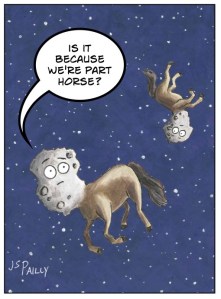
As I mentioned in my first Sciency Words: A to Z Challenge post, some scientific terms are kind of dumb. This isn’t one of them. I actually think this one’s pretty clever. There’s a class of large objects in the Solar System that astronomers have decided to call centaurs.

Eh… no. These objects have nothing to do with horses, but they are sort of half one thing and half another! When they were first discovered, astronomers were confused because centaurs appeared to have the characteristics of both asteroids and comets.

I first learned about centaurs in this article from Discovery News. It’s now believed that centaurs originally came from the Kuiper belt—a sort of second asteroid belt that lies beyond the orbit of Neptune. Basically, they came from Pluto’s neighborhood.

Due to gravitational interactions with the gas giants, these objects were pulled inward. The now have highly unstable orbits crossing between the orbits of Neptune and Jupiter. Eventually, further gravitational interactions may hurl a centaur into the inner Solar System, putting it within melting distance of the Sun and transforming it into a full-fledged comet.

Originally, the International Astronomy Union wanted to name all the centaurs after actual centaurs from Greek mythology. But they quickly ran out of names. Now the official naming theme includes all mythical hybrids and/or shape-shifters. Examples include Typhon (half man, half dragon), Ceto (half woman, half sea monster) and Narcissus (a man who transformed into a flower).

Next time on Sciency Words: A to Z Challenge, we’ll find out why dimetrodon is not a dinosaur.

Sciency Words: Brontosaurus (An A to Z Challenge Post)

Today’s post is a special A to Z Challenge edition of Sciency Words, an ongoing series here on Planet Pailly where we take a look at some interesting science or science related term so we can all expand our scientific vocabularies together. In today’s post, B is for:

BRONTOSAURUS

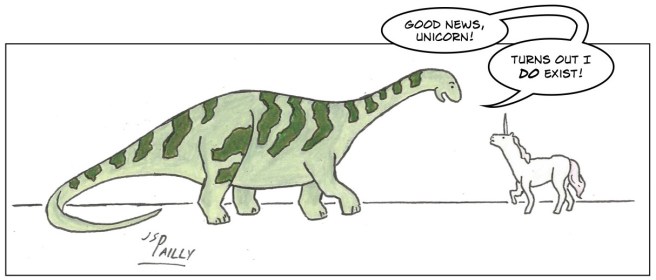
I’ll never forget that sad moment in my childhood when I found out that brontosaurus is not a real dinosaur. Someone made a mistake, and we had to call brontosaurus apatosaurus instead.

Here’s a quick rundown of events in the brontosaur/apatosaur naming controversy:

  • 1877: A dinosaur skeleton is discovered and given the name scientific name (genus and species) Apatosaurus ajax.
  • 1879: Another dinosaur skeleton is discovered and given the name Brontosaurus excelsus.
  • 1903: Upon further examination, it’s determined that these two dinosaur specimens are too closely related and should be classified as the same genus. Since the genus Apatosaurus was identified first, Brontosaurus excelsus became Apatosaurus excelsus.

On a personal note, I was stunned to find out all this happened way back in 1903. When I was a kid, I was under the impression that this was a much more recent development.

Anyway, there’s some good news for brontosaurus fans. In 2015, Brontosaurus was reinstated as its own genus. Turns out that while those two skeletons are very similar, there’s enough of a difference in the structure of the neck to justify classifying them separately.

By the way, brontosaurus means “thunder lizard,” because of the sound it must have made when it walked. Apatosaurus apparently means “deceptive lizard.” I’m not sure why they called it that back in 1877, but after this case of attempted identity theft, I’d say the name fits.

Next time on Sciency Words: A to Z Challenge, we’ll head out into space and meet some centaurs.

Sciency Words: Acetic Acid (An A to Z Challenge Post)

Today’s post is a special A to Z Challenge edition of Sciency Words, an ongoing series here on Planet Pailly where we take a look at some interesting science or science related term so we can all expand our scientific vocabulary together. In today’s post, A is for:

ACETIC ACID

Chemists have several different ways to define what an acid is (specifically, they have three definitions for acids and bases). But in many if not most cases, the key distinguishing feature of an acid is what I like to call a “dangling proton.”

By that I mean there’s a single proton (a.k.a. a hydrogen ion) sort of sticking off the side of the molecule. This proton is only loosely attached, and it could easily break off given the opportunity. With that in mind, I’d like you to mean acetic acid.

You probably know acetic acid best for its staring role in vinegar. Vinegar is a mix of water, acetic acid, and sometimes traces of other things for flavor.

I probably first heard about acetic acid in school, long before I had any reason to care about chemistry. It wasn’t until more recently, when I committed myself to learning this science stuff for the sake of becoming a better science fiction writer that I really found out what acetic acid is.

I decided to start the A to Z Challenge with acetic acid because the name illustrates something that I think is an important thing to know about scientific terms: some of them are kind of dumb. The “acetic” in acetic acid comes from the Latin word acetum, which means acid.

So acetic acid literally means “acid acid.” Not very creative, chemists.

Next time on Sciency Words: A to Z Challenge, we’ll find out what the deal is with the name brontosaurus.

Sciency Words: A to Z Challenge

I’ve wanted to do this for a while now, but every year I chicken out. It’s a lot of writing. That by itself is intimidating. For me, it’ll be a lot of research and a lot of drawing as well, all packed into twenty-six days.

I nearly chickened out again, but this year I’m finally doing it. I’m doing the A to Z Challenge. Throughout the month of April, I’ll be posting every day (excluding Sundays), with each post proceeding through the alphabet letter by letter. And my theme will be Sciency Words (obviously).

For those of you who might be new to my blog, Sciency Words is a weekly series where we look at some interesting new science or science related term so we can all expand our scientific vocabularies together.

I’m going to use the A to Z Challenge as an opportunity to cover some terminology that I’ve never really had a good reason to cover before. I’ll also revisit a few terms that I’d like to say more about. And while we’re at it, we might touch on a few controversies surrounding the definitions of certain terms.

Don’t worry, Pluto. We’ll get to you.

So tune in beginning tomorrow for the Sciency Words: A to Z Challenge. We’ll be starting with acetic acid.

A to Z Challenge Links

Main Website: www.a-to-zchallenge.com

Facebook Page: www.facebook.com/atozchallenge

Twitter: @AprilAtoZ

Twitter Hashtag: #atozchallenge

Why Sci-Fi?

Today, my first official post as a contributor for Universe of Possibilities is up. Universe of Possibilities is a new Sci-Fi hub started by Simon Farnell. My post is about how I got into science fiction in the first place.

This ended up being a more personal kind of post than I originally intended, but that’s okay. Science fiction lies at the heart of who I am as a person. A post like this was bound to touch on some personal stuff.

Looking for Life in All the Wrong Places

It’s been over a month since my trip to KIC 8462852, better known as Tabby’s Star. And yes, my trip was totally for real. I was actually there and saw the alien megastructure for myself. You can trust me on this.

Anyway… I did a lot of research and reading to prepare for my trip, and I noticed a common theme in almost all the papers and articles I read: whatever’s happening to Tabby’s Star, it was very easy for us Earthlings to miss. In fact, it almost was missed.

Tabetha Boyajian herself (for whom Tabby’s Star is named) initially dismissed the star’s anomalous light curve as faulty data. And that could have been the end of it, no further investigation required.

It’s almost dumb luck (plus the persistence of a few citizen scientists) that Boyajian and others ended up taking a second look at that “faulty” data and realized it wasn’t a problem with the telescope, that something legitimately weird was going on.

Enrico Fermi Still Whats to Know: Where Is Everybody?

I’m bringing this up because I think it has interesting implications for the Fermi Paradox. Circa 1950, physicist Enrico Fermi argued that advanced space faring civilizations should be out there somewhere, and furthermore Fermi said we should have seen them or heard from them by now. So where is everybody?

Now I don’t want to oversell my point here, because there are a lot of possible answers to Fermi’s question. Maybe we really are alone in the universe, or maybe intelligent life is less common than Fermi assumed. Or maybe intergalactic law forbids making contact with primitive worlds like Earth.

But it’s also possible—in my opinion, very possible—that evidence of alien civilizations is there, but we’ve just missed it. Maybe we haven’t been looking in the right places, or maybe we haven’t been looking for the right things. Tabby’s Star is a perfect example. I don’t know if aliens are responsible for what’s happening to Tabby’s Star… wait, I mean I do know, because I was there and saw the aliens. No really, I did.

Umm… anyway… even if there weren’t an alien megastructure, the story of Tabby’s Star should tell us something about how easy it is for us to overlook what’s happening right in front of our eyes—or what’s happening right in front of our telescopes.

Sciency Words: The Fermi Paradox

Today’s post is part of a special series here on Planet Pailly called Sciency Words. Each week, we take a closer look at an interesting science or science-related term to help us expand our scientific vocabularies together. Today’s term is:

THE FERMI PARADOX

Enrico Fermi was an Italian physicist, one of the many great scientists who immigrated to the United States right before the outbreak of World War II. He is most noted for creating the first nuclear reactor and the role he played in the development of the atomic bomb.

But that’s not what we’re going to talk about today. Today we’re talking about something Fermi said half-jokingly over lunch.

Where Is Everybody?

Based on some historical detective work, we can say this probably happened in the summer of 1950. Fermi was visiting the Los Alamos National Laboratory. He and a few colleagues were having a lunchtime conversation about flying saucers. Apparently there had been an amusing cartoon about little green men in a recent edition of the New Yorker.

The conversation got serious (sort of) when Fermi suddenly asked: “but where is everybody?” Everyone at the table laughed, but Fermi’s question and the not-entirely-serious discussion that followed would become the basis of what we now call the Fermi paradox.

As a matter of statistics and probability, it seems like advanced alien civilizations should be out there somewhere. There are over 100 billion stars in our galaxy. Many (if not most) of these stars have planets orbiting them. Some of these planets must surely support life, and in at least a few cases intelligent life—life capable of developing interstellar travel.

Even without faster-than-light technology, one or more of these space-faring civilizations could conceivably spread across the whole galaxy in just a few million years. The galaxy is far, far older than that. There’s been plenty of time for the aliens to do it. So where is everybody? Shouldn’t we have heard from somebody by now?

Or so Fermi argued over his club sandwich (or whatever he was eating) in a half-serious conversation about flying saucers. Of course there are plenty of objections to Fermi’s line of reasoning here, but I’m not going to weigh in on that. Not today. I’m saving my opinion for Monday’s post.

Sciency Words: Magnetar

Today’s post is part of a special series here on Planet Pailly called Sciency Words. Each week, we take a closer look at an interesting science or science-related term to help us expand our scientific vocabularies together. Today’s term is:

MAGNETAR

Space has a lot of cool ways to kill you. This one’s especially nifty! Magnetars are neutron stars with intensely powerful magnetic fields. Like, absurdly powerful magnetic fields.

Fly your spaceship near a magentar, and that overpowered magnetic field will start pulling the electrons off your atoms. This will kill you. It’ll destroy your spaceship too. Without those electrons, chemical bonds don’t work. Your molecules will unravel, and you and your ship will just disintegrate.

Even from a distance, magnetars are a menace. In 2004, a strong burst of gamma radiation washed over Earth, compressing our planet’s magnetic field and partially ionizing our atmosphere. That gamma radiation came from a magnetar on the other side of the galaxy.

If a magnetar could do that to us from so far away, just think what it must have done to any alien civilizations that happened to live closer. I can’t help but imagine there’s a vast dead zone on the other side of the galaxy, with magnetar SGR 1806-20 right in the middle.

The good news is that magnetars don’t last long. Their magnetic fields decay rapidly, so these raging monsters turn into regular neutron stars within a few thousand years. Also, while their outbursts of gamma rays and X-rays can affect our planet, there aren’t any magnetars close enough to Earth to really threaten us.

Oh wait. Yes there are. Sort of.

Sneezing in Space

So in case you were wondering: yes, astronauts do sometimes sneeze in their spacesuits. And no, there’s nothing they can do about it when it happens. The sneeze just splatters on the helmet’s faceplate.

I believe I first read about this in one of those Time Magazine specials I reviewed last year (click here or here).

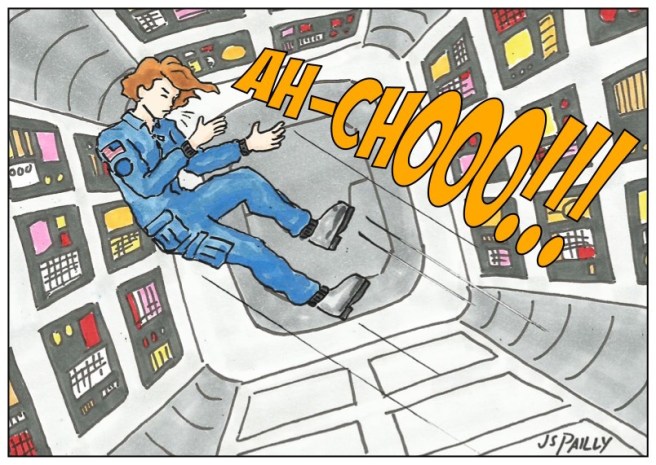
The thing I really want to know is how the force of the sneeze affects the astronaut’s motion, especially when the astronaut is not wearing a helmet. For example, what happens when an astronaut is floating freely aboard the I.S.S. or some other spacecraft and suddenly sneezes?

I’d imagine the force of the sneeze could have some amusing propulsive effects in microgravity.