Sciency Words: Metallicity (An A to Z Challenge Post)

Today’s post is a special A to Z Challenge edition of Sciency Words, an ongoing series here on Planet Pailly where we take a look at some interesting science or science related term so we can all expand our scientific vocabularies together. In today’s post, M is for:

METALLICITY

Astronomers. All the other scientists had a meeting, and they all agree: there’s something wrong with those astronomers. For some reason, astronomers do not understand what is or is not a metal.
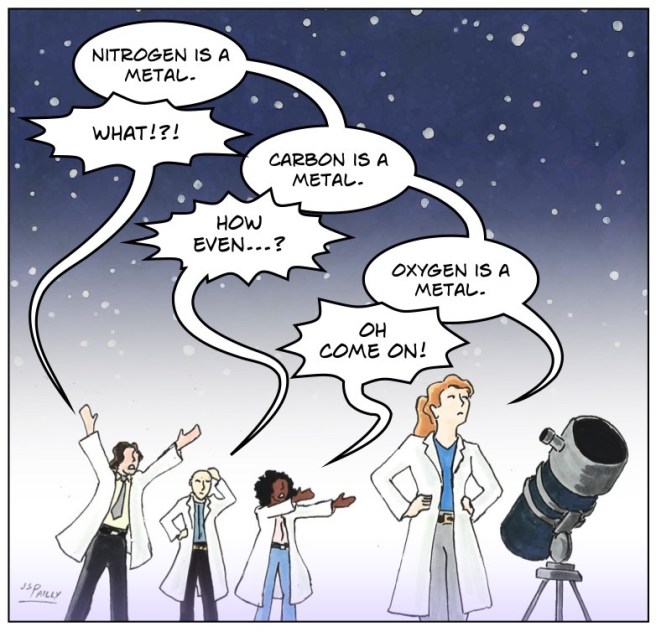
According to astronomers, the only elements that aren’t metals are hydrogen and helium.

Now it does make sense for hydrogen and helium to be special in astronomers’ eyes. By mass, something like 75% of the observable universe is hydrogen. Helium makes up almost all of the remaining 25%. And the hundred-plus other elements on the periodic table? All combined, all that other stuff constitutes less than 1% of the observable universe.

So for astronomers, it’s convenient to have a word that lumps all this “other stuff” together. But why does that word have to be metal? I’ve never found a wholly satisfactory answer for this, but I do have a personal theory.

Turns out that in technical shorthand, the amount of “other stuff” in a star is represented as [Fe/H]. That’s the chemical symbols for iron (Fe) and hydrogen (H). In other words, the amount of “other stuff” is quantified as a ratio (sort of) of iron to hydrogen (the math is a little more complicated than a simple ratio, but I won’t to get into that here).

I’m guessing that out of all the non-hydrogen, non-helium atoms you might expect to find in a star, iron must be the easiest—or at least one of the easiest—to identify with a spectroscope, and thus iron serves as a convenient proxy for everything else.

The quantity represented by [Fe/H] is called metallicity. Everyone would agree that iron is a metal, so that makes sense. But since metallicity actually tells us more than just the iron content of a star—since it also gives us a sense of how much carbon and silicon and argon etc is in that star—suddenly the word metallicity is covering metals and non-metals alike, in a way that comes across as very odd to everyone who isn’t an astronomer.

Next time on Sciency Words: A to Z, an electron by any other name would still be negatively charged.

Sciency Words: Libration (An A to Z Challenge Post)

Today’s post is a special A to Z Challenge edition of Sciency Words, an ongoing series here on Planet Pailly where we take a look at some interesting science or science related term so we can all expand our scientific vocabularies together. In today’s post, L is for:

LIBRATION

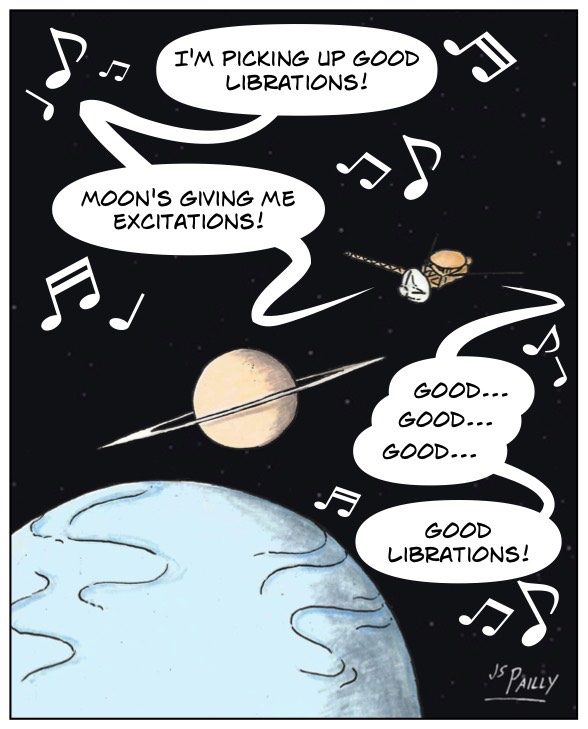
The Moon is tidally locked to the Earth, meaning one side is always facing toward us and the other side is always facing away. Except this tidal locking isn’t perfect. The Moon rocks back and forth just a little bit.

The technical term for this is libration. It comes from a Latin word meaning balance. In the visual simulation above (courtesy of Wikipedia), we can see the phases of the Moon on fast-forward. We can also see that the Moon moves a little closer to us and then a little farther away, due to its elliptical orbit.

And if you watch closely, you can see the Moon rocking or swaying back and forth. If you’re having trouble seeing it, I recommend picking a surface feature—a crater, perhaps—and following it with your eyes.

Of course our Moon isn’t the only moon that librates. I first learned about libration from a paper about Enceladus, a moon of Saturn.

Thanks to the Cassini mission, we were able to get extremely precise measurements of Enceladus’s libration, and we discovered Enceladus librates a lot. Like, a whole lot.

Enceladus librates so much that it cannot be solid all the way through. Instead, there must be a vast ocean of liquid water sloshing around inside, with only a thin, icy crust floating on top.

That’s a big deal because with all that liquid water, there’s a chance that maybe—just maybe—Enceladus could support life.

Next time on Sciency Words: A to Z, we’ll talk about metal. Everyone knows what metal is. Everyone except astronomers.

Sciency Words: Kilogram (An A to Z Challenge Post)

Today’s post is a special A to Z Challenge edition of Sciency Words, an ongoing series here on Planet Pailly where we take a look at some interesting science or science related term so we can all expand our scientific vocabularies together. In today’s post, K is for:

KILOGRAM

We’ve already met the International Astronomy Union and the International Commission on Stratigraphy. There are lots of international science organizations like these, and a big part of their job is to set official definitions for scientific terms, so that the use of these terms doesn’t cause confusion in scientific discourse.

Today we’ll get to know the International Bureau of Weights and Measures, which is in charge of defining all the units of measurement for the metric system. Originally, all the metric system units were based on physical prototypes. So for example, there was a prototype meter stick. A meter was equal to however long that meter stick was, and all other meter sticks had to be cut to match the prototype.

And if something happened to the prototype meter stick, if it got shorter or longer somehow, then by definition the meter would get shorter or longer too. As you can imagine, this caused problems.

Over the years, the International Bureau of Weights and Measures has been redefining all the metric system units using universal constants like the speed of light or other fixed values like the triple point of water. They’ve been able to do this for every unit except one: the kilogram.

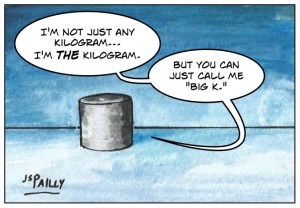
The kilogram is still based on a protoype: a cylinder of platinum/iridium alloy made in the late 1880’s.

Actually, most people call it Le Grand K because it’s located in France. On very, very rare occasions, Le Grand K is taken out of its high security vault and compared to other weights, which are then used to calibrate measuring instruments all around the world.

Unfortunately, it seems Le Grand K has lost a little weight. A very, very little amount of weight. Its total mass appears to have decreased by 0.05 milligrams. You’d need to be doing some extremely precise measurements before the change in Le Grand K’s mass would matter, but of course there are scientists and engineers out there who are doing those kinds of extremely precise measurements. Or at least they’re trying to.

But a fix for the kilogram may be on its way, using Planck’s constant and Einstein’s famous E = mc2 equation. Assuming the math checks out, the International Bureau of Weights and Measures might be able to retire Le Grand K by the end of 2018.

Next time on Sciency Words: A to Z, let’s get ready to librate!

Sciency Words: Juno (An A to Z Challenge Post)

Today’s post is a special A to Z Challenge edition of Sciency Words, an ongoing series here on Planet Pailly where we take a look at some interesting science or science related term so we can all expand our scientific vocabularies together. In today’s post, J is for:

JUNO

The current NASA mission exploring Jupiter is named Juno. That stands for Jupiter Near-polar Orbiter. Except not really. I’m pretty sure someone came up with that acronym long after the Juno mission was already named.

According to a press release from 2011, NASA named its Jupiter mission after the Roman goddess Juno (a.k.a. Hera), the wife of Jupiter (a.k.a. Zeus). Now if you’re at all familiar with Greek and Roman mythology, you know Jupiter and Juno didn’t exactly have an ideal marriage.

In that 2011 press release, NASA reminds us of one specific story in which Jupiter tried to hide his “mischief” behind a veil of clouds. Of course the whole veil of clouds routine didn’t work, and Juno saw right through her husband’s trickery.

NASA was kind of brilliant with this specific mythological reference. It’s a lot cleverer than some silly acronym.

The Juno space probe is equipped with ultraviolet and infrared cameras, which can see through the top most layers of Jupiter’s atmosphere. Even better, Juno is carrying instruments for studying Jupiter’s magnetic field, which will indirectly tell us more about the planet’s core. And Juno will be mapping the planet’s gravitational field, which will reveal how mass is distributed in the planet’s interior.

In other words…

Next time on Sciency Words: A to Z, what’s the total mass of a kilogram?

Sciency Words: I.A.U. (An A to Z Challenge Post)

Today’s post is a special A to Z Challenge edition of Sciency Words, an ongoing series here on Planet Pailly where we take a look at some interesting science or science related term so we can all expand our scientific vocabularies together. In today’s post, I is for:

I.A.U.

Yesterday I mentioned the International Commission on Stratigraphy (I.C.S.), the organization that assigns names to the geological strata of our planet. When you really get into this sciency words stuff, it seems like just about every single field of scientific research has its own international commission or union or organization like the I.C.S.

Which brings us to the International Astronomy Union or I.A.U. I’m willing to bet you already know about this organization, even if you didn’t know its name. They did something that made them very famous. Or perhaps I should call them infamous. And what did the I.A.U. do to become so infamous?

Yup. They’re the people who decided Pluto isn’t a planet.

Also, if you’ve ever wanted to name a star after your girlfriend or boyfriend or most beloved pet, the I.A.U. would like you to know that you’re not allowed to do that. Sorry. (They’re not actually sorry.)

Okay, it’s easy (and fun) to get mad at the I.A.U. over Pluto, and I know it’s disappointing to find out your thoughtful star name gift isn’t valid. I’ve known people to get pretty upset about that star name thing.

But according to the I.A.U.’s website, their goal is to establish “unambiguous astronomical nomenclature” for use in scientific literature. That means assigning official names to astronomical objects and writing official definitions for terms astronomers use, so as to avoid confusion or miscommunications in scientific discourse.

While I’m not exactly a big fan of the I.A.U., I do get where they’re coming from. Having dozens of stars named Jessica or Mary or Bobby would create a lot of confusion. And as for that matter with Pluto… we’ll come back to that later this month.

Next time on Sciency Words: A to Z, we’ll say hello to NASA’s Juno mission.

Sciency Words: Holocene (An A to Z Challenge Post)

Today’s post is a special A to Z Challenge edition of Sciency Words, an ongoing series here on Planet Pailly where we take a look at some interesting science or science related term so we can all expand our scientific vocabularies together. In today’s post, H is for:

HOLOCENE

Real dinosaur fans can tell you that dinosaurs lived in the Mesozoic Era, a geological era that is subdivided into the Triassic, Jurassic, and Cretaceous Periods.

Real fans of humans can tell you that humans live in the Cenozoic Era, in a subdivision called the Quaternary Period, in a further subdivision known as the Holocene Epoch—a name which can be translated from Greek to mean “entirely recently.” Again, scientists, you can be more creative than that.

This “entirely recent” epoch began approximately 11,700 years ago, a time which corresponds loosely to the end of the most recent ice age and also corresponds loosely to what archeologists call the mid to late Stone Age.

Major developments during the Holocene include melting glaciers, the extinction of animals like the woolly mammoth and saber-toothed tiger, and of course the rise and spread of human civilization.

The Holocene ends with… well, obviously we don’t know how it ends. Or maybe we do.

There’s an ongoing debate among geologists about whether or not the Holocene has ended already. Some say a new geological epoch—called the Anthropocene—has begun. Anthropocene is derived from the Greek word for human, and it would be characterized by the effects human activities are having on the geology of this planet.

The International Commission on Stratigraphy is in charge of naming geological time periods and defining their start and end points, and the I.C.S. has a working group studying the Holocene vs. Anthropocene issue.

If the Anthropocene is accepted as an official geological epoch by the I.C.S., then the Holocene may have ended about two hundred years ago with the beginning of the Industrial Revolution. There’s an alternative proposal that would have the Holocene end in the mid-20th Century with the dawn of the nuclear age, because changing levels of radioisotopes in rock strata would make the boundary between the two epochs easier to identify. And there’s a proposal to make the Anthropocene a subdivision within the Holocene, rather than making it its own separate epoch.

Whatever the I.C.S. decides to do, their decision will probably be controversial. But it won’t be the first time an international organization like this stirred up controversy over how to define scientific terms. More on that tomorrow.

Sciency Words: Gravity (An A to Z Challenge Post)

Today’s post is a special A to Z Challenge edition of Sciency Words, an ongoing series here on Planet Pailly where we take a look at some interesting science or science related term so we can all expand our scientific vocabularies together. In today’s post, G is for:

GRAVITY

We’ve all heard the story about how Isaac Newton discovered gravity.

But Newton’s discovery was not just that objects fall to the ground. Other people had noticed this before.

Newton’s real breakthrough was realizing that the same force which causes apples to fall also holds the Moon in its orbit around the Earth. Previously, it had been assumed that earthly physics here on the ground must be different from the celestial physics of the Moon, the planets, and the stars.

This is why Newton called his discovery the law of universal gravitation: because he believed his law must apply no matter where you are in the universe. Of course Newton didn’t know the planet Mercury was “breaking the law,” so to speak, nor did he know about black holes.

But I don’t want to get into Einstein and general relativity. Not today, at least. For today’s post, I just want to focus on the word gravity itself. Where did that word come from?

I used to think it was really cool how a scientific term like gravity had spread out and acquired additional shades of meaning in the English language. Think of a phrase like “the gravity of the situation,” where gravity means something like importance or seriousness.

But I’ve since learned that it actually happened the other way around. English originally borrowed gravity from French, and the word can be traced back to Latin. It originally meant something like dignified or serious. It could also mean weighty, in the sense of either metaphorical or literal weightiness.

But the idea of defining gravity as a physical force permeating the universe, causing objects to be attracted toward one another—that’s apparently an invention of Newton and his contemporaries. So now I think it’s really cool how science can take a word we already had and give it a whole new meaning.

Next time on Sciency Words: A to Z Challenge, we’ll talk about humans. Oh no, wait… that’s not my pick for the letter H. I have a much more interesting H-word to talk about; but humans will be involved.

Sciency Words: Frost Line (An A to Z Challenge Post)

Today’s post is a special A to Z Challenge edition of Sciency Words, an ongoing series here on Planet Pailly where we take a look at some interesting science or science related term so we can all expand our scientific vocabularies together. In today’s post, F is for:

FROST LINE

They say it’s cold in space. That’s not quite true. First off, how do you define what temperature means in a vacuum? That’s a much harder question that you might think.

But secondly—and more importantly for today’s post—a lot depends on where you are in space, because if you happen to be anywhere near a star, I guarantee you will feel the heat.

If you read enough scientific literature about space, you’ll eventually encounter the term “frost line,” and you’ll probably be able to guess from context what it means. Objects on one side of the line are close enough to the Sun for ice to melt (or more likely, sublimate), while objects on the other side are far enough away that ice remains frozen.

In our Solar System, the frost line is usually placed somewhere in the middle of the asteroid belt.

But there’s a lot of disagreement about where specifically the frost line is, in large part because there’s a lot of disagreement about how, specifically, the term should be defined.

Some astrophysicists define the frost line based on temperature conditions in the Solar System today. Others define it based on conditions from back when the Solar System was still forming. Also, there can be different frost lines for different chemicals, because the freezing point of water is different than that of methane or nitrogen or carbon dioxide.

This is a case of how some scientific terms are more clearly and precisely defined than others. And yet despite all the ambiguity about the frost line (or lines), it is still an incredibly useful term to help describe the layout of the Solar System. Which is why, if you read enough scientific literature about space, you are bound to come across this term eventually.

Next time on Sciency Words: A to Z Challenge, where did the word gravity come from?

Sciency Words: Earth (An A to Z Challenge Post)

Today’s post is a special A to Z Challenge edition of Sciency Words, an ongoing series here on Planet Pailly where we take a look at some interesting science or science related term so we can all expand our scientific vocabularies together. In today’s post, E is for:

EARTH

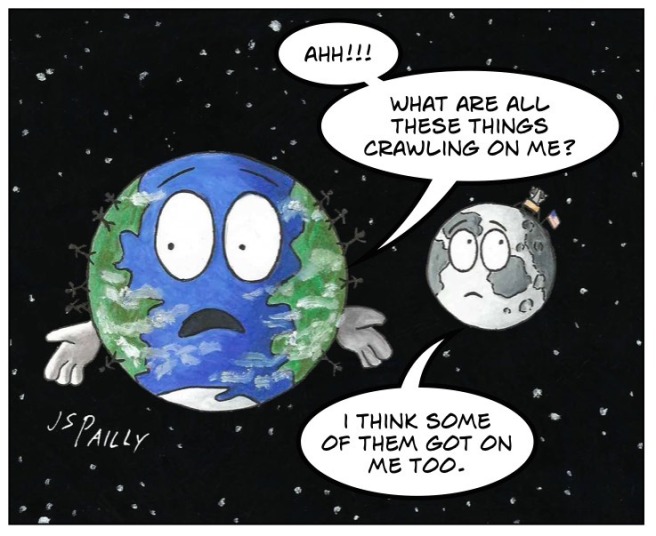
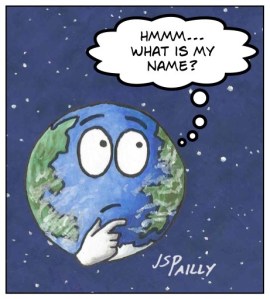
What planet do you live on? What is its name? Officially?

If you’re a regular reader of science fiction, you may have seen your home planet referred to by several “official” names: Terra, Gaia, Telluria, or perhaps Sol III.

But in real life, the International Astronomy Union (I.A.U.) is the only organization that gets to decide what planets and other objects in space are officially named. We’ll be hearing a lot about the I.A.U. as this Sciency Words: A to Z challenge continues.

And according to the I.A.U., our planet is officially and unambiguously named Earth. Except when it’s not. The I.A.U. makes the concession that Earth’s name is different in different languages, though they do insist that it should always be treated as a proper noun.

That may seem like common sense. It would be extremely culturally insensitive to force the English name for our planet on every other culture in the world. But in fact the I.A.U. seems to be making a special exception for Earth (and also for the Sun, the Moon, and the Solar System) by allowing other languages to use other names.

For example, they want you to call Mars Mars regardless of what language you speak, at least for the purposes of scientific discourse. Saturn should always be called Saturn, and Pluto should always be called Pluto—and don’t you dare call Pluto a planet!—according to the I.A.U.

As I said, we’ll be hearing a lot about the I.A.U. as the month progresses.

Next time on Sciency Words: A to Z Challenge, we’ll leave Earth (or whatever it’s called) behind and visit a frostier region of the Solar System.

IWSG: Risks

Today’s post is part of the Insecure Writer’s Support Group, a blog hop where insecure writers like myself can share our worries and offer advice and encouragement. Click here to find out more about IWSG and see a list of participating blogs.

* * *

So I guess my 2017 is going to be all about trying new things and taking bigger and bigger risks. Already, some of these new things have fallen apart. Others are proceeding at a frustratingly slow pace. But some stuff is working, and working out quite well, if I do say so myself.

Welcome to a Universe of Possibilities!

I recently became a contributor for Universe of Possibilities, the new Sci-Fi hub started by blogger extraordinaire Simon Farnell. My first Universe of Possibilities post went live last week. It’s called “Why Sci-Fi?”

That post ended up being a huge emotional risk for me. It was originally intended to be a simple little article about why I became interested in science fiction and what science fiction means to me. But it ended up turning into something deeply personal. Something kind of painful to write.

I had doubts about sharing such a personal story on the Internet. But after talking it over with some friends plus doing a lot of late night soul searching, I realized that this is who I am. I’m the kind of writer who writes with his heart on his sleeve.

What’s My Next Big Risk?

Now I’m taking another risk. I almost chickened out for like the third or fourth year in a row, but I’m finally doing it. I’m doing the A to Z Challenge, and… wait a minute. There are how many letters in the alphabet?

Oh jeez… umm… sorry, I need to get back to writing my A to Z posts!!!

P.S.: Click here for my A to Z Challenge theme reveal, and click here for today’s A to Z post on dinosaurs.