Sciency Words: Grey Goo

Sciency Words: (proper noun) a special series here on Planet Pailly focusing on the definitions and etymologies of science or science-related terms.  Today’s Sciency Word is:

GREY GOO

American engineer Eric Drexler is often credited with coining the word nanotechnology, a term which essentially made his career and his reputation.  Ironically, Drexler also created the term that, according to this article from Wired.com, seems to have destroyed his career.

Nanotechnology, as Drexler envisioned it, involves nano-scale robots swimming around in a sea of atoms, assembling whatever molecules we have programmed them to build for us.  But what if we program our nano-assemblers to build more of themselves?  What if we can’t get them to stop building more of themselves?

Drexler warned of this possibility in 1986, in his book Engines of Creation. He described the growing mass of nano-assemblers as a grey goo, a blobby thing that just keeps growing and growing and growing until it consumes the whole planet.

That article from Wired is kind of dated (it’s from 2004), but the story it tells is fascinating, especially for our purposes here on Sciency Words.  It portrays Drexler as a shy, nerdy kid who grew up to be a shy, nerdy adult.  He had a revolutionary idea (nanotechnology) which propelled him to success and prestige.

But he also planted the seeds of his own downfall.  The grey goo scenario got picked up by science fiction writers and the media.  Fear and anxiety grew among the general public, and ultimately Congress cut off funding for nanotechnology, or at least they cut off funding for the kind of research Drexler wanted to do.  Drexler’s career was ruined as a result.

This sounds so much like a Greek tragedy, or perhaps the origin story of a super villain, that I can’t help but think Wired was embellishing some of the details.  Even so, words have enormous power to shape public discourse about any issue. Drexler seems to have learned that lesson.

Next time on Sciency Words, we’ll look at one more word Eric Drexler invented in an effort to salvage his vision of tiny, molecule-assembling robots.

Exomoons and Trickster Moons

I’ve been looking forward to this for many years now: we’ve discovered thousands of exoplanets out there, and now we may have discovered our very first exomoon!

There are a handful of moons in our own Solar System that may be home to alien life, so if we can start observing and studying exomoons, in addition to exoplanets, that greatly expands the number of places we can search for alien life and greatly increases the chance that we might find something.

However, exomoons may also pose a serious problem for astrobiologists.  You see, one of the things astrobiologists are looking for are planets with atmospheres in a state of “chemical disequilibrium.”  For example, chemicals like oxygen and methane should react with each other and thus remove each other from the atmosphere.  The only way those two chemicals can coexist long term is if some ongoing process (like biological activity) is constantly replenishing them.

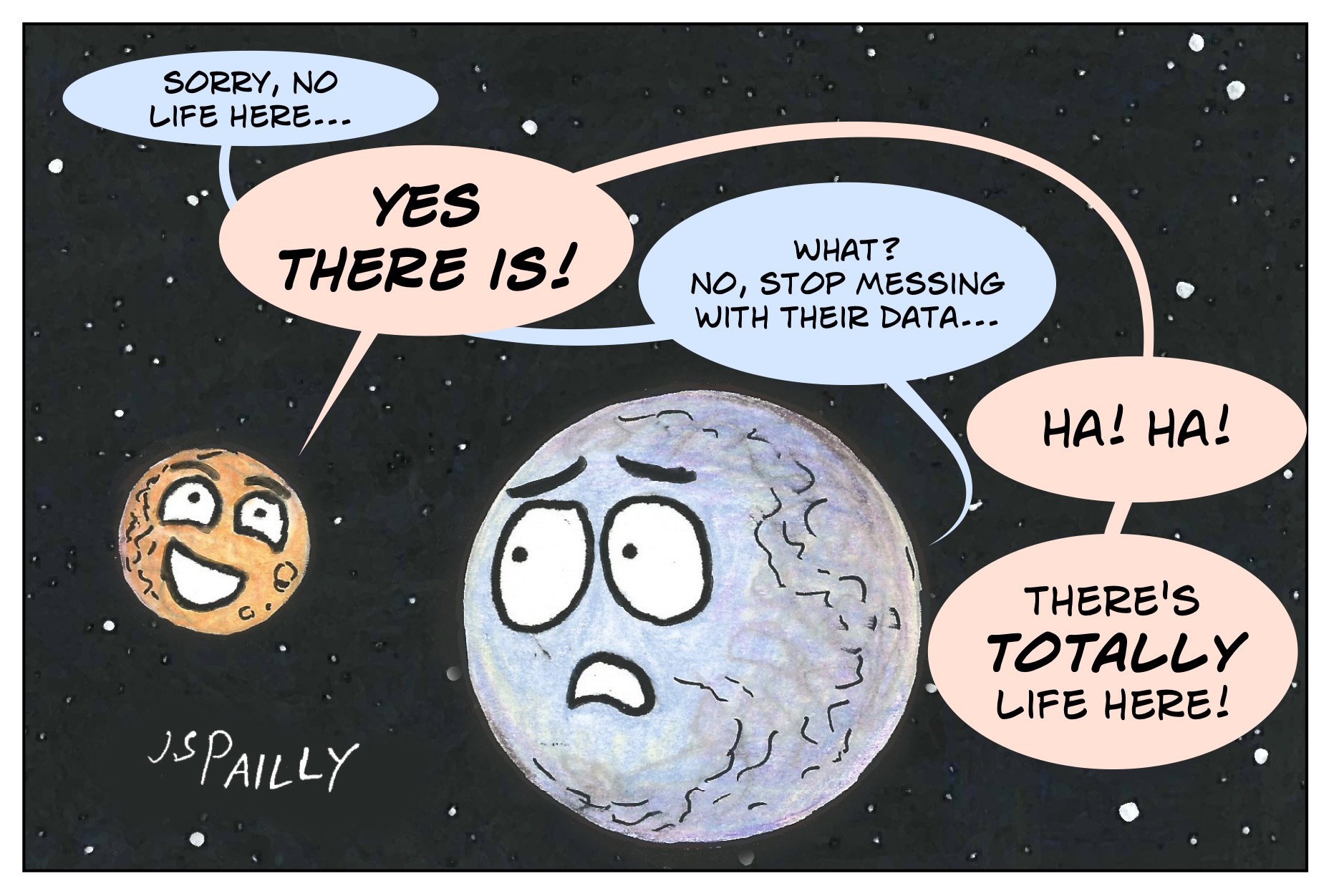
But imagine an exoplanet with an oxygen-rich atmosphere and an exomoon with a methane-rich atmosphere.  From here on Earth, that planet-moon system could easily be mistaken for a single exoplanet, with the two separate atmospheres appearing to be one atmosphere in that much coveted state of disequilibrium.

In this paper—a paper which describes its results as “inconvenient, yet unavoidable”—this is referred to as the exomoon false-positive scenario, but I’m calling it the trickster moon problem, because someday some undetected exomoon might trick us into thinking we’ve discovered alien life when we haven’t.

The good news is that we may have already detected one exomoon, so in time we should get better at detecting others.  But as that “inconvenient yet unavoidable” paper warns, it may be decades (at least) before we can reliably tell which exoplanets do or do not have moons.  Until then, fellow space explorers, beware of those trickster moons!

Keeping an Open Mind

I know some people who believe some pretty ridiculous things.  I know people who buy into astrology and tarot cards.  I know people who insist the Earth is only 6,000 years old.  I’m friends with someone who believes the Moon Landing was a hoax, and recently I had a conversation with a 9/11 truther. That conversation got uncomfortable real fast.

The thing is, whenever these people find out I’m a huge science enthusiast, they always end up throwing science back in my face. It’s a basic principle of science, isn’t it?  You have to keep an open mind, don’t you?  Scientific theories have been disproven before, and scientists should be prepared to admit when they’re wrong.

Whenever I get the “keep an open mind” lecture, I respond with a quote that’s often attributed to Carl Sagan: “It pays to keep an open mind, but not so open your brains fall out.”

Because in science, the consensus opinion does change.  Old theories do make way for new ones (though it’s rare for a well established theory to be overturned in its entirety). It does pay to keep an open mind, but that doesn’t mean switching off your critical thinking skills.  And when a hypothesis doesn’t stand up to questioning and scrutiny, when it doesn’t agree with experimental or observational evidence, it’s probably not because my mind isn’t open enough; it’s probably because your hypothesis is wrong.

Just my two cents for today.

Sciency Words: Nanotechnology

Sciency Words: (proper noun) a special series here on Planet Pailly focusing on the definitions and etymologies of science or science-related terms.  Today’s Sciency Word is:

NANOTECHNOLOGY

In 1959, Richard Feynman gave a lecture at Caltech entitled “There’s Plenty of Room at the Bottom” (here’s a transcript).  In that lecture, Feynman said:

The principles of physics, as far as I can see, do not speak against the possibility of maneuvering things atom by atom.  It is not an attempt to violate any laws; it is something, in principle, that can be done; but in practice, it has not been done because we are too big.

This is often cited as the point at which the science of nanotechnology was born, but it would be a few decades yet before the word nanotechnology came into use.

American engineer Eric Drexler is often credited with coining the term in reference to machines that would operate on a nanometer scale—on the scale of atoms, in other words.  Drexler envisioned what he called nano-assemblers which could maneuver about among atoms, picking individual atoms up and sticking them together like Lego blocks.

There was, and still is, a lot of debate among scientists about whether of not this could really work.  Atoms, in a sense, have minds of their own.  They’re not going to sit passively and let us do whatever we like with them.  You can’t circumvent the usual chemical processes that allow molecules to form.  Rather than sticking Lego bricks together, it might be better to compare a nano-assembler’s job to herding cats.

But for the purposes of this post, I’m going not going to say anything more about the actual science of nanotechnology, because there’s an interesting story to tell about the word itself.  While the word may have been coined by a scientist, it was laypeople (especially the media) that embraced it and turned it into a popular scientific term.  As explained in this paper from Interdisciplinary Science Reviews:

Interestingly, there was no process of consensus in the scientific community that nanotechnology was to be the term to describe the science, but then no one had come up with a competing word and it rather succinctly described what the activity was all about.  Like clothing fashion, however, the term rapidly became the norm without anyone actually stopping to ponder where it came from and why.

The word nanotechnology nicely demonstrates the role that the media can have in spreading a new scientific term and thus, in turn, influencing the parlance of the scientific community who came up with the science in the first place.

So if not for the media and public interest, maybe nanotechnology would not have become as well established a term as it is.  This is important because universities have established departments of nanotechnology, and grant money is allocated specifically for nanotechnology research.  That might not have happened if the word weren’t so well known.

However, the case could also be made that media attention has held nanotechnology research back.  But we’ll talk about that in next week’s episode of Sciency Words.

Europa’s Cold Spot

I still have a ton of research reading to catch up on from 2018.  This weekend, I read a paper about Europa.  I wasn’t sure at first why this was on my to-be-read list, but by the end I knew why this one had caught my attention.

Europa is one of the icy moons of Jupiter.  It’s often listed as one of the most likely places in the Solar System where we might find alien life.  That’s because there’s evidence of a vast ocean of liquid water sloshing around beneath Europa’s icy crust.

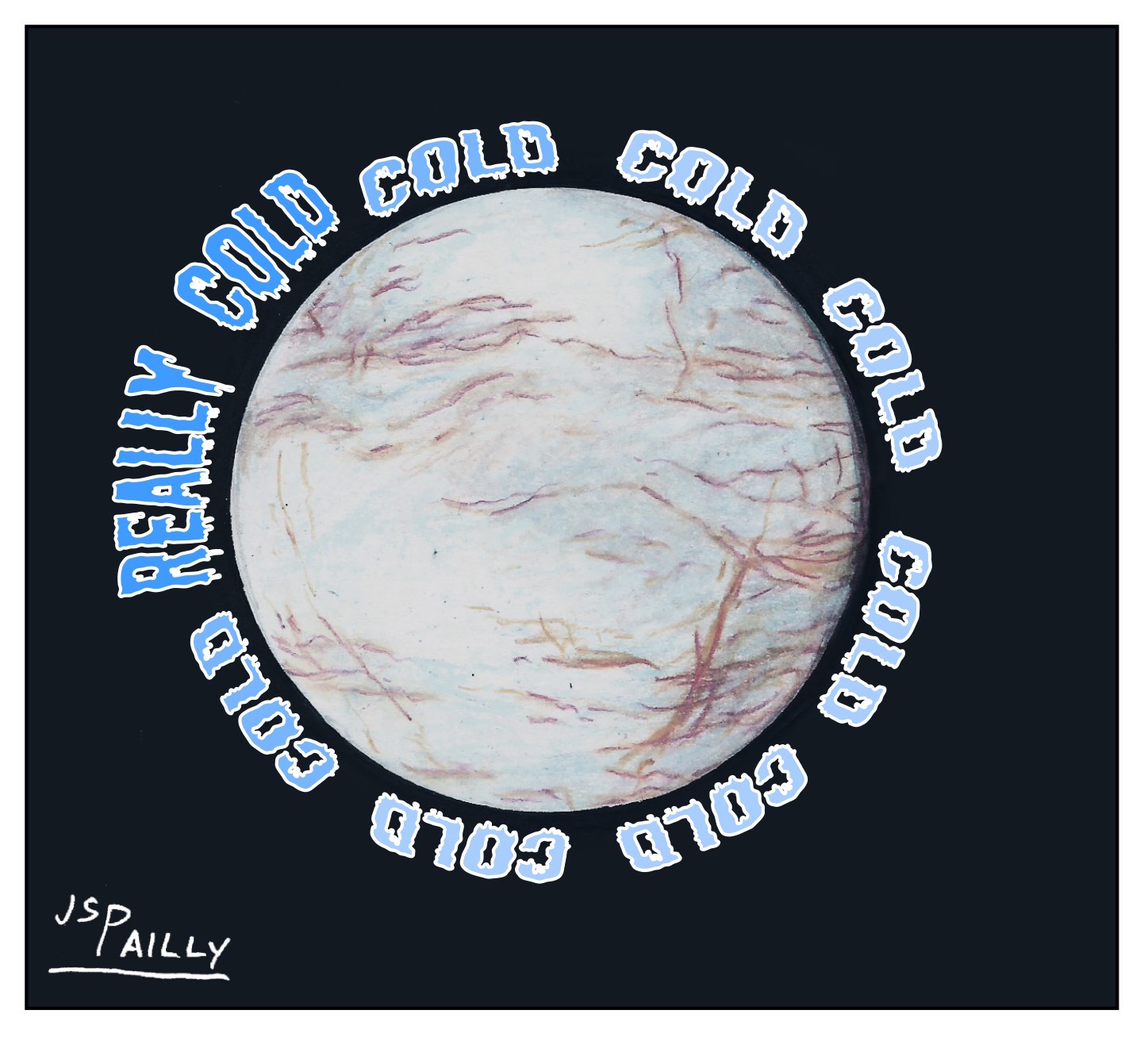
Maybe someday we’ll be able to drop a little robo-submarine into that ocean and see if anything’s swimming around down there. But in the meantime, we’re really only able to explore Europa’s surface.  And as you can see in the highly technical diagram below, no matter where you go on Europa’s surface, it’s cold.  But in one specific region, Europa gets really cold.

Or at least, that one region appears to be extra cold.  This is a case where it’s important to understand how we get our data. We’re really measuring Europa’s thermal emissions, the amount of heat that gets radiated out into space. So that cold spot may represent one of two things:

  • Either that region absorbs less sunlight than the rest of Europa, and so it never heats up in the first place…
  • Or that region does a better job trapping the heat it absorbs from the sun, and so we detect less heat escaping back into space.

Either way, something weird is happening. Unfortunately, our previous missions to the Jupiter system did not provide us any useful photos of that one specific spot on Europa’s surface.  Our current Juptier mission, Juno, is unable to approach Europa at all, so that’s no help.

So we can’t match this anomalous cold spot to a visible surface feature.  However, the authors of the paper I read did suggest that this could be a sign of recent geological activity—the formation of chaos terrain, perhaps.

And if that’s true, we might (might!) find the waters of Europa’s subsurface ocean seeping up to the moon’s surface.  Maybe there’s fresh organic material seeping up onto the surface too.  Maybe.

Maybe.

Could be worth checking out, though.  Don’t you think?

Sciency Words: Nominal Solar Radius

Sciency Words: (proper noun) a special series here on Planet Pailly focusing on the definitions and etymologies of science or science-related terms.  Today’s Sciency Word is:

THE NOMINAL SOLAR RADIUS

Last week, I told you about the classification system in use for main sequence stars. Today we’re going to talk specifically about G-type stars.  Or rather, we’re going to talk about one G-type star in particular: the Sun.

I was recently clued in on a controversy about the Sun.  After reading up on the issue, though, I don’t think this is a real controversy.  It’s more like an Internet controversy.

If you’ve ever wondered how big the Sun is, a quick Google search will get you an answer.  But it won’t get you the correct answer.  That’s because we apparently do not know precisely how big the Sun is.  As this paper from 2018 states: “[…] measuring with high accuracy the diameter of the Sun is a challenge at the cutting edge of modern techniques.”

Part of the problem is that we’ve tried using multiple methods for either measuring the Sun’s radius by direct observation or by calculating the radius based on other kinds of measurements.  And we keep getting different answers.  I take it we’re not getting wildly different answers, but there’s enough variation there to create a problem for scientists who study the Sun.

So here’s where the alleged controversy comes in.  Our friends at the I.A.U.—the International Astronomy Union, the same organization that decided Pluto is not a planet—decided a few years ago what the Sun’s radius should be.  They said it equals 695,700 km.  No more, no less.  I mean, who are these people to decide what is or is not a planet?  Who are these people to decide now how big the Sun is?

Except that’s not actually what the I.A.U. did. Regardless of how I may feel about the whole Pluto thing, I do agree with the I.A.U. about their definition of the solar radius.  Or to speak more precisely, I agree with their definition of the nominal solar radius.  As explained in the I.A.U. resolution on this matter:

These nominal values should be understood as conversion factors only—chosen to be close to the current commonly accepted estimate […] not as the true solar properties.  Their consistent use in all relevant formulas and/or model calculations will guarantee a uniform conversion to SI units.

So I don’t think the controversy, such as it is, really exists.  If we’re going to use the nominal solar radius as a unit of measure, we all have to agree about what that unit of measure is equal to—especially because we still don’t know what the actual solar radius is.

Feel free to bash the I.A.U. about Pluto, if you want, but when it comes to their nominal solar radius definition, I think the way they handled it makes a lot of sense.

Mind Your P’s and Q’s

Welcome to story time here on Planet Pailly!  Today’s story was inspired by a recent conversation I had with a new friend, a conversation which I described in a previous blog post.

Mind Your P’s and Q’s

The whole class was staring at the teleportation chamber, cringing at the wisp of smoke rising from the chamber floor.  Cadet Keefer had just killed a gerbil.  Again.

Keefer’s face blanched as she realized what had happened. Suddenly she was mashing the reset button.  Reset!  Reset!  Reset!  But the whole teleportation system had locked up.  The controls were frozen on their last settings, with all the emergency lights on.

Professor Montgomery was coming over.  “What happened?”

“I… I can’t…” Keefer said, still frantically trying to get the teleporter to reverse.  The machine had disassembled that poor gerbil atom by atom, so Keefer just had to make the stupid contraption put the gerbil back together again.  Right?

“It must’ve been the Heisenberg unit,” Keefer said, or at least that was her best guess.  On the very first day of teleportation training, Professor Montgomery had said 90% of the teleportation accidents he’d seen were caused by Heisenberg commutation units.  They were finicky pieces of hardware.  You had to keep a close eye on them.  The quantum teleportation system needed to track the exact momentum and position of each and every atom in your body (or in this case, in that gerbil’s body), and that was impossible if the Heisenberg unit failed.

On the control board, the momentum and position were represented by the letters p and q.  And sure enough, right there in the middle of the status board, an error message read:

pq ≠ qp

“Looks like you’re right,” Professor Montgomery said, tapping his finger on that message.  “What have I told you about the Heisenberg unit?”

Keefer’s face was turning bright red with embarrassment. “Mind your p’s and q’s,” she recited.

“That’s right,” Montgomery said.  “You can take the test again in a month.  Until then, I don’t want you touching the teleporters.  I don’t want you anywhere near them.  Stick to the simulators until you know you can do it right.  Understood, cadet?”

“Understood, sir!”

What Kind of Writer Do I Want to Be?

Today’s post is about a personal revelation I recently had.  You see, I spend a lot of time researching for this blog, making sure I understand what I’m talking about, and doing my best to explain it all clearly and concisely.  And all this work, in theory, is supposed to benefit my science fiction writing.

But I don’t want to write hard Sci-Fi.  I used to think science fiction existed on a spectrum from hard science fiction, where everything is super scientifically accurate (and here’s a full chapter explaining the math to prove it), to soft science fiction, where everything’s basically space wizards and technobabble magic (lol, who cares if unobtainium crystals make sense?).

I’ve since discovered another way to think about science fiction, and I find that to be more useful.  But sometimes I’m still left wondering why am I doing all this extra work?  What’s it all for if I’m not trying to write hard Sci-Fi?

Recently, I was talking with a new friend, and somehow the conversation turned to quantum physics.  I swear I wasn’t the one who brought it up!  My friend had seen a video on YouTube, and I felt the need to disillusion him of the weird quantum mysticism he’d apparently been exposed to.  I was doing my best to explain what the Heisenberg uncertainty principle actually means, and I ended up digging into what I remembered about the math.

Mathematically speaking, the momentum of a quantum particle is represented by the variable p, its position by the variable q, and the relationship between p and q is often expressed as:

pq ≠ qp

I don’t have the math skills to explain how this non-equivalency equation works.  I think it has something to do with matrices.  My high school math teacher skipped that chapter. To this day, I still haven’t got a clue how a matrix works.  I just know it’s an important concept in quantum theory.

But by this point, my friend was staring at me with a sort of dumbstruck awe, and he said: “Wow, you really do understand this stuff!”

That brought me up short.

“No, not really,” I said, feeling slightly embarrassed. I couldn’t help but recollect the famous line attributed to Richard Feynman: If you think you understand quantum theory, you don’t understand quantum theory.

So I told my friend about this blog and about my writing, and how I use the research I do for my blog to flesh out the story worlds in my science fiction.  And then I said something that I don’t remember ever thinking before or being consciously aware of, but as soon as the words were out of my mouth I knew they were true: “I just want to make sure I know enough so that I don’t make a total fool of myself in my stories.”

And that’s it.  That’s the answer I needed.  I’m okay with stretching the truth if it suits my story.  I’m okay with leaving some scientific inaccuracies in there.  I just don’t want to make a mistake so glaringly obvious to my readers (some of whom know way more about science than I do) that it ruins the believability of my story world.

And now if you’ll excuse me, I have to get back to writing.  The fiction kind of writing, I mean.  And on Wednesday, we’ll have story time here on the blog.

Sciency Words: Oh Be A Fine Girl/Guy, Kiss Me!

Sciency Words: (proper noun) a special series here on Planet Pailly focusing on the definitions and etymologies of science or science-related terms.  Today’s Sciency Word is:

OH BE A FINE GIRL/GUY, KISS ME!

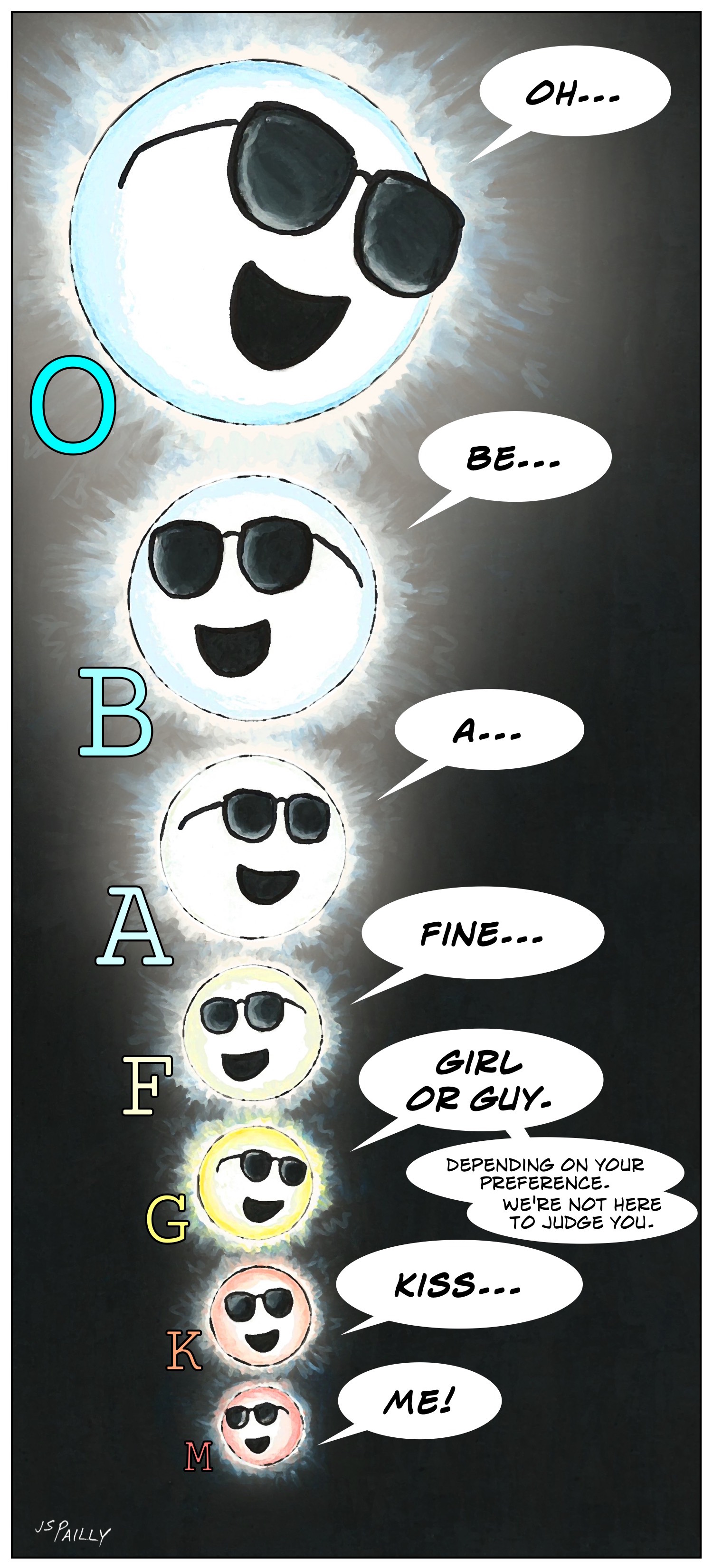
Our Sun is a main sequence star, meaning it fuses hydrogen into helium within its core.  The vast majority of stars in the universe are main sequence stars. They’re very important. Unfortunately, the classification system we use for these main sequence stars is a bit odd and not very easy to remember.

The biggest, hottest main sequence stars are called O-type stars.  The smallest and coldest are called M-type stars.  You’d be forgiven for thinking the stars in between are called N-type stars, but no.  Between the letters O and M, we get B, A, F, G, and K-type stars.

Apparently, at least according to Wikipedia, it didn’t start out this way.  Initially, all stars were classified under a different alphabetical system which, I presume, made more alphabetical sense.  But this seems to be yet another case of scientists naming things before those things are properly understood.

In the early 1910’s, Danish astronomer Ejnar Hertzsprung and American astronomer Henry Norris Russell put together what is now known as a Hertzsprung-Russell diagram.  This diagram revealed a close relationship between the color and brightness of most stars.  The color and brightness of these main sequence stars is also closely related to temperature and mass, respectively.

The old system no longer made much sense, but the alphabetical labels had been so widely used in scientific literature that it would have been difficult to get rid of them.  American astronomer Annie Jump Cannon is credited with fixing the problem: she rearranged the old lettering scheme to reflect our new knowledge about stars.  Henry Norris Russell then came up with a handy mnemonic device to help us remember the new system:

I have to admit I’ve always felt like this phrase is a bit pervy.  At least it’s a little more gender inclusive than it used to be (Russell’s original version was “Oh be a fine girl, kiss me,” because obviously astronomers are always male, and obviously males only want females to kiss them—but we’ve moved on from both of those assumptions since Russell’s time).

Still, as a mnemonic device, it works well enough. As I was reading this paper about the search for Earth-like planets, and how various types of main sequence stars might affect those planets, I found myself repeating the “Oh be a fine girl/guy, kiss me!” line quite a lot.  Not out loud, of course.  That would have gotten me slapped by somebody, I’m sure.