Mercury A to Z: The Twinkling Planet

Hello, friends!  We’re in the final week of this year’s A to Z Challenge!  If you don’t know what the A to Z Challenge is, it’s a monthlong blogging event where participants write a full alphabet’s worth of blog posts about a topic of their choice.  My topic this year is the planet Mercury, and in today’s post T is for:

THE TWINKLING PLANET

When you look up in the nighttime sky, stars twinkle, and planets don’t.  This is probably the first astronomy lesson most people learn.  It’s one of those basic facts almost everybody seems to know.  However, like most super basic facts that everybody seems to know, there are exceptions to the rule.  Mercury is a planet, and yet Mercury twinkles.

Stars twinkle because they’re very far away, and their starlight is relatively faint.  So when starlight hits Earth’s atmosphere, the atmosphere distorts the light, causing a twinkling effect.  But planets are much closer, and sunlight reflecting off a nearby planet is much brighter and more intense than the light emitted by distant stars.  Earth’s atmosphere still distorts the light reflecting off planets, but the distortion is nowhere near as noticeable.  Usually.

Two factors make Mercury different.  First, Mercury is much smaller than the other planets, so he doesn’t reflect as much sunlight our way as, say, Venus or Jupiter.  It’s probably worth mentioning that Mercury is also a darker colored planet, with much of his surface covered in graphite.  Second, because Mercury is so close to the Sun, we Earthlings usually can’t see him except just after dusk or just before dawn.  This means that whenever we see Mercury, Mercury’s light has to pass through Earth’s atmosphere at an angle.  In other words, Mercury’s light has to travel through more of Earth’s atmosphere in order to reach our eyes.

Less light plus more atmospheric distortion equals a twinkling planet.  As William Sheehan notes in his book Mercury (for the Kosmos series), “[Mercury] is more often seen, no doubt, than recognized.”

I love star gazing.  I love looking for planets in the sky, and I love the moment of realization when I recognize one of them.  I only know for certain that I’ve seen Mercury two times in my life, and I needed help from an astronomy app both times.  However, I may have seen Mercury many times than I know and just assumed he was another star, twinkling near the horizon.

The real lesson here is that there are those basic facts that everyone knows, basic facts like stars twinkle and planets don’t.  But once you learn the basic facts about something, start learning about the exceptions to the rule.  You may miss out on some really neat experiences in life if you ignore the exceptions and stick to knowing only the basic facts.

WANT TO LEARN MORE?

Here’s an article from EarthSky.org about why stars twinkle and planets (usually) don’t.  It’s one of the rare articles I’ve seen that notes how, under the right circumstances, planets can twinkle, too.

And also, I’m going to once again recommend Mercury by William Sheehan.  Chapter One of that book is about how Mercury twinkles, or rather how Mercury “scintillates,” to use a more scientific term.

Mercury A to Z: Solar vs. Sidereal Days

Hello, friends!  Welcome to another posting of the A to Z Challenge.  My theme for this year’s challenge is the planet Mercury, a planet that often gets overlooked by space geeks like me.  In today’s post, S is for:

SOLAR vs. SIDEREAL DAYS

We’ve been talking about Mercury all month long, and we’ve been talking a lot about Mercury’s rotation rate.  In some posts, I’ve told you that Mercury has a rotation rate equal to approximately 59 Earth days.  In other posts, I said a day on Mercury is about 176 Earth days long.  That seems like a contradiction, but both of those numbers are correct.  It all depends on whether we’re talking about a solar day or a sidereal day.

A solar day can be defined as the time it takes a planet to rotate once relative to the Sun, while a sidereal day is the time it takes a planet to rotate once on its own axis.  A solar day is what we Earthlings usually mean by the word “day.”  It’s the 12 a.m. on Monday to 12 a.m. on Tuesday kind of day.  A sidereal day (pronounced si-der-e-al) is more like a planet’s true rotation period, relative to the rest of the universe.  Why are these things different?  Because planets orbit the Sun.  Because as they orbit, they change position relative to the Sun.

In Earth’s case, it takes about 23 hours and 56 minutes to rotate once on its own axis, but because Earth moves through space during that time (changing positions relative to the Sun), it takes an extra 4 minutes to rotate once in reference to the Sun. And according to my math, 23 hours and 56 minutes, plus an extra 4 minutes, makes Earth’s solar day 24 hours long.

The situation is similar for Mars.  A Martian sidereal day is about 24 hours and 37 minutes, while a Martian solar day is more like 24 hours and 40 minutes.  For both Earth and Mars, the difference is small.  Most of the time, it’s not worth mentioning.  But on Mercury, a sidereal day is 59 Earth days long, while a solar day ends up being 176 Earth days in length.  You see, Mercury rotates very, very slowly.  Over the course of one sidereal day, Mercury travels two-thirds of the way around the Sun.  That puts Mercury in a very different position, relative to the Sun, at the end of a sidereal day.  As a result, Mercury’s solar day ends up being longer—a whole lot longer—than Mercury’s sidereal day.

I have to admit I had a hard time understanding the distinction between solar and sidereal days the first time I heard about it.  I hope that I have done a decent job explaining it to you.  But if anyone was wondering why I quoted different numbers in different posts for Mercury’s day/rotation period, this is the reason I did that.  For some topics, the sidereal day matters; for others, it’s the solar day that’s important.  And for the purposes of the A to Z Challenge, I wanted to save this discussion for S-day, so I just glossed over it until now.

WANT TO LEARN MORE?

I’m going to recommend an article from Universe Today called “How Long is a Day on Mercury?”

I also want to recommend another article from Universe Today called “How Long is a Day on Venus?” because if you think Mercury’s day is confusing, wait until you hear how messed up a day on Venus is.

Mercury A to Z: Resonance

Hello, friends!  Welcome back to the A to Z Challenge.  My theme for this year’s challenge is the planet Mercury, and in today’s post R is for:

RESONANCE

There are many weird coincidences in the Solar System, most of which really aren’t coincidences.  It’s usually just the force of gravity doing its thing.  Sometimes objects in space keep tugging on each other, gravitationally, pulling each other into these oddly specific mathematical relationships which astrophysicists call “resonances.”

As an example, for every three complete orbits of Neptune, Pluto completes exactly two (a 3:2 orbital resonance).  Another example: for every thirteen complete orbits of Venus, Earth completes exactly eight (a 13:8 orbital resonance).  And then there are the resonating moons of Jupiter.  For every four complete orbits of Io, Europa completes exactly two orbits, and Ganymede completes exactly one (a 4:2:1 orbital resonance).

Earth’s Moon is locked into a different kind of resonance, called a spin-orbit resonance.  For every orbit the Moon completes around the Earth, the Moon rotates (spins) exactly one time (a 1:1 spin-orbit resonance).  This happens because the Moon is not perfectly spherical.  The Moon bulges a little at the equator, kind of like a football (or a rugby ball, for readers outside the U.S.).  As the Moon circles around the Earth, Earth’s gravity keeps pulling one of the pointy ends of this football-shaped Moon towards the Earth.  This is why you always see the same side of the Moon whenever the Moon appears in the sky.

Mercury is also locked into a spin-orbit resonance, specifically a 3:2 spin-orbit resonance.  So for every two orbits around the Sun, Mercury rotates (spins) exactly three times.  This happens for two reasons:

  • Like the Moon, Mercury is slightly football shaped.
  • Unlike the Moon, Mercury’s orbit is highly eccentric (non-circular).

Since Mercury is slightly football-shaped, gravity tries to keep one of Mercury’s pointy ends pointed toward the Sun.  However, Mercury’s highly eccentric orbit means that Mercury’s orientation, with respect to the Sun and with respect to the Sun’s gravity, changes.  This changing orientation creates torque, which causes Mercury to spin.

So every time Mercury reaches perihelion (the point when Mercury is closest to the Sun) one end of the football-shaped planet points directly toward the Sun.  As Mercury moves away from perihelion, gravitational torque sets the planet spinning.  Mercury spins very slowly, only managing to turn 180° before reaching perihelion again, at which time gravity once again forces the football-shaped planet to point directly toward the Sun.  This has probably been happening for billions of years now, and it will probably keep happening for billions of years to come.

WANT TO LEARN MORE?

I want to recommend this very short video I found on YouTube.  I’ve read a lot about this topic.  Most sources I looked at get very technical very fast.  This video was, by far, the clearest and most straightforward explanation of Mercury’s spin-orbit resonance that I could find.

I also want to recommend this article from Space.com.  Some exoplanets may be locked into Mercury-like spin-orbit resonances, and for exoplanets orbiting red dwarf stars, a spin-orbit resonance has implications for potential alien life.

Mercury A to Z: q

Hello, friends!  Welcome back to the A to Z Challenge.  My theme for this year’s challenge is the planet Mercury, and in today’s post Q is for:

q

Today, I’m going to expand a little on something we already talked about in a previous post.  Back in the late 1800’s, Italian astronomer Giovanni Schiaparelli made a bold effort to observe and characterize the planet Mercury.  He saw several prominent surface features (or at least he thought he saw them), and he determined that Mercury has a rotation period that is approximately 88 Earth days long (we now know this is incorrect).  So what happened?  Where did Schiaparelli go wrong?

In a previous post, I told you about Schiaparelli’s five.  When he looked in his telescope, he kept seeing a surface feature on Mercury that looked like a gigantic numeral five.  Looking at photographs of Mercury today, most people can’t find Schiaparelli’s five, and it’s really unclear what the heck Schiaparelli was looking at.

Specifically, Schiaparelli saw (or thought he saw) this gigantic five whenever Mercury happened to be east of the Sun, as seen in Earth’s sky.  And whenever Mercury appeared west of the Sun, as viewed from Earth, Schiaparelli saw (or thought he saw) a different large surface feature.  On his hand drawn maps on Mercury, Schiaparelli labeled this other large surface feature “q” (always lower case).

Unlike Schiaparelli’s five, which supposedly looked like the number five, q did not look like the letter q.  In Schiaparelli’s drawings of q, it reminds me a little of that Æ symbol (the combination of A and E) that you sometimes see in fantasy novels, very old English literature, and a few modern languages like Icelandic or Norwegian.  I’m not sure why this Æ feature got named q, but Schiaparelli labeled several other surface features on Mercury with lower case letters, so there must have been some method to his madness.

The important thing is that the five and q appeared, consistently, when Mercury reached certain points in his orbital path—either east of the Sun for the five or west of the Sun for q, as viewed from Earth.  Or at least they appeared consistently whenever Schiaparelli went looking for them.

The surface of Mercury is covered in light and dark splotches, making it a bit like a Rorschach test.  You see whatever your brain wants to see in those light and dark patterns.  I have tried my best to match Schiaparelli’s hand drawn maps to actual photos of Mercury.  I can kind of see the five, some of the time, but it takes a little squinting and a lot of imagination to make things line up right. I cannot find q, no matter how hard I try.

But Schiaparelli wasn’t too far off to believe he was seeing the same surface features time and again, whenever Mercury reached specific points in his orbital path.  Schiaparelli was only half wrong about that.  Exactly half wrong, in a sense.  I will try to explain what I mean by that in tomorrow’s post.

WANT TO LEARN MORE?

For this third time this month, I’d like to recommend Mercury, by William Sheehan.  It’s part of the Kosmos series, published by Reaktion Books, and it includes a lengthy and fascinating discussion of Schiaparelli and his sightings of five and q on Mercury.

Mercury A to Z: Prokofiev Crater

Hello, friends!  My theme for this year’s A to Z Challenge is the planet Mercury, a planet that just never seems to get the same love and attention as all the other planets of the Solar System.  In today’s A to Z post, P is for:

PROKOFIEV CRATER

We haven’t talked about this as much as I expected to, but there is ice on Mercury.  The frozen water kind of ice.  Craters near Mercury’s north and south poles are shielded from direct sunlight throughout the Mercurian year.  As a result, despite the proximity of the Sun, the bottoms of these craters are dark enough and cold enough to allow ice to remain frozen.  One of the largest and, perhaps, most well studied of Mercury’s icy craters is Prokofiev Crater, near Mercury’s north pole.

Prokofiev Crater is named after Russian classical composer Sergei Prokofiev.  The crater is slightly removed from the north pole, and so part of the crater floor does get exposed to direct sunlight during part of the Mercurian year.  However, there is still a large region inside the crater that remains in permanent shadow.  That same region also happens to be a radar bright spot, meaning that radar beams directed at Mercury reflect off that region in an especially bright and brilliant way.

These super bright radar reflections could be caused by water, but they could also be caused by large deposits of metal.  In the early 2010’s, NASA’s MESSENGER space probe took a much closer look, using multiple scientific instruments, and confirmed that the radar reflections in Prokofiev (and other neighboring craters) are indeed caused by frozen water.

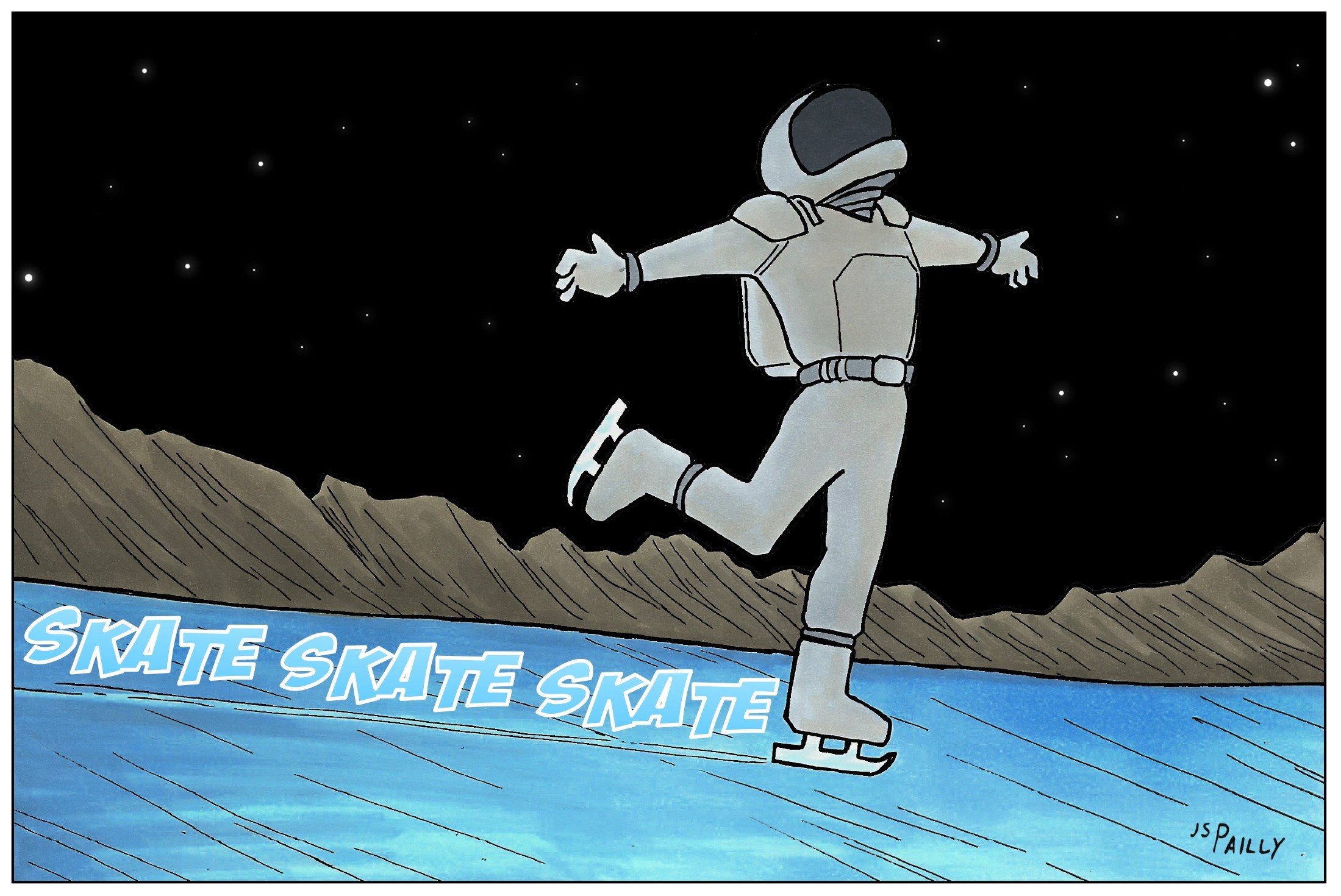
Now ever since I first heard about ice on Mercury, there was one thing I wanted to know: is it possible to go iceskating on Mercury?  I’ve done research on this in the past, and I couldn’t find a clear answer.  Is the ice exposed on the surface, or is it covered by a layer of dust and rock?  Most sources I looked at were vague about that.  I got the impression that nobody really knew for certain.  But it seems there’s been some new research since the last time I looked into this.

In most cases, Mercury’s ice is covered by some sort of insulating layer.  But in the largest, deepest, and coldest craters on Mercury—craters like Prokofiev Crater, as well as nearby Kandinsky Crater, Tolkien Crater, and Chesterton Crater—the ice is most likely out in the open, exposed or partially exposed, just waiting for somebody with a spacesuit and a pair of ice skates to show up.

Someday, if humans decide (for some reason) to settle on Mercury, places like Prokofiev Crater will be prime real estate.  Not just for iceskating but for basic survival reasons. Humans need water, after all.

Personally, I wouldn’t mind living in nearby Tolkien Crater, because that’s the kind of nerd that I am.  However, I’d strongly advise that nobody should live in Lovecraft Crater, a large, icy crater near Mercury’s south pole.  If you’re familiar with H.P. Lovecraft’s work, you’ll know why.

WANT TO LEARN MORE?

Here are maps of Mercury’s north and south poles, showing the locations of radar bright spots, regions in permanent shadow, and where the two overlap.

Here’s an article from NASA explaining the different experiments MESSENGER used to confirm the presence of water in Mercury’s polar craters.

And here is a 2022 paper published in The Planetary Science Journal confirming that water ice lies exposed on the surface inside Prokofiev Crater.

Mercury A to Z: Orbiting Mercury

Hello, friends!  Welcome back to this year’s A to Z Challenge.  For this year’s challenge, my theme is the planet Mercury, and in today’s post, O is for:

ORBITING MERCURY

On April 1, 2012 (note that date), NASA announced the discovery of a moon orbiting Mercury.  NASA went on to propose naming this newly discovered moon Caduceus, after the coiled-snake-shaped staff that Mercury carried in ancient Roman mythology.  This would have been a very exciting discovery except, of course, this was announced on April 1st.  Maintaining orbit around Mercury is hard… so hard it’s basically impossible.  The idea of a moon maintaining orbit around Mercury is so absurdly impossible that NASA thought it would make a good April Fool’s Day joke.

But for the sake of argument, let’s pretend that Caduceus is real.  Let’s pretend that Mercury does have a little, tiny moon, similar to the asteroid-like moons of Mars.  What would happen to Mercury’s moon?  Well, very rapidly, she’d find herself caught in a gravitational tug-of-war between Mercury and the Sun—and sadly, this is a tug-of-war that Mercury could never, ever hope to win.

With each successive orbit around Mercury, Caduceus would be feel the increasing and decreasing gravitational force of the Sun.  When she circles around to the dayside of Mercury, the Sun’s pull would be stronger; when Caduceus circles around the Mercury’s nightside, the Sun’s pull would be weaker.  A little stronger, a little weaker, a little stronger, a little weaker, over and over again.  If Caduceus’s orbit started off as near circular, that orbit would gradually stretch into a wider and and wider oval shape.  Eventually, inevitably, that oval would become so stretched out that it would extend beyond the reach of Mercury’s gravity.

Caduceus would not necessarily crash into the Sun after that.  Remember that every action has an equal and opposite reaction.  Every time the Sun’s gravity pulled Caduceus hard one way, she would then swing just as hard in the opposite direction.  So when the moment came and Caduceus finally broke free of Mercury’s gravity, there’s a very good chance that she would launch herself off into space like a child leaping from a swing set.

But regardless of Caduceus’s ultimate fate (crashing into the Sun or flinging herself off into space), the outcome for Mercury is the same.  He loses his moon.  Mercury will always lose his moon, no matter what.  Even artificial satellites, like MESSENGER or BepiColombo, cannot maintain orbit around Mercury for long without their thrusters.  Orbiting Mercury is really, really hard work for a spacecraft, and for a small, asteroid-like moon?  It’s basically impossible.

So if you have ever wondered why Mercury doesn’t have a moon, now you know why Mercury doesn’t have a moon.

WANT TO LEARN MORE?

Here’s NASA’s April Fool’s Day announcement about the discovery of Caduceus.

And here’s an article from Universe Today entitled “How Many Moons Does Mercury Have?” written by a good friend of this blog, Matt Williams.

Mercury A to Z: NASA Missions to Mercury

Hello, friends!  We are halfway through this year’s A to Z Challenge.  I have to admit when I picked the planet Mercury as my theme for this year’s challenge, I was a little worried I wouldn’t be able to find enough material for a full alphabet worth of posts.  But Mercury has not disappointed me.  There are more than enough Mercury facts to cover!  In today’s post, N is for:

NASA MISSIONS TO MERCURY

Which planet is closest to the Sun?  More often than not, the answer is probably Mercury.  That may seem counterintuitive, since the orbital path of Venus (the 2nd planet) lies between the orbital paths of Mercury (the 1st planet) and Earth (the 3rd planet).  But consider it this way: every time Venus and Earth happen to be on opposite sides of the Sun, Mercury is somewhere in between.  So on average, Mercury ends up being the closest planet to Earth more often than Venus, Mars, or any other planet.

And yet, despite the fact that Mercury is so close to Earth so much of the time, Mercury is still one of the absolute hardest places for Earth-launched spacecraft to reach.  The problem is the Sun.  The Sun is very big, and the gravitational pull of the Sun is very strong.  For our purposes, imagine that the Sun is “down,” and you’ll start to see what the problem is.  Flying to Mercury is an awful lot like falling toward the Sun.

Now I do want to acknowledge that I’m glossing over a whole lot of technical details here.  The purpose of this blog post is not to teach you the science and mathematics behind orbital mechanics.  All I want is to give you a small taste of what makes flying to Mercury so very challenging, so that you can better appreciate the amazing accomplishments of NASA’s Mariner 10 and MESSENGER Missions.

MARINER 10

NASA’s original plan for Mariner 10 was to aim carefully and fly by Mercury one time.  A certain Italian astronomer had a better idea, involving a never-before-attempted gravity assist maneuver near Venus.  This tricky maneuver allowed Mariner 10 to perform three flybys of Mercury for the price of one.

Gravity assist maneuvers, where a spacecraft uses a planet’s gravity to make a “for free” course adjustment, are standard practice in spaceflight today, but Mariner 10 was the first to ever attempt such a thing.  Mariner 10 was also the first spacecraft to visit two planets, collecting some data about Venus before continuing on its way to Mercury (Mariner 10 was also lucky enough to collect data from a nearby comet—another first in space exploration).

Mariner 10 flew by Mercury in March of 1974, September of 1974, and March of 1975.  During those three encounters, Mariner 10 discovered Mercury’s magnetic field and Van Allen radiation belt.  Mariner 10 also discovered Caloris Basin, Kuiper Crater, and many other important surface features.  Unfortunately, only half of the planet was in daylight during Mariner 10’s three flybys, and it was always the same half of the planet, so the other half of Mercury remained unseen and mostly unknown for decades thereafter.

Shortly after Mariner 10’s third flyby of Mercury, the spacecraft ran out of fuel for attitude control.  Without attitude control, the spacecraft couldn’t keep its communications system pointed toward Earth.  So before contact was lost, mission control ordered the spacecraft to shut down.  The now defunct spacecraft is still, presumably, orbiting the Sun somewhere near the orbit of Mercury.

MESSENGER

MESSENGER is an acronym for MErcury Surface, Space Environment, Geochemistry, and Ranging.  The name is also a reference to Mercury’s role in Roman mythology as the messenger of the gods.  The MESSENGER Mission was funded through NASA’s Discovery Program, a highly competitive program for space missions that can be done on a tight and highly-restrictive budget.

MESSENGER launched on August 3, 2004.  Unlike Mariner 10’s series of flybys, the plan for MESSENGER was to enter orbit of Mercury.  This required a much longer and more intricate flight trajectory, with one gravity assist maneuver at Earth, two at Venus, and a series of three maneuvers at Mercury to help match Mercury’s orbital velocity.  MESSENGER achieved Mercury orbit on March 18, 2011, after seven-plus years of travel.

Over the next four years, MESSENGER photographed the entire surface of Mercury (including the half of the planet Mariner 10 couldn’t see), continued to study Mercury’s magnetic field, and revealed Mercury’s internal structure through a process called gravity mapping, which involved measuring subtle variations in a planet’s gravitational field.  Oh, and who could forget this?  MESSENGER also discovered water on Mercury.  Believe it or not, there is water (frozen as ice) inside craters around the north and south poles of Mercury.

In early 2015, MESSENGER ran out of fuel, and the spacecraft’s orbit around Mercury began to deteriorate.  On April 30, 2015, MESSENGER finally crashed into the planet’s surface, giving the most heavily cratered planet in the Solar System one additional crater.

WHAT’S NEXT?

The work of NASA’s Mariner 10 and MESSENGER Missions will be continued by BepiColombo, a collaborative mission by ESA (the European Space Agency) and JAXA (the Japanese Aerospace eXplotation Agency).  I wrote about BepiColombo in a previous post.

Now I want to correct something I’ve been saying about BepiColombo in previous posts.  I’ve said that BepiColombo will arrive at Mercury in 2025; that’s not quite right.  BepiColombo will enter Mercury orbit in 2025, but much like MESSENGER, BepiColombo needs to perform several gravity assist maneuvers near Mercury first.  Two of those gravity assists have already happened, and during those maneuvers, BepiColombo already started snapping photos and gathering science data.

So every time this month that I said only two spacecraft have ever visited Mercury, that was incorrect.  BepiColombo has already become Mercury’s third visitor.

WANT TO LEARN MORE?

NASA has posted some nice articles about Mariner 10, MESSENGER, and BepiColombo on one of their educational websites.  Click these links to check them out:

Mercury A to Z: Magnetosphere

Hello, friends!  Welcome back to the A to Z Challenge, a month long blogging event.  For this year’s challenge, my theme is the planet Mercury, and in today’s post M is for:

MAGNETOSPHERE

Back in the 1960’s and 70’s, Earth’s magnetosphere seemed like something special.  Both the American and Soviet space programs had sent missions to the Moon, Venus, and Mars.  None of those places had protective magnetic fields, like Earth does.  It was assumed that Mercury would be the same.  But in 1974, as NASA’s Mariner 10 space probe approached Mercury, a charged particle experiment got some unexpected readings, and Mariner 10’s magnetometer picked up a weak magnetic field.

Mercury’s magnetic field is said to be about 1% as strong as Earth’s.  That’s very weak, but 1% is not 0%.  And Mercury even has his own Van Allen belt, a region encircling the planet where the magnetic field gathers and concentrates radiation.  Again, Mercury’s Van Allen belt is not as powerful as Earth’s, but it is there.

For scientists in the 1970’s, the discovery of Mercury’s magnetosphere was difficult to explain.  To generate a magnetic field, a planet needs two things:

  • A molten metal core
  • A rapid rotation rate

Mars is a rather small planet, and small planets lose their internal heat very quickly.  Since Mars doesn’t have enough internal heat left to maintain a molten metal core, Mars can’t generate any meaningful magnetic field.  Venus, meanwhile, is a very large planet—almost as large as Earth.  She probably does have a molten metal core, BUT her rotation rate is extremely slow.  It takes Venus over 200 Earth days to rotate once.  That’s way too slow to generate a magnetic field.

As we’ve discussed previously, Mercury has a very slow rotation rate.  Mercury is also very small.  That should be a double whammy for Mercury’s magnetosphere, and yet the magnetosphere persists anyway.  Somehow, Mercury retained enough internal heat to have a molten metal core.  And somehow, Mercury overcame his own slow rotation rate to keep a weak magnetosphere alive.  Science accepts that Mercury has done these things.  But how?  How did Mercury do these things?

I don’t think anyone can answer that yet.  Mercury’s magnetic field is still something of a mystery.  Hopefully the upcoming BepiColombo Mission will help find some answers.

WANT TO LEARN MORE?

Here’s a brief article from Scientific American about the magnetic fields of all the planets in the Solar System (well, all the planets that have magnetic fields, at least—sorry, Venus and Mars).

And here’s an article from Space.com about how Mercury’s magnetic field may have changed over time—at some point in the past, it may even have been as strong as Earth’s.

Mercury A to Z: Lobate Scarps

Hello, friends!  Welcome back to this year’s A to Z Challenge.  My theme for this year’s challenge is the planet Mercury, an often under-appreciated but still fascinating little world.  In today’s post, L is for:

LOBATE SCARPS

The planet Mercury is shrinking!!!  How do scientists know this?  Well, the story begins with photos taken by NASA’s Mariner 10 space probe, back in the 1970’s.  Mariner 10 found these long, serpentine features on Mercury, winding their way across the planet’s surface.  Scientists decided to call these strange features “lobate scarps” (a sciency way of saying “curvy cliffs”).

Mariner 10 only photographed part of Mercury, but in the 2010’s, NASA’s MESSENGER space probe was able to map almost all of the planet’s surface, confirming that these lobate scarps are everywhere.  Rough, heavily cratered terrain?  Covered in scarps.  Smoother, flatter terrain?  Interrupted by scarps.  Young terrain, old terrain, middle-aged terrain?  Doesn’t matter.  The lobate scarps are all over the place (though one source I looked at suggested that some parts of Mercury are more scarp-y than others—especially parts of the southern hemisphere).

Images from both Mariner 10 and MESSENGER show scarps that are hundreds of kilometers long, and by looking at the scarps’ shadows, scientists are able to determine how tall they are—up to three kilometers in height, in some cases!  Just imagine that: a cliff three kilometers tall!  The tallest cliff on Earth isn’t even half that high.

The most likely explanation for all this is that Mercury is shrinking.  The planet’s core is cooling off, plus gasses trapped beneath Mercury’s crust are slowly leaking to the surface and escaping into space.  This ongoing loss of internal heat and mass puts stress on the planet’s crust, causing thrust faults and earthquakes Mercury-quakes.  I’ve read several sources that said Mercury is shriveling up like a raisin, but it sounds to me more like Mercury is very slowly crumpling like a tin can.

I’ve seen many different estimates for how much Mercury has shrunk, from as little as 2 kilometers in radius to as much as 20.  Since lobate scarps are found on young and old terrain alike, this process of global shrinkage must have been happening for billions of years, and it’s likely continuing to happen to this day.

WANT TO LEARN MORE?

Here’s an article from The Atlantic, quoting one of those larger estimates for how much Mercury has shrunk.

And here’s an article from Space.com, quoting a much lower estimate.

And here’s another article from Space.com, which talks about how some parts of Mercury are more scarp-y than others.

Lastly, if you want to get a better sense of what a lobate scarp looks like, click here to see a picture of one cutting across one of Mercury’s craters.

Mercury A to Z: Kuiper Crater

Hello, friends, and welcome back to the A to Z Challenge.  For this year’s challenge, my theme is the planet Mercury, and in today’s post K is for:

KUIPER CRATER

Mercury is a big, grey rock covered in craters.  In fact, Mercury is the most heavily cratered object in the whole Solar System.  So what’s so special about Kuiper Crater?  Why am I devoting an entire blog post to this one crater in particular?  Well, because Kuiper Crater is a surprisingly young and bright-looking crater among all the darker, older-looking craters of Mercury.

Kuiper Crater was officially discovered in 1974 by NASA’s Mariner 10 space probe.  Earth-based astronomers had seen it before (it is, as I said, very bright-looking), but they didn’t realize what it was.  Giovanni Schiaparelli, for example, apparently thought it was a cloud.  The crater was named after famed planetary scientist Gerard Kuiper, who was highly involved in the Mariner 10 mission but who, unfortunately, died only a few months before Mariner 10 reached Mercury (this was, by the way, before the I.A.U. established the rule that craters on Mercury should be named after artists, writers, and musicians).

Now you may be wondering how scientists can look at a crater and tell how old it is.  Unlike with people, lines and wrinkles are a clear sign of youth for a crater.  Fresh, recently formed craters have tall crater walls, sharply defined crater rims.  They have deep crater basins, and ejecta scattering away from a crater after impact leave obvious trails that radiate away from the crater across the planetary surface.  In the case of Mercury, newer craters also tend to be brighter in color.

Time wears all these signs of youth away.  Crater walls slowly crumble.  Crater basins get filled in with debris.  Those lines radiating away from newer craters gradually start to disappear.  And for craters on Mercury, solar and cosmic radiation causes the bright color to slowly fade away.

Looking at Kuiper Crater, it is very line-y, very wrinkly.  It’s also very bright, as I said before.  Kuiper Crater is, in fact, the single brightest spot on all of Mercury.  There does seem to be some scientific debate over Kuiper Crater’s exact age, but everyone seems to agree that it must be very young, that it formed very recently—within the last few hundred million years, perhaps.  That’s not a long time when compared to the age of the Solar System.

Much like Earth, Mercury’s geologic history is divided up into different eras.  Kuiper Crater is young enough and prominent enough that it lends its name to the current era of Mercury’s history: the Kuiperian Period.

WANT TO LEARN MORE?

This was not an easy topic to research.  I got most of my information for today’s post from this paper, titled “Revised Constraints on Absolute Age Limits for Mercury’s Kuiperian and Mansurian Stratigraphic Systems.”