#IWSG: Being a Writer is Soooo Boring!

Welcome to the Insecure Writer’s Support Group!  If you’re a writer, and if you feel in any way insecure about your writing life, click here to learn more about this awesome group!

I, J.S. Pailly, stand accused of being a boring person.  Or at least that’s what a few well-meaning friends and acquaintences seem to think.  You see, all I ever do is write and read and do research.  Then I do more research, which is followed up with more writing.

Most people are willing to concede that all the art I do might be fun.  But otherwise my life is soooo boring.  Boring, boring, boring.  I need to get out more, travel, go to loud parties, eat at popular restaurants… or other stuff like that, I guess.

Anyway, I’ve been accused of being boring.  So in my defense, I’m going to talk about something that I find really interesting: space.  And perhaps the story I’m about to tell will serve as a nice little allegory about what it means to be boring or interesting.

In 1986, the Voyager 2 spacecraft became the first—and thus far the only—spacecraft to visit the planet Uranus.  As I’m sure you’re already aware (you may already be giggling), Uranus is a much-maligned planet, because of its name.  Voyager 2’s visit gave us yet another reason to malign our poor seventh planet.

Uranus turned out to be a featureless cyan-blue orb.  There was nothing like Jupiter’s Great Red Spot or Saturn’s polar hexagon.  There were no atmospheric zones or belts.  There was nothing interesting to look at at all! What a boring planet, scientists said.
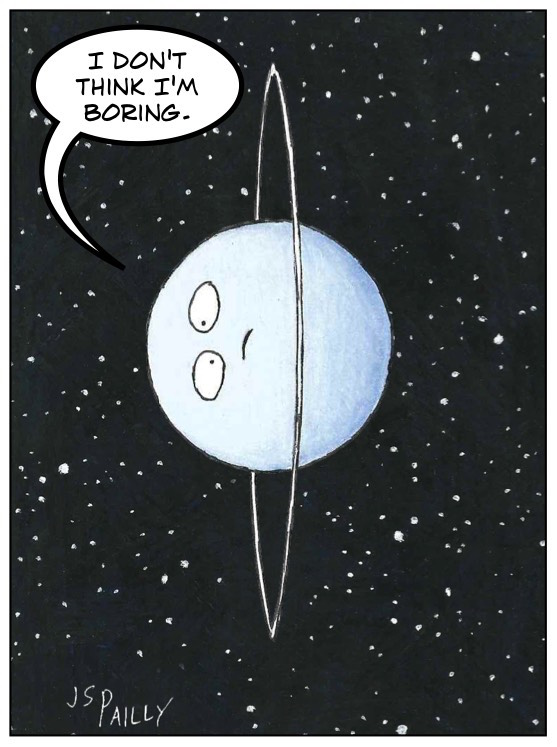
But of course, this was only true from our limited human perspective.  Our eyes can only see a range of approximately 400 to 700 nanometers on the electromagnetic spectrum (which we perceive as the colors violet to red).

If you observe Uranus only in this 400 to 700 nm range, there’s not much to see.  Switch to ultraviolet, however, and you’ll find a complex and dynamic atmosphere that’s every bit as interesting as Jupiter or Saturn’s.

Whether we’re talking about planets or people, what is boring versus what is interesting is all a matter of perspective.  Will this little anecdote change anybody’s mind?  I’m not sure.  I suspect if you already think I’m a boring person, me talking about sciency stuff only reinforces that belief. But I hope the rest of you get what I’m trying to say.

P.S.: Fun fact!  If you’ve ever wondered why Uranus got stuck with its giggle-inducing name, it’s because the guy who picked the name was German, and he probably didn’t realize what it would sound like in English.

Beneath the Blue-Green Clouds

It would have been the most celebrated discovery in human history: life on another world.  But the press and the late night comedians soon turned what should have been an auspicious occasion into one great big joke.

In February of 2050, NASA’s Herschel spacecraft released a small probe, one of many such probes designed to penetrate the atmospheres of gas giants.  We had learned much about the atmospheres of Jupiter and Saturn in this manner, but the Herschel mission would be a first, in more ways than one.

Among its many scientific instruments, the Herschel probe included a camera.  We expected to see a tranquil layer of blue-green clouds, with a layer of storms underneath.  If we were lucky, we thought we might even see methane ice crystals falling like snow.

But then, in a forty-three second sequence of images, we saw them.  They were giant, shadowy forms lurking in the dark, occasionally backlit by lightning.  They were enormous, easily the size of whales, and there were swarms of smaller organisms all around them, like the krill whales feed upon.

The krill-like life forms are difficult to make out in any detail, but the whales are clearly held aloft by gas bladders, filled with hydrogen, perhaps; and they have fin-like wings which they must use to maneuver. A great multitude of tentacles dangle from their underbellies, tentacles which seem to be writhing violently from one photo to the next, very much as though these animals were busily feeding.

Of all the places in the Solar System, this was the last place we expected to find alien life.  How could these creatures have evolved?  How could such a complex ecosystem sustain itself in the cold, far reaches of the Solar System?  These will have to be questions for some future mission, assuming Congress and the general public will take this seriously enough to support a future mission.

But unfortunately these mysterious and majestic creatures have become the laughing stock of the world, all because of one minor circumstance. All because of the planet where they happen to live.  All because of that planet’s name.

Although, truth be told, who wouldn’t laugh a little when the top headline on every newspaper reads: “Alien life discovered in Uranus.”

Sciency Words: Ice

Sciency Words: (proper noun) a special series here on Planet Pailly focusing on the definitions and etymologies of science or science-related terms.  Today’s Sciency Word is:

ICE

I have a friend who teases me whenever I use the word ice. This is because, depending on what we’re talking about, I can’t just say “ice.”  As soon as the conversation turns to space stuff (as it often does when I’m around, for some reason), I feel the need to say “water ice.” I feel the need—no, the compulsion to specify that I mean the frozen form of water, as opposed to the frozen form of something else.

In more normal, down-to-earth sorts of conversation, I don’t feel that same compulsion.  Water ice is the only kind of ice we’re likely to encounter here on Earth. On rare occasions, if you’re at a science fair, or maybe a Halloween party, you might encounter carbon dioxide ice (a.k.a. dry ice).  But that’s a very rare special case.

However, as soon as we start talking about other planets and moons, or comets and asteroids, the word ice takes on a much broader meaning. In these more cosmic conversations, you really do need to be specific about which ice you’re talking about. To quote from a recent issue of The Planetary Report:

In the strictest definition, ice is the solid form of water.  However, planetary astronomers often use “ice” to refer to the solid form of any condensable molecule.

Beyond Earth, and especially in the outer Solar System, we find all sorts of crazy ices, like ammonia ice, methane ice, or nitrogen ice.  Along with the water ice and CO2 ice we Earthlings are more familiar with, these ices make up the hard crusts of many planetary bodies, like Titan or Pluto.

We also find ice crystals (of various types) forming in the clouds of planets like Uranus and Neptune.  In fact, Uranus and Neptune are often called “ice giants” in large part because of all those weird ices found in their atmospheres.

Starting next week, I’m planning to take a much closer look at those ice giant planets.  I expect my research to turn up plenty of questions, but very few answers.  Uranus and Neptune are, at this point, the least well explored planets in the Solar System.

So stay tuned!

P.S.: I want to start referring to all forms of igneous rock as “magma ice.”  After all, what is igneous rock but frozen magma?  I can’t think of any good reason why the term “magma ice” shouldn’t apply.

The Nine Lives Hypothesis, or Why Schrödinger’s Cat Can Never Die

Today’s story was inspired by my recent Sciency Words post on Schrödinger’s cat.  I cannot emphasize enough that this story is not meant to be taken seriously.

It is often said that anyone who claims to understand quantum mechanics is either lying or delusional.  In 1935, world-renounced physicist Erin Schrödinger proposed an experiment to demonstrate the true absurdity of all things quantum.  The experiment came to be known as Schrödinger’s cat. Now today, despite the vehement protests of animal rights groups, researchers at Omni-Science Laboratories have conducted the first ever real world test of the Schrödinger’s cat experiment.

A cat is placed inside a test chamber, along with a sample of cesium-131, a radioactive isotope.  A contraption within the test chamber will either kill the cat or spare the cat’s life, depending on what that cesium isotope does.  If the cesium undergoes radioactive decay, the cat will die.  In not, the cat will live.  The conditions of the experiment are so devised that the cat should have an even 50/50 chance at survival.

But according to the bizarre laws of the quantum world—the world of atoms, including radioactive cesium atoms—nothing is real unless it is being observed.  In the absence of an observer, anything and everything that can happen does happen, all at once, all jumbled together in a coexistent meta-state.

And so once the test chamber is sealed and its contents can no longer be observed, the laws of quantum mechanics should take over. The cesium isotope simultaneously does and does not decay.  The killing apparatus simultaneously has and has not been triggered. The cat simultaneously is and is not dead.  And so the situation should remain, until the scientists reopen the test chamber and observe its contents.

Researchers at Omni-Science originally intended to run the experiment only a dozen times, but the test results were so surprising and so confusing that additional tests were warranted.  In total, 63 cats were put through the experiment.  And to the astonishment of everyone involved, all 63 cats survived.

“We’re at a loss to explain it,” says Dr. D.C. Bakshali, principal investigator on the Schrödinger’s cat project.  “Statistically speaking, roughly half the cats should have died, and half should have survived.  But the survival rate was 100%.  We didn’t lose one cat.  Not one!”

Several hypotheses have been proposed to explain these surprising results.  One possibility is being referred to as the nine lives hypothesis.  Since cats are said to have nine lives, perhaps whenever a cat dies in the test chamber it immediately resurrects itself.  Although this notion was initially suggested as a joke, one Omni-Science researcher latched onto the idea and even proposed a mechanism that may explain how unobserved cats are able to continuously revive themselves.

“Even in the 1930’s,” says Dr. Haru Hoshiko, “it was pointed out that a cat is perfectly capable of observing itself.  But has it not occurred to anyone that only living cats are able to make such observations?”

Hoshiko goes on to explain: “So long as Schrödinger’s cat remains alive, it observes itself as living.  The moment it dies, however, there is no longer an observer present.  The laws of quantum mechanics reign once more, the cesium has once again simultaneously decayed and not decayed, and thus the cat is once again simultaneously dead and alive. But the living version of the cat is capable of observing itself to be alive, causing the superposition to collapse.  Thus, Schrödinger’s cat can never die!”

According to Hoshiko, the nine lives hypothesis should more accurately be called the infinite lives hypothesis, as there is no theoretical limit to how many times a cat—or any other animal, for that matter—would be able to revive itself in this manner.  Hoshiko’s paper on the subject has been accepted for publication in Nature.

Needless to say, the results of the Schrödinger’s cat experiment have profound implications for our understanding of quantum mechanics and, indeed, the nature of reality itself.

Sciency Words: Eustress vs. Distress

Sciency Words: (proper noun) a special series here on Planet Pailly focusing on the definitions and etymologies of science or science-related terms.  Today’s Sciency Word is:

EUSTRESS vs. DISTRESS

So I’ve been dealing with more stress than usual this past week, but maybe that’s not such a bad thing.  Like cholesterol, there can be good stress and bad stress.

When I started researching this topic, I was surprised to learn that the whole concept of stress, in the psychological sense of the word, is a relatively modern development.  According to the American Institute of Stress, Hungarian-American endocrinologist Hans Selye gets credit for coining the term in 1936.

Selye defined stress as “the non-specific response of the body to any demand for change.”  Selye seems to have gone to great lengths to emphasize that stress is not an inherently bad thing.  As stated in this paper on stress in video games:

Medical anthropologists and others commonly frame stress as negative and connected to poor mental and physical health.  However, Selye (1975) pointed out that stress itself is adrenaline- and/or cortisol-fueled arousal, relatively neutral in character, but rendered by context either pleasurable eustress or painful distress.

Selye gets credit for coining those words as well: eustress and distress.  In this context, the Greek prefixes “eu-” and “dis-” simply mean “good” and “bad,” respectively.

Research and discussion of eustress and distress typically focuses on productivity in the workplace, but I think research related to video games does a better job illustrating the concept.  To quote once more from that stress in video games paper, “Without some degree of stress, there is no fun, a point that both anthropologists and game developers understand well.”

But as the paper goes on to demonstrate, certain hardcore gamers—those who “game too hard and too long”—tend to transition at some point from eustress to distress.  Basically, so long as you feel like you’re “up to the challenge,” whatever that challenge might be, you’re probably experiencing eustress.  But if you start to feel overwhelmed, that’s distress.

The point at which eustress turns into distress is, of course, different for each of us, and it varies from one activity to another.  It may even vary from day to day.  Something that you found eustressful yesterday might suddenly feel distressful today, or vice versa.

As for my own stress this past week, there may have been a little too much distress going on.  But that’s over now, and I’m looking forward to a highly eustressful weekend!

Google Knows I’m Thinking About Quantum Physics

Ever since my Schrödinger’s cat post last week, I’ve had quantum physics on the brain.  Some Google algorithm must’ve deduced this somehow, because suddenly YouTube started recommending videos like this one:

If quantum physics is a subject you’re interested in, and if you don’t mind sitting through a little math (not a lot of math, just a little), then this video is worth your time.  It’s a demonstration of a quantum physics experiment you can do at home.

Yes, you read that correctly.  You can do a quantum physics experiment at home!

Sciency Words: Schrödinger’s Cat

Sciency Words: (proper noun) a special series here on Planet Pailly focusing on the definitions and etymologies of science or science-related terms.  Today’s Sciency Word is:

SCHRÖDINGER’S CAT

Quantum physics has a mascot: a cat.  Specifically, it’s a cat that is somehow, almost magically, both dead and alive at the same time.  Does that sound weird?  Confusing?  It should.  This simultaneously living and dead cat has come to represent everything that makes quantum physics such a weird and confusing subject.

I’m not going to go into the details of how quantum mechanics works because A) I don’t have the math skills to do that properly and B) even if I did, it’s way too big a topic to cover in one blog post.  For the purposes of a Sciency Words post, it’s enough for you to know this: based on a strict interpretation of quantum mechanics, you would be forced to conclude that nothing is real unless it is being observed.

If you find that hard to accept, you’re not alone.  Many of the scientists who came up with quantum mechanics couldn’t accept it.  In 1935, German physicist Erwin Schrödinger—a man who’d received a Nobel Prize for his contributions to quantum theory—had had enough, and he published this article titled “The Present Situation in Quantum Mechanics.”

Don’t let that stolid title fool you.  Schrödinger was mad.  I’d characterize his article as an angry rant about everything wrong with quantum mechanics, or at least everything that was wrong with the strict interpretation of quantum mechanics.  That strict interpretation was becoming increasingly popular among Schrödinger’s colleagues, and it remains very popular among physicists today.

It was in the middle of this angry rant that Schrödinger first presented his now famous cat-in-a-box paradox.  Schrödinger first describes a killing contraption worthy of a James Bond villain.  A radioactive isotope is placed in a box.  A Geiger counter is rigged to trigger a hammer, which will smash a flask of hydrocyanic acid if the Geiger counter detects radioactive decay.  Lastly, a cat is placed in the box.  The box is sealed up so that no one can observe what’s happening inside, and it’s left undisturbed for one hour.

There’s a fifty-fifty chance that that radioactive isotope will decay before the hour is up.  Therefore, there’s a fifty-fifty chance that the cat will die.  So until we open the box and make an observation, a strict interpretation of quantum mechanics would have us believe the isotope simultaneously has and has not decayed.  The Geiger counter simultaneously has and has not gone off, and the cat simultaneously is and is not dead.

Schrödinger’s cat was meant to demonstrate that a strict interpretation of quantum mechanics leads to nonsensical conclusions. “The rejection of realism has logical consequences,” Schrödinger warns us.

No one has ever tried this experiment with an actual cat (I hope), but according to this article from Quanta Magazine, the Schrödinger’s cat phenomenon can and does happen in real life.  Quantum mechanics is weird.  It’s confusing.  It defies common sense.  But as author John Gribbin writes in his cleverly titled book In Search of Schrödinger’s Cat:

Common sense has already been tested as a guide to quantum reality and been found wanting.  The one sure thing we know about the quantum world is not to trust our common sense and only believe things we can see directly or detect unambiguously with our instruments.

Beware Wishful Thinking: A Science Lesson

This may seem like a contradiction. Astrobiologists are actively searching for alien life.  It’s their job.  And yet whenever new evidence of alien life is presented, astrobiologists are the first and most vocal skeptics about it.  If your job is to search for alien life, why would you be so quick to doubt any evidence that alien life actually exists?

This goes back to the famous “extraordinary claims require extraordinary evidence” line from Carl Sagan, or the whole proof beyond a reasonable doubt thing I kept saying during my recent A to Z series on the search for alien life.  Astrobiologists very much do want to find alien life.  They’re eager to find it.  Perhaps a little too eager.

And thus, astrobiologists have to be careful.  They have to be extra skeptical, because they have to be on guard against their own wishful thinking.

And really, this is not only true in the field of astrobiology; it’s true of science in general.  And frankly, it’s a valuable lesson for us all, even if you’re not a scientist.

I can’t tell you how many times I’ve really wanted to believe something.  I’ve really wanted to believe that some girl likes me, or that I’ve put my money in sound investments, or that I’ve voted for the right people.  And when you really want to believe something, you’ll latch onto whatever flimsy evidence you can find to prove to yourself that it’s true.

Astrobiologists know this.  Scientists know this (or at least they’re supposed to).  And I think it’s good advice for us all to live by.  The more you want to believe something, the more you should question and doubt it.  Always, always, always be on guard against your own wishful thinking.

Wisdom of Gattaca: Measuring Human Potential

I recently spent a whole month researching and writing about aliens.  For a science fiction writer like me, learning about astrobiology—the scientific search for and eventual study of alien life—is an immensely valuable source of inspiration.  However, there is more to Sci-Fi than aliens and outer space.

I think I always knew this on some level, but the first movie to really make me understand it was Gattaca.  Growing up with Star Trek, Battlestar Galactica, and Doctor Who, I thought I had a pretty good feel for what science fiction was all about. While Gattaca didn’t totally break the mold (it does have spaceships, after all), it stretched the limits of the genre as I understood it at the time.

It was also a movie that raised a lot of questions and did not always supply the audience with easy answers.  Take this scene where the Mission Director at Gattaca talks about “a new measuring stick” for human potential.

Mission Director: We have to ensure that people are meeting their potential.

Police Detective: And exceeding it?

M.D.: No one exceeds his potential.

P.D.: If he did?

M.D.: It would simply mean that we did not accurately gauge his potential in the first place.

I really don’t want to agree with the Mission Director’s point.  I’m pretty sure, given the overall themes Gattaca explores, that the movie doesn’t want me to agree with him.  And yet it’s really hard to argue against the Mission Director’s logic here.

You can’t really “turn it up to eleven.”  You can’t really “give 110%,” because that’s just not how percentages work.  People may underestimate you.  You may underestimate yourself.  But you do have limits.  You can’t do more than you’re capable of doing, you can’t achieve more than you’re able to achieve… can you?

So I don’t really know how I feel about this exchange of dialogue, except that maybe the Mission Director’s logic started from a faulty premise.  Maybe the very idea of “a new measuring stick” for human potential is wrong.  Maybe human potential isn’t a thing that can be measured at all.  Maybe it’s not a quantifiable thing, at least not in the way the Mission Director presumes that it is.

But I don’t know.  Have you seen this movie?  Do you agree with what the Mission Director is saying?  Do you disagree? Let me know in the comments!

A to Z Reflections

You don’t really understand something until you can explain it to somebody else.  There are lots and lots of quotes out there to that effect, sometimes attributed (or misattributed) to Einstein, sometimes attributed (or misattributed) to other great scientists.  Regardless of where all those quotes really came from, that sentiment has long been the guiding philosophy of this blog.

For this year’s A to Z Challenge, my theme was the scientific search for alien life.  Obviously I’ve written about that topic before, many times over, but I still felt a bit shaky in my knowledge.  So I wanted to dive deep into the science of astrobiology and the closely related field of SETI.  I wanted to double check the things I thought I already knew, and of course I wanted to add to that knowledge.

Writing those 26 blog posts was the final step, the final test. Have I learned this stuff well enough to explain it clearly and concisely?  I suppose only you, dear reader, can be the judge of that. But based on the responses I’ve gotten so far and the conversations I’ve been having with people in the comments, I feel like I must’ve done a decent enough job.

With this year’s A to Z Challenge now behind me, I certainly feel more confident talking about astrobiology and SETI than I did before. More importantly, I feel a whole lot more comfortable incorporating what I’ve learned into my science fiction. After all, I started this blog with one purpose in mind: to force myself to do the kind of research that, in my opinion, a science fiction writer ought to do.

If any of you came away from my A to Z series feeling like you learned something, or even if you just have a newfound sense of wonder for the stars—for all the things that might be out there in the cosmos—I consider that a bonus.  Thank you for reading, and thank you especially to those of you who commented.

On Monday, I’ll be back to my regular blogging schedule.