Sciency Words: Colony

Hello, friends!  Welcome to another episode of Sciency Words.  Normally on Sciency Words, we talk about those strange words scientists use, but today we’re going to talk about a word scientists—or at least some scientists—would prefer to stop using.  And that word is:

COLONY

Mars is so eager for humans to come visit and maybe even stay permanently.  And plenty of humans are eager to do just that!  We’ll bring life to Mars.  Not only that, we’ll bring civilization and culture.  One might say it is humanity’s destiny to colonize Mars.

But is this language of “colonization” and “destiny” too evocative of European imperialism?  Some think so, and they would ask that we stop using such colonialist language when we talk about space exploration.

Now I want to be clear about where I’m coming from on this: I try my best to call people by the names and terms they prefer to be called, and if I find out that the language I use offends somebody, I’ll do may best to change.  Some would accuse me of being too P.C., but I think it’s just good manners.

And I have found that if you make an effort to be respectful and accommodating to others, others will make an effort to be respectful and accommodating to you, and in general they’ll be more willing to forgive you if/when you do slip up and say something unintentionally hurtful.

So a few years back, when I came across this article from National Geographic, I started reading it with an open mind and a willingness to change.  But by the end of the article, even I felt like this was an example of political correctness run amok.  The word “colony” is offensive.  So are the words “settlement” and “frontier.”  Okay.  What words should I use instead?  Even that National Geographic article seems to concede at one point that we don’t have many workable alternatives to these terms.

But this concern does seem to be coming up more and more.  Plenty of people in the scientific community are shying away from words like colony and colonization.  Bill Nye (the Science Guy) says he avoids the word colony, and this official glossary of SETI terminology warns that “settle” and “colonize” may have certain negative connotations for some people.

So at this point, I’m not sure what to think.  What about you?  Do you think this is much ado about nothing, or should we really start looking for alternatives to words like “colony” or “settlement” in our space exploration vocabularies?

Next time on Planet Pailly… I actually don’t have anything planned yet for my next blog post.  We’ll probably just talk about more space stuff.
Being Polite to Siri

Hello, friends!

I recently bought a new phone, and I seem to have slipped into an odd new habit.  Whenever I ask Siri to do something for me, I say please.  And afterward, I say thank you.

Why do I do this?  Well, I could joke with you and say I’m worried about artificial intelligence taking over the world.  On the day when the machines overthrow their human masters, I’m hoping Siri will remember that I was one of the polite ones, and maybe then I’ll receive a less severe punishment than the rest of humanity.

But I won’t say that.  That would be silly.

Instead, I’m going to borrow a sentiment from Star Trek’s Ensign Sonya Gomez.  Why am I polite to technology?  Because why not?

Honestly, being polite to a machine costs you nothing.  And maybe if you practice good manners with your technology, you’ll develop other good habits, like having good manners when you interact with actual human beings.

Also, it really wouldn’t surprise me much if there’s a database somewhere where I’m flagged as one of the “polite ones,” and maybe someday that will become really important.

Next time on Planet Pailly, is it politically incorrect to talk about colonizing Mars?

Why Haven’t We Found Planets in Alpha Centauri?

Hello, friends!  Today I’d like to take you on a quick tour of the Alpha Centauri star system, the Solar System’s next door neighbors.

Alpha Centauri consists of three stars.  Two of those stars orbit in a tight binary formation, sort of like this:

Animation courtesy of Wikipedia.

The third star is known as Proxima Centauri.  It’s a tiny red dwarf star, orbiting very far away from that central binary pair.  Proxima is known to have at least one (possibly two) planets, but we’ll visit Proxima’s planets in a future post.

Today, I really just want to focus on Alpha Centauri A and B, the two stars in that central binary, to see if they have any planets.  In 2012, astronomers announced the discovery of a planet orbiting Alpha Centauri B, but that discovery turned out to be a ghost in the data.  Otherwise, astronomers have found nothing out there.

Over the last decade or so, we’ve found so many exoplanets, both near and far.  Given how close-by Alpha Centauri is, you’d think we would have found something there by now.  It’s enough to make you wonder if, maybe, there’s nothing to find.  But it turns out there’s a very good reason why we’re having so much trouble finding Alpha Centauri’s planets.

As Alpha Centauri A and B move through their figure-eight orbital paths, sometimes they’re close together, and sometimes they’re far apart.  Over the past decade or so, it just so happens that they’ve been very close together, at least from our vantage point here on Earth.  Even with all the advanced planet hunting techniques we’ve developed in the past ten years, the double glare of those two stars would’ve concealed any signs of a planet from our view.

But that’s about to change.  In February of 2016, Alpha Centauri A and B were as close together as they’ll get (as seen from Earth).  They’ve been moving away from each other ever since, and according to this article from Scientific American, 2020 is the magical year when A and B are finally far enough apart that our telescopes can observe them separately.

Based on the metallicity of those two stars, they should be just as capable of forming planets as our own Sun.  Planetary orbits would be stable up to 2.5 astronomical units away from either star, according to Scientific American (our entire inner Solar System could fit comfortably inside that 2.5 A.U. radius).  And computer simulations produce many plausible scenarios where Earth-like planets could exist in the Alpha Centauri binary.

In some of those computer simulations, an Alpha Centaurian planet might be even more suitable for life than Earth!  So stay tuned.  In the next few years, we may finally get news about habitable planets—or even a superhabitable planets—in Alpha Centauri.

Next time on Planet Pailly, how are you preparing for the robot rebellion?

Sciency Words: Superhabitable

Hello, friends!  Welcome to Sciency Words, a special series here on Planet Pailly where we talk about the meaning and origin of scientific terms.  Today’s sciency word is:

SUPERHABITABLE

The word “habitable” traces all the way back to ancient Latin.  Think of a residence or dwelling.  Think of tenants and landlords and the act of paying rent.  That’s the sort of thing words like habitabilis, habitator, or habitatio referred to.

Of course when we talk about planets, the meaning of “habitable” and “habitability” is a bit different.  Unless…

In our ongoing search for extraterrestrial life, it’s generally assumed that Earth is typical of habitable planets.  But why should we assume that?

In this 2014 paper, physicists René Heller and John Armstrong claim that Earth is not as perfectly suited for life as it seems.  In some ways, Earth is kind of a dangerous place to live, and there have been several instances where life on Earth nearly got snuffed out.  Heller and Armstrong then go on to argue that other worlds may “offer more benign environments to life than Earth does.”

If we insist on calling Earth “habitable,” then Heller and Armstrong propose calling those other worlds “superhabitable.”  Though really, if we’d stop being so geocentric and anthropocentric in our terminology, it is the “superhabitable” planets that should set the standard for habitability, and Earth would be better described as “marginally habitable.”

So what sort of planet would offer a more benign environment for life than Earth does?  Well, according to Heller and Armstrong, planets that are two to three times as massive as Earth would do nicely.  More massive planets will remain geologically active for longer, and they’ll have stronger magnetic fields to protect life from solar and cosmic radiation.  Shallower oceans and a thicker atmosphere would help too.

A smaller and cooler star would also be preferable.  A K-type “orange dwarf” would spew out less harmful radiation than our own G-type Sun, and K-type stars last longer.  A whole lot longer.  No need to worry about the day the sun dies if your planet orbits a K-type star!

Personally, I feel like Heller and Armstrong are making a lot of big assumptions in describing their superhabitable planets.  There may be some wishful thinking at work here.  But then again, it’s also a pretty big assumption to assume that Earth is a typical example of a habitable world.  There’s probably some wishful thinking at work there too.

Next time on Planet Pailly, the nearest superhabitable planet could be a lot closer than you think (unless you clicked that link above, in which case you probably know where Heller and Armstrong said the nearest superhabitable planet might be).

The Peril of Being Self Educated

Hello, friends!

As many of you already know, I blog about science, but I am first and foremost a science fiction writer (fingers crossed, soon to be a published science fiction writer!).

Back in 2010, I started this blog as a way to force myself to do the kind of research that I, as an aspiring Sci-Fi author, thought that I ought to be doing.  In the beginning, I really didn’t know much about science, except for some stuff I remembered learning in school.  And most of that stuff I remembered from school turned out to be wrong or, at best, only half true.

That’s one of the reasons I love being self educated.  Writing this blog has given me an opportunity to discover and correct many of the misconceptions I once had about science.  And my Sci-Fi writing has improved as a result.  I was recently looking over one of my old manuscripts.  So many silly misconceptions are on full display in that text.  Thank God that story never got published!

Another reason I love being self educated: doing deep dives on topics that I find interesting or that I think could be useful in my stories—topics like lithium mining, Troodon intelligence, or Venus’s unknown absorber.  The kinds of topics that never seem to get covered in school or that rarely get attention from the popular press.

I have, on occasion, surprised professional scientists with just how much I know about some weirdly specific topics.  And then I’ve surprised those same scientists with how much I don’t know about more ordinary, more generalized things.  That’s the peril of being self educated.  Your knowledge is splotchy, inconsistent.  You end up with these weird gaps in your knowledge, gaps that someone with a more traditional science education would not have.

And that’s why I keep blogging: because there’s still a whole lot I don’t know, and I’m sure I still have a lot of misconceptions in my head about science, and about other things too.  One thing I didn’t anticipate when I started this blog was how valuable a resource you, dear reader, would be.  You’ve asked me questions.  You’ve challenged me.  Some of you have pointed out my mistakes and suggested new avenues of research.

For that, I just want to say thank you, and please keep it up!

Next time on Planet Pailly, what if I told you Earth is not the perfect planet for life?

Sciency Words: Anophthalmus hitleri

Hello, friends!  Today’s post is probably a bad idea!

Sciency Words is a special series here on Planet Pailly where we talk about scientific terminology.  In today’s episode, we’re talking about:

ANOPHTHALMUS HITLERI

If you’re the first person to identify a new species, you get to name it.  That’s the rule.  You do have to double check to make sure nobody else identified your species first, and the name you pick should sound vaguely like Latin.  But otherwise, be creative, have some fun, and name your newly discovered species however you like!

That’s what Austrian entomologist Oskar Scheibel did in 1937.  Scheibel was the first to identify a species of blind, cave-dwelling beetle native to Slovenia, and he decided to name these beetles after one of his greatest heroes: Adolf Hitler.

Anophthalmus hitleri can be translated to mean “the blind one of Hitler”—a name which seems symbolically appropriate, in a way.  They’re now an endangered species.  Apparently a lot of Neo-Nazis really want a Hitler beetle for their Nazi memorabilia collections, so much so that Anophthalmus hitleri is being driven to extinction by poachers—a fact which also seems symbolically appropriate, in a way.

But this post isn’t really about Hitler or Neo-Nazism.  Rather, I’m bringing this up because the example of Anophthalmus hitleri helps illustrate an important point about scientific terminology: once a name has been established in the scientific lexicon—even if it’s a really awful name like Anophthalmus hitleri—it’s really hard to change it.

Scientists like being able to review prior research about a given topic.  If scientists were constantly renaming things, that would make finding all that prior research rather difficult.  This is especially true when it comes to species names.  There are an absolutely ridiculous number of species out there, and keeping track of them all is hard enough as it is.

The International Commission of Zoological Nomenclature is currently in charge of the rules for naming animal species.  And the rules are, basically, what I said before: if you’re the first to identify a new species, you get to name it.

The only way a species name can be changed is if some new information comes to light, or some new discovery is made, revealing that you made some sort of mistake.  Maybe you weren’t really the first person to identify that species, or maybe you assigned your newly discovered species to the wrong family or genus.  But Oskar Scheibel doesn’t seem to have made any mistakes like that, and so Anophthalmus hitleri is stuck with the name it’s got.

Next time on Planet Pailly, I like to think I’m pretty smart, but maybe I’m not as smart as I think.

Dancing with the Binary Stars

Hello, friends!

Today I just want to share a thing that came up during my research for last week’s episode of Sciency Words.  It has to do with our next-door neighbors, the Alpha Centauri star system.

Alpha Centauri is, famously, the nearest star system to our own Solar System.  As such, Alpha Centauri gets a lot of love from science fiction writers.  So many space aliens come from there, and so many human space adventurers will be heading Alpha Centauri’s way, just as soon as we invent faster-than-light technology.

Alpha Centauri is also, famously, a binary star system: two stars locked in orbit together1.  But the way the Alpha Centauri binary is portrayed in science fiction is… well, I think a lot of Sci-Fi writers get this wrong.  I know I’ve gotten it wrong in the past.

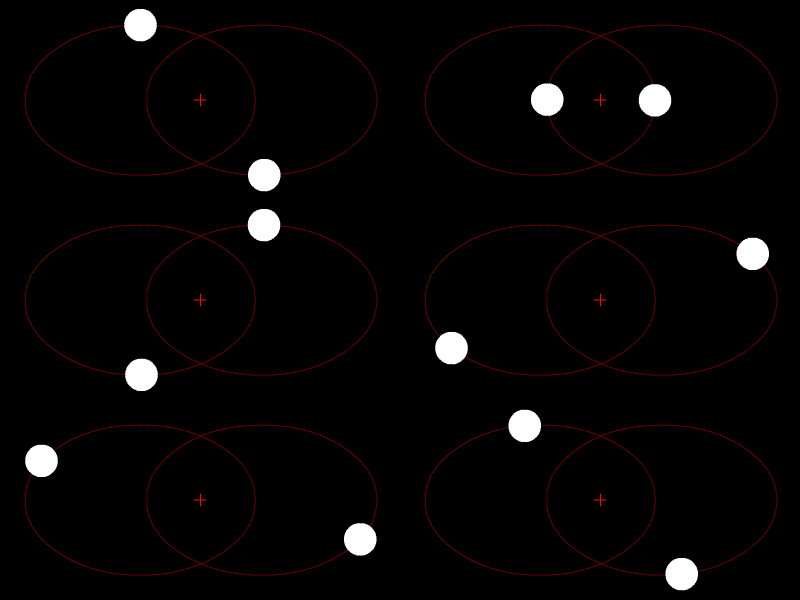
Which brings me to the thing I want to share with you today.  It’s a simple but absolutely perfect visualization of the way Alpha Centauri A and B dance around their common center of mass (a.k.a. their barycenter).

Image courtesy of Wikipedia.

In my experience, a lot of science fiction writers make it sound like Alpha Centauri A and B are right next to each other.  They make it sound like you could stand on the surface of a planet, look up, and see two suns side by side, like you’re Luke Skywalker watching the double sunset on Tattooine.

But even at closest approach, Alpha Centauri A and B are approximately 11 astronomical units apart (roughly equivalent to the distance between the Sun and Saturn).  And at maximum separation, they’re approximately 36 astronomical units apart (roughly equivalent to the distance between the Sun and Pluto).

Yes, watching a double sunset like that scene in Star Wars would be incredible.  But this figure-eight dance that happens in Alpha Centauri (and in many other binary star systems too) is even more amazing, in my opinion.

Next time on Planet Pailly, we’ll meet some insects who would really appreciate it if we’d change their name already.

1 Umm, actually Alpha Centauri has three stars: two Sun-like stars in the middle and a tiny red dwarf star orbiting much farther out.

Something Worth Knowing

Hello, friends!

Today I’d like to share a very old video I found on YouTube.  It’s a series of man (and woman) on the street interviews where people are asked if they think we’ll find life on other planets.

According to the video description, this was filmed in 1962.  It’s interesting to me to hear people talk about the possibility of finding “vegetable” and/or “animal” life on Venus.  At that time, the Soviet Union’s Venera 1 spacecraft would have already visited Venus; however, due to a technical glitch, Venera 1 failed to transmit any data about Venus back to Earth.  So surface conditions on Venus were still unknown to us Earthlings.

But setting aside the Venus stuff in particular, in general people’s opinions about space exploration and extraterrestrial life have not changed much since 1962.  Some people are enthusiastically optimistic, others think it’s all nonsense, and a lot of people don’t seem to care one way or the other.

Then, of course, you get the one guy who swears he’s seen a U.F.O.  And then, of course, you get the guy who’s “working off the theory of the Bible,” where it says God only created life on one planet (F.Y.I., I’ve read the Bible too, and I don’t remember it ever saying that).  So again, not much has changed since 1962.

But my favorite is the woman at 1:40 who says she doesn’t expect we’ll find any life on Venus, but then goes on to say we’ll still find “something worth knowing.”  I’d say she was right on both counts!

Personally, I do think there’s life on other planets, and also on other moons (I’m looking at you, Europa).  But regardless of whether or not we find alien life out there, we should absolutely keep searching and keep exploring.  I suspect we will continue to learn all sorts of things that are worth knowing!

Next time on Planet Pailly, we’ll learn how to dance like binary stars.

Sciency Words: Barycenter

Hello, friends!  Welcome to Sciency Words, a special series here on Planet Pailly where we talk about those big, complicated words scientists use.  Today’s Sciency Word is:

BARYCENTER

Excuse me, but I’m going to do that “um, actually” thing that people who think they’re really smart like to do.  Now you may think the Earth orbits around the Sun.  Um, actually… the Earth and Sun both orbit something called the barycenter.

The word barycenter comes from two Greek words meaning “heavy” and “center,” and it refers to the common center of mass for two or more celestial bodies.  Based on sources I found via Google Ngrams, the term started appearing frequently in astronomical journals during the early 20th Century, and it may have been in use as early as the 1880’s.

Let’s say you have two celestial bodies.  One is really massive, the other is much less massive.  In that case, the barycenter will probably be located somewhere inside the more massive object.  This is the case for the Earth and her Moon.  Based on numbers I got from Wikipedia, the Earth-Moon barycenter is about 1000 miles (1700 km) beneath Earth’s surface.  Or to measure that a different way, the barycenter is about 3000 miles (4600 km) away from the center of the Earth.

Now let’s say you have two celestial bodies of roughly equal mass.  In that case, the barycenter will be located somewhere between them.  Something like this has happened with Pluto and his giant moon, Charon.  Once more using numbers from Wikipedia, it looks like the Pluto-Charon barycenter is about 500 miles (960 km) ABOVE the surface of Pluto.

As for the Earth-Sun barycenter, it’s located deep inside the Sun.  So if you say Earth orbits the Sun, you’re not too far from the truth.  But of course Earth is not the only planet in the Solar System, and when you consider the Solar System as a whole, you’ll find the Sun wibbles and wobbles about in weird, loopy patterns.  As you can see in the highly technical diagram below, the Sun wibbles and wobbles so much it can wobble into a totally new position in just a few years.

Click here for an actual diagram of the Sun’s movement relative to the Solar System’s barycenter.

As explained in this paper, this is mainly due to the gravitational influences of Jupiter and Saturn. Over longer time scales (centuries rather than decades), the subtler influences of Uranus and Neptune also have a noticeable effect.

So the next time someone tells you the Earth orbits the Sun, you can do the “um, actually” thing and explain what a barycenter is.  Trust me, it’s a great way to sound smart and make lots of new friends!

Next time on Planet Pailly, what did people in 1962 think we’d find on other planets?

#IWSG Judge Not and You Shall Not Be Judged

Hello, friends!  Welcome the first posting of the Insecure Writer’s Support Group for 2020!  If you’re a writer, and if you feel in any way insecure about your writing life, click here.  I.W.S.G. is an awesome organization for insecure writers like us!

For years now, I’ve used these I.W.S.G. posts to tell you about the relationship I have with my muse.  She’s a clever muse.  She can also be really annoying sometimes.  But my muse is also a little bit more than just my muse.  She’s also my conscience.

If you’ll allow me to get religious for a moment, I’d say my muse has a favorite Bible verse.  It’s from the Gospel of Luke.  It’s the “judge not and you shall not be judged” part.

I have to admit I have a tough time with this.  Other people can be so stupid, so crass, so self-centered and inconsiderate.  I can’t help but feel a teeny bit judgmental.  I think it may be part of human nature.  We can’t help but judge each other.

But the muse does not accept my “human nature” excuse.  Every time I start to get judgy, my muse reminds me that I am a writer.

As a writer, I have a responsibility to see how everyone is the hero of their own story (or at least I have a responsibility to try).  No matter what horrible things my gut instinct may tell me about other people, other people have their own reasons for doing what they do or being the way they are.  Other people have backstories.  Other people have motivations.  They have needs and wants, and maybe their needs are in conflict with their wants.  And they have inner monologues that, regardless of what I might think, must make logical sense to them.

This is not meant to be a Bible-themed blog post.  This isn’t about being a better Christian.  It’s not even about being a better human being.  This is simply a matter of becoming a better writer, because if you can learn to sympathize with other people in real life, then, miraculously, your readers will find it easy to sympathize with the characters you put into your stories.

At least that’s what my muse keeps telling me.

Next time on Planet Pailly, the Earth orbits the Sun… right?  Right?