Hello, friends, and welcome back to Sciency Words! Each week, we take a closer look at the definition and etymology of a science or science-related term. Today’s Sciency Word is:
TIME’S ARROW
Which way is time going? Prior to the 1890’s, no one would have asked such a silly question. Time is time. Everything about time is self-evident. Why would anyone question it?
But then in 1895, H.G. Wells introduced the concept of time travel to the readers of adventure fiction. And then in 1915, Albert Einstein started treating time as a variable, rather than a constant, as part of his general theory of relativity. In his book Time Travel: A History, science historian James Gleick explains:
Millennia had gone by without scientists needing special shorthand like “time’s arrow” to state the obvious—the great thing about time is that it goes on. Now, however, it was no longer obvious. Physicists were writing laws of nature in a way that made time directionless, a mere change of sign separating +t from –t.
British astronomer Sir Arthur Eddington gets credit for introducing the “arrow of time” as a conceptual metaphor. Eddington’s arrow points from the past toward the future. Unless it doesn’t. Depending on what sort of physics problem you’re trying to solve (or what sort of Sci-Fi story you’re trying to tell), it may be more convenient to imagine time’s arrow pointing from the future toward the past.
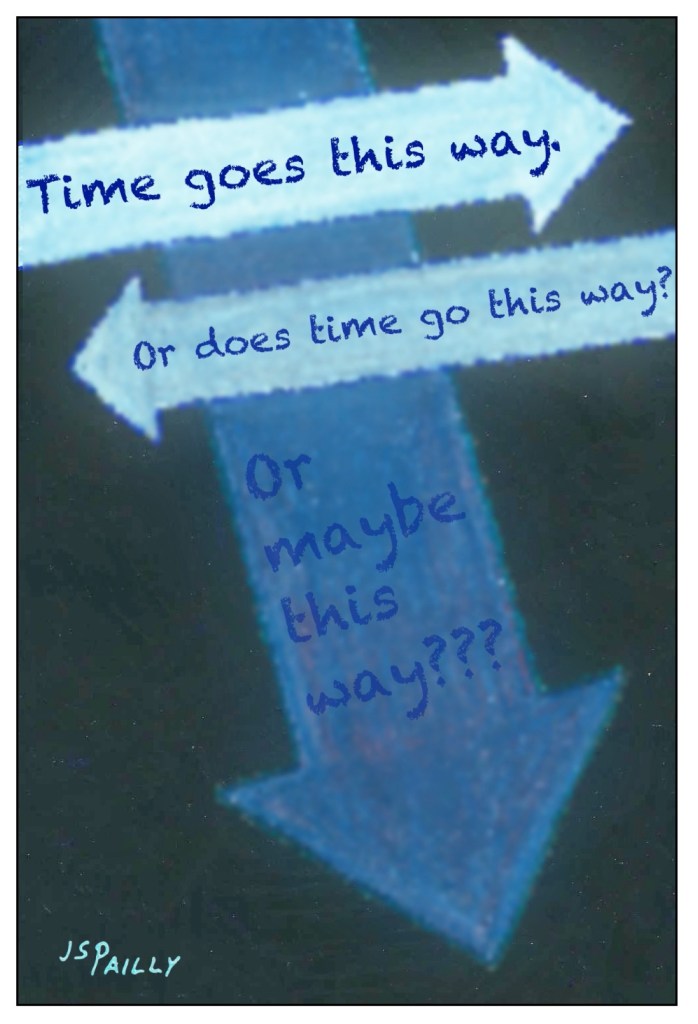
In 1927, in a series of lectures at the University of Edinburgh, and then later in a book titled The Nature of the Physical World, Eddington made three key points about time’s arrow, which I’ll paraphrase as:
- Gosh, time’s arrow sure does seem real to us humans.
- And common sense reasoning insists that time’s arrow must always point in the same direction.
- But when you do the math, you’ll find that none of the laws of physics actually require time’s arrow to exist, except one.
That one exception is the second law of thermodynamics, which tells us that the entropy of a closed thermodynamic system will inevitably increase with the passage of time. So time’s arrow must always point in the direction of increasing entropy.
Of course a lot of people remain skeptical about time travel. The Time Machine by H.G. Wells is a fine piece of fiction. As for general relativity, treating time as a variable (rather than a constant) might help make the math work, but that doesn’t necessarily mean variable time is a real phenomenon.
Still, thanks in larger part to Arthur Eddington and his arrow metaphors, the question “which way is time going?” no longer sounds like total nonsense.
Next time on Planet Pailly: have we discovered a second planet orbiting Proxima Centauri?


 Planet Pailly