Sciency Words: The Unknown Absorber

Hello, friends!  Welcome back to Sciency Words, a special species here on Planet Pailly where we talk about those weird and wonderful words scientists like to use.  Today on Sciency Words, we’re talking about:

THE UNKNOWN ABSORBER

We’ve talked about this one before.  Several times now.  But given the recent news about Venus, I feel like this is a topic worth revisiting right now.

In 1974, NASA’s Mariner 10 spacecraft discovered that an unknown chemical in Venus’s atmosphere was absorbing copious amounts of ultraviolet light.  No one could figure out what this chemical could be.  And whenever science can’t figure something out, people’s imaginations tend to run wild.

What if this unknown ultraviolet absorber were a complicated chlorophyll-like molecule?  That would imply that some sort of organism, perhaps something like Earth’s cyanobacteria, was soaking up U.V. light and using it for some sort of alien version of photosynthesis!

Now you may be wondering how anything could live on a planet as absurdly hot as Venus.  Venus’s surface temperature is approximately 460°C (870°F).  But the unknown absorber wasn’t found on Venus’s surface; it was drifting around in the upper layers of Venus’s clouds, where the temperature is about 30°C (80°F)—almost Earth-like!  And as we learned in a previous Sciency Words post, microorganisms can (and do) use clouds as a habitat.

Don’t get too excited, though.  The unknown absorber was a mystery for a time, but in 2016 it was identified as a fairly simple sulfur compound.  At this point, there is no reason to think the formerly unknown absorber has anything to do with photosynthesis or any other biological process.  It’s just another weird chemical among the many, many weird chemicals found on Venus.

So when you hear about the discovery of phosphine in Venus’s atmosphere, and when you hear speculation about where that phosphine might be coming from, remember the story of the unknown absorber.

More Phosphine Fever with Jupiter and Saturn

Hello, friends!  When the news came out that phosphine gas had been discovered on Venus, I’m sure we were all thinking the same thing: So what?  There’s phosphine on Jupiter and Saturn too.  Everybody knows that (don’t they?), and nobody thinks that means Jupiter or Saturn have life.

Fortunately, the authors of this paper from Nature Astronomy address the obvious Jupiter/Saturn issue right away:

[Phosphine] is found elsewhere in the Solar System only in the reducing atmospheres of gas giant planets, where it is produced in deep atmospheric layers at high temperatures and pressures, and dredged upwards by convection.  Solid surfaces of rocky planets present a barrier to their interiors, and PH3 would be rapidly destroyed in their highly oxidized crusts and atmospheres.

In other words, it’s very simple for astrophysicists to explain how Jupiter and Saturn make their phosphine.  Gas giants with hydrogen-rich atmospheres can do this easily. But how does Venus do it?  That’s a much harder question.  The only other small, rocky planet with phosphine in its atmosphere is Earth, and we know where Earth’s phosphine comes from: life.

And that is why the discovery of phosphine on Venus is so exciting, while the presence of phosphine on Jupiter and Saturn is no big deal.

Venus Has Phosphine Fever

Hello, friends!

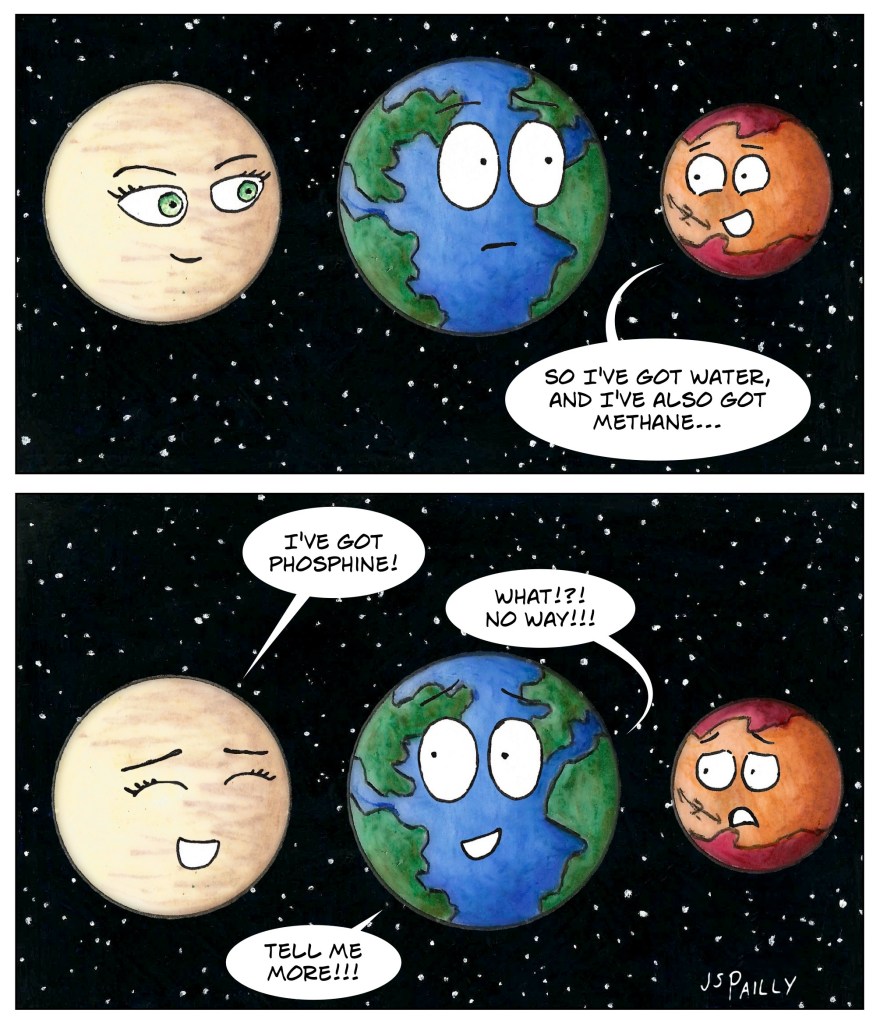
Over the last decade or so, Mars has been trying really hard to convince us that he can (and does) support life.  We’ve seen evidence of liquid water on the Martian surface, and traces of methane have been detected in the Martian atmosphere.  These things are highly suggestive, but none of that proves Martian life exists.

It would be nice if we knew of a chemical that clearly and unambiguously proved that a planet has life, wouldn’t it?  According to this paper published in Nature Astronomy, phosphine (chemical formula PH3) might be the clear and unambiguous biosignature we need.  Here on Earth, phosphine gas is a waste product produced by certain species of anaerobic bacteria.  It’s also produced by humans in our factories.  Either way, the presence of phosphine in Earth’s atmosphere is strong evidence that there’s life on Earth.

And according to that same paper from Nature Astronomy, astronomers have now detected phosphine on another planet.  No, it wasn’t Mars.

Okay, we humans do know of non-biological ways to make phosphine, but they’d require Venus to be a very, very different planet than she currently is.  For example, Venus would need to have a hydrogen-rich atmosphere, or Venus would have to be bombarded constantly with phosphorus-rich asteroids, or the Venusian surface would have to be covered with active volcanoes (more specifically, Venus would need at least 200 times more volcanic activity than Earth).

None of that appears to be true for Venus, so we’re left with two possibilities:

  • There is life on Venus.
  • There’s something we humans don’t know about phosphine, in which case phosphine is not the clear and unambiguous biosignature we hoped it was.

In either event, Venus is about to teach us something.  Maybe it’s a biology lesson.  That would be awesome!  Or maybe it’s a chemistry lesson.  Personally, I’m expecting it to be a chemistry lesson.  There must be some other way to make phosphine that we humans never thought of.

P.S.: Now I’m sure a lot of you are thinking: “Wait a minute, don’t Jupiter and Saturn have phosphine in their atmospheres too?”  You’re right.  They do, and we’ll talk about that in Wednesday’s post.

Sciency Words: Aerobiology

Hello, friends!  Welcome to Sciency Words, a special series here on Planet Pailly where we talk about those weird and wonderful words scientists like to use.  Today on Sciency Words, we’re talking about:

AEROBIOLOGY

You will find life pretty much anywhere you go on Earth.  Living things are in the water, on the land, and up in the air.

Aerobiology comes from three Greek words meaning “air,” “life,” and “the study of.”  So aerobiology is the study of airborne life, specifically airborne microbial life.  According to the Oxford English Dictionary, the term was first introduced in the late 1930’s.

I have to confess I am totally new to aerobiology.  I only found out about this term yesterday, and I don’t want anything I say to misrepresent the field.  But based on what I have read, it sounds like aerobiologists are primarily concerned with protecting public health from the spread of pollen and other allergens, as well as the spread of airborne diseases.

However, aerobiologists also study airborne microbes that are not a direct threat to human health—and this is the part that connects to the outer space stuff I normally write about.  For decades now, aerobiologists have known that algae and other common microorganisms can fly up into Earth’s atmosphere and travel great distances on the wind.  And according to this 2001 paper, microorganisms can (and do) remain active—growing and reproducing—inside the water droplets found in clouds.  As the authors of that 2001 paper explain it, we should start thinking of clouds as microbial habitats.

So what does this have to do with outer space?  Well, if clouds on Earth can serve as a habitat for microorganisms, then maybe microorganisms could exist in the clouds of some other planet.

And by some other planet, I mean Venus.

And by maybe, I mean stay tuned for Monday’s post.

A Breath of Fresh Hydrogen

Hello, friends!

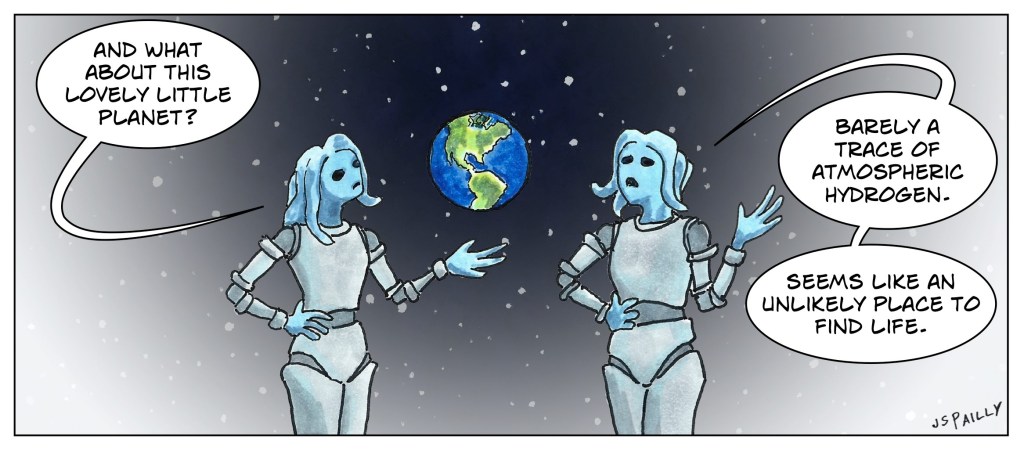
So let’s imagine that extraterrestrials don’t breathe oxygen.  Oxygen is a pretty dangerous chemical, after all, so there’s good reason why alien organisms might want to avoid it.  But what would these aliens breathe instead?

A few years back, I came across an interesting “fact” on a conspiracy theory website.  The government doesn’t want you to know this, but apparently a lot of alien species breathe hydrogen.  That conspiracy theory website said a lot of weird and wacky things, but this hydrogen-breathing alien idea… based on what I know about chemistry, that idea kind of made sense to me.

You see we Earthlings use oxygen to oxidize our food.  This oxidation reaction generates the energy we need to stay alive.  But oxidation reactions are sort of equal-and-opposite to reduction reactions.  Oxygen is a powerful oxidizing agent, obviously, but hydrogen?  Hydrogen is a pretty effective reducing agent.

A paper published earlier this year examined the possibility of Earth-like planets with hydrogen-rich atmospheres.  Such planets could, in theory, exist, but they’d have to meet one or more of the following criteria:

  • The planet would have to be much colder than Earth (think Titan or Pluto-like temperatures).
  • The planet would have to have much higher surface gravity than Earth.
  • The planet would have to continuously outgas hydrogen from some underground source (subsurface reservoirs of water ice mixed with methane ice might do the trick).

If one or more of these conditions are not met, then a hydrogen-rich atmosphere would quickly fizzle out into space through a process called Jeans escape.

Now, could life exist in that sort of hydrogen-rich environment?  The answer is yes.  Absolutely yes.  Even here on Earth, there are organisms that “breathe” hydrogen and use it to generate energy through reduction reactions.  These organisms can be found deep underground, or clustered around deep-sea hydrothermal vents, or in other exotic niche environments where hydrogen is plentiful and oxygen is rare.

The real question is: could hydrogen-breathers evolve into complex, multicellular life forms?  Earth’s hydrogen-breathers are mere microorganisms.  Their version of respiration is nowhere near as efficient as the oxygen-based system we humans and our animal friends use.  The inefficiency of hydrogen-based respiration has stunted the evolutionary development of Earthly hydrogen-breathers.

But maybe on another planet—a planet with a hydrogen-rich atmosphere unlike anything Earth has ever seen—maybe complex multicellular life could evolve on a planet like that.  Maybe.

It’s plausible enough for science fiction, at least.

New Concept Art: The Hykonians

Hello, friends!

I had a really good weekend of writing and art, and I’m finally making real progress with the next Tomorrow News Network novella.  With that in mind, today I’d like to share some new concept art:

I’ve blogged about these guys (gals…? gender ambiguous pals…?) before.  They’re Hykonians.  In the Tomorrow News Network universe, the Hykonians are Humanity’s nearest neighbors, and they’re not exactly friendly neighbors.

I’ve really struggled to pin down the look of the Hykonians.  For a long time, I figured they should have glossy black, almond-shaped eyes.  You know, the kind of eyes stereotypical space aliens always have.  But this weekend, I finally came to terms with the fact that I just don’t like that look, and I went with this new “frog eye” look instead.

Let me know what you think.  I really hope people like it.  Just please don’t call the Hykonians “froggies.”  In the Tomorrow News Network universe, that’s kind of an ethnic slur.

P.S.: And if you haven’t read the previous Tomorrow News Network novella, click here to buy it on Amazon, or you can read it for free with Kindle Unlimited.

Sciency Words: Outgassing

Hello, friends!  Welcome to Sciency Words, a special series here on Planet Pailly where we talk about science or science-related terminology.  Today on Sciency Words, we’re talking about:

OUTGASSING

Okay, I’m tempted to start this blog post with a fart joke.  But I won’t.  I’m too classy for that.  Outgassing is a normal and natural process that occurs on all the rocky and/or icy planets and moons of our Solar System.

According to the Oxford English Dictionary, the earliest known usage of “outgas” or “outgassing” is this 1919 paper titled “The Relative Adsorption of Mixtures of Oxygen and Nitrogen in Cocoanut Shell Charcoal.”  It’s a thrilling read.

Basically, solid substances (cocoanut shell charcoal, planetary regolith, etc) can get gas particles stuck to their surfaces or trapped inside them.  Gradually, these gas particles will escape.  The process of gas particles gradually escaping from a solid material is called outgassing.

On a planetary scale, outgassing is a major contributing factor in the formation of a planet’s atmosphere.  Or at least that’s true for small, terrestrial planets like Mercury, Venus, Earth, and Mars.  Gas giants tend to form their atmospheres through a different process (so before anyone makes a comment about this, there is no outgassing happening on Uranus).

So the main takeaway of today’s post is this: solid materials often have gas particles trapped inside them.  On a planetary scale, the gradual release of these gas particles helps to form planetary atmospheres.  This is known as outgassing.

Or you could just say terrestrial planets fart, almost constantly, and that’s where their atmospheres come from.

Sciency Words: Oxidation

Hello, friends, and welcome back to Sciency Words, a special series here on Planet Pailly where we talk about the definitions and etymologies of scientific terms.  Today on Sciency Words, we’re talking about:

OXIDATION

You may think of oxygen as something good and wholesome.  It’s what we breathe.  It gives us life.  How easily you forget all the other things oxygen can do.  It corrodes metals.  It degrades organic materials.  And under the right conditions, oxygen supports and perpetuates combustion reactions (a.k.a. fire).

French chemist Antoine Lavoisier usually gets credit for coining the words oxygen and oxidation.  He was the first to write about the principe oxygine (French for the acidifying principle).  The words oxygen and oxidation appeared soon afterwards in English translations of Lavoisier’s work, so maybe the English translators should get some of the credit too.

Anyway, oxidation originally referred to chemical reactions involving oxygen, specifically.  But then through a process of semantic generalization, the word oxidation came to refer to any chemical reaction similar to the kind of chemical reaction oxygen could cause.  Oxygen is no longer considered a necessary ingredient for oxidation, and some chemicals (i.e.: chlorine and fluorine) have turned out to be better oxidizers than oxygen.

So what actually happens when one chemical substance oxidizes another?  Well, oxygen and other strong oxidizing agents are greedy for electrons.  Oxidation is the act of stealing electrons from another chemical substance.  Or, if outright stealing doesn’t work, then oxidizing agents will try to form chemical bonds that allow them to “share” electrons—but it will be a highly unequal kind of sharing, one that does not favor the atoms that originally owned those electrons.

A whole lot of energy can be released in oxidation reactions.  That’s what makes them so destructive.  However, life on Earth has found ways to control the energy released by oxygen oxidation and put that energy to good use.  That’s why oxygen is generally thought of as something good and wholesome, even though it’s really one of the most dangerous and destructive chemicals in the world.

P.S.: It’s important to remember that whenever an oxidation reaction occurs, a reduction reaction also occurs.  And reduction is another Sciency Word with an interesting history.

Sharing Some Science Love

Hello, friends!

You know, spending time on the Internet can be a truly disheartening experience.  But there are good things on the Internet too.  For me, I love finding and interacting with other people who share my enthusiasm for science (and also science fiction).  So today, I’d like to spread some of that science love around.  Here are a few of my favorite science or science related posts that I’ve seen in the last week or so:

First up, Fran from My Hubble Abode has a great post about the history of the Crab Nebula.  I’ve found that the best way to learn about science is to learn about the history of science: to learn the stories about how we figured all this science stuff out.  Turns out the Crab Nebula played a much bigger role in the history of science than I thought.  Click here to learn more!

Next, I’ve mentioned before that I’m a bit of stamp collector.  Well, Stamp of the Day recently shared a neat stamp from Germany commemorating Weltraumlabor (Spacelab), which was a joint project between NASA and the ESA back in the 1980’s and 1990’s.  Click here to check it out!

And Twinspiration has a cool post called “6 Space Activities for Children.”  I think some of these activities could be fun for adults too, especially if you’re stuck at home in these COVID-ful times.  Anyway, if you’re looking for fun ways to teach your kids (or yourself) about space, click here!

Lastly, on a more serious note, speculative fiction author Del Sandeen recently wrote a thought provoking article for Uncanny Magazine about the Black Lives Matter and Black Voices Matter movements.  For anyone who wants to see more representation and more diversity in science fiction and fantasy, this article is well worth a read.  Click here!

If you enjoy any of these articles/blog posts, please be sure to leave a comment letting the author know.  And if you have some science you’d like to share, I’d love to hear about it in the comments below!

Until next time, keep it sciency, my friends!

Sciency Words: Oxygen

Hello, friends!  Welcome to Sciency Words, a special series here on Planet Pailly where we take a closer look at the definitions and etymologies of scientific terms.  Today on Sciency Words, we’re talking about:

OXYGEN

Earth.  Fire.  Air.  Water.  Only the Avatar can master all four elements.  Only the Avatar… or Antione-Laurent Lavoisier, the 18th Century French chemist.  As described in this article, Lavoisier originally intended to study each of the four elements in turn, starting with air.  But Lavoisier’s air research quickly “bent” the concept of the four elements so hard that the whole concept broke. And thus…

Lavoisier did not discover oxygen, but he did name it.  You see, when oxygen was first discovered in the early 1770’s, it was called “dephlogisticated air.”  That’s a mouthful of a name, but it made perfect sense to anyone who was familiar with the phlogiston theory of combustion.

Now I’m not going to waste your time explaining what phlogiston theory was, except to tell you that it was an updated-for-the-18th-Century version of the theory that fire is an element.  The important thing to know is that Lavoisier’s experiments on dephlogisticated air poked some pretty big holes in phlogiston theory, and so that theory had to be abandoned in favor of “oxygen theory.”

So where did the word oxygen come from?  Let me try to reconstruct Lavoisier’s thought process.  Among other things, Lavoisier found that burning stuff in “dephlogisticated air” tended to produce substances that were more acidic than the original reactants.  “Oxy” is Greek for acid.  So some sort of acid-generating process was occurring… an “oxy-genesis,” if you will.  Or “oxy-gen” for short!

The term Lavoisier actually used was principe oxygéne, meaning “the acidifying principle.”  The words oxygen and oxidation start appearing in English shortly thereafter, thanks mainly to translations of Lavoisier’s work.  But by that point, it was clear that oxygen was more than merely an acid-generating gas.  It had other properties too. Lavoisier demonstrated that oxygen played an important role in both combustion and animal respiration, as well as other natural processes like the rusting of iron.

But we’ll talk more about oxygen’s many abilities in next week’s episode of Sciency Words.

P.S.: Lavoisier also named hydrogen.  Burning “inflammable air” and “dephlogisticated air” together produced water.  “Hydro” is Greek for water.  So some sort of water-generating process was occurring… a “hydro-genesis,” if you will.  Or “hydro-gen” for short!

P.P.S.: And since you can make water by mixing two different kinds of air, water must not be an element.  Also, how can air truly be an element if there are different kinds of air? This whole four elements thing fell apart pretty quickly as Lavoisier continued his research.