Sci Friday

This week, NASA launched a new mission to the Moon and announced a new rocket design to take humans as far as Mars.  Also, scientists discovered another planet that just might be able to support life.  I covered those stories in posts earlier this week.  Here’s some of the exciting science news I didn’t talk about.

Life As We Know It

Scientists say they’ve found yet another planet capable of supporting life.  This brings the grand total to three: Earth, Gliese 581 d, and this newly discovered HD 85512 b.  I’m still not sure why we don’t give planets simpler names.  Maybe we’re waiting to ask their inhabitants what they call them.

Learn how the
Source: SPACE.com: All about our solar system, outer space and exploration

Anyway, these planets are special because they reside in their parent stars’ Goldilocks Zones, the region that’s not too hot and not too cold.  For a planet to sustain life-as-we-know-it, it must have a temperature just right for liquid water to flow on the surface.

HD 85512 b is bigger than Earth and probably a bit warmer, but I’m sure the HD 85512 b-ians don’t mind… just as the Gliese 581 d-ians don’t mind the cold.

The quest for life-bearing planets continues, but we also have to consider the possibility of alternative forms of life.  Recent studies suggest arsenic-based and chlorine-based life are possible, and researchers in Scotland are trying to create inorganic life (life with no carbon whatsoever).

Silicon-based life, like the Horta from Star Trek or the creatures from the Aliens movies, still seems unlikely for lots of reasons, but scientists should remain open to that possibility too.

To the best of my knowledge, life based on arsenic, chlorine, and silicon still require liquid water, just like we do (our biochemistry is based on carbon in combination with hydrogen, nitrogen, oxygen, phosphorus, and sulfur).  So these two planets are still special.  But today we know of thousands of planets.  By focusing on only two, we could overlook life-as-we-don’t-know-it.

NASA Makes a Comeback

NASA has unveiled its new rocket design.  Below is an animation of what it will look like.  This monster will have more power than the space shuttle’s booster rockets, more even than the Saturn V used for the Apollo Missions (Saturn V is the most powerful rocket ever put into operation).  It will be ridiculously expensive with a cost estimate of $35 billion (keep in mind NASA’s cost estimates are always wrong) and won’t be ready for at least ten years.

But the Space Launch System, or SLS, isn’t just another space shuttle.  The boring task of putting astronauts in Earth orbit will be left to private companies.  NASA’s new rocket will take humans beyond the Moon.  In other words, we’re going to Mars!

I have to admit I was skeptical when Congress and the Obama Administration shut down the space shuttle program and canceled the next mission to the Moon.  Companies like SpaceX and Virgin Galactic are picking up where they left off, but somehow that just doesn’t feel the same.  For the last year or two, space enthusiasts like myself have only had the International Space Station to be excited about.

According to NASA officials, the first SLS crew is supposed to fly in 2021.  The SLS will send astronauts to an asteroid in 2025, and the first human on Mars will arrive sometime in the 2030’s.  Private companies can worry about traveling to and from Earth orbit while NASA gets to be pioneers.

Fly Me to the Moon

This past weekend (Saturday, September 10th to be exact), NASA launched a new mission to the Moon, and officials say this is the most important Moon mission since the original.  After all, the original only got us information about the Moon’s surface; this time, we’re going to learn about what’s inside.

Two probes, named GRAIL A and GRAIL B, will orbit the Moon, carefully measuring its gravitational field.  From this data, scientists can determine what’s inside.  Does the Moon have magma under its crust, like Earth, or is it solid all the way through?  What elements are in its core, and are they different than what’s found on Earth?  And most importantly, where is all that green cheese we were promised?

But the really cool part of this mission is that middle schoolers from all over the US get to participate.  NASA has set up a program for schools that allows students to select sites on the lunar surface to photograph.

The United States is not doing a great job with science education.  I believe science fiction writers can help by writing stories children enjoy with a sprinkling of real science added in.  But this program, which is called MoonKAM, is even better because it allows children to get involved in the scientific process and experience the thrill of discovery first hand.

For more on MoonKAM, click here.

Sci Friday

Here are this week’s links.

Dr. Xbox

One day, your psychologist might give you a prescription not for drugs but for a video game.  According to a post on kotaku.com, researchers at the Rochester Institute of Technology and St. John Fisher College are developing a game that uses biofeedback to help treat anxiety disorder.  This could become the first of many games designed to improve your mental health.

Biofeedback technology reads signals from your body to control the game.  Think of the Kinect for Xbox, where a camera watches the player’s movements and the character in the game mirrors them.  Another game, this one for PC, uses a webcam to monitor the player’s breathing, turning the player’s lungs into a video game controller.  Using electrodes on the head, a video game system could even be controlled with brainwaves.

The video game designed at Rochester is customizable, meaning a psychologist could program features into the game specifically tailored for their patients.  Patients could then face their fears in a safe, consequence free environment and learn to overcome them.  The biofeedback technology—especially the kind using brainwaves—could also record the patient’s reactions to each virtual situation, giving the psychologist more information to further improve and refine that patient’s treatment.The science fiction novel Ender’s Game included a psychological video game, one in which a computer determined what challenges each player most needed to face.  As a result, each player entered a different virtual labyrinth representing his or her unique psychological issues.  The game was a useful tool not only for psychological health but also for manipulating young boys and girls, turning them into good soldiers (it’s important to remember than any technology can be used for good or evil).

Although the field of psychological gaming is in its infancy, I believe it has tremendous potential to do some good.  With more research and new technology, something similar to the game envisioned in Ender’s Game could become a reality.

Sci Friday

It’s been another big week for science.  The Opportunity Rover has reached a new milestone, traveling further than anyone ever expected it to, and researchers in Iceland might have a solution for all that global warming you’ve been hearing about.  Here are this week’s sciency links.

Compressed Carbon is a Girl’s Best Friend

In 2061: Odyssey Three, one of the sequels to 2001: A Space Odyssey, the human race discovers an endless supply of diamonds on Jupiter.  Carbon, being one of the most common elements in the universe, probably is abundant on Jupiter, and Jupiter, along with the other gas giants, would exert such tremendous amounts of pressure on that carbon that it could form diamonds.

By the end of the Space Odyssey series, diamonds are so common that they’re used as an ordinary construction material.  Not for decoration, but for strength.  Diamond windows, for example, are far less breakable than old-fashioned glass.

A recent study has shown that Uranus and Neptune really could produce diamonds.  In fact, these planets have the right internal pressures and temperatures to form vast oceans of liquid diamond, with solidified chunks floating like icebergs on the surface.  Far stranger and more wonderful than what Arthur C. Clark envisioned in his books.

Now we just have to figure out how to get there and how to extract these diamonds safely.  It might even be possible, if these diamond oceans really exist, to collect the liquid, mold it, and produce diamonds in any shape we want.

In other news, scientists have discovered a planet 4000 light years away that is one giant diamond.  This planet was once a star, but all it’s stellar material has burned off, leaving a huge lump of compressed carbon—there for the taking.

One thing is clear: when the day comes that space travel is safe and cheap, diamonds will not be quite as valuable as they are today.  The universe has lots of carbon and lots of places where that carbon is under extreme pressure.  Diamonds are everywhere.

A Cure for Cancer

Sometime in the early 21st Century, humanity was plagued by not one but two incurable diseases.  That was until a group of brilliant scientists realized they could use one to fight the other.

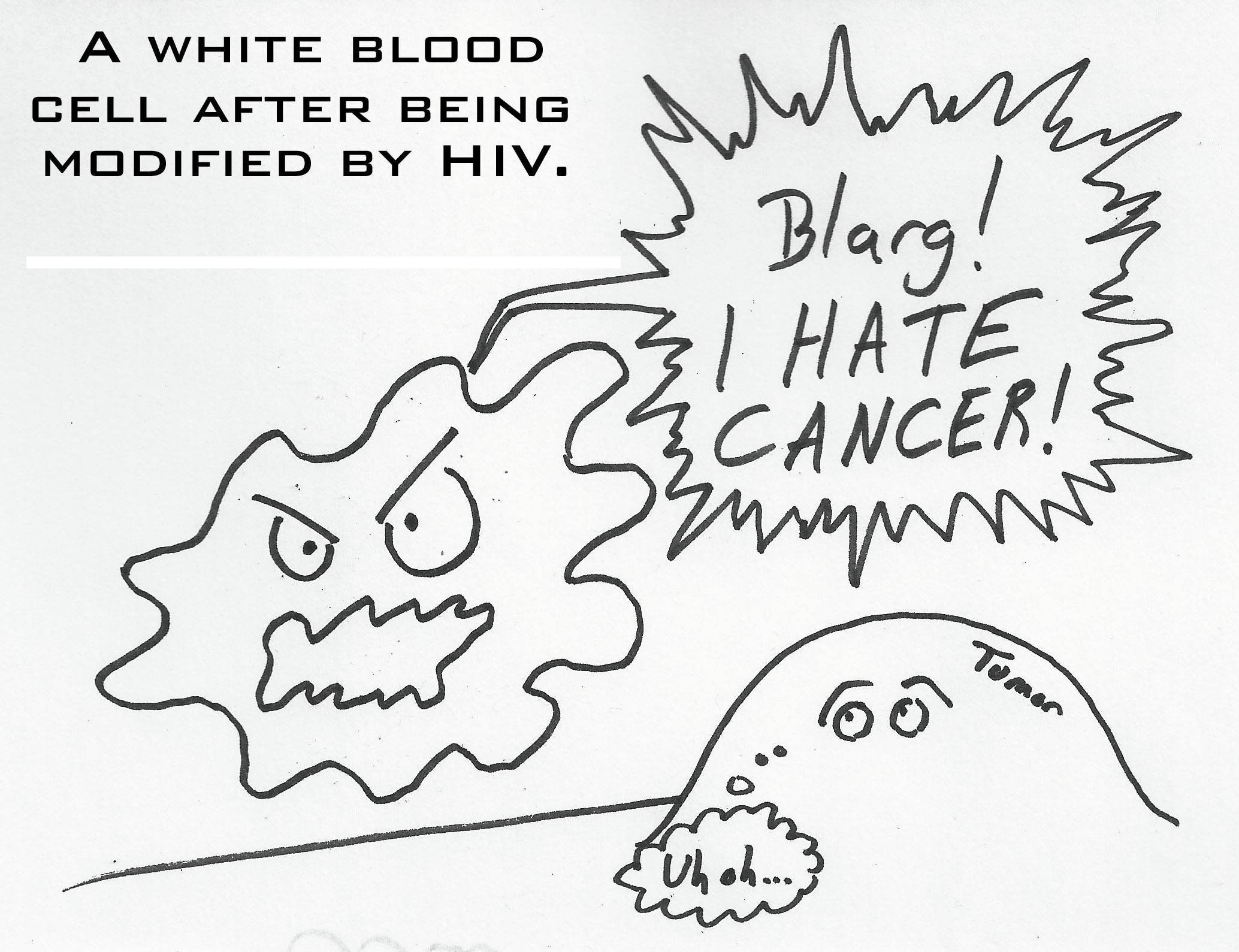
That’s right: they’re trying to cure cancer with HIV.  Basically, modified HIV infects T-cells (white blood cells) and reprograms them to target cancer cells.  The reprogrammed white blood cells go crazy, slaughtering every cancer cell they find.  In at least one test patient, five pounds worth of cancer was destroyed!

If we’re living in a science fiction novel, this is one plot twist I never saw coming.  Click here for the full story.

Sci Friday

You may or may not be aware of this, but one of the crew aboard the International Space Station is a robot.  He even has his own Twitter feed.  Here’s that and this week’s other sciency links.